Potosí, Bolivia — famed silver-tin polymetallic locality, home to luminous blue-green phosphophyllite crystals, mining history, and strong collecting appeal.
Key facts
Potosí is one of the few mineral localities whose name carries equal weight in economic geology, world history, and fine-mineral collecting. For collectors, “Potosí” usually means Cerro de Potosí, the Cerro Rico—the steep, reddish, mine-riddled volcanic hill rising directly above the city. It is not a quiet alpine cleft or a single pocket mine, but a supergiant silver-tin-polymetallic system emplaced in and around a Miocene dacitic volcanic dome, its underlying tuff ring and breccias, and the fractured Ordovician sedimentary basement beneath. The ore is famous for silver minerals and sulfosalts, cassiterite, sphalerite, galena, pyrite, arsenopyrite, siderite, quartz, and an exceptionally rare late phosphate prize: phosphophyllite.
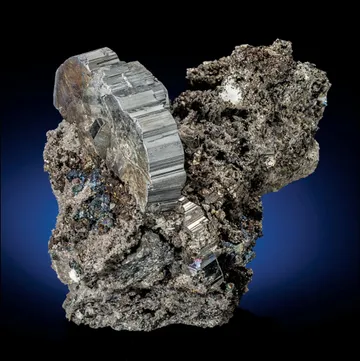
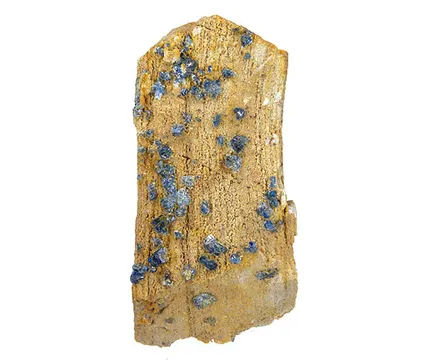
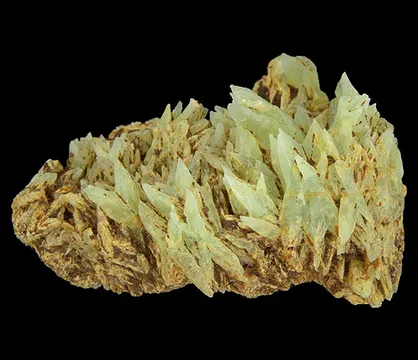
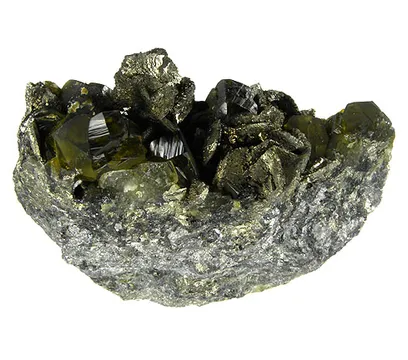
The great Potosí specimens have a look all their own. The best phosphophyllites are luminous blue-green to sea-green, sharply twinned, glassy and fragile, often set against tan siderite, dark sphalerite, quartz, pyrite, or iron-stained gossanous matrix. Quartz itself is more a gangue and association mineral than a celebrity species here, but it is part of the visual grammar of the locality: white to translucent crystals and drusy linings in a sulfide-carbonate environment, sometimes giving contrast to phosphophyllite or sulfosalts. Beyond the specimen case, Potosí is inseparable from the history of silver: mining began in the sixteenth century, production fed the Spanish imperial economy, and the mountain became one of the great mining symbols of the Americas.
Regional View
Country View
The collector’s Potosí is therefore layered: a world-class ore deposit, a dangerous and still-active mining landscape, a UNESCO-listed historic city, and the source of some of the most coveted phosphate crystals ever recovered. The old phosphophyllite labels often say “Unificada mine,” but careful collectors treat that name with caution. “Unificada” was an administrative grouping of workings on Cerro Rico, not a precise pocket locality, and many phosphophyllites are better cataloged simply as Cerro Rico or Cerro de Potosí unless a specific vein, stope, or old collection record is known.
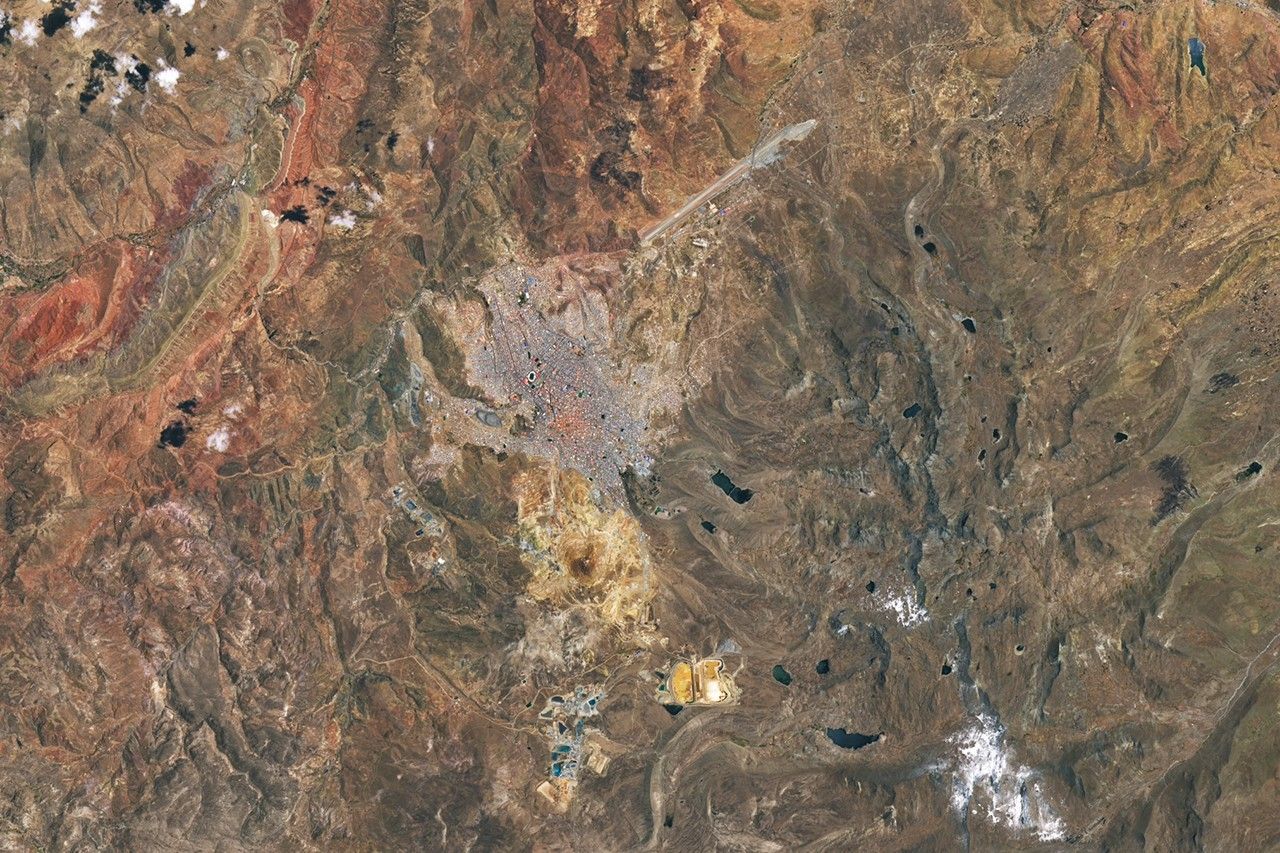
Photo: NASA Earth Observatory

Photo: Wikimedia Commons
Search for specimens: View all specimens from Potosí, Bolivia
Cerro Rico is the classic Bolivian silver-tin-polymetallic vein system. The mountain is centered on a strongly altered dacitic to rhyodacitic dome emplaced in the Middle Miocene along the western structural margin of the Kari Kari volcanic complex. The deposit is not simply “a silver mine”; it is a vertically and laterally zoned hydrothermal system. In the hotter central assemblage, cassiterite, wolframite, bismuthinite, arsenopyrite, pyrite, stannite and related tin-bearing sulfides dominate. Outward and later in the cooling history, lower-temperature base-metal and silver assemblages appear, including sphalerite, galena, tetrahedrite-group minerals, lead sulfosalts, acanthite, pyrargyrite, miargyrite, pyrostilpnite and native silver. Quartz-sericite-pyrite alteration is pervasive in parts of the dacite, with advanced argillic assemblages such as alunite, pyrophyllite, dickite and svanbergite documented from the district.
The structure is as important as the chemistry. The ore bodies are chiefly steep veins and stockworks that cut altered volcanic rocks and extend into the surrounding sedimentary basement. The principal mineralized structures trend roughly north-south to northeast-southwest and have been exploited through a long series of named levels and workings, including historic and modern references to Pailaviri, Caracoles, San Francisco and other levels on the mountain. Mining and drilling have shown mineralized structures with great vertical continuity, and the mountain’s conical form is now riddled with centuries of stopes, adits, shafts, collapsed ground, dumps and tailings.
Oxidation played a major role in Potosí’s economic history. Early colonial mining concentrated on rich oxidized silver ores in the iron-stained upper zone of the mountain—the gossanous “cap” that made the Cerro Rico so visibly different from the surrounding slopes. Later mining moved downward into sulfide ores and then increasingly into tin, zinc, lead and other polymetallic production. The weathering history is unusually long: published geochronology indicates that supergene oxidation began soon after emplacement and continued for millions of years. This oxidation did not simply make picturesque red slopes; it helped make parts of the disseminated silver ore more workable.
The mining history is vast. Spanish exploitation began in 1545 after the discovery of silver, and by the late sixteenth century Potosí had become one of the great industrial centers of the world. Colonial processing depended on water, mills, mercury amalgamation, forced indigenous labor under the mita system, and a transcontinental economy built around silver. In the twentieth century the emphasis shifted strongly toward tin and zinc as well as silver, with production passing through private, state and cooperative phases. COMIBOL, the Bolivian state mining corporation, has long been central to administration of the mountain, while cooperative miners have worked many of the active headings in recent decades.
Access today is not collecting access in the hobby sense. Cerro Rico remains an active, hazardous mining area, not an open collecting locality. Underground work is dangerous because of unstable ground, old stopes, poor ventilation, dust, gases, explosives, and the cumulative structural damage of more than four centuries of mining. The upper mountain has been the subject of emergency preservation measures, closures of workings above the 4,400-meter level, and ongoing disputes between heritage preservation and miners’ livelihoods. Specimens that reach the market generally come through old collections, dealer dispersals, estate material, or occasional mine-source channels; collectors should not interpret the presence of tourist mine tours in Potosí as permission to collect.
The great specimen story here is phosphophyllite. The finest material is associated with old Cerro Rico production, especially the famous “Unificada” material and the Krause vein or phosphophyllite stope tradition in collector literature. The best pockets appear to have been a short-lived event of the late 1950s through early 1960s, with later small finds and dispersed old material continuing to surface. Classic pieces are overwhelmingly scarce, and the best specimens have passed through major collectors and museums rather than the normal commercial stream.
Potosí phosphophyllite is the standard by which the species is judged: transparent to translucent sea-green, blue-green or mint-green crystals, commonly in sharp fishtail or butterfly twins, as isolated crystals, crystal sections, or rare matrix pieces with siderite, sphalerite, quartz, pyrite and iron-stained gossan. Most obtainable pieces are small—millimeters to thumbnail scale—and even a clean 1–2 cm crystal is important; 4–5 cm crystals are exceptional, and the celebrated giant twins from the classic Cerro Rico finds reach a scale almost unreal for the species. The best pieces show saturated color, high transparency, crisp re-entrant twinning, glassy luster, minimal cleaving or repair, and either a clean freestanding crystal or a protected, aesthetically placed crystal on contrasting tan carbonate and dark sulfide matrix. Material labeled “Unificada” should be evaluated with provenance in mind, because the term was often used broadly for Cerro Rico phosphophyllite rather than for a precisely documented mine pocket.
Quartz from Potosí is important less as a cabinet species in isolation than as the durable gangue and visual framework of the Cerro Rico ore system. It occurs as vein quartz, drusy cavity linings, milky to translucent crystals, chalcedonic silica, and quartz-sericite-pyrite alteration assemblages in the altered dacite and associated structures. On collector specimens, quartz is most desirable when it helps place rarer species in context—especially phosphophyllite crystals set with quartz, siderite and sphalerite—or when it forms sharp, bright miniature associations with pyrite, sulfosalts or oxidized silver-zone minerals. The best Potosí quartz pieces are not judged like alpine quartz; they are judged as orebody specimens, where contrast, undamaged accessory minerals, and credible old locality data matter more than size alone.
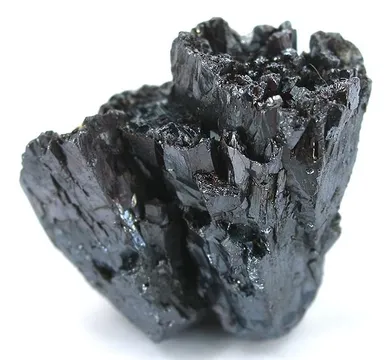
Other documented Cerro Rico minerals include a rich suite of silver, tin, lead, zinc, copper, bismuth, antimony and alteration species. Berndtite, SnS2, and ottemannite, Sn2S3, are both recorded as type-locality minerals from Cerro de Potosí. The district also carries classic Bolivian associations of acanthite, native silver, pyrargyrite, pyrostilpnite, miargyrite, diaphorite, fizélyite, bournonite, tetrahedrite-group minerals, stannite, cassiterite, wolframite-group minerals, arsenopyrite, bismuthinite, sphalerite, galena, siderite, rhodochrosite, alunite, pyrophyllite, dickite, nacrite, svanbergite, faustite, wavellite, jarosite-group minerals, greenockite and post-mining sulfate efflorescences. Many of these are far better known as ore-mineral or micromount occurrences than as showy hand specimens, but they make Cerro Rico one of the most mineralogically consequential localities in Bolivia.
The first authenticity problem is locality precision. “Potosí, Bolivia” may mean Cerro Rico, the city, the department, or other Bolivian phosphate localities in Potosí Department. For phosphophyllite, this matters enormously. Classic Cerro Rico material should not be casually confused with later phosphophyllite from Huayllani, Canutillos, Machacamarca, Llallagua, Morococala or other Bolivian occurrences. Some of those are excellent and collectible in their own right, but they are not interchangeable with the old Cerro Rico specimens. A label that simply says “Unificada Mine, Potosí” is historically common, but not always precise; strong pieces deserve old labels, collection history, photographs, invoice records, or published references whenever available.
Repairs are a real issue, especially with phosphophyllite. The mineral has perfect cleavage, low hardness, and a habit that makes large twins vulnerable to shock. Major classic crystals may have been repaired, reassembled, contacted, cleaved or stabilized, and even famous pieces have repair stories. Examine large crystals under strong light and ultraviolet light, look for glue lines, mismatched luster, suspicious fracture continuity, filled cleavages and matrix joins. A repaired historic Potosí phosphophyllite can still be a great specimen, but the price must reflect condition honestly.
Condition standards are severe. On phosphophyllite, small edge bruises, cleaved terminations, missing twin wings and dull rehealed-looking surfaces drastically change value. Color matters, too: pale washed-out green or cloudy crystals are much less desirable than saturated blue-green crystals with internal brightness. Matrix pieces should be checked for whether the phosphophyllite is naturally seated or glued onto a plausible sulfide-carbonate base. Loose crystals should be judged by form, completeness, transparency and the absence of sawn or polished surfaces.
For quartz and sulfide-rich matrix specimens, the chief concerns are ordinary mine damage, oxidation, and old label drift. Pyrite, marcasite-like material, iron sulfates and other weathering products can stain, crumble or acidify storage environments. Keep Cerro Rico sulfide specimens dry and stable, away from humid cases. Post-mining sulfate efflorescences from Potosí can be attractive as locality material but may be water-soluble, friable and reactive; they should not be washed indiscriminately.
Market availability is sharply divided. Ordinary Potosí ore specimens, quartz associations and small sulfide pieces appear sporadically and remain accessible. Good phosphophyllite from Cerro Rico is scarce at every size. Fine thumbnails are expensive, matrix pieces are much rarer, and cabinet-scale phosphophyllite specimens occupy the trophy end of the market. When a serious Potosí phosphophyllite appears, the questions should be immediate and disciplined: exact locality wording, old provenance, dimensions, damage, repair, matrix authenticity, comparison to Huayllani-type material, and whether the color and habit match the classic Cerro Rico suite.
The most repeated collecting story from Potosí begins not underground, but with a letter. In July 1977, Richard Kosnar received a Spanish-language letter and snapshots of a matrix phosphophyllite. Kosnar was in Boulder, Colorado, and was spending that summer working the Sweet Home mine at Alma, so his Bolivian partner drove from La Paz to Sucre to inspect the piece. The owner was Urquidi, a mining engineer who had worked at Unificada for years. The crystal was a full 13 cm long on matrix, and Urquidi was selling it for a very unromantic reason: he wanted enough money to become a partner in a small ceramic tile factory.
Kosnar’s partner could not reach him, so he bought the specimen anyway. The next message was cinematic: he was flying to Denver the next day and bringing the phosphophyllite. Once the specimen reached Kosnar’s house, the first test was ultraviolet light. The crystal glowed along its fractures—Kosnar later said it “lit up like a Christmas tree” and looked like “a tic-tac-toe grid.” A Denver friend who saw it blurted out, “Christ, I hope you can get your money back!” The famous specimen was not one untouched object as delivered; it consisted of seven pieces, including the matrix, crudely glued together. Kosnar kept it.
That judgment proved historic. The specimen was sold to David Wilber in November 1978, displayed at the Tucson Show in February 1979, and later passed into the Yampol sphere of collections. The same crystal has been described in later museum writing as the “Great Phosphophyllite,” a 13.2 cm twinned crystal group on a 20.3 cm specimen from the 1962 Cerro Rico find, and it has become one of the emblematic mineral specimens of the modern collecting world.
Urquidi’s recollection of the underground pocket is even more haunting than the sale. He had been mining engineer from 1956 through 1964 and placed the best early pockets in 1957, with the largest and most spectacular crystals in 1962. After one blast, the miners returned to the phosphophyllite stope and found the drift floor covered with broken phosphophyllite. The comparison that survived is unforgettable: it looked as if hundreds of glass bottles had been smashed in the stope. The miners spent days scooping up broken pieces and thumbnails.
The end of that stope was practical, not mythical. By 1964, according to Urquidi’s account, COMIBOL closed it with a concrete bulkhead. The reason was not merely secrecy or exhausted collecting. The drift was a dead end with no ventilation raises; heat had become severe, bad air had accumulated, and poisonous gases had killed miners over the years. The beauty of Potosí phosphophyllite came from a place that even hardened Bolivian mining administrators considered too dangerous to keep open.
Modern Cerro Rico has its own unsettling field notes. Reports from recent years describe cooperative miners working in poorly ventilated tunnels, chewing coca leaves and making offerings to El Tío, the underworld figure of the mine. The mountain is still a workplace, but also a wounded monument. Above the 4,400-meter level, closures and relocation plans have tried to reconcile preservation of the cone with the fact that thousands of families depend on the ore. For collectors, that context should temper romance. A Potosí specimen is not merely “old Bolivian material”; it is a fragment from one of the longest, richest and most dangerous mining landscapes on Earth.