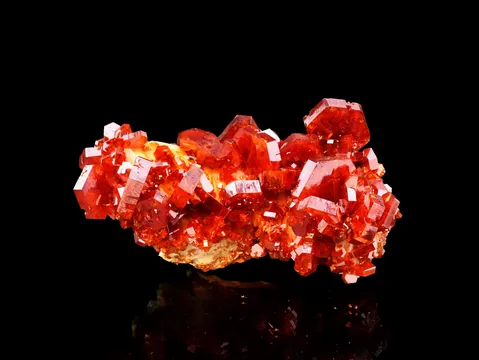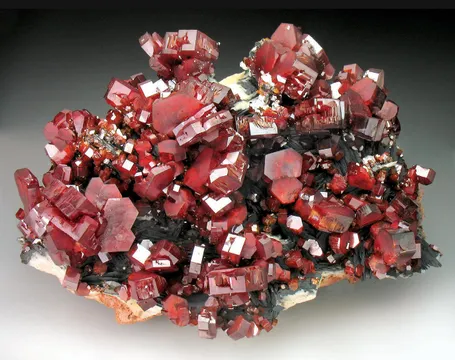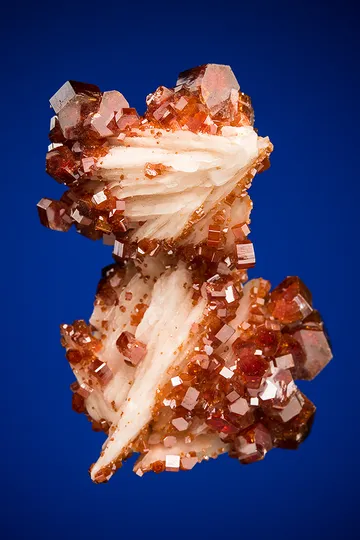
Taouz Caïdat, Morocco: renowned vanadinite locality with red hexagonal crystals on dark oxide matrices; a classic Moroccan site prized for sculptural forms.
Key facts
Taouz Caïdat is one of the defining Moroccan names for collectors who like their vanadinite in dramatic contrast: red to orange-red hexagonal crystals scattered over black, velvety, botryoidal, stalactitic, or manganese-stained iron-oxide matrix. The label “Taouz” is best understood not as a single village mine, but as a broad Tafilalet mining area of lead-bearing veins northwest of the small oasis settlement of Taouz, near Merzouga and the Algerian frontier. Its most famous specimen-producing ground is the Tadaout–Tizi n’Rsas vein field, especially Tadaout’s Vein 12, where oxidized Pb-Cu-Zn-Ba veins have yielded vanadinite, cerussite, goethite, coronadite and other manganese oxides, quartz, barite, siderite, calcite, and a surprising suite of minor secondary lead, copper, phosphate, and chromate species.
Geologically, the district sits on the southeastern side of Morocco’s eastern Anti-Atlas, in the Tafilalet metallogenic district. The important Tadaout–Tizi n’Rsas veins are hosted largely by Ordovician sedimentary sandstone formations and are interpreted as late Variscan to post-Variscan polymetallic veins, later overprinted by oxidation that produced the collector minerals. The specimen story is therefore a supergene one: primary galena, chalcopyrite, sphalerite, and pyrite were broken down by near-surface fluids, producing cavities and oxide-rich matrices in which vanadinite, cerussite, goethite, coronadite, malachite, hematite, quartz, calcite, and related species crystallized.
Regional View
Country View
For collectors, Taouz occupies a useful middle ground between the familiar abundance of Moroccan vanadinite and the sharper specificity of a classic locality. Mibladen made Morocco’s most famous vanadinite in quantity, often on barite; Taouz made fewer, darker, more sculptural specimens, commonly on goethite, coronadite, pyrolusite, or undifferentiated manganese oxides. The best pieces are not simply “red crystals on black rock.” They are miniature landscapes: orange-red plates on charcoal spires, cherry-red barrels in black vugs, doubly terminated or hopper-faced crystals on manganese oxide, and occasional vanadinite groups on siderite or quartz that immediately separate themselves from the standard Moroccan look.

Photo: Wikimedia Commons
Search for specimens: View all specimens from Taouz Caïdat, Morocco
Mineral specimens labeled Taouz come from several lead-bearing veins spread across a broad area northwest of the village of Taouz rather than from the oasis settlement itself. Important names in the specimen geography include Mefis or M’fis, Tadaout, Tizi n’Ressas, Chaib-Ras, Bou Maïz, Adrar, Bouladame, Jbel Rheriss, and Mirsan. Tadaout is the best-known collector subdistrict, and more than twenty veins have been recorded around Jbel Tadaout. Vein 12, known locally as Filon 12, is the most famous of them and has been repeatedly described as the principal source for many of the district’s vanadinite and cerussite specimens.
The broader deposit type is polymetallic vein mineralization, with lead, copper, zinc, and barite as the principal economic components in the Tadaout–Tizi n’Rsas field. Published geological work places these deposits in the southeastern eastern Anti-Atlas, within the Tafilalet metallogenic district. The Tadaout–Tizi n’Rsas veins are hosted by the upper Ordovician Ktaoua Group sandstone sequence, and the district is part of a Variscan foreland setting that was fractured and mineralized during late Variscan to post-Variscan tectonism. The veins trend mainly northeast-southwest and cut the Tadaout–Tizi n’Rsas anticline; described ore bodies range from roughly meter-scale widths to veins several meters thick, and from hundreds of meters to more than a kilometer in length.
The primary ore assemblage is galena, chalcopyrite, sphalerite, and pyrite, accompanied by gangue quartz, carbonates, and barite. The minerals that collectors prize are mainly products of oxidation: cerussite after galena, goethite and hematite after iron sulfides, malachite and other copper species after copper sulfides, plus vanadinite, pyromorphite-group phases, coronadite, pyrolusite, manganese oxides, calcite, and quartz in the open spaces of the oxidized vein material. This is why the specimens have such a strong visual identity: the red Pb-vanadate crystals grew in vugs, seams, and crusts on iron- and manganese-rich black to brown matrices rather than on the pale barite crusts so familiar from Mibladen.
The documented mining history reaches at least to the colonial geological surveys of the 1940s and 1950s. A 1946 report by J. Agard, Georges Jouravsky, and F. Permingeat treated the Mefis mining deposits in the Taouz region, and Agard’s later work on the lead-copper deposits of Tafilalt, Maïder, and Ougnat placed the district into a regional metallogenic context. Modern geological studies continue to discuss the Tadaout–Tizi n’Rsas field as one of the important Pb-Cu-Zn-barite vein fields of the Tafilalet district. Mining and collecting have been largely artisanal, with trenching, small shafts, adits, and hand-worked pits rather than large modern industrial operations over most of the Taouz specimen ground.
Mefis is a separate and important name within Taouz Caïdat. It is described as a large polymetallic deposit rich in galena, pyrite, chalcopyrite, barite, goethite, and pyrolusite, and is the source of additional lead and copper secondary minerals. Chaib-Ras, about 17 km south of Rissani and 15 km northwest of Taouz, is recorded as a barite-working area developed by trenches and wells. Tizi n’Ressas adds nickel arsenide minerals such as gersdorffite, nickelskutterudite, and rammelsbergite from Vein 23, reminding collectors that “Taouz” is not a single-species vanadinite label but a broad mining district with varied vein chemistry.
For specimen collectors, Vein 12 at Tadaout is the classic field locality. It was visited during the second Mindat.org conference in November 2012, when attendees collected from dumps, stream-washed debris, small shafts, adits, and oxide-rich cavities. Reports from that visit describe vanadinite fragments concentrated by rain wash, vanadinite in situ in adits with iron and manganese oxides, quartz crystals from dumps, and local miners selling pieces at the workings. Photographs and specimen records from the same period document crystals from sub-millimeter micromount material to cabinet-size plates with vanadinite crystals several millimeters across, plus rarer pieces showing quartz, phosphohedyphane, pyrolusite, and yellow-green phosphate crusts.
Collecting access today should be treated as permission-dependent and potentially hazardous. The workings include old stopes, adits, pits, narrow trenches, loose dumps, and abandoned or intermittently worked artisanal openings. The best material comes from oxidized cavities in hard, dirty, fracture-prone iron and manganese oxide vein rock; freshly loosened vug material may be attractive, but underground work and unsupported adits carry obvious collapse risks. Serious collectors are better served by buying well-labeled specimens from reliable Moroccan or international sources than by treating the locality as an open rockhounding site.
Taouz vanadinite is the signature mineral of the district: red, orange-red, cherry-red, brownish-red, and occasionally yellow crystals, most often as tabular to short prismatic hexagons on black goethite, coronadite, pyrolusite, or mixed manganese-oxide matrix. Many pieces show small crystals in the 1–5 mm range, but better specimens reach around 1 cm and exceptional old pieces have been described with thick, lustrous crystals larger than that. Vein 12 at Tadaout, Vein 13, and the Four Man Mine are especially associated with the species, and the characteristic Taouz aesthetic is a sharp red crystal field against botryoidal or stalactitic black oxides rather than the paler barite matrix common at Mibladen. Top pieces have bright luster, saturated color, undamaged hexagonal outlines, three-dimensional coverage, and either dramatic black contrast or an unusual association such as siderite, calcite, quartz, or manganese oxides.
Goethite at Taouz is both a mineral species and a major sculptural element in the locality’s best vanadinite specimens. It occurs as dark brown to black botryoidal crusts, stalactitic “spires,” oxide-rich cavity linings, and compact limonitic masses in the oxidized Pb-bearing veins, particularly at Tadaout’s Vein 12 and in the Four Man Mine material. The finest collector pieces are not valued as standalone goethite in the way that classic iridescent localities are; they are prized because the goethite creates high-relief black architecture for red-orange vanadinite or hosts small quartz, phosphohedyphane, pyrolusite, hematite, or cerussite in vugs. Ordinary examples are dull, massive brown-black oxide; good Taouz goethite has clean botryoidal or stalactitic form, attractive sheen, and enough relief to make the vanadinite crystals look perched rather than merely sprinkled.
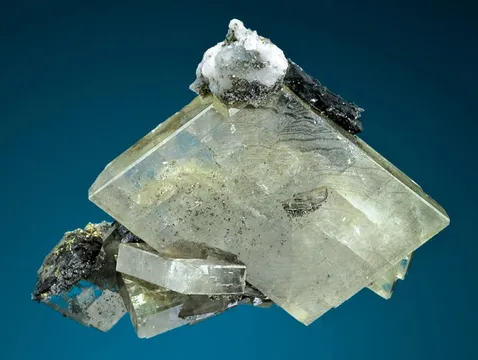
Quartz at Taouz is a gangue mineral in the polymetallic veins and a secondary specimen association rather than the headline attraction. It is recorded from Tadaout, including Veins 7, 12, and 13, and from the Four Man Mine, and appears as clear to white crystals, drusy coatings, chalcedony, and vein quartz with vanadinite, barite, goethite, manganese oxides, and phosphohedyphane. The most interesting Taouz quartz pieces are those where sparkling quartz lines small cavities in limonitic or manganese-rich matrix or shares a vug with red vanadinite; such specimens preserve the sequence of oxide-lined cavity formation and later silica growth. Ordinary quartz from the district is mainly context material, but sharp, lustrous crystals on dark oxide or with bright vanadinite have locality value far beyond their intrinsic quartz quality.
Collector specimens sold simply as “manganese” from Taouz are best understood as manganese-oxide material rather than native manganese metal. In the Taouz assemblage these oxides form black, grey-black, or brown-black botryoidal crusts, compact masses, cavity linings, dendritic coatings, and locally stalactitic surfaces, especially at Vein 12 and the Four Man Mine. They are important because they make the classic matrix for vanadinite, and older labels may use broad names such as “manganese oxides,” “psilomelane,” “pyrolusite,” or “hollandite” when the material has not been analytically confirmed. Good examples have clean black contrast, rounded or stalactitic form, open vugs, and bright red vanadinite in protected recesses; ordinary examples are heavy, sooty, massive oxide with little crystal development.
Coronadite, Pb(Mn4+6Mn3+2)O16, is one of the most important matrix identifications for Taouz collectors, especially at Tadaout’s Vein 12. It has been described there as the black Mn oxide coating on goethite stalactites with vanadinite, with black color, stalactitic habit, no luminescence, and common occurrence at the site. On the market, many such pieces have been broadly labeled “manganese oxides,” “psilomelane,” “hollandite,” or even simply “goethite,” so confirmed coronadite carries extra locality interest. It is not usually beautiful as a standalone mineral species; its appeal is the dark, satiny to velvet-black relief beneath red vanadinite, particularly when the matrix forms rolling botryoidal mounds or upright spires rather than flat crust.
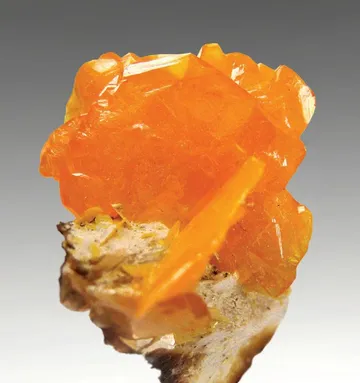
Other documented Taouz minerals broaden the locality well beyond its vanadinite reputation. Tadaout has produced cerussite, anglesite, barite, calcite, caledonite, brochantite, linarite, malachite, mimetite, mottramite, phosphohedyphane, pyromorphite, siderite, smithsonite, turquoise, vauquelinite, and wulfenite, among others. Vauquelinite from Vein 7 is especially notable as a reported first Mindat reference for the species in Morocco, identified by SEM/EDS. Phosphohedyphane, quartz, and goethite from Vein 12 are recorded in rare yellow-green cavity specimens collected in 2013, while Mefis adds the famous Moroccan wulfenite association within the broader Taouz Caïdat mineral province. Tizi n’Ressas, with gersdorffite, nickelskutterudite, and rammelsbergite, represents a different nickel-arsenide vein chemistry within the same administrative area.
The most common Taouz problem is not fakery but labeling. “Taouz” may refer to a broad area, a specific mine, Tadaout, Vein 12, Four Man Mine, Mefis, or simply the old Taouz mining district, and older labels often use historical administrative names such as Er Rachidia or Meknès-Tafilalet. Serious labels should ideally preserve the most specific wording available: Vein 12, Tadaout, Taouz Caïdat is more useful than “Taouz, Morocco,” and “Mefis Mine, Merzouga, Taouz Caïdat” should not be collapsed into Tadaout.
The black matrix is another frequent source of confusion. Older specimens may be labeled goethite, psilomelane, pyrolusite, hollandite, manganese oxides, or coronadite, and visual identification alone is unreliable for fine-grained Mn-oxide mixtures. Coronadite is documented from Vein 12 and is a meaningful identification when analytical work supports it, but broad “manganese oxides” is often the more honest name for untested black matrix.
Vanadinite, mimetite, pyromorphite, and phosphohedyphane can also be confused at Taouz, especially where yellow, pale yellow, greenish, powdery, or transparent hexagonal microcrystals occur with more typical orange-red vanadinite. Collectors should be cautious with labels that assert mimetite or pyromorphite from Vein 12 solely on color and habit. In this district, red-orange hexagonal crystals on black oxide are usually vanadinite, while unusual pale, yellow-green, or phosphate-looking coatings deserve analytical confirmation.
Condition matters greatly. Taouz vanadinites are commonly small, exposed crystals perched on rough oxide, so edge bruising, missing crystal faces, and rubbed terminations are common. The dark matrix can be powdery, friable, or dirty, and specimens collected from dumps or stream-washed debris may show abrasion. The best pieces have protected vugs or high-relief pockets where the vanadinite is sharp and lustrous rather than flattened, dusty, or dulled by handling.
Handling should reflect the chemistry. Vanadinite and coronadite are lead-bearing minerals; avoid inhaling dust, do not use them for elixirs or metaphysical water preparations, wash hands after handling, and keep specimens away from children and pets. Aggressive cleaning is risky: acids can attack associated calcite or cerussite, abrasion can dull vanadinite faces, and water may mobilize loose oxide dirt into cavities. Use a blower, soft brush, and minimal mechanical cleaning unless you fully understand the associated minerals.
On the market, Taouz remains available but not abundant in the way Mibladen vanadinite is abundant. Small vanadinite-on-goethite or vanadinite-on-manganese-oxide pieces appear regularly, but sharp, aesthetic miniatures and small cabinets with rich red color, clean black relief, old labels, or confirmed coronadite command more attention. Large, undamaged, three-dimensional pieces from older finds are much scarcer than casual Moroccan vanadinite buyers often assume.
The second Mindat.org conference in Morocco turned Taouz from a label into a lived place for many collectors. In early November 2012, the pre-conference field trip left the Erg Chebbi dunes and moved toward Taouz, then took desert tracks to Tadaout’s Vein 12. Recent rain had changed the desert in a way that collectors remembered vividly: irrigation channels at an oasis were running carefully through cultivated palms and vegetables, an “unexpected inhabitant of the desert” appeared in the form of an oasis frog, and at Vein 12 rain wash had concentrated small vanadinite fragments in the stream bed.
At the workings, visitors saw the locality as miners know it: a vein crossing a stream bed, small shafts with hand winches, a couple of adits, dumps, pits, and oxide-rich vein rock. One collector entered an adit and saw vanadinite in situ with iron and manganese oxides. Another worked boulders upstream on the south side of the stream and found greeny-brown microcrystalline coatings on goethite that looked promising enough to hope for mottramite, only for an infrared spectrum by Dr. R. S. W. Braithwaite of Manchester University to show the material was “just goethite.”
The most tactile Taouz story from that conference belongs to John R. Montgomery, whose first piece from a small adit at Vein 12 became a 10.5 x 8 x 4 cm cabinet specimen of vanadinite, manganese oxides, and quartz, with vanadinite crystals to 5 x 5 mm. His head and shoulders were in the adit when a local miner warned him to watch for cave-ins and then pointed him to the ceiling. Montgomery followed the advice and later recorded that the ceiling was exactly where all his specimens came from. His short verdict on the locality was the sort collectors understand immediately: “I loved this place.”
David Joyce’s account of the same broader trip gives the Taouz day its desert frame. The group stayed at the Yasmina Hotel beside Erg Chebbi, a fort-like hotel enclosure with a pool, live Moroccan music at night, and a temporary lake beside it from recent torrential rain. From there, the organizers arranged a fleet of Land Rovers for the run to Taouz; sometimes the vehicles followed the road, and sometimes they went “helter skelter across the desert.” At the mine, Joyce noted abundant waste dumps of oxidized ore, with chunks of manganese and iron oxides full of cavities containing vanadinite crystals. After collecting, the group went to ancient rock carvings near Taouz, ate lunch while looking out across the desert toward grazing camels and the Algerian border, and later washed the black and brown oxide dust off in the hotel pool before a sunset camel ride into the dunes.