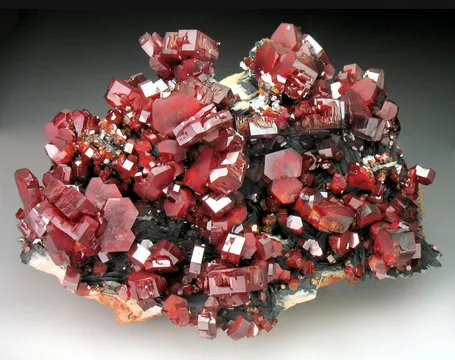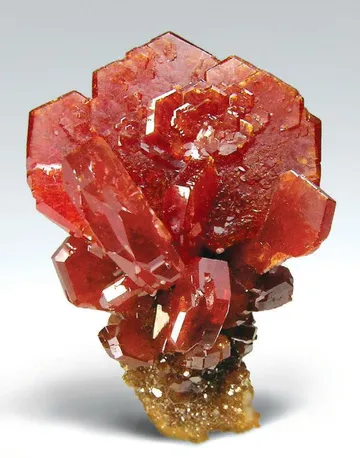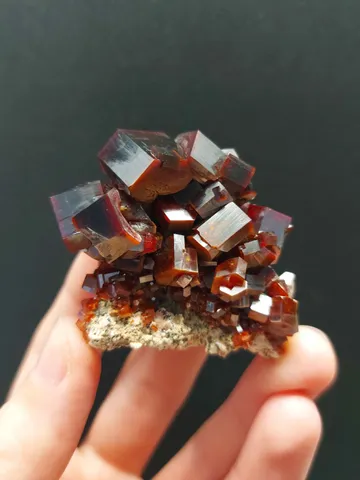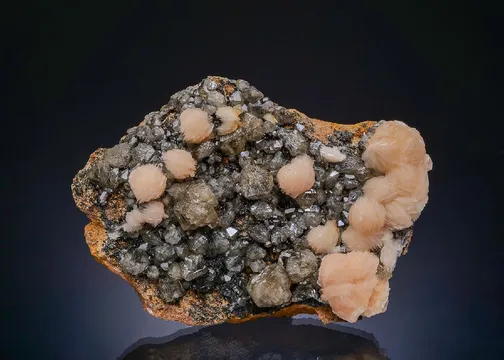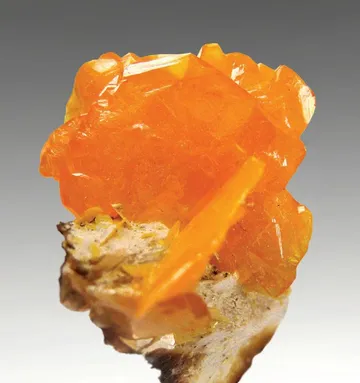
Mibladen, Morocco: an arid lead-baryte locality famed for red vanadinite on baryte, with gemmy crystals and striking color making it a standout for collectors.
Key facts
Mibladen is one of the defining names in modern specimen mineralogy: a high, arid lead-baryte district near Midelt in central Morocco, set between the Middle Atlas and High Atlas domains of the Upper Moulouya. To ore geologists it belongs to the Aouli–Mibladen–Zeïda lead province, where distinct deposit styles occur in close company: vein-style lead mineralization at Aouli, sandstone-hosted redbed-style ore at Zeïda, and carbonate-hosted stratabound to Mississippi Valley-type mineralization at Mibladen. To collectors, the name means something more immediate: red to orange-red vanadinite on white, cream, pinkish, or manganese-blackened baryte, with the best examples sparkling like a lacquered enamel crust over jagged baryte blades.
The industrial ore was chiefly galena in a barytic carbonate gangue, oxidized near surface into a collector’s suite of cerussite, anglesite, vanadinite, wulfenite, pyromorphite, mottramite, calcite, aragonite, iron oxides, and manganese oxides. That oxidation history is the whole aesthetic secret of the district. The lead came from galena; vanadium and molybdenum were mobilized into supergene fluids; baryte provided brilliant sculptural matrix; and the arid climate preserved delicate secondary crystals rather than washing them away. Mibladen’s best vanadinites are not merely red—they are sharp, translucent to gemmy, lustrous, often thick-tabular or hoppered hexagonal crystals, either scattered with deliberate spacing across bladed baryte or crowded into rich, glittering carpets. The finest cerussites, wulfenites, barytes, and odd rarities remind collectors that the district is not a one-mineral locality but an entire landscape of small mines, shallow shafts, old industrial rooms, and specimen workings.
Regional View
Country View
Mibladen’s specimen history has several chapters. Early industrial mining exposed the oxidized lead bodies and made collectors aware of the locality; older classic specimens circulated from the mid-20th century onward. Later, after the main lead-mining era waned, Moroccan miners and specimen diggers learned to follow the mineralized horizons for pockets rather than ore tonnage. That change transformed Mibladen from a mining district that happened to produce fine specimens into one of the world’s most productive specimen-mining districts. The names attached to the best material—ACF Mine, Coud’a, Bou el Maden, Les Dalles, Les O, Adeghoual, Assif, Les T Ouest, Lrar Lahmar—matter because each produced its own visual dialect.

Photo: Klaproth, Wikimedia Commons

Search for specimens: View all specimens from Mibladen, Morocco
The Mibladen mining district lies about 25 km northeast of Midelt, in what is now Midelt Province, Drâa-Tafilalet Region. In collector usage, “Mibladen” is normally a district name rather than a single shaft. It includes many separate workings, old mine sectors, pits, rooms, adits, and specimen shafts known from labels as ACF Mine, Coud’a, Bou el Maden, Les Dalles, Les O, Les R, Les S, Les T, T-Ouest, Adeghoual or Aderhoual, Marguerite, Liwali, Lrar Lahmar, Second Horizon, Anne-Marie, and other named or semi-named workings.
Geologically, Mibladen is a carbonate-hosted lead-baryte deposit. The principal ore bodies are stratiform to stratabound subhorizontal masses hosted in Liassic limestone and dolomite. Moroccan geological descriptions place the mineralization in two carbonate series of the Middle Lias, one about 10 m thick and the other about 25 m thick, within a broader structure controlled by the Aouli and Amourou fault systems. The exploited ore averaged about 5% Pb in the cited geological guide, with galena and secondary cerussite in dolomitic limestone and baryte gangue; pyrite is widely distributed even in weakly mineralized rock. Vanadinite, wulfenite, and anglesite belong to the oxidized secondary suite derived from galena-bearing mineralization.
The deposit is commonly compared with Mississippi Valley-type systems because of its low-temperature, carbonate-hosted, stratabound lead-baryte character. It also sits in a province where ore-forming fluids interacted with multiple stratigraphic and structural levels. In the broader Upper Moulouya district, Aouli is the basement-hosted vein member, Zeïda is the Triassic sandstone-hosted redbed member, and Mibladen is the carbonate-hosted MVT-style member. That distinction is important for labels: an attractive Moroccan lead mineral on baryte may be from Mibladen, but not every Midelt-area or Upper Moulouya specimen should automatically be collapsed into that name.
Mining began as shallow exploitation of near-surface oxidized lead ore. Between 1926 and 1949 more than 600 shafts were worked in the district, most originally shallow, around ten meters deep. Industrial organization developed under French-era companies operating from the nearby Aouli mining center, later associated with the Société des Mines d’Aouli and the wider Aouli–Mibladen operation. A flotation plant at Mibladen processed lead concentrates, and the district’s output was connected to the larger infrastructure of Midelt, Aouli, Port-Lyautey—now Kenitra—and smelting and export networks serving France. Industrial exploitation was concentrated in the 20th century, with peak production during the mid-century lead-mining period and decline by the 1970s.
The modern specimen district is the post-industrial afterlife of that mining landscape. Today, collecting is not casual public rockhounding. Moroccan miners and local diggers work old stopes, dumps, collapsed or partly accessible rooms, and newly sunk narrow shafts. Baryte and cerussite are commonly recovered from old lead workings; vanadinite is often pursued by drilling or hand-sinking small shafts from the surface into favorable horizons. Many workings are dangerous: unstable rooms, old pillars, vertical shafts, loose baryte plates, and crumbly oxidized zones are part of the district’s reality. Serious specimens usually reach collectors through local miners, Moroccan dealers, and international dealers rather than through visitors collecting freely.
The ACF Mine is one of the most important collector names at Mibladen. It was the district’s only true deep mine in the usual collector descriptions, with a vertical shaft and inclined workings reaching roughly 100 m in depth. ACF is especially associated with bright red to orange-red vanadinite on white lamellar baryte, although cerussite and baryte also occur. Older ACF material from the late 20th century through later pockets remains a market benchmark because it combines saturated color, sharp tabular hexagons, and high-contrast baryte.
Coud’a is the great late chapter of Mibladen vanadinite. Discovered as a major specimen-producing sector around 1999, it became one of the most prolific and influential sources of modern Mibladen vanadinite. Coud’a specimens commonly show lustrous red to magenta-red tabular crystals, parallel growths, hoppered crystals, and baryte or manganese-oxide-coated matrix. The 2019 deeper-level Coud’a discoveries, including material labeled Mohamedine, produced high-quality vanadinite with thick tabular crystals, doubly terminated forms, vivid reddish to magenta color, and better-than-usual depth provenance for the sector.
Bou el Maden—literally “mountain of mines”—is one of the older and historically important vanadinite sectors east of the main Mibladen area. It produced large quantities of vanadinite, often on tan dolomitic or limestone matrix rather than the stark white baryte stage that many collectors associate with ACF and Coud’a. Fine Bou el Maden specimens can have excellent individual crystal form, but the matrix and luster can differ from the classic white-baryte style.
Les Dalles and Les O are central names for cerussite, baryte, and wulfenite collectors. These old industrial workings near the village produced colorless to smoky or milky cerussite, often twinned, reticulated, or in wheel-like aggregates, as well as baryte and occasional fine wulfenite. Les O has been noted for spectacular wheel-twinned cerussites, while Les Dalles is one of the classic sources for cerussite-baryte combinations. Some galleries remain physically present but are hazardous and not a casual collecting environment.
Adeghoual, also spelled Aderhoual, is mineralogically important beyond ordinary collector vanadinite. It is the type locality for grguricite, a rare chromium carbonate hydroxide hydrate described from lilac crusts in the Pb–Ba–V mineralization. The same broader area has produced wulfenite, cerussite, baryte, and pyromorphite, and occasional specimen lots from Adeghoual have drawn attention because the sector was not historically thought of as one of the finest vanadinite areas.
Smaller sectors add texture to the district. Les AB is known for brownish vanadinite that has sometimes been described historically as endlichite-like material. Lrar Lahmar, “the red hole,” has yielded orange to reddish-brown vanadinite on calcite and manganese oxides. Les S, Les T Ouest, Liwali, Marguerite, and other named pockets are encountered on labels and in collector literature, but precise attribution depends heavily on old labels, dealer knowledge, and comparison with published specimens.
Mibladen vanadinite is the district’s signature mineral and one of the world standards for the species: red, orange-red, brick-red, magenta-red, or reddish-brown hexagonal crystals, usually tabular to short-prismatic and commonly hoppered, parallel-grown, or grouped into sparkling carpets. Typical commercial specimens have crystals from a few millimeters to about 1 cm; better pieces may show crystals in the 1–3 cm range, and exceptional older or documented pieces have been reported with crystals larger still. The classic association is vanadinite on white to cream baryte from ACF and Coud’a, sometimes with black manganese oxides giving a dramatic red-white-black contrast; Bou el Maden material may place sharper isolated crystals on beige limestone or dolomitic matrix. The best Mibladen pieces are judged by saturated color, glassy to adamantine luster, sharp undamaged terminations, three-dimensional composition, strong baryte contrast, and reliable mine or pocket provenance. Ordinary pieces are abundant; great pieces have depth, rhythm, undamaged crystal faces, and the particular glow that makes a red Mibladen plate visible from across a room.
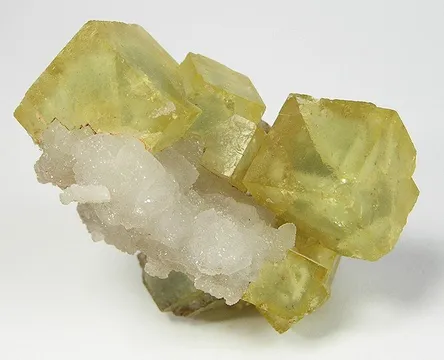
Mibladen’s other minerals give the district its depth. Cerussite is the most important secondary lead mineral after vanadinite, occurring as colorless, smoky, milky, twinned, reticulated, and wheel-like crystals, especially from Les Dalles, Les O, ACF, and related old workings; some specimens fluoresce yellow under ultraviolet light. Wulfenite occurs as yellow to orange plates and small tabular crystals, especially in barytic zones such as Adeghoual and older lead workings, though it is far scarcer than vanadinite. Baryte is both ore gangue and specimen architecture, appearing as white lamellar blades, crests, rosettes, pinkish plates, honey-colored forms, and manganese-coated blackened matrix. Galena, anglesite, pyromorphite, mottramite, calcite, aragonite, gypsum, hematite, hollandite or other manganese oxides, malachite, minium, phosgenite, paralaurionite, quartz, siderite, sphalerite, native copper, native silver, and other species are documented from the district. The rarest scientifically significant name is grguricite, CaCr2(CO3)2(OH)4·4H2O, described from Adeghoual in the Mibladen district as lilac fine-grained crusts in Pb–Ba–V mineralization and now the district’s valid type-locality mineral.
Mibladen vanadinite is common enough that availability is not the problem; selectivity is. Moroccan dealers, show tables, online auctions, and specialist inventories regularly offer Mibladen material from thumbnail to cabinet size. The collector’s task is to separate merely bright Moroccan vanadinite from pieces with specific locality confidence, fine luster, clean condition, and aesthetic composition. A large plate of dull, abraded, muddy crystals is not automatically superior to a small, brilliantly lustrous miniature.
The most important authenticity issue is locality precision. “Morocco” is not the same as “Mibladen,” and “Mibladen” is not the same as “ACF Mine,” “Coud’a,” or “Bou el Maden.” Mibladen material is often mixed in the market with vanadinite from other Moroccan localities, especially broader Midelt-area or Taouz-type material. Classic Mibladen usually means red to orange-red vanadinite on baryte or carbonate matrix from the Upper Moulouya lead district; Taouz-style material more often involves dark goethite or manganese-oxide matrices and can have a different visual character. If provenance matters, buy from a dealer who can state the district and, ideally, the mine or sector.
Outright manufactured fakes are not a major documented tradition for Mibladen vanadinite, but repairs, glued baryte plates, stabilized crumbly matrix, exaggerated mine names, and overconfident relabeling are realistic concerns. Check isolated large crystals at their bases, broken baryte blades reset into place, suspicious glue shine in protected crevices, and mismatched dust or matrix color across a repair. Dense vanadinite druses can hide broken crystal tips; inspect with magnification and raking light. Many good pieces have minor edge wear, especially on baryte, but damage should be priced honestly.
Natural coatings are part of Mibladen’s paragenesis. Manganese oxides may blacken baryte or matrix and can enhance contrast; iron oxides can warm the color; late calcite or aragonite may dust or partially cover vanadinite. These coatings are not automatically defects, but they change value. Thin natural aragonite can add rarity and texture; heavy white crusts can obscure luster. Overcleaned specimens may show harsh etched baryte, loosened crystals, or an unnaturally stripped appearance.
Vanadinite contains lead and vanadium. Intact display specimens are appropriate for normal mineral-cabinet use, but they should not be cut, ground, soaked, or cleaned aggressively without proper controls. Wash hands after handling, keep fragments and dust away from children and pets, and avoid food contact. Baryte is comparatively inert but brittle; cerussite and wulfenite are also lead minerals and deserve the same sensible handling. Cerussite pieces should be protected from knocks, and UV-reactive cerussite should be evaluated under both daylight and the stated UV wavelength rather than bought solely from fluorescence photographs.
Light exposure deserves caution. Many vanadinites tolerate normal cabinet display, but long-term direct sunlight can dull or darken some specimens and can heat fragile matrices. The safest practice is stable indoor display away from strong sun, excessive humidity, and temperature cycling. Fine baryte-vanadinite plates should be stored so projecting crystals do not touch foam, cotton, or box lids; a custom base often prevents the common fate of rubbed edges and snapped baryte crests.
In the older collector literature, Mibladen reads like a district that refused to give up its best pockets on schedule. Victor Clay Yount’s 1985 Tucson symposium abstract is a remarkable period snapshot because it came after Mibladen was already famous and before the later Coud’a era rewrote the market. Yount had made 58 trips to the district and counted only three major strikes. That number says more than a dozen adjectives: even in one of the world’s great vanadinite districts, truly important pockets were rare events, not daily miracles.
Yount singled out Bou el Maden as by far the largest producer of Mibladen vanadinite, but also made the connoisseur’s distinction that collectors still make today: quantity and top quality are different things. Bou el Maden crystals, he wrote, were commonly on tan dolomitic marble and only rarely matched the brilliance of the celebrated Assif material. One of the great Bou el Maden strikes ran from October 1975 through January 1976, when the miner Moha Ben-Ali recovered “a rather large quantity of the finest quality brilliant red crystals.” Those dates place a legendary collector event right at the hinge between industrial mining and specimen mining—the old ore district was fading, while the specimen district was becoming immortal.
The 2012 Mindat conference field visit, recounted by Raymond McDougall, gives the modern counterpoint. Midelt appeared not simply as a mining town but as a mineral economy; local officials and dealers estimated that roughly ten percent of the town’s annual GDP came from collector minerals, fossils, and associated business. At Coud’a, the party entered the vanadinite workings with the guide Abdellah. The access was not a romantic open quarry but rope-access shafts and cramped tunnels—McDougall’s warning was that it was “a bad idea for anyone who doesn’t like small closed spaces.” When a working was exhausted, too tight, or unsafe, Abdellah’s solution was patient and brutal: return to the surface and spend roughly eight weeks sinking a new shaft by hand until the mineralized level was reached again.
That image—eight weeks of hand work for the possibility of a pocket—is the modern Mibladen economy in miniature. A collector in Tucson or Munich sees a red miniature in a glass case. The miner sees weeks of rubble, heat, dust, rope, candle or lamp light, and a narrow geological bet. It explains why high-grade pieces can be abundant in one season and scarce the next, and why the best labels are not just geographic tags but records of labor.
Mibladen also keeps producing surprises outside the narrow script of “red crystals on white baryte.” The 2019 deeper Coud’a finds made a sensation because they came from levels deeper than usual and showed thick tabular crystals, doubly terminated forms, hoppered faces, and vivid magenta to reddish color. At the other end of the district’s personality are the cerussite rooms of Les Dalles and Les O, where the old industrial lead workings produced wheel-twinned cerussites and fluorescent material rather than the familiar vanadinite plates. Then there are the oddities: vanadinite crusting fossil material, chromium-rich grguricite from Adeghoual, brownish endlichite-like vanadinite from Les AB, and the red-hole character of Lrar Lahmar. Mibladen’s fame rests on one mineral, but its stories keep widening.