A collector's guide to Agoudal Centre Mine, Morocco: its geology, mining history and notable minerals, illustrated with the 22 specimens documented from this locality on EarthWonders.
Key facts
Agoudal Centre Mine sits in the eastern part of Morocco’s Bou Azzer cobalt district, one of the great arsenide districts of the mineral-collecting world and one of the few mining districts where cobalt has been exploited as the principal metal rather than as a byproduct. For collectors, Agoudal matters because it condenses the Bou Azzer story into a small, visually distinctive suite: cobalt-bearing calcite in saturated pink to mauve, deep red roselite-group arsenates, erythrite, spherocobaltite, cobaltaustinite, talmessite, lavendulan, and a scattering of analytical rarities that reward careful labels and testing.
Geologically, the setting is classic Bou Azzer: cobalt-nickel-iron arsenide and sulfarsenide mineralization related to serpentinite of the Bou Azzer ophiolitic complex, quartz diorite and other adjacent rocks, quartz-carbonate gangue, and later oxidation that produced the vivid secondary arsenates and carbonates collectors prize. The best Agoudal specimens have a look that is immediately recognizable: pink to mauve calcite crystals, sometimes transparent and sharply rhombohedral, sometimes rounded and botryoidal, carrying wine-red to raspberry roselite or anorthoroselite crystals. In finer pieces, the cobalt color is not just a stain; it is a saturated, internally glowing palette against pale calcite, gray matrix, or sparkling quartz.
Regional View
Country View
Agoudal Centre Mine is best understood as part of the Agoudal Mines group rather than as an isolated show locality. Mineral records distinguish the Agoudal Centre Mine from the Agoudal Centre Quarry, a small quarry about 250 meters west of the mine, but older specimen labels and dealer catalogues often use “Agoudal Mine,” “Agoudal Mines,” or simply “Agoudal” for material from this tight working area. That label reality matters: a first-rate Agoudal specimen may be mineralogically sound yet still require careful interpretation if the collector wants to distinguish Centre Mine, Centre Quarry, or broader Agoudal Mines provenance.

Photo: Fabre Minerals
Search for specimens: View all specimens from Agoudal Centre Mine, Morocco
Agoudal Centre Mine belongs to the Bou Azzer mining district of the central Anti-Atlas, south of Ouarzazate, within the broader Bou Azzer–El Graara inlier. The district is famous for Co-Ni-Fe arsenide ores spatially tied to serpentinite and related ophiolitic rocks. The principal ore systems are generally described as contact-type mineralization along serpentinite contacts, serpentinite-hosted ores, and crosscutting vein systems that carry quartz-carbonate gangue with arsenides, sulfarsenides, sulfides, and later supergene minerals. Agoudal lies toward the eastern side of the district, beyond Aghbar and Tamdrost and west of Aït Ahmane in the commonly cited west-to-east arrangement of Bou Azzer deposits.
The ore mineralization is not a simple “pink calcite” occurrence. The specimen-forming suite reflects a cobalt-rich primary system later overprinted by oxidation. Primary cobalt-nickel-iron arsenides and sulfarsenides provided the chemical source; late quartz, calcite, and dolomite provided the open-space linings and contrasting matrix; oxidation generated cobalt arsenates and cobalt carbonates. At Agoudal, the collector minerals are dominated by cobalt-bearing calcite and arsenates of the roselite-anorthoroselite-talmessite association, with erythrite and cobaltaustinite especially important in the adjacent Centre Quarry records.
Mining in the Bou Azzer district began after cobalt indicators were recognized in the late 1920s, and CTT, the Compagnie de Tifnout Tighanimine, became the historic operating company. The modern Bou Azzer operation is associated with Managem through CTT and remains an industrial cobalt source, with ore treated through the Guemassa hydrometallurgical complex. Agoudal itself is one of the district’s named mines and workings, and field reports from 2010 document an active shaft, ore transport from the Agoudal shaft, cobalt-bearing calcite on dumps, and collecting in the nearby Agoudal Centre quarry where a narrow vein was being worked.
For collectors, access should be considered controlled and industrial rather than recreational. This is not an open public dig locality. Specimens reach the market through miners, local intermediaries, Moroccan dealers, and international show circuits, especially European venues such as Sainte-Marie-aux-Mines and Munich. Labels from the last several decades range from broad “Bou Azzer” and “Agoudal Mine” tags to more precise “Agoudal Centre Quarry” or “Agoudal Centre Mine” designations. The more precise the label, and the more internally consistent the assemblage, the more useful the specimen is for serious collections.
Notable Agoudal finds cluster around two collector categories. The first is the early-2000s to 2010s run of cobalt-bearing calcite: mauve to pink rhombohedra, scalenohedral druses, rounded botryoidal aggregates, and transparent to translucent crystals with minor to strong fluorescence reported on some specimens. The second is roselite-group material: red to burgundy crystals on calcite or quartz, with some pieces described from 2004, 2006, 2013, and 2018 dealer records, and an unusual 2023 analyzed anorthoroselite specimen from Agoudal Mines. The very best pieces combine saturated color, undamaged crystal terminations, clear association, and a label that does more than say “Morocco.”
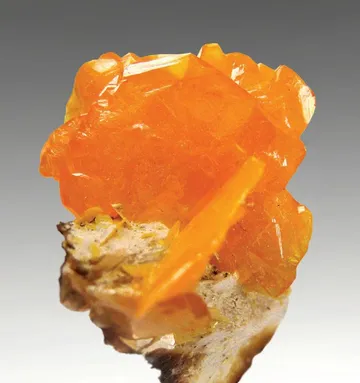
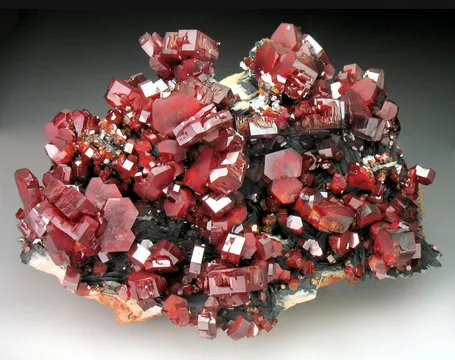
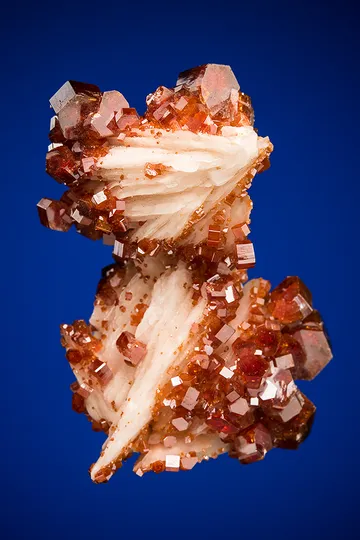
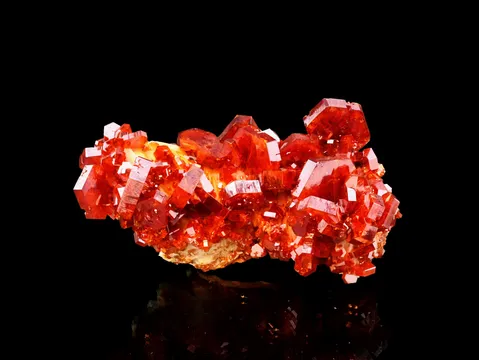
Roselite from Agoudal is collected for its saturated red to raspberry-purple color and its contrast on pale cobalt-bearing calcite or quartz-calcite matrix. Documented Agoudal Mines specimens include crystals in the 3 to 6 mm range, with individual examples described as lustrous, translucent to transparent, striated, complexly formed, and in some cases doubly terminated; one Fabre reference specimen from a 2004 Agoudal find measured 5.5 × 4 × 3 cm with roselite crystals to 0.4 × 0.3 cm on calcite, while another Agoudal roselite specimen from 2004 carried crystals to 0.6 × 0.4 cm. Good Agoudal pieces are not merely red crusts: they show separated, bright crystals or dense but sparkling crystal lacework, ideally perched on pale calcite with enough matrix relief to make the color read cleanly. Ordinary examples tend to be small, crowded, partly bruised, or broadly labeled; the better ones have deep color, intact terminations, and a believable Agoudal provenance rather than a generic Bou Azzer tag.
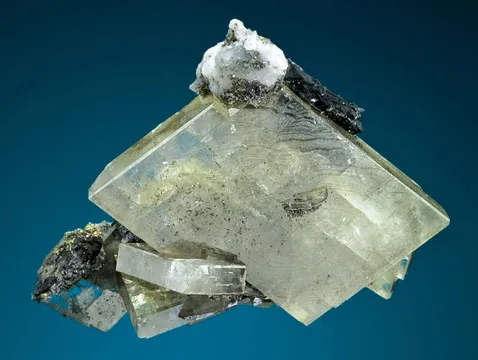
Calcite from Agoudal Centre Mine is chiefly prized as cobalt-bearing calcite: pink, mauve, and reddish-pink CaCO3 in which cobalt gives the color that collectors often, imprecisely, call “cobaltoan calcite” or “cobaltocalcite.” Verified Agoudal material includes rhombohedral crystals with rich face development, short six-sided prismatic crystals capped by flattened rhombohedra, acute scalenohedral druses with rhombohedral terminations, rounded botryoidal growths built of rhombohedral calcite, and polycrystalline aggregates from the Centre Quarry area. Dealer records document cabinet-scale pieces around 8 to 10 cm across and main crystals commonly around 0.8 to 1.7 cm, with fluorescence ranging from minor to strong under longwave and shortwave ultraviolet on some specimens. The strongest Agoudal calcites have uniform mauve to pink color, transparency or lively translucency, sharp undamaged terminations, and sculptural growth; lesser pieces may still be colorful but are commonly massive, abraded, chalky, or too vaguely labeled to separate Agoudal from the wider Bou Azzer district.
Other documented minerals from the Agoudal Mines and the immediately adjacent Centre Quarry include erythrite, anorthoroselite, talmessite, cobaltaustinite, spherocobaltite, lavendulan, bariopharmacosiderite, alloclasite, quartz, and cobalt-bearing calcite-spherocobaltite mixtures. Agoudal is not best known as a type locality; its importance is as a productive and well-photographed occurrence for rare cobalt arsenates and carbonates within the greater Bou Azzer mineral province. Particularly worthwhile are analyzed anorthoroselite pieces formerly liable to be called “roselite-beta,” cobaltaustinite from the 2010 Agoudal Centre quarry find, and specimens where red arsenates sit on pink cobalt-bearing calcite rather than being present only as tiny indistinct coatings.
The largest authenticity issue is nomenclature, not outright fabrication. “Cobaltocalcite” is entrenched in the mineral trade but is not the correct species name for most Agoudal material. The species is calcite, with the collector variety described as cobalt-bearing or cobaltoan calcite. Some specimens may also contain spherocobaltite, and visually similar pink cobalt carbonates can be hard to separate without analysis. For catalogue-grade specimens, label the species as calcite and note “cobalt-bearing” as the variety unless analytical work demonstrates another carbonate.
Roselite-group naming also requires care. Older labels may say “roselite-beta,” “beta-roselite,” or “β-roselite.” The current IMA-approved name for that triclinic dimorph is anorthoroselite. Both roselite and anorthoroselite are documented in the Bou Azzer district, and Agoudal records include anorthoroselite from the Agoudal Mines/Centre Quarry area. Color alone is not enough to separate them. If a specimen is important, or if it has unusually lenticular, tabular, orange-brown, or deep red crystal groups, an analysis report is far more meaningful than a dealer’s historical name.
Condition is the usual separator between souvenir-grade and serious Agoudal specimens. The calcite can show bruised rhombohedral tips, edge wear, contact marks from pocket extraction, and minor acid etching where carbonate matrix has been removed or cleaned. Roselite and erythrite crystals are small, brittle, and easily dulled by careless cleaning. Avoid aggressive acids, ultrasonic cleaning, or prolonged soaking unless you fully understand the assemblage; cobalt arsenates and delicate carbonate surfaces are not forgiving.
Fluorescence is worth checking but should not be treated as the only value driver. Several Agoudal cobalt-bearing calcite specimens have been documented with minor to strong fluorescence under longwave and/or shortwave ultraviolet, while associated roselite-group minerals are valued principally for color, luster, and crystal definition. Because arsenates are present, use ordinary good practice: wash hands after handling, do not grind or trim without dust control, and keep small fragments away from children and pets.
Market availability is moderate for small Agoudal cobalt-bearing calcite and much tighter for top roselite or analyzed anorthoroselite. Common pieces circulate under broad Bou Azzer or Morocco labels; better examples with Agoudal provenance, attractive pink calcite, and distinct red arsenate crystals are much scarcer. The best buys are not necessarily the largest specimens, but those with label precision, crystal integrity, natural color, and a believable association that matches known Agoudal material.
In 2010, the Spirifer Minerals field team reached Bou Azzer after the sort of Moroccan collecting route that sounds improbable only to people who have never traveled the mining roads: dunes, desert tracks, specimen stops, two flat tires at the same time near Oumjrane, and then a sandstorm. When they finally arrived in the Bou Azzer area, Agoudal was one of the stops that mattered. Their field photographs show the Agoudal Centre quarry with the shaft of the Agoudal mine visible in the background, a narrow vein being worked, collectors on the quarry floor, ore rich in erythrite, and freshly mined erythrite sprays measuring about 4 cm.
The same field report captured the most vivid Agoudal association of that moment: an exceptional specimen of roselite, erythrite, and β-roselite on quartz from the Agoudal Centre quarry, followed by a close-up field photograph with a 4.5 cm view. Other Agoudal images from the trip show gemmy, very lustrous erythrite from the Centre quarry, including views around 4.2 and 4.5 cm, and the mine area described in the caption as the source of the best Moroccan cobalt-bearing calcites. For collectors, that series is valuable because it ties the showy red and pink specimens to the ground: quarry, shaft, vein, dumps, ore, and freshly recovered sprays, not just polished dealer labels.
A separate market episode played out in the international show circuit. In a Mineralogical Record online report on 2015 Sainte-Marie-aux-Mines material, Tom Moore described six miniature to cabinet-size cobalt-rich calcite groups from the Agoudal mines area offered by Mch Minerals. His point was partly taxonomic—he explicitly warned that “cobaltocalcite” is not a valid species name—but the visual description is the memorable part: large, clean, nearly damage-free rounded clusters of sharp, trigonally terminated scalenohedral crystals protruding evenly all around. That is exactly the kind of Agoudal calcite that changed the locality from a footnote on Bou Azzer labels into a name collectors began seeking in its own right.