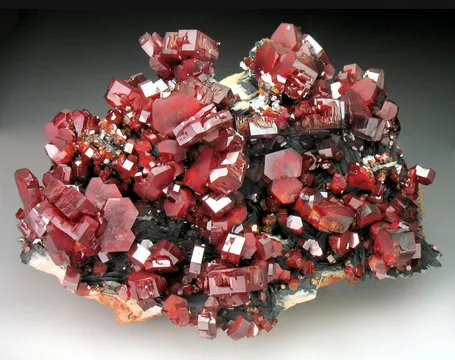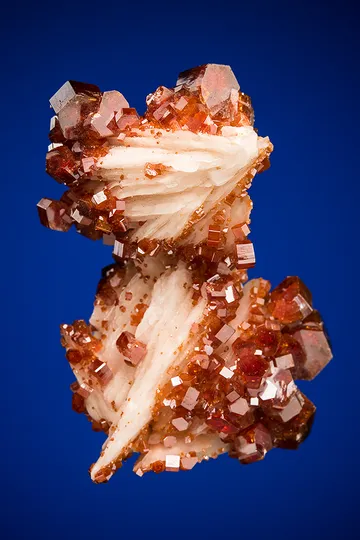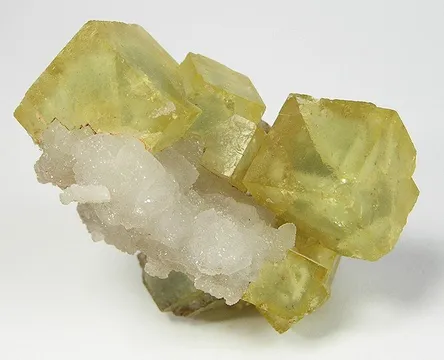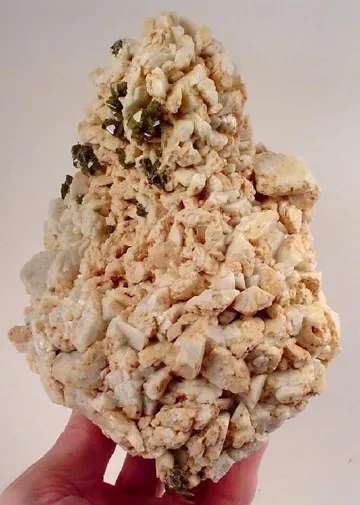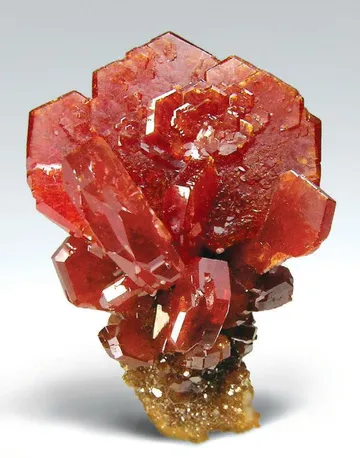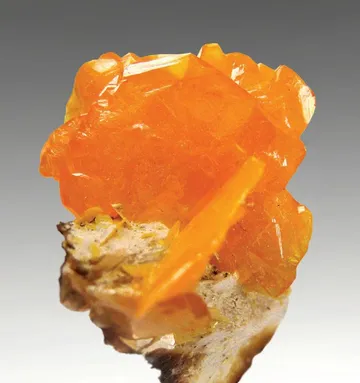
Midelt, Morocco — renowned for Mibladen vanadinite crystals in red to orange-red on barite, within a broad lead-barite province; premier collecting locality.
Key facts
Midelt sits on the high interior corridor between the Middle Atlas and High Atlas, and for mineral collectors the name has become shorthand for one of Morocco’s great specimen provinces: the Upper Moulouya lead district, especially the Mibladen–Aouli area northeast of town. The classic collector image is unmistakable: lustrous red to orange-red vanadinite crystals, commonly hexagonal and tabular to barrel-shaped, perched on pale bladed barite or on buff carbonate matrix. The best specimens have an almost graphic color design—scarlet crystals against white barite, or red vanadinite blazing over black manganese-oxide-stained blades—and the contrast made Mibladen one of the defining vanadinite localities of the late twentieth and early twenty-first centuries.
The district is not a single mine in the usual specimen-label sense. It is a broad lead-barite province with named workings, sectors, shafts, and small artisanal diggings: ACF or Assif, Coud’a, Bou el Maden, Adeghoual, Les Dalles, Les O, Les T Ouest, and others. Geologically, the Midelt-area lead province records several related styles of mineralization. Aouli is a vein-style lead-fluorite-barite system in Hercynian basement rocks; Mibladen is the carbonate-hosted, stratabound and karstic member of the district; Zeïda, nearby, is the redbed-style lead deposit. For collectors, Mibladen’s fame comes from the supergene overprint on earlier galena-barite mineralization: oxidation generated cerussite, anglesite, wulfenite, vanadinite, malachite, azurite, pyromorphite, mottramite, and iron-manganese oxide associations in cavities, fractures, and old ore zones.
Historically, Midelt mattered first as a mining town and administrative base for lead production, and later as the trading center through which Moroccan specimens reached Europe, North America, and the wider show circuit. Industrial lead mining in the Aouli–Mibladen–Zeïda belt gave way, after closure and decline, to a specimen economy sustained by local miners and dealers. That shift is central to understanding the locality: many of the finest Midelt-labeled specimens were not byproducts of modern industrial ore extraction, but the result of decades of small-team pocket hunting in old workings and in new shallow shafts aimed specifically at mineral specimens.
Regional View
Country View
The most collectible Midelt material rewards close locality reading. “Midelt, Morocco” on a label may refer broadly to specimens traded from the town, but the mineralogical story changes sharply between the old Aouli copper-bearing and lead-bearing veins, the Mibladen vanadinite-barite pockets, the cerussite-rich Les Dalles and Les O workings, and the later Coud’a discoveries. Fine examples from the ACF mine tend to show large, sharp vanadinite crystals, often reddish brown to rich red, with excellent luster and complex tabular forms. Coud’a specimens made a sensation for cherry-red crystals on flowering barite, including blackened barite matrices that give the pieces a dramatic, almost theatrical look. Bou el Maden material is more often vanadinite on light carbonate rather than on bright white barite, and good pieces have isolated, well-formed crystals rather than simply coverage.
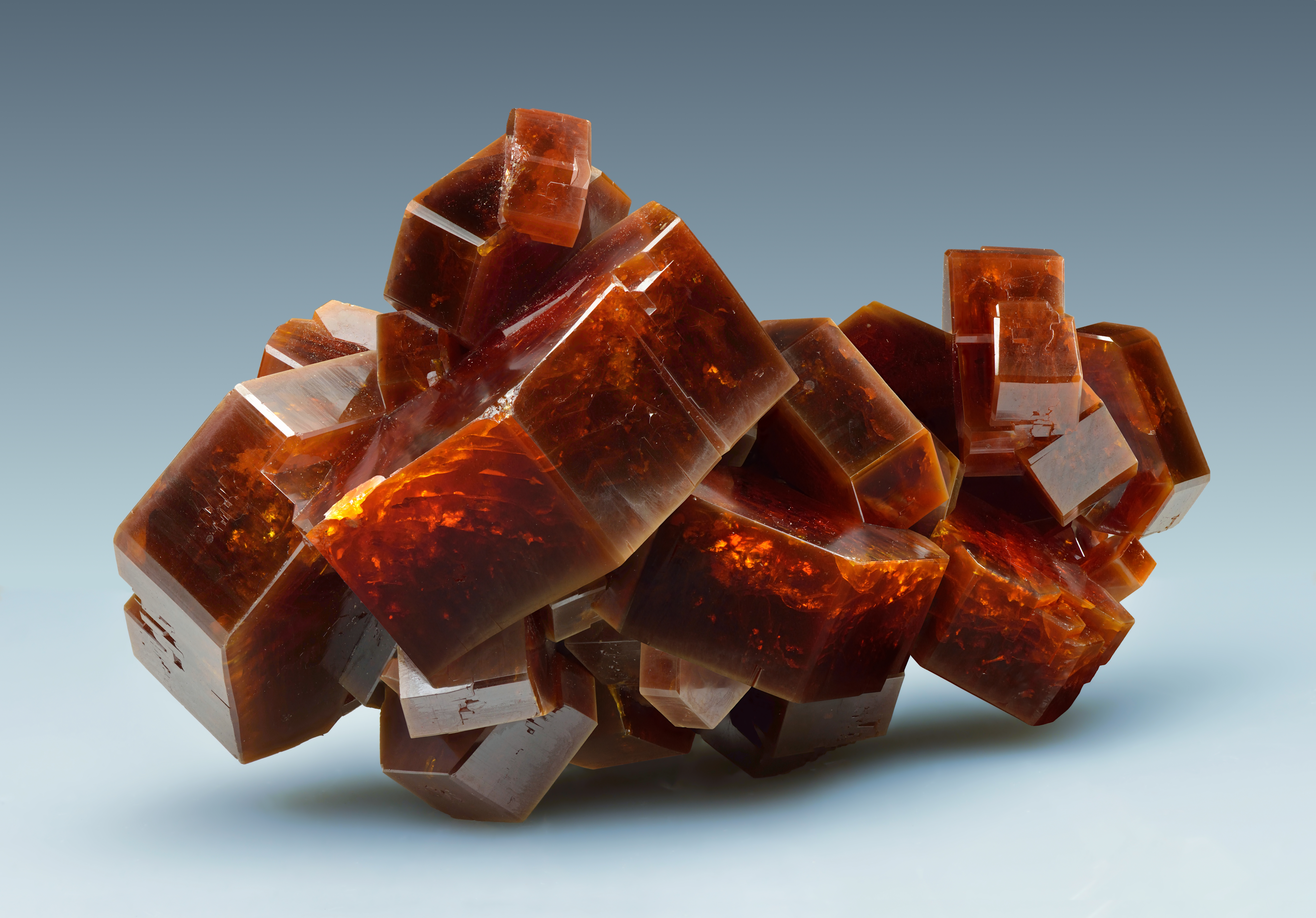

Search for specimens: View all specimens from Midelt, Morocco
Midelt is the collector gateway to the Upper Moulouya mining district of central Morocco. The most famous specimen source is the Mibladen mining district, generally placed northeast of Midelt and historically tied to the Aouli mines. The district lies in a high, semi-arid landscape of limestone plateaus, low hills, old mine dumps, ruined industrial structures, and modern artisanal workings. Its specimen mineralization is best understood as oxidized lead-barite mineralization developed in and around carbonate host rocks, with cavities and karstic openings providing the space in which collector-quality crystals formed.
In the regional geology, Aouli, Mibladen, and Zeïda represent related but distinct lead settings. Aouli is known for vein-style ore in older basement rocks, with fluorite and barite important in the vein assemblage. Mibladen is the carbonate-hosted, stratabound and karstic system, commonly described in the literature as Mississippi Valley Type or MVT-style mineralization. Zeïda is the redbed-hosted counterpart. This distinction matters to collectors because the specimen suites differ: Aouli contributes copper-bearing secondary minerals such as azurite and malachite, along with barite, fluorite, galena, and related species, whereas Mibladen supplies the classic vanadinite-barite, cerussite-barite, and wulfenite-bearing assemblages.
The original economic ore was principally lead, with galena as the dominant primary lead mineral and barite a major gangue and ore-associated mineral. Oxidation produced cerussite, anglesite, vanadinite, wulfenite, pyromorphite, malachite, azurite, and related secondary minerals. In the specimen zones, mineralization occurs along beds, fractures, pockets, lenses, and karst openings. The most beautiful pieces came from open cavities where early barite blades, carbonate matrix, or oxidized ore surfaces were later coated by vanadinite, cerussite, or wulfenite.
Mining history in the area reaches back to early twentieth-century lead exploration and production. Older references record the district under names such as Bou-Selloum or Mibladene, and industrial work expanded under French-linked mining companies, including the Société des Mines d’Aouli and Penarroya-associated operations in the broader Aouli–Mibladen belt. Midelt functioned as a service and administrative center, while the mining villages and workings supplied ore. Reports on Mibladen describe hundreds of shallow shafts sunk during the early mining period, later deeper exploration, flotation infrastructure, and transport of lead concentrate out of the district.
The industrial phase declined as ore reserves and lead economics worsened. By the 1970s and early 1980s, the classic mining system had largely wound down, with Aouli and Mibladen becoming abandoned or semi-abandoned mine landscapes rather than active modern lead mines. That closure did not end mineral extraction. Instead, it changed the purpose of extraction. Former miners, local families, and later specialized specimen miners began reopening old workings, digging new shallow shafts, and following mineralized seams for crystals rather than for ore tonnage. The region’s modern reputation as a mineral marketplace grew from that transition.
Named specimen-producing sectors have distinct collector personalities. The ACF mine, also connected in collector usage with Assif, is one of the great Mibladen names for vanadinite. It produced tabular to prismatic crystals, locally large by species standards, with lustrous red, reddish brown, orange-red, and honey-brown colors. Coud’a became famous after late 1990s to early 2000s discoveries of exceptionally attractive vanadinite on barite, including the dramatic black manganese-oxide-coated barite plates and “flower” clusters that are now instantly recognizable. Bou el Maden is known for vanadinite on pale carbonate matrix, typically without the bright barite contrast but often with sharply isolated crystals. Adeghoual is important for wulfenite and also figures in the modern scientific record through grguricite. Les Dalles and Les O are key names for cerussite and barite specimens, including twinned and cyclic cerussite groups.
Collecting access today is not comparable to recreational collecting on an open public dump. Much of the specimen supply comes through local miners, dealers, and established Moroccan mineral networks. Old mine openings, deep shafts, unstable galleries, and makeshift artisanal workings can be dangerous, and access may be controlled informally or practically by those actively working the ground. For collectors buying specimens, provenance is therefore more often reconstructed through dealer labels, miner/dealer relationships, pocket names, and the specimen’s style than through personal collecting.
Vanadinite is Midelt’s signature species because the Mibladen district produced the modern archetype: red to orange-red hexagonal crystals on barite or carbonate matrix. Habits range from short barrel-shaped prisms to thick tabular crystals, stacked parallel growths, skeletal or hoppered crystals, and dense sparkling druses; fine individual crystals from the ACF and Coud’a areas can reach centimeter scale, with exceptional examples larger, while common material is made of smaller but bright crystals carpeting barite. The most desired pieces combine sharp form, saturated red color, glassy to adamantine luster, clean undamaged crystal fields, and a contrasting matrix—especially white bladed barite or black manganese-oxide-coated “flower” barite from Coud’a-type pockets. Bou el Maden vanadinites are usually judged differently: the matrix is paler carbonate rather than barite, so value rests on isolated crystal definition, color, and sculptural spacing rather than on the red-white contrast.
Barite is not merely the background for Midelt vanadinite; it is one of the structural minerals of the Mibladen specimen aesthetic. In the Mibladen workings it forms bladed, tabular, lamellar, cockscomb, and radiating “flower” aggregates, ranging from white and cream to honey, pinkish, tan, orange-brown, gray, or blackened by iron and manganese oxides. The finest collector barites are those that contribute architecture: open rosettes, curved blades, clean plates with no bruised edges, or sculptural matrices carrying sharply placed vanadinite, cerussite, wulfenite, malachite, or azurite. Ordinary material is massive, chipped, heavily iron-stained, or visually crowded; better pieces have undamaged blade tips and enough open space for the crystal form to read.
Midelt malachite is most familiar to collectors from Aouli–Mibladen copper-bearing oxidized zones, where it occurs with azurite, barite, fluorite, gypsum, limonite-rich matrix, and locally tennantite-tetrahedrite-group material. The attractive pieces are typically not polished masses but specimen pieces: velvety green coatings, small blocky to botryoidal aggregates, fibrous or sparkling crusts, and malachite intergrown with deep blue azurite over rusty or baritic matrix. A documented large Midelt specimen from the Wein Collection measured 21.1 x 12.4 x 9.6 cm and showed small blocky malachite crystals with velvety surfaces mixed with azurite on limonitic matrix, illustrating the locality’s best visual strength: green-blue contrast broken by reddish brown matrix rather than a monotonous crust. Fine pieces need crisp texture, good color separation, and minimal rubbing; average pieces are common as dull green coatings with little crystal definition.
Azurite from the Midelt area is chiefly a secondary copper mineral of the Aouli–Mibladen system rather than the headline mineral of the vanadinite pockets. It appears as deep blue crusts, small crystals, sparkling druses, compact aggregates, and mixed azurite-malachite surfaces on oxidized matrix, commonly with barite and locally with fluorite or gypsum. Reported dealer and museum-type examples from Aouli and Lizaste in the Mibladen district are generally small to cabinet-sized rather than giant azurite classics, but the best pieces win on color harmony: intense blue azurite preserved beside fresh green malachite, with pale barite or rusty limonite adding contrast. Pieces should be checked for bruised high points and indistinct “blue-green” coatings; the most desirable examples show recognizable azurite crystals or sparkling crystal texture rather than a dull alteration film.
Beyond the four headline minerals, the Midelt-area record is deep. Mibladen is especially important for cerussite, including colorless to white, twinned, reticulated, and wheel-like groups on barite and galena; many show yellow response under ultraviolet light. Wulfenite from Adeghoual and related workings occurs as orange to red-orange, thin, lustrous plates and is far scarcer than the vanadinite, making fine undamaged pieces highly selective. Galena, anglesite, pyromorphite, mottramite, calcite, aragonite, gypsum, hematite, hollandite and other manganese oxides, native copper, native silver, sphalerite, siderite, quartz, and barite-fluorite assemblages are also documented in the district. Scientifically, the standout rarity is grguricite, CaCr2(CO3)2(OH)4·4H2O, approved as a new mineral with the Adeghoual mine on the northern outskirts of Mibladen as its type locality.
The biggest authenticity issue for Midelt specimens is not a widespread tradition of synthetic or manufactured vanadinite fakes. The more practical problem is locality precision. “Midelt,” “Mibladen,” “Mibladen mines,” “Morocco,” “Atlas Mountains,” “Aouli,” “ACF,” and “Coud’a” are not interchangeable labels. For inexpensive display pieces, a broad Midelt or Mibladen label may be acceptable. For a serious locality suite, ask for the working or sector when the specimen style justifies it: ACF for large tabular vanadinite, Coud’a for dramatic vanadinite on white or blackened barite, Bou el Maden for vanadinite on pale carbonate, Les Dalles or Les O for cerussite-rich pieces, and Aouli for many azurite-malachite-barite-fluorite associations.
Moroccan vanadinite is abundant in the market, and Mibladen is so famous that the name can be used too loosely. Taouz, Touissit, and other Moroccan vanadinite localities have their own styles, and vague labels are often upgraded by assumption rather than by evidence. Mibladen vanadinite on barite is usually quite recognizable, but not every Moroccan vanadinite on pale or dark matrix should be accepted as Mibladen without supporting provenance.
Repairs and stabilization deserve more attention than outright fakery. The best Midelt specimens are often fragile: vanadinite crystals stand proud on barite blades, barite rosettes cleave and chip, and old pocket extraction could leave broken margins or repaired matrix. Examine crystal bases with a loupe, especially on isolated show crystals, and look for glue lines, mismatched matrix, unnatural gaps, or repeated “perfect” crystals positioned too conveniently. Minor matrix repair may be acceptable if disclosed, but undisclosed crystal reattachment materially affects value.
Condition standards should be strict because so much material is available. On vanadinite, inspect the leading faces and rims of tabular crystals, the high points of barrel crystals, and the edges of hoppered forms. On barite, look for chipped blade tips and crushed rosette margins. On malachite and azurite, avoid rubbed velvety surfaces and dull, dirty coatings unless the piece has unusual association value. Cerussite from the district is dense but brittle, and terminations, twin re-entrants, and projecting cyclic forms bruise easily.
Do not overclean Midelt specimens. Iron and manganese oxides are part of the natural look of many Coud’a and Aouli pieces, and blackened barite can be exactly what makes a specimen desirable. Late calcite, aragonite, gypsum, or oxide coatings may be natural paragenetic features rather than removable dirt. Aggressive acids or soaking can damage associated carbonates, loosen fragile matrix, or change the appearance of iron-manganese coatings.
Handling is straightforward but sensible. Vanadinite is a lead vanadate chloride, so avoid generating dust, do not grind or cut it without professional controls, wash hands after handling, and keep loose chips away from children and pets. Intact display specimens in a cabinet are not a special hazard, but dusty or damaged pieces should be treated carefully.
Market availability remains strong. Midelt and Mibladen vanadinite appears at shows, online dealer updates, auctions, and Moroccan dealer inventories in every price tier, from small bright thumbnails to major cabinet pieces. The challenge is selection, not supply. Fine undamaged red crystals on clean white barite, old-label Coud’a or ACF material, convincing Bou el Maden carbonate-matrix examples, and superior azurite-malachite-barite associations are much less common than ordinary plates of small vanadinite crystals or dull mixed copper coatings.
In 1985, Victor Clay Yount’s Tucson symposium abstract captured Mibladen at a remarkable turning point. The old lead-mining world was ending, but the specimen legend was already well established. Yount had made 58 trips to the area, yet he counted only three major vanadinite strikes. That number explains why the old great pieces carry such weight: abundance in the market can make Mibladen feel inexhaustible, but the truly exceptional pockets were episodic.
Yount placed the mines along the road from Midelt toward Mibladen and named Bou el Maden, Assif, and Les T Ouest among the principal sources. Bou el Maden, in his account, was the large producer, but its crystals on tan dolomitic marble only rarely had the brilliance of the Assif specimens. One famous Bou el Maden strike ran from October 1975 through January 1976 and was worked by Moha Ben-Ali, who recovered a large quantity of brilliant red crystals. Another came in January 1979. Assif’s great image was different and more theatrical: red vanadinite set on white to orange barite. Yount singled out March 1980 as the most famous strike of that material.
The later Coud’a story changed the district again. After the industrial mines had closed and older peripheral workings had already supplied the trade for years, the Coud’a sector became the great new name. The late 1990s discovery and the strong production that followed in the early 2000s turned the plateau into a specimen landscape of small shafts and hand-dug openings. The best Coud’a pieces had exactly the qualities international collectors wanted: saturated red vanadinite, sculptural barite, and dramatic contrast. Accounts of the rush describe hundreds, even more than a thousand, miners working the area during the fever for red crystals on “flower” barite.
The human story around Aouli and Mibladen is much harder than the beauty of the specimens suggests. A 2015 report from Le Desk described El Koudya Zawja, between Midelt and Mibladen, as a desolate Atlas slope where jerricans and water cans along a rough road were among the signs of human presence. There, Mohamed Aït Benali, a 32-year-old artisan miner from Khénifra, said more than 300 people were working the many shafts on the hillside. The miners, aged roughly 30 to 60, worked with rudimentary tools in teams of three or four, eight hours a day, at depths of about 10 to 16 meters, searching for what the report called “la belle roche écarlate et brillante.”
Another report from the abandoned Aouli mines evokes the district before abandonment: Penarroya’s golden-age operations in the 1950s and 1960s employed more than 3,000 permanent workers. Aouli had once been tied into a wider industrial world, with early electrical installations and a rail connection remembered as linking Midelt toward Algeria. Aziz, a miner’s son guiding visitors through the ruins, remembered a cosmopolitan village where Moroccans from many regions worked alongside Algerians, French, Spanish, Italians, Germans, Portuguese, and Greeks, and where Muslims, Jews, and Christians all lived in the same mining society.
The collapse of that industrial world left a dangerous afterlife. After lead prices fell and the mines stopped, people returned underground because the landscape still held ore and specimens. Reports describe men and women entering abandoned galleries daily, sometimes attacking support pillars with hammers and lamps because they lacked proper equipment. The same abandoned workings that produced livelihood also threatened collapse. In that setting, mineral specimens are not anonymous objects. A Midelt vanadinite is part of a chain that runs from Jurassic carbonate, to lead ore, to colonial and postcolonial mining, to abandoned infrastructure, to local hand work in shafts, and finally to the glass shelves of collectors far from the Atlas.
Tomasz Praszkier, “Famous Mineral Localities: Mibladen, Morocco,” The Mineralogical Record, 44(3), 247–285, 2013 — The major collector-oriented monograph on the Mibladen district, its workings, history, and specimens.
Michel Jébrak, Éric Marcoux, M. Nasloubi, and M. Zaharaoui, “From sandstone- to carbonate-hosted stratabound deposits: an isotope study of galena in the Upper-Moulouya District (Morocco),” Mineralium Deposita, 33, 406–415, 1998 — Important paper distinguishing Aouli vein-type ores, Zeïda sandstone-hosted ores, and Mibladen carbonate-hosted stratabound and karstic mineralization.
ONHYM, “Lead-Zinc: Aouli–Mibladen–Zeïda” — Moroccan mining-summary document identifying the Upper Moulouya lead-zinc district and its contrasting Aouli, Mibladen, and Zeïda deposit styles.
Tomasz Praszkier, “Mibladen monograph in The Mineralogical Record,” Spirifer Minerals notice — Useful bibliographic confirmation for the 2013 Mibladen issue and page range.
Mike S. Rumsey, Mark D. Welch, John Spratt, and Annette Kleppe, “Grguricite, IMA 2019-123,” in CNMNC Newsletter 54, European Journal of Mineralogy, 32, 2020 — Approval notice for grguricite, CaCr2(CO3)2(OH)4·4H2O, with the Adeghoual mine near Mibladen as type locality and Natural History Museum, London type material BM2019,5.
Luca Boni and coauthors, “Vanadium ore resources of the African continent: State of the Art,” Ore Geology Reviews, 2023 — Regional vanadium-resource synthesis that highlights the Mibladen Pb-Ba-V deposit and its importance for vanadinite specimens.
Wikimedia Commons file: “Vanadinite - ACF mine, Mibladen, Morocco.jpg,” Ivar Leidus, 2021 — High-resolution focus-stacked image of an ACF mine vanadinite specimen, with size and locality information.
Wikimedia Commons file: “Malachite-Azurite-165825.jpg,” Rob Lavinsky/iRocks.com — Documented Midelt azurite-malachite specimen from the notable Wein Collection, with dimensions and descriptive notes.
“Vanadinite from the ACF Mine, Mibladen, Morocco” — Fabre Minerals — Video of an ACF mine specimen with tabular red vanadinite crystals, documented as a 2017 find.
“Vanadinite - Mibladen, Maroc” — La Mine 2 Tout — Short specimen video showing Mibladen vanadinite for visual reference.
“DMB2819 Vanadinite, Mibladen Mining District, Morocco” — Crystal Classics — Dealer video of a Mibladen vanadinite specimen, useful for seeing luster and three-dimensional crystal coverage.
“Vanadinite on Barite” — Wilensky Minerals — Specimen video and descriptive dealer note discussing Mibladen-style red vanadinite on barite.
“VIDÉO. Les mineurs clandestins d’Ahouli, au Maroc” — Le HuffPost — Report on abandoned Aouli-area mining and the human consequences of the post-industrial mine landscape.
Mindat: Mibladen mining district, Midelt Province, Drâa-Tafilalet Region, Morocco — Core locality page for minerals, photos, sublocalities, and references.
Mindat: Midelt Province, Drâa-Tafilalet Region, Morocco — Broader regional mineral list including Mibladen, Aouli, Tamazert, and other Midelt Province localities.
Minerals from Mibladen, Morocco — Le Comptoir Géologique — Accessible overview of Mibladen history, geology, major workings, and specimen minerals.
Mibladen.com — Locality-focused site on the geology, mineralogy, and heritage of Mibladen and the Midelt region.
Wikimedia Commons: Minerals of Midelt — Open image category including Midelt azurite-malachite, gypsum, and related specimen photographs.
Wikimedia Commons: Minerals of Mibladene — Large open image archive of Mibladen vanadinite, cerussite, wulfenite, and related minerals.
Le Desk: “Au fond de la mine, avec les traqueurs de pierres écarlates” — Field-reportage view of the modern artisan-mining landscape near Mibladen.
Le HuffPost: “Les mineurs clandestins d’Ahouli, au Maroc” — Reporting on abandoned Aouli mining, local memory, and present-day underground work.
Spirifer Minerals: Mibladen monograph in The Mineralogical Record — Bibliographic notice and preview for the essential 2013 Mibladen article.
Fabre Minerals: Morocco reference specimens — Dealer archive with notable Mibladen and Moroccan specimens, useful for documented pocket and date references.
CNMNC Newsletter 54, European Journal of Mineralogy — Official new-mineral approval record including grguricite from the Adeghoual mine.