A collector's guide to Coud'a workings, Morocco: its geology, mining history and notable minerals, illustrated with the 35 specimens documented from this locality on EarthWonders.
Key facts
Coud’a is the specimen-maker’s name for one of the great modern vanadinite sources in the Mibladen mining district near Midelt, on the high, dry ground between the Middle Atlas and High Atlas of central Morocco. It is not an old romantic single-shaft mine so much as an elongated field of small workings cut into the Mibladen lead-baryte system: stratabound galena and baryte mineralization in Liassic carbonate rocks, later overprinted by supergene oxidation that filled fractures, seams, and karstic cavities with lead carbonates, molybdates, and vanadates. Among those oxidation products, Coud’a vanadinite is the star—red to orange-red, cherry-red, reddish brown, and occasionally very dark crystals on white, cream, honey, or manganese-blackened baryte.
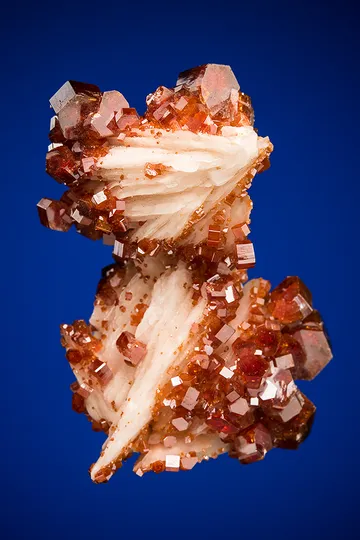
What makes Coud’a matter to collectors is the way it reset expectations for Moroccan vanadinite after the late twentieth-century classics. The sector was discovered in 1999, and a spectacular system of vanadinite pockets opened in June 2001. By the early 2000s, Coud’a had become one of the two premier sources of top-quality Mibladen vanadinite. The best pieces have an immediately recognizable architecture: lustrous hexagonal crystals, from small sparkling druses to crystals reported up to about 5 cm, standing on radiating or “flowering” baryte rosettes. The contrast can be theatrical—blood-red crystals on white baryte, red crystals dusted across black manganese-oxide-coated baryte, or magenta-red tabular aggregates rising from a dark mottramite-coated matrix.
Regional View
Country View
The locality is divided into three named segments running west to east: the Mohamadine workings, the Midelt workings, and the “Mibladen” workings. That internal geography matters, because Coud’a labels are often imprecise. Mohamadine is especially important to collectors for later finds, including the analyzed mottramite association that appeared as a novelty in 2012 and the deeper 2019–2024 vanadinite finds with thick tabular, doubly terminated, hoppery, and polycrystalline “feather” growths. The eastern “Mibladen” segment is notable for the unusual observation, in November 2022, of cerussite and wulfenite in the same mineralized horizon as vanadinite—an exception to the usual collector shorthand that separates Mibladen’s vanadinite-baryte and cerussite-wulfenite-baryte assemblages.

Photo: Wikimedia Commons
Search for specimens: View all specimens from Coud'a workings, Morocco
Coud’a belongs to the Mibladen mining district of the Upper Moulouya lead province. The district lies near Midelt, in Midelt Province, Drâa-Tafilalet Region, and its classic lead-baryte mineralization is hosted in Jurassic carbonate rocks—especially Liassic limestones and dolomites. At district scale, Mibladen is a carbonate-hosted, stratabound lead-baryte system generally treated as a Mississippi Valley-type setting, contrasting with the Aouli vein system in older basement rocks and the Zeïda red-bed-hosted lead deposits farther northwest.
The primary industrial ore was galena with abundant baryte gangue, accompanied in the broader district by comparatively minor sphalerite and chalcopyrite. Oxidation of that lead-rich system produced the minerals collectors know: cerussite, anglesite, wulfenite, vanadinite, mottramite, gypsum, late carbonate coatings, manganese oxides, and iron oxides. In the Coud’a vanadinite zone, baryte is not a passive backdrop but an essential part of the specimen architecture. It lines cavities as bladed, lamellar, rosette, and crested aggregates, then serves as the stage on which late vanadinite crystallized. In the best pockets, baryte and vanadinite grew in open space, producing specimens with aerial crystals and usable display geometry rather than merely mineralized seams.
Coud’a itself is described as an elongated plain about 2 km long and 300 m wide, located near the ACF area. It is cut by many small artisanal shafts and shallow underground crawls rather than by one consolidated industrial mine. The sector is formally divided into the Mohamadine, Midelt, and “Mibladen” workings. The Mohamadine segment is the western part, close to Adeghoual, and was named for Mr. Mohamadine, the miner credited with discovering the deposits in 1999. The working depths reported for Coud’a specimen mining are shallow by industrial standards but significant by hand-mining standards: accounts describe mineralized levels around 10–15 m down, and dealer labels record shafts such as “Puit 24 m.” The veins and pocket zones mined at Coud’a are mineralogically distinct from those of the ACF mine, a point worth preserving on labels because many older or hastily written labels compress the whole neighborhood into “ACF” or simply “Mibladen.”
The mining history of the broader Mibladen district began as a lead story before it became a specimen story. Industrial exploitation expanded during the first half of the twentieth century under the Société des Mines d’Aouli and related operators. More than 600 shafts were reportedly sunk between 1926 and 1949, many initially shallow and aimed at near-surface ore. A flotation plant at Mibladen produced tens of thousands of tons of lead concentrate before the district’s economics deteriorated. Sources differ slightly on the end of industrial production—collector accounts often emphasize closure in 1976, while geological guide literature treats Aouli-Mibladen as stopped by 1983—but the collecting history is clear: once ore mining waned, local miners turned increasingly to specimen recovery.
Coud’a transformed that post-mining economy. The 1999 discovery and the 2001 pocket system sparked a rush for vanadinite. In its most active early years, the ground was opened by independent local teams supported by Midelt dealers, and specimens moved rapidly into the international market. The first Coud’a material caused a sensation at Tucson in 2002, where collectors saw large red crystals on white baryte from a new Mibladen shaft. Later pulses kept the locality current: an important Mohamadine find in mid-2012 produced about 50 specimens with 1–2 cm vanadinite crystals on sparkling mottramite; the 2019 deeper finds yielded thick tabular, polycrystalline, doubly terminated, hoppery, and red-magenta crystals; and 2024 material from Mohamedine continued the same deeper-level style.
Collecting access today should be understood as mining access, not casual rockhounding. The area contains privately or locally controlled claims, old shafts, narrow ladders, crawlways, unstable ground, and active or intermittently active artisanal work. Serious visitors normally go through knowledgeable local contacts, established Moroccan dealers, or organized field trips with explicit permission. A specimen buyer does not need to romanticize the risk: the same shallow shafts that produce beautiful small-cabinet specimens are also confined, dusty, and structurally unforgiving.
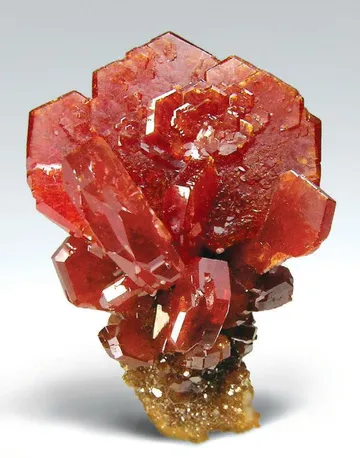
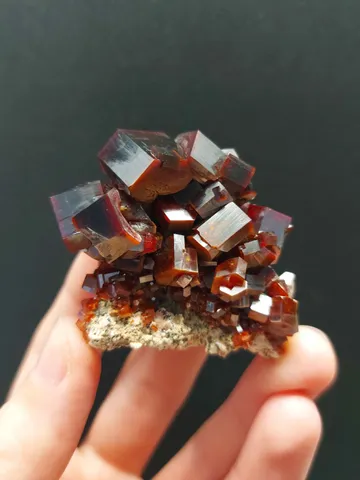
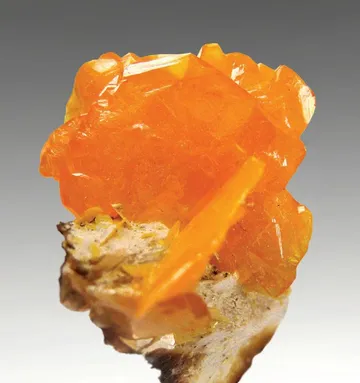
Coud’a vanadinite is the locality’s defining mineral and one of the great modern expressions of the species: hexagonal crystals in tabular, short-prismatic, barrel-like, hopper, skeletal, doubly terminated, and polycrystalline parallel habits, colored orange-red, cherry-red, blood-red, red-magenta, reddish brown, and at times nearly blackish by tone or matrix contrast. Ordinary Coud’a pieces show small bright crystals scattered over baryte; better examples carry sharp, highly lustrous crystals rising cleanly from white or cream lamellar baryte, or from manganese-darkened “flower” baryte that intensifies the red. The celebrated early 2001 pockets produced large and striking vanadinite-on-baryte specimens, while later Mohamadine finds added two distinctive collector subtypes: 2012 vanadinite on sparkling black mottramite, generally with crystals in the 1–2 cm range, and deeper 2019–2024 material with thick tabular, hoppery, doubly terminated, red-magenta crystals and feather-like parallel aggregates. Top pieces are judged by saturation, luster, crystal sharpness, lack of bruising on exposed edges, contrast with baryte or mottramite, and the elusive “aerial” placement of crystals rather than a flat sprayed coating.
At Coud’a, barite is both a documented species and the most important aesthetic matrix for vanadinite. It occurs as white, cream, honey, orange-brown, and manganese-blackened tabular to lamellar aggregates, radiating crests, lenticular crystals, and compact “baryte flowers,” commonly carrying later vanadinite. The best barite-bearing Coud’a specimens are not collected for barite alone but for the way the baryte builds sculptural contrast: white crested blades supporting red crystals, black oxide-coated baryte carrying fiery red points, or stable lenticular baryte matrices that lift vanadinite into display position. Condition is critical because the baryte can be platy and exposed; a specimen with intact crests, clean crystal bases, and no crushed baryte ridges is far superior to a larger but abraded plate. Coud’a barite is especially associated with vanadinite, galena, manganese oxides, and locally wulfenite in the “Mibladen” segment.
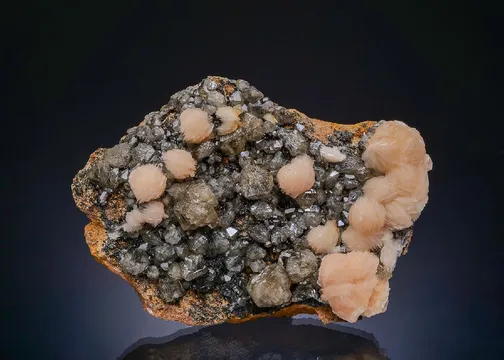
Other documented minerals from the Coud’a workings include galena, cerussite, gypsum, wulfenite, mottramite, manganese oxides, and photo-documented associations involving hollandite, aragonite, calcite, dolomite, and goethite. No type-locality mineral is credited to Coud’a in the verified locality records, but the site is important for notable rarities within the Mibladen collecting context. Mottramite is the most significant of these: the Mohamadine material introduced analyzed black to very dark green mottramite microcrystals as a striking matrix for red vanadinite, and that association became one of the signature post-2001 Coud’a subtypes. Wulfenite and cerussite are far less characteristic here than vanadinite-baryte, but the 2022 observation of cerussite and wulfenite in close proximity to vanadinite in the eastern “Mibladen” workings complicates the older, cleaner separation of Mibladen’s mineralized horizons.
The chief authenticity problem with Coud’a is not synthetic vanadinite or a famous fake tradition; it is locality precision. Many specimens entered the trade as “Mibladen,” “Midelt,” “ACF Mine,” or “Coudia,” and older labels may use Coud’a loosely for nearby workings or, conversely, put true Coud’a material under ACF. If the exact sublocality matters to the value of a specimen, ask for the label trail: Coud’a workings, Mohamadine, Midelt workings, “Mibladen” workings, ACF, and Bou el Maden are not interchangeable names.
Black matrix is not automatically suspicious. Manganese oxides and hollandite-type coatings are well represented in Moroccan vanadinite assemblages, and Coud’a is especially known for red crystals on blackened baryte or dark mottramite-coated matrix. That said, collectors should examine very dark matrices under magnification. Natural oxide films usually follow crystal faces, fractures, and cavity surfaces irregularly; paint-like coatings, shiny residues in protected recesses, or black material bridging broken contacts deserve scrutiny. Also look closely for glued crystals, filled cracks, concealed sawed backs, and baryte plates stabilized after mining damage. Repairs are not rare in fragile baryte-vanadinite specimens from any locality, but they should be disclosed.
Condition is everything. Vanadinite has exposed terminations and delicate crystal edges; baryte rosettes chip readily; and the high-contrast red-on-white pieces show even small bruises. Inspect crystal rims, corners of tabular faces, and the outermost baryte ridges. Muddy pocket clay can hide damage, while aggressive cleaning can dull baryte, loosen oxide coatings, or strip away the natural contrast that made the piece attractive. Late aragonite or calcite coatings may be natural rather than dirt, but they can either add locality character or obscure the vanadinite, depending on placement.
Handling should be sensible rather than alarmist. Vanadinite contains lead and vanadium, so avoid inhaling dust, do not grind or trim without proper controls, keep pieces away from children and pets, and wash hands after handling friable specimens. Do not soak Coud’a pieces in acids or harsh cleaners: vanadinite, baryte, carbonate coatings, clay seams, and oxide skins may respond differently, and a chemically “improved” specimen can quickly become a dulled or destabilized one. For display, keep specimens dry, padded, and out of prolonged direct sunlight; although high-quality vanadinite is generally stable in cabinets, collectors often avoid intense light exposure to preserve color and luster.
Market availability remains healthy because Coud’a produced in quantity and continues to appear through Moroccan dealers, show stock, online shops, and collection dispersals. The common material is affordable: small red crystals on baryte, often attractive but flat or slightly bruised. Fine Coud’a pieces are more selective: vivid color, glassy luster, documented sublocality, intact baryte, three-dimensional form, and either classic white contrast or convincing black mottramite/manganese contrast. The best strategy is to buy the specimen, not the square centimeters of red—one small, undamaged, well-balanced Coud’a miniature can outrank a larger plate with battered terminations and vague “Morocco” provenance.
The modern Coud’a story begins with a name. The western segment, Mohamadine, was named for Mr. Mohamadine, the miner credited with discovering the deposits in 1999. Within two years, the locality had moved from a local discovery to an international specimen event. In June 2001, a large system of vanadinite pockets opened at Coud’a, and the plateau north of the ACF area became the center of a rush. Accounts of the early 2000s describe small shafts multiplying across the elongated ground and local miners working the new vanadinite zone intensely enough that Coud’a became one of the world’s most famous modern vanadinite sources.
At Tucson in 2002, collectors met Coud’a as a new name with an unfamiliar punch. Fabre Minerals described the find as an “exciting novelty” from a new Mibladen shaft called “Coud’a,” pronounced “Coudia,” and singled out the new material for very large vanadinite crystals. The representative specimen was small—2.5 x 2.4 x 1.9 cm—but the impact was in the color and staging: lively red crystals, undamaged and aerial, standing against white baryte. It was exactly the recipe that would make the sector famous: not simply vanadinite from Morocco, but red crystals lifted clear of a sculptural baryte matrix.
The most vivid underground description comes from Timothy Greenland’s account of the 2012 Mindat trip to Morocco. After visiting the Les O mine, the group went to Coud’a near the ACF shafts. The ground was “pocked by small one-man shafts,” each dropping a few meters toward the vanadinite-rich zone, with small stone huts beside some shafts where miners lived while working their claims. Specimens were laid out on tables or blankets nearby. Greenland paid 200 dirhams to descend one shaft. The opening was narrow, about 70 cm around, with an iron ladder fixed to one wall; the awkward part was that the ladder began about 1.5 m below the surface, requiring what he called “a bit of monkey work” just to get onto it. At roughly 6 m depth, crawlways ran along the seam. About 10 m along one crawl, he saw brilliant red vanadinites to about 8 mm on baryte in the roof, but the rock was hard and the visit short. He left with a 6 x 7 cm specimen: crested baryte, white on the sides, black in the middle, “constellated” with tiny bright vanadinites. It is a wonderfully exact Coud’a image—cramped workings, a roof seam, black-and-white baryte, and small red crystals bright enough to justify the descent.
That same 2012 season produced another kind of story: mottramite. The Mohamadine segment yielded a small pocket of roughly 50 specimens with 1–2 cm vanadinite crystals on sparkling mottramite. Dealers at Sainte-Marie-aux-Mines presented the association as a novelty for Mibladen, with analyzed mottramite microcrystals coating the matrix beneath translucent red vanadinite. The best pieces have a different mood from the classic red-on-white baryte plates. Instead of clean contrast, they give a red-on-black tension: tabular vanadinite crystals with vivid color, toothed or polycrystalline edges, and dark, glittering mottramite beneath.
A later chapter came from deeper-than-usual Coud’a workings in 2019. The material was repeatedly described as coming from greater depth, especially in the Mohamadine area, and it brought a distinct habit: thick tabular crystals, many doubly terminated, some with hopper growths, grouped into parallel, feather-like or plume-like aggregates. The color was often red-magenta to reddish brown with orange shades, and the luster was strong enough that many high-end dealers documented the pieces with videos. Some specimens were thin, nearly floater-like plates only a centimeter thick; others were cabinet groups with main crystals around 2.5–2.6 cm. By 2024, similar deeper Mohamadine material was still appearing, showing that Coud’a’s importance did not end with the original 2001 rush.