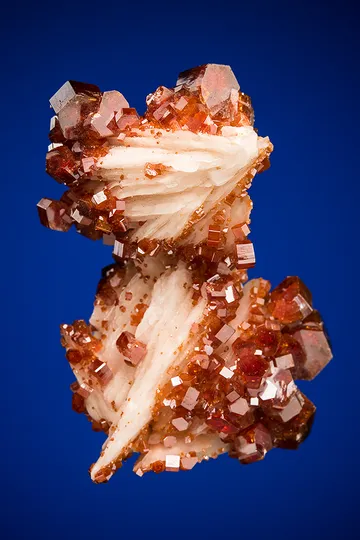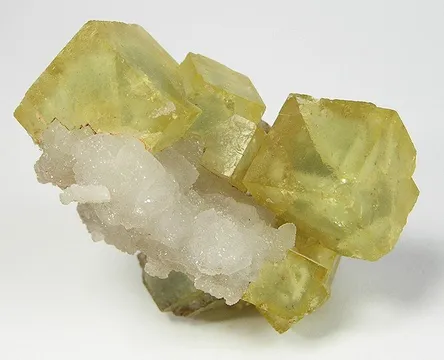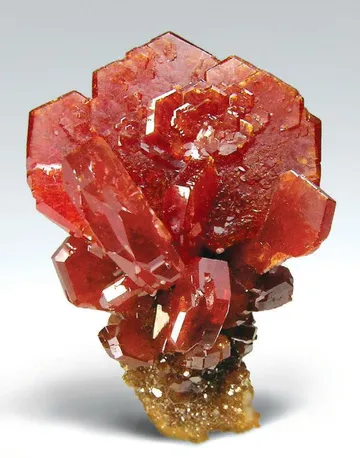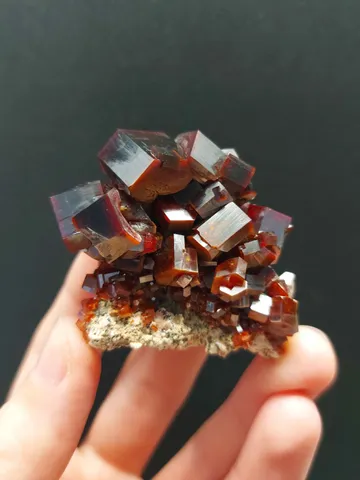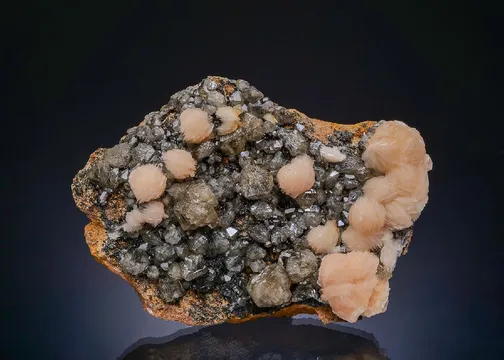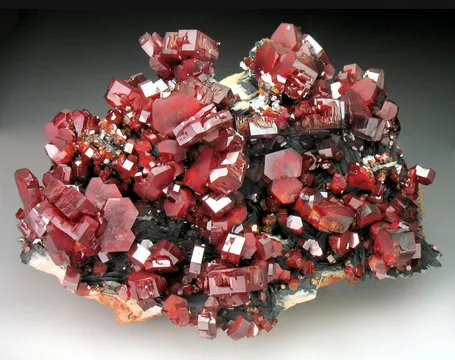
Les Dalles Mine, Morocco - key Mibladen locality famed for baryte and galena, with pale smoky cerussite twins on baryte and orange wulfenite on galena.
Key facts
Les Dalles Mine is one of the named underground workings that give the Mibladen district its depth as a collector locality. Mibladen, north-east of Midelt in the Upper Moulouya district of central Morocco, is best known worldwide for vanadinite, but Les Dalles belongs to the older, heavier, lead-mine side of the district’s fame: baryte and galena in Liassic carbonate rocks, later oxidized to cerussite and locally ornamented with wulfenite. In specimen terms, Les Dalles is not simply “another Mibladen” label. It is a distinctive source of pale to smoky cerussite twins on bladed baryte, orange to yellow wulfenite on baryte and galena, and chunky plates that carry the visual grammar of a worked lead-barite mine: white, cream, pinkish, or iron-stained baryte; grey-black galena; adamantine cerussite; and small but electric wulfenite crystals.
The mine is recorded as Les Dalles Mine, also historically associated with the names Lidal Mine, Chantier des Dalles, and Leedal. It sits within the Mibladen commune in the Aït Oufella Caïdat, Midelt Province, Drâa-Tafilalet Region. Mindat gives its coordinates as 32°44'57'' N, 4°39'51'' W, and identifies it as a system of underground workings and the second-largest working in the Mibladen district. It was also one of the Mibladen localities visited during the 2nd Mindat.org conference in November 2012, which helped fix Les Dalles more clearly in the vocabulary of modern collectors rather than leaving its specimens under the broad district label.
Regional View
Country View
Geologically, Les Dalles is part of the Mibladen Pb-Ba system: stratabound and fracture-controlled lead-barite mineralization hosted mainly in Jurassic carbonate cover around the Aouli inlier. The economic mineralization is baryte and galena; the collector minerals are mostly products of open-space crystallization and oxidation. The best Les Dalles specimens feel dense, structural, and architectural. Cerussite may appear as V-twins, cyclic twins, pseudo-octahedral sixlings, or golden to smoky crystals scattered across baryte plates. Wulfenite is more selective: small yellow “windowpane” tablets are commoner than large display crystals, but exceptional pieces from modern finds show aerial orange crystals reaching the centimeter scale on white baryte. The mine’s finest specimens work because of contrast—clear lead carbonate on pinkish baryte, orange molybdate on white blades, or bright micro-wulfenite set against dark galena.
Search for specimens: View all specimens from Les Dalles Mine, Morocco
Les Dalles lies in the Mibladen mining district, about 15 to 25 km north-east of Midelt depending on whether one is speaking of the deposit area or the wider Aouli-Mibladen district. The district is part of the High Moulouya lead province, where three important deposit styles sit near one another: Aouli vein-type mineralization in Paleozoic basement rocks, Zeïda red-bed lead mineralization in Triassic sandstones and conglomerates, and Mibladen’s stratabound Mississippi Valley-type Pb-Ba mineralization in Jurassic carbonate rocks and related cover. That distinction matters to collectors because specimens labelled vaguely “Mibladen” can come from workings with different habits, matrices, and parageneses.
The Mibladen Pb-Ba zone forms an ENE-WSW belt roughly 15 km long and 1 to 4 km wide, framed by the Amourou fault to the south and the Aouli fault to the north. The mineralized bodies are not a single vein, but a set of horizons and structures in carbonate rocks. Modern structural work places Les Dalles in the Upper Horizon of the Mibladen system, along with Adeghoual, T-Ouest, Les O, and several AB workings. The main host rocks across Mibladen are argillaceous limestones, dolomitic limestones, dolostones, and limestones of Liassic age; early Liassic dolostones can contain stratiform baryte bodies up to about 100 cm thick, while Middle Liassic carbonate rocks host important Pb-Ba bodies in interstratal joints, karst cavities, and dissolution structures.
At Les Dalles itself, the collector-relevant ore is the baryte-galena assemblage and its oxidation products. Mindat’s current locality list records six valid minerals from the mine: baryte, calcite, cerussite, galena, hematite, and wulfenite. Field observations from in situ Les Dalles mineralization describe a vein about 12 cm wide in which galena formed along the outer parts of the vein, baryte infilled much of the remaining space, and later cerussite and yellow platy wulfenite developed in the oxidized zone. That sequence explains the look of many specimens: dark galena or altered galena at the base, baryte blades rising through or over it, cerussite perched or crusted on the galena, and wulfenite sprinkled across the baryte or lining small protected cavities.
Industrial exploitation at Mibladen developed from early twentieth-century lead prospecting in the Upper Moulouya. The broader Aouli-Mibladen history includes discovery work in the 1920s, development under companies associated with the Aouli mines and Peñarroya, and later Moroccan state involvement. Mibladen was worked intensively as a lead producer; between 1926 and 1949 more than 600 shafts were sunk in the district, most initially shallow, with deeper exploration after 1948 revealing the broader extent of mineralization. The district’s production from 1938 to 1983 has been estimated at about 6.253 million tonnes of ore at roughly 5 wt% Pb, representing a major share of Moroccan lead production. The High Moulouya mines were active in the 1970s, but Aouli-Mibladen closed as an industrial operation by 1983.
Les Dalles is an underground working, not a tourist collecting pit. The mine’s surviving collector history is tied to the old room-and-pillar style workings and to later artisanal recovery of specimen material from old mine spaces. Access should be treated as local, conditional, and hazardous. Reports from collector visits describe entering portals, moving through old workings, and chiselling mineralized pillars or boulders for small vugs, but those accounts should not be read as an invitation to enter. Old Mibladen workings have unstable roofs, hidden openings, oxygen and dust concerns, and the social reality of local artisanal miners whose livelihoods depend on the ground. Any visit requires local permission, local guidance, and conservative mine-safety judgment; many collectors will be better served by buying well-provenanced specimens than by attempting underground collecting.
The finds that made Les Dalles collectible are primarily cerussite-baryte-galena plates and wulfenite-bearing baryte pieces. Cerussite has been found both as loose or matrix crystals and as plates scattered across baryte; some specimens show yellow fluorescence under long-wave ultraviolet light. Baryte occurs as tabular to bladed crystals, commonly white, cream, pinkish, or iron-oxide tinted. Wulfenite ranges from tiny yellow plates to exceptional orange tabular groups, with modern dealer records noting Les Dalles wulfenite on baryte from 2018 and specimen videos of orange wulfenite crystals on baryte from recent market offerings. For collectors, the strongest Les Dalles labels are those that preserve the exact mine name rather than merely “Mibladen,” because the mine-specific habit—cerussite and wulfenite on baryte and galena—is both recognizable and value-bearing.
Wulfenite from Les Dalles is the showier but less abundant accent mineral in the mine’s classic baryte-galena-cerussite assemblage, typically appearing as bright yellow to orange tabular crystals on baryte, galena, or cerussite-bearing matrix. In situ material observed in the old mine roof showed yellow platy crystals to about 5 mm in a baryte-galena vein, and market specimens commonly describe small yellow windowpane prisms to about 7 mm scattered among iron-stained baryte rosettes; exceptional modern pieces are much larger, including aerial orange wulfenite groups on white baryte with main crystals around 2 cm. The best Les Dalles wulfenites are not merely “Moroccan wulfenite”—they have clean tabular form, saturated orange or lemon-yellow color, convincing baryte association, and minimal bruising, which is a real achievement given the softness and brittleness of wulfenite and the heavy baryte-galena matrices from which these specimens are extracted.
Cerussite is the signature collector species of Les Dalles, occurring as colorless, white, golden, smoky-brown, and translucent to transparent crystals on baryte, galena, and oxidized lead matrix. The mine is especially known for twinned material: V-twins, cyclic twins, pseudo-octahedral sixling-like crystals, and complex lustrous groups, with documented specimens ranging from thumbnail-scale crystals of a few millimeters to matrix plates carrying crystals to 2.6 cm, and collector descriptions of Les Dalles cerussite groups of several centimeters on tabular baryte. Many pieces fluoresce yellow to pinkish-yellow under long-wave ultraviolet light, a useful field and collection-room clue when cerussite sits among pale baryte blades. Top Les Dalles cerussites combine sharp twinning, glassy to adamantine luster, transparency, strong placement on pinkish or white baryte, and preserved association with galena; ordinary examples are more massive, contacted, chalky, or visually lost among broken baryte.
Barite is the structural mineral of Les Dalles specimens: the heavy, tabular to bladed BaSO4 framework on which the more glamorous cerussite and wulfenite are staged. It occurs as white, cream, pinkish, orange, and iron-oxide-stained blades, rosettes, and plates, commonly intergrown with or cutting through galena and then carrying later cerussite and wulfenite. Good Les Dalles baryte pieces are judged less like isolated baryte crystals and more like association specimens: clean bladed architecture, attractive iron or hematite staining without muddying the piece, strong contrast with cerussite or wulfenite, and enough matrix stability to survive trimming and display. Baryte from Les Dalles can be quite heavy and brittle, so undamaged sprays or plates with intact terminations and good mineral placement are far more desirable than large but battered masses.
Beyond wulfenite, cerussite, and baryte, the confirmed Les Dalles mineral list is concise: galena, hematite, and calcite complete the six valid species recorded specifically for the mine. Galena is more than a matrix note here; it is the primary lead sulfide whose oxidation supplied the cerussite and whose corroded dark surfaces give many specimens their best contrast. Hematite and iron oxides contribute the orange to reddish staining seen on some baryte blades, and calcite is a minor carbonate associate. No type-locality mineral is documented from Les Dalles itself. At district scale, the Mibladen area does have a modern type-locality mineral—grguricite from the Adeghoual mine—but that should not be transferred onto Les Dalles labels.
The principal authenticity issue with Les Dalles material is locality precision. Specimens are often sold broadly as “Mibladen,” and some older or dealer-circulated cerussite-on-baryte pieces have been confused with other Moroccan lead localities, including Touissit. Les Dalles pieces should make mineralogical sense: baryte plus cerussite, commonly with galena; wulfenite as yellow to orange plates on baryte or galena-bearing matrix; and occasional iron-oxide or hematite staining. A label claiming Les Dalles for a specimen dominated by a different district habit should be checked carefully.
Documented fabrication scandals are not a defining problem for Les Dalles in the way they are for some high-volume gem or geode markets. The more realistic concerns are repaired baryte blades, glued wulfenite tabs, restored cerussite clusters, and upgraded locality names. Wulfenite is particularly vulnerable: the crystals are soft, brittle, and easily bruised, and even genuine crystals may have edge nicks or reattached plates. Fine examples with major orange wulfenite crystals on baryte should be inspected under magnification for glue menisci, unnatural contact points, color-mismatched restoration, and impact bruising along exposed edges.
Cerussite from Les Dalles is dense, brittle, and often twinned in forms with exposed re-entrant angles. It can look tougher than it is. Watch for broken twin arms, contacted backs, cleaved terminations, and scuffed lustrous faces. Yellow fluorescence under long-wave ultraviolet light is often reported for Les Dalles cerussite and can help reveal hidden cerussite sections on galena-rich pieces, but fluorescence alone is not a locality proof. Handle all specimens as lead-bearing mineral specimens: do not grind or soak them casually, wash hands after handling, keep dust out of display cases, and avoid letting children handle galena- or cerussite-rich pieces.
Market availability is moderate but uneven. Small cerussite-baryte plates and barite-with-minor-wulfenite specimens appear regularly from Moroccan dealers and international resellers, while sharp, undamaged, mine-specific Les Dalles wulfenite is much scarcer. The most desirable specimens combine exact Les Dalles provenance, aesthetic baryte architecture, visible galena context, and cleanly positioned cerussite or wulfenite. For serious collectors, a “Les Dalles” label with date, dealer, former collection, or field-collecting history is worth preserving; it separates the piece from the ocean of generic Mibladen lead minerals.
During the 2012 Morocco conference organized around Mindat and the Spirifer Geological Society, collectors encountered Mibladen not as a single mine but as a living mineral landscape. The broad district had already become famous in cabinets around the world, yet the field reality was far more intimate: small artisanal shafts, old industrial workings, mineral dealers from local families, and rooms underground where the old lead-mining fabric had not disappeared so much as changed purpose.
One of the most vivid accounts comes from Canadian collector and dealer David K. Joyce, who travelled with Ray McDougall during the conference field program. After visiting the ACF workings, where miners were chasing vanadinite layers about 10 m below the surface, Joyce described the directness of local work: miners chiselled a shaft straight down until they reached the productive horizon, a task that could take about two months, then continued by hand until a vug was found. At the top of the shaft, small shelters allowed miners to sleep near their claims when good ground had been located. Joyce and McDougall visited a miner named Abdellah, descended his shaft, and tried hand-chiselling for a couple of hours. The reward was modest—small vanadinite crystals—but the experience gave them a feel for the patience behind the specimens that appear so effortlessly on show tables.
Les Dalles entered the story in the old room-and-pillar workings. Joyce described walking in through a portal, moving down to promising ground, and chiselling at pillars and boulders that still carried veins of galena, vanadinite, baryte, cerussite, and wulfenite. Cerussite and baryte were the most common successful finds for the group, which fits the mine’s reputation perfectly. Joyce’s own prize was more elusive: he found “a nice yellow wulfenite specimen at Les Dalles,” only to lose it on the way home. That lost piece is a wonderfully human footnote for a locality where the best wulfenites are already fragile, uncommon, and easy to underestimate until they are gone.
The conference also produced one of the more surreal modern scenes in Moroccan mineral collecting: an abandoned room-and-pillar mine near Mibladen converted into a banquet hall. Local hosts cleared coarse rock from the mine floor, spread gravel, laid carpets, brought in tables and chairs, and served a multi-course meal underground. There was live music, dancing, wine, and Polish Krupnik. In a district where old lead mines had once been industrial workplaces and later became sources of specimen income, that evening captured the strange afterlife of Mibladen’s underground spaces: part mine, part museum, part community gathering place, part mineralogical pilgrimage stop.
Tomasz Praszkier, “Famous Mineral Localities: Mibladen, Morocco,” The Mineralogical Record, vol. 44, no. 3, 2013, pp. 247–285. The key modern collector-locality article for Mibladen, cited by Mindat for Les Dalles cerussite, galena, and hematite.
https://zh.mindat.org/reference.php?id=12910115
Steffen Jahn, Rainer Bode, Peter Lyckberg, Olaf Medenbach, and Hans-Jürgen Lierl, Marokko – Land der schönen Mineralien und Fossilien, Bode Verlag GmbH, 2003, pp. 1–528. A major Morocco mineral reference cited for Les Dalles baryte and wulfenite.
https://www.mindat.org/reference.php?id=16957808
M. Jébrak, É. Marcoux, M. Nasloubi, and M. Zaharaoui, “From sandstone- to carbonate-hosted stratabound deposits: an isotope study of galena in the Upper-Moulouya District (Morocco),” Mineralium Deposita, vol. 33, no. 4, 1998, pp. 406–415. Important regional isotopic work on Upper Moulouya lead deposits, including the geological distinction between Mibladen and neighboring deposit styles.
https://doi.org/10.1007/s001260050158
“Analysis of tectonic fracturing in the Mibladen ore deposit (Upper Moulouya, Morocco) and its impact on the Pb-Ba mineralization emplacement.” This structural study is useful for understanding Les Dalles as part of the Upper Horizon of the Mibladen Pb-Ba system and for the role of fractures, interstratal joints, and karst cavities in concentrating ore and specimen pockets.
https://www.researchgate.net/publication/349037044_Analysis_of_tectonic_fracturing_in_the_Mibladen_ore_deposit_Upper_Moulouya_Morocco_and_its_impact_on_the_Pb-Ba_mineralization_emplacement
“Le district plombifère de la Haute Moulouya (Aouli-Mibladen, Zeïda),” in Les Nouveaux Guides Géologiques et Miniers du Maroc, vol. 9. A concise field-guide treatment of the High Moulouya district, separating Aouli vein ores, Mibladen stratabound MVT ores, and Zeïda red-bed ores.
https://cartesgeoscientifiques.mem.gov.ma/catalogue/pages/les_nouveaux_guides_geologiques/livres/vol9/files/basic-html/page299.html
Mike S. Rumsey, Mark D. Welch, John Spratt, and Annette Kleppe, “Grguricite, CaCr2(CO3)2(OH)4.4H2O, a new alumohydrocalcite analogue,” Mineralogical Magazine, vol. 84, no. 5, 2020, pp. 778–784. Not a Les Dalles mineral, but the relevant type-mineral publication for the wider Mibladen area; grguricite is from Adeghoual.
https://www.cambridge.org/core/journals/mineralogical-magazine/article/abs/grguricite-cacr2co32oh44h2o-a-new-alumohydrocalcite-analogue/BAB25B14A24AFEF9CD0B712B97E47377
Ritsuro Miyawaki, Frédéric Hatert, Marco Pasero, and Stuart J. Mills, “IMA Commission on New Minerals, Nomenclature and Classification (CNMNC) – Newsletter 54,” European Journal of Mineralogy, vol. 32, 2020, pp. 275–283. Includes the IMA approval summary for grguricite from Adeghoual, Mibladen.
https://ejm.copernicus.org/articles/32/275/2020/ejm-32-275-2020.html