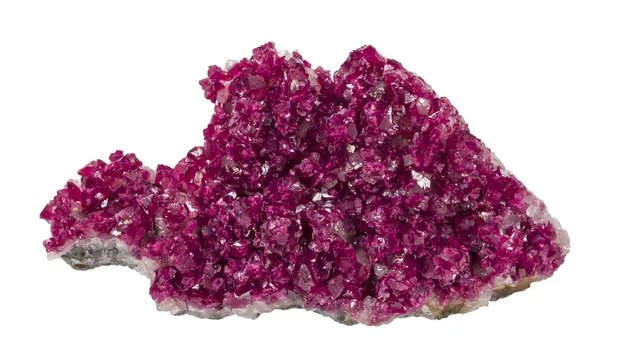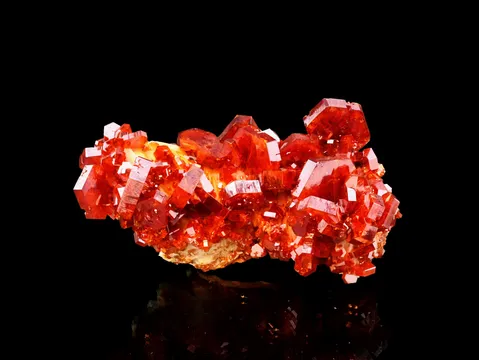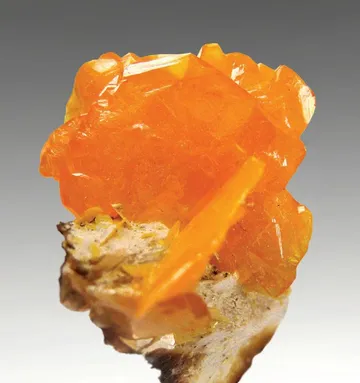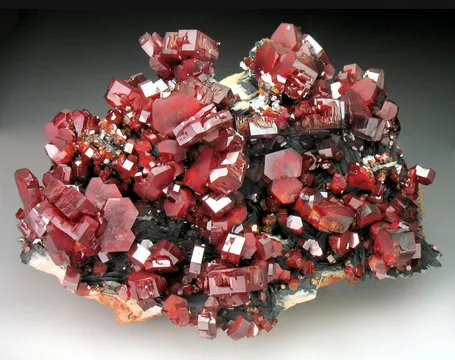
Oumjrane mining area, Morocco - a copper district famed for vivid azurite and malachite, and rare native copper pockets, a prized collector locality.
Key facts
Oumjrane matters because it is one of the few modern Moroccan localities that is simultaneously an active copper district, a serious geological case study, and a living specimen producer. In the collecting world the name usually points to the Oumjrane–Bou Nahas system south of Alnif, on the eastern Anti-Atlas fringe of the Maïder basin, where steep fault veins cut Ordovician sandstone, quartzite, shale, marl and related siliciclastic rocks. Economically, the district is a sediment-hosted, structurally controlled Cu-(Ni-Pb-Zn-Ba) vein system; aesthetically, it is a locality of vivid blue azurite, green malachite, lustrous yellow to grey barite, pyrite- and marcasite-bearing associations, and the celebrated 2015 native copper pocket from Bou Nahas.
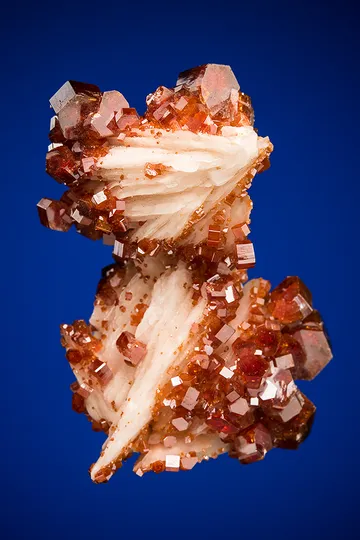
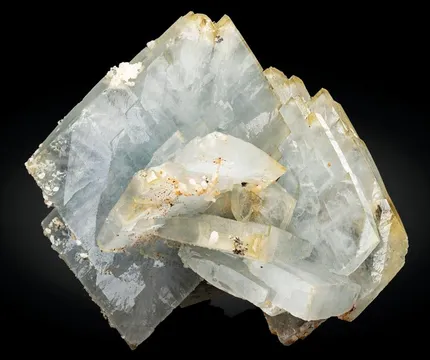
The best Oumjrane specimens have a very particular look. The azurite can form flattened, wedge-like, lustrous crystals packed in subparallel groups, often described by collectors as “electric blue” because the color is unusually vivid for Morocco and can recall Milpillas material while remaining visually distinct. Malachite appears both as green coatings and as primary-looking crystal sprays or tufts, commonly in direct association with azurite. Barite from Bou Nahas is often sharply tabular, lustrous, and zoned in grey, brown, honey-yellow or canary-yellow tones; some groups show transparent centers, white margins, or marcasite and pyrite accents. Native copper specimens range from arborescent, malachite- and cuprite-coated masses to sharp skeletal spinel-law twins that emerged from a small clay-filled zone and quickly became one of the locality’s most memorable modern finds.
Regional View
Country View
For collectors, Oumjrane is best treated as a district rather than a single hole in the ground. The Bou Nahas mine is the principal modern mining center and the source of much of the barite, sulfide, copper and supergene material. The old azurite workings south of Oumjrane village produced a different style of azurite, especially from the period of local specimen digging in the 2000s. The El Fecht prospects, northwest of Oumjrane, are tied to the same broader mineralized system but yield their own habit: darker, flatter to lenticular azurite clusters, locally in “sun” forms from marly horizons, with better pieces showing larger edge crystals and attractive malachite contrasts.
Search for specimens: View all specimens from Oumjrane mining area, Morocco
The Oumjrane mining area lies in the eastern Anti-Atlas, roughly 50 km south to southeast of Alnif and about 90 km northeast of Zagora, in a pre-Saharan hamada landscape of stony desert, low relief and intermittent wadis. In specimen labels the locality may appear as Oumjrane, Oumjerane, Oumjrane–Bou Nahas, Bou N’has, Bou N’hass, Bounhas, or Bou Nahas Mine; for serious cataloguing, the most precise labels distinguish Bou Nahas Mine from the older Oumjrane azurite workings and the El Fecht prospects.
Geologically, Oumjrane–Boukerzia is part of the Maïder–Tafilalt vein field. The district occupies a broad NE-SW mineralized belt, on the order of 40 km long and 10 km wide, within a Paleozoic cover sequence above the older Anti-Atlas basement. The important host rocks at Bou Nahas are sandstone-quartzite and pelitic units of the Upper Ordovician Second Bani Formation, with the wider district including Ordovician to Carboniferous rocks, Silurian black shales, Devonian carbonate and shale successions, and later intrusive rocks. Brittle faulting is fundamental: mineralization follows E-W and ENE to E-W structures in the Bou Nahas domain, while NE-SW structures are more characteristic toward the Boukerzia side of the district.
The deposit type is best described as a structurally controlled, sediment-hosted polymetallic vein system. Recent work recognizes the Oumjrane Cu-(Ni-Pb-Zn-Ba) district as a 25 x 25 km system of steeply dipping quartz-sulfide fault veins. The exploited veins are open-space fillings, veinlets, stockworks and breccia veins, with textures that include breccia, laminated ore, comb structure, cockade texture, crack-and-seal structure and cataclastic zones. The ore is not a single simple stage: the main copper-nickel event is dominated by chalcopyrite with subordinate gersdorffite, magnetite and pyrite in quartz and apatite-bearing gangue, while a later Pb-Zn-Ba event introduced galena, sphalerite and barite. The supergene overprint then produced the minerals that make the locality most recognizable to collectors: azurite, malachite, native copper, cuprite, brochantite, chrysocolla, covellite, anglesite, goethite and hematite.
The Bou Nahas system is the economically dominant part of the district. Modern descriptions give the principal Bou Nahas lode as lenticular, generally E-W striking and south dipping, hosted by alternating sandstone-quartzite and pelitic rocks. Its textures range from brecciated ore with sandstone fragments cemented by quartz and chalcopyrite to banded ore in which chalcopyrite ribbons alternate with barite ribbons, as well as disseminated and massive styles. Published resource figures for Bou Nahas include approximately 3,772,773 tonnes grading 1.73% Cu, equivalent to about 64,441 tonnes of copper metal, while the broader Oumjrane district has been described as containing 5.7 Mt at 1.5% Cu.
Mining history is layered. Local copper exploitation is said to go back to the Middle Ages and perhaps earlier, which fits the Moroccan Anti-Atlas tradition of small ancient workings on conspicuous oxidized copper showings. Modern exploration is attributed to the former BRPM, now ONHYM, beginning in 1956. Later work during the French-influenced mining period focused especially on Bou Nahas and the area south of Oumjrane, where ore was mined from quarries and shafts and sent to a flotation plant at Bou Skour. Those operations were abandoned in the 1970s. A modern revival followed when Managem created Compagnie Minière d’Oumjrane in 2010, with mining activity restarting around 2011 and production reported from 2014 onward. Published production for the district includes about 217,396 tonnes of run-of-mine ore in 2023 at an average grade of 1.53% Cu, totaling 3,326 tonnes of copper.
Specimen production followed the mine history but did not always come from the same places as ore. From about 2000 to 2010, local diggers worked azurite-bearing material from old workings south of Oumjrane village, producing sharp, flattened blue crystals on matrix, commonly with malachite and barite. Around 2015, a new Oumjrane azurite find reached the international market and was shown at Sainte-Marie-aux-Mines; these were loose crystal aggregates and small groups noted for saturated blue color, bright luster and unusually attractive associations with malachite and small white barite crystals. El Fecht, roughly 15 km northwest of Oumjrane, produced darker azurite clusters in marls, including flattened “sun” forms; most material from that area is low grade, but occasional zones have yielded good pieces to about 10 cm with larger crystals along the margins.
Bou Nahas has been the major modern specimen source for barite, sulfides and native copper. Its barite appears in two main collecting styles: sharp tabular crystals, commonly parallel-grown and multiply terminated, and rosette aggregates, including a remarkable two-generation rosette reported at about 23 cm. The tabular crystals are usually in the 4–6 cm range but may reach around 10 cm. Pyrite and marcasite associations occur, and a 2020 find produced pyrite coatings and perimorphs after barite, with minute pyrite crystals forming shells over partly dissolved white tabular barite. Native copper had been known as arborescent to spongy oxidized aggregates before early 2015, but the important 2015 clay-zone pocket produced roughly a thousand copper specimens, only about a hundred of which showed well-formed sharp crystals; the best are skeletal elongated spinel-law twins, typically a few centimeters but with some to about 7 cm and specimens to about 10 cm.
Collecting access today should be understood conservatively. Bou Nahas is not an abandoned weekend collecting site; it is an active mining area tied to a modern operating company and a significant copper resource. Old underground workings, deep shafts, unstable stopes, clay pockets, oxidized zones and desert access logistics make casual collecting inappropriate. Any visit requires explicit permission from landholders and mineral-rights holders, local guidance, and mine-safety awareness. Most collector specimens now enter the market through miners, Moroccan dealers and international dealers rather than through self-collecting.
Barite is one of Bou Nahas’s signature collector minerals, and the best pieces are immediately recognizable: sharp tabular crystals with strong luster, grey to brown to honey-yellow or canary-yellow color, and geometric zoning or phantoms, commonly in parallel, multi-terminated groups. The usual good crystal size is about 4–6 cm, but crystals to around 10 cm are documented, and the species also forms rosettes, including large two-generation groups. Associations include quartz, pyrite, marcasite, galena, sphalerite, chalcopyrite, dioptase and secondary copper minerals; especially desirable pieces combine translucency, clean terminations, visible color zoning, and enough matrix or sulfide contrast to show that they are Bou Nahas specimens rather than generic Moroccan barite.
Azurite from Oumjrane is prized for flattened to lenticular crystals, vivid blue color and bright luster, with the best 2015 material forming sharp aggregates from roughly miniature to small-cabinet size, commonly 3.5–9 cm, accompanied by malachite and small white barite. The older Oumjrane workings south of the village produced fish-scale-like subparallel groups, while El Fecht yielded darker, flatter “sun” clusters in marls and later larger lenticular crystal groups, some reaching cabinet scale with crystals to a few centimeters. Good Oumjrane azurite is not merely blue; it has saturated color in daylight, crisp flattened crystal form, minimal bruising on the thin edges, and a natural green-and-white association that frames the blue rather than overwhelming it.
Malachite at Oumjrane is both an accessory and, in select pieces, the main event. It occurs as green alteration coatings on native copper and cuprite, botryoidal or spheroidal growths with azurite, small equant crystals on azurite from El Fecht, and elongated primary-looking crystals or sprays on matrix; Fabre recorded a druse of elongated, terminated malachite crystals from El Fecht, with individual crystals about 0.9 cm long. The most appealing specimens show malachite as a deliberate-looking part of the composition: velvety or crystalline green against electric-blue azurite, fibrous green after copper, or malachite-cuprous patinas preserving arborescent copper form rather than reducing the piece to a shapeless oxidized mass.
Native copper is one of the great modern surprises of Bou Nahas. Older specimens were chiefly arborescent to spongy aggregates, often heavily oxidized and coated by malachite, cuprite or other secondary copper minerals, but an early-2015 green clay zone yielded about a thousand copper specimens, perhaps a hundred with sharp, well-formed crystals. The best are skeletal elongated spinel-law twins, usually 2–4 cm but locally to about 7 cm as individual twins, with specimen sizes to about 10 cm; surfaces range from clean coppery and lustrous, to iridescent oxide films, red microcrystalline cuprite coatings, and green malachite coatings. Top pieces preserve an elegant, sharply crystallized copper skeleton rather than only a copper-bearing mass, and the most distinctive show red, green and metallic surfaces together without obscuring the crystallography.
Beyond the four headline species, Oumjrane–Bou Nahas has a robust polymetallic suite. The hypogene assemblage includes chalcopyrite, pyrite, arsenopyrite, gersdorffite, galena and sphalerite with quartz, ankerite, siderite and barite; the oxidation and enrichment assemblage includes cuprite, covellite, tenorite, chrysocolla, brochantite, anglesite, cerussite, calcite, goethite, hematite, paratacamite and other copper chlorides. The most important rarity is bounahasite, Cu+Cu2+2(OH)3Cl2, described as a new mineral from the Bou Nahas Mine and named for the locality; it occurs as microscopic green pseudo-hexagonal plates in loose clusters with native copper and paratacamite. Collector-visible rarities include cuprite on copper, pyrite perimorphs after barite, marcasite on quartz, galena with pyrite, quartz and barite, and uncommon dioptase coatings on barite.
Oumjrane material is not especially plagued by a well-documented locality-specific fake industry, but it sits inside a broader Moroccan and international market where azurite-malachite labels are sometimes vague and where “Oumjrane,” “Bou Nahas,” “Alnif,” “El Fecht,” “Morocco,” and older provincial names may be used inconsistently. Serious collectors should ask whether a specimen is specifically from Bou Nahas Mine, the old Oumjrane azurite workings, or El Fecht, because those sublocalities carry different specimen habits and different collecting histories. A flattened, electric-blue azurite group with malachite and white barite is not the same locality story as a darker El Fecht lenticular azurite on limonitic or marly matrix, and neither should be blurred into a generic “Moroccan azurite.”
Condition is the central issue. Oumjrane azurite has thin flattened crystal edges that chip easily; edge bruising is common and should be inspected under strong light. Old-workings pieces may have dirt in crevices, light rubbing, or contact marks from extraction. Malachite coatings on copper can mask breaks, repairs or weak points in delicate arborescent specimens. Copper spinel-law twins are especially vulnerable at the skeletal terminations and along elongated crystal edges; check for glued repairs, repaired stems, and artificial mounting that conceals an incomplete base. Barite is relatively soft and cleaves readily, so look carefully at terminations, edge nicks and rehealed-looking zones; some Bou Nahas barite is naturally corroded or partly dissolved, especially where pyrite has formed coatings or perimorphs, and that texture should not automatically be mistaken for damage.
Cuprite associated with Oumjrane native copper may show fluorescence under longwave and shortwave ultraviolet light in some documented specimens, so UV response can be a useful descriptive feature but should not be treated as a locality test. Copper specimens with red coatings may owe their color to microcrystalline cuprite; green coatings are commonly malachite, and iridescent films may be thin copper and iron oxides. These coatings are part of the appeal and should not be cleaned aggressively. Avoid acids on azurite, malachite, barite and copper associations; avoid water soaking for clay-rich or friable matrix pieces; and store copper specimens in stable, dry conditions to reduce the risk of ongoing corrosion.
Market availability is uneven by species and quality. Common lower-grade azurite-malachite pieces and barite groups appear regularly, but the finest 2015 electric-blue azurites, sharp El Fecht lenticular specimens, large clean zoned barites, and crystallized copper spinel-law twins are much scarcer than the locality name might suggest. The 2015 copper pocket was small and reportedly exhausted, so fine skeletal twins from that find should be regarded as finite pocket material. Barite remains the most available high-quality Oumjrane species, but top pieces with sharpness, translucency, zoning and attractive sulfide associations still stand well above ordinary production. Bounahasite is a microscopic species for systematic or type-mineral specialists rather than a display mineral.
Before the modern reopening, the country around Oumjrane was a quiet pre-Saharan landscape of hamada, stony desert and small dunes, with old workings that only local people and occasional mineral travelers knew well. Bou N’has itself carries the mineral story in its name: “there where the copper is.” A few kilometers north of Oumjrane village, the largest polymetallic veins cut the desert, and over a few years the place changed from old buildings and quarries into a mining center with shafts, dumps and renewed copper activity.
One of the most evocative episodes in the district’s specimen history is the decade of digging at the old azurite workings south of Oumjrane village. These workings had been opened earlier and abandoned by the 1970s; from about 2000 to 2010, locals returned for specimens rather than ore. The material they pulled from those old passages helped define the Oumjrane look: flattened, sharp blue crystals on matrix, commonly with malachite and barite. The best pieces were small but intense, their crystals lying in overlapping ranks like fish scales, the faces bright enough that Tom Moore later singled out their rare “electric” blue as one of the reasons the locality deserved international attention.
El Fecht tells a rougher and more selective story. Northwest of Oumjrane, miners followed azurite into extensive underground workings in marly beds, searching for flat “sun-shape” clusters. Most of what came out was low-grade wholesale material, the sort that can make a new locality look abundant but not necessarily important. Then, in better zones, the same basic habit sharpened: clusters grew larger, some reaching about 10 cm, with better crystals along the edges and a darker blue than the old Oumjrane workings. The result is a useful reminder for collectors that “Oumjrane azurite” is not one thing; it is a family of related habits spread across nearby workings.
The 2015 copper pocket at Bou Nahas is the kind of event collectors remember because it was both sudden and limited. Until then, native copper from the area was known mainly as arborescent or spongy oxidized masses, often green with malachite. Then miners opened a small zone of green clay containing copper floaters. Around a thousand specimens were recovered, but only about a hundred had the sharp, well-formed crystals that made the find famous. The best were not ordinary branching copper: they were elongated skeletal spinel-law twins, some stretched into delicate copper spears with red cuprite, green malachite, iridescent oxide films, or rare clean coppery surfaces. The clay zone was small and was completely exploited; as far as the published field reports indicate, no comparable zone had appeared by the time the find was written up.
Barite produced its own surprises. Bou Nahas was already known for tabular yellow-grey barite, but the locality also yielded rosettes, marcasite associations and, in 2013, an unusual zone where pyrite formed sharp casts after tabular barite crystals that had dissolved away. A later 2020 find brought that process to the dealer market in especially collectible form: corroded white barite, some crystals still intact and others nearly gone, wrapped by shiny shells of tiny cubic and octahedral pyrite crystals. In such pieces, the absence is part of the specimen—the barite is present as form, memory and architecture, while pyrite supplies the glittering skin.
Mohamed Idbaroud, Mohammed Bouabdellah, Gilles Levresse, E.L. Mostafa Mouguina, Ryan Mathur, Erik Melchiorre, Johan Yans and Ahmed El Guedou, “Timing of the telescoped sediment-hosted Cu-(Ni) and Pb-Zn-Ba mineralization at the Oumjrane vein system (Eastern Anti-Atlas, Morocco) and its relevance to Pre-Cretaceous Central Atlantic and Maghrebian Tethys geodynamics,” Gondwana Research, 149, 351–372, 2026 — The key modern geochronology paper, giving apatite U-Pb ages of 175.6 ± 1.1 Ma for the copper-rich event and 151.3 ± 3.1 Ma for the later Pb-Zn-Ba event.
Abdel-Ali Kharis, Said Ilmen, Mohamed Aissa, Bouchra Baidada, Azizi Moussaid, Hafid Mezougane, Ahmed Fadili, Hicheme Houane, Sghir Syad and Lhou Maacha, “Metallogenesis of the Cu-Ni sulfide type mineralization in the Bounhas vein deposit (Eastern Anti-Atlas, Morocco): Insights from ore mineral paragenesis and fluid phases,” Scientific African, 21, e01767, 2023 — Detailed paragenesis and fluid-inclusion study of the Bounhas vein deposit, including the hypogene Cu-Ni-As and Pb-Zn-Ba stages and the later supergene assemblage.
Inna Lykova, Ralph Rowe, Glenn Poirier, Henrik Friis and Kate Helwig, “Bounahasite, Cu+Cu2+2(OH)3Cl2, a new mineral from the Bou Nahas Mine, Morocco,” Mineralogical Magazine, 87(2), 218–224, 2023 — Type description of bounahasite, the locality’s named new mineral and a microscopic mixed-valence copper chloride from the Bou Nahas oxidation zone.
Ritsuro Miyawaki, Frédéric Hatert, Marco Pasero and Stuart J. Mills, “Newsletter 67,” Mineralogical Magazine, 86, 849–853, 2022 — CNMNC newsletter listing IMA 2021-114 bounahasite from Bou Nahas Mine, Oumjrane mining area, with coordinates for the type locality.
Tom Moore, “What’s New in the Mineral World? Report #41,” The Mineralogical Record, August 22, 2015 — Collector-market report documenting the 2015 Oumjrane azurite finds, the old Oumjrane workings, El Fecht azurite habits and Bou Nahas barite.
Tom Moore, “What’s New in the Mineral World? Report #62,” The Mineralogical Record, January 2022 — Notes the 2020 Bou Nahas pyrite-coated barite and pyrite perimorphs after barite offered by Fabre Minerals.
“Oumjrane-Bou Nahas, une mine de cuivre dans l’Ordovicien supérieur du Maïder,” in Les Nouveaux Guides Géologiques et Miniers du Maroc, Volume 9 — Geological guide material illustrating the Oumjrane–Bou Nahas copper district framework and cross-section.
“Pyrite with Baryte from Bou Nahas Mine, Oumjrane mining area, Morocco” — Fabre Minerals — Video of a 2021 Bou Nahas specimen with pyrite coating white barite, representative of the pyrite-after-barite style.
“Galena with Pyrite and Quartz from Bou Nahas Mine, Oumjrane mining area, Morocco” — Fabre Minerals — Video of a 2023 Bou Nahas polymetallic specimen with galena, pyrite, quartz and bluish tabular barite.
“Native copper elongated spinel twin coated in cuprite, Bou Nahas mine, Oumjrane, Morocco” — Catawiki seller video on Vimeo — Short specimen video showing the modern copper-twin style from Bou Nahas.
Mindat: Oumjrane mining area, Alnif Cercle, Tinghir Province, Drâa-Tafilalet Region, Morocco — Core locality page for the district, mineral list, photographs and reference trail.
Mindat: Bou Nahas Mine, Oumjrane mining area, Morocco — More precise mine page for Bou Nahas, including resource figures, mineral list and type-locality connection to bounahasite.
Spirifer Minerals: Minerals of the Oumjrane area, Morocco — Essential collector field report with locality photographs, mining history, geology, azurite sublocalities, barite habits and the 2015 copper pocket.
Fabre Minerals: Reference specimens from Morocco, including Oumjrane — Detailed specimen descriptions and measurements for Oumjrane azurite, barite, copper and malachite.
Mindat Photo Gallery: Oumjrane mining area — Useful visual reference for verified Oumjrane specimens, especially native copper, malachite, cuprite, galena, pyrite, quartz and barite.
Mineral Auctions: Azurite on Malachite, Oumjrane mining area — Dealer description illustrating the flattened, bladed Oumjrane azurite habit and malachite contrast.
La Mine 2 Tout: Barite and pyrite, Bou Nahas mine, Oumjrane — Example of modern Bou Nahas barite with color zoning, pyrite and microquartz.
ScienceDirect: Idbaroud et al., 2026, Oumjrane vein-system geochronology — Publisher page for the open-access Gondwana Research article on the timing and geodynamic setting of the Oumjrane mineralizing events.
ScienceDirect: Kharis et al., 2023, Bounhas metallogenesis — Publisher page for the Scientific African paper on ore paragenesis and fluid phases at Bounhas.
Cambridge Core: Lykova et al., 2023, bounahasite type description — Full PDF of the new-mineral description for bounahasite.