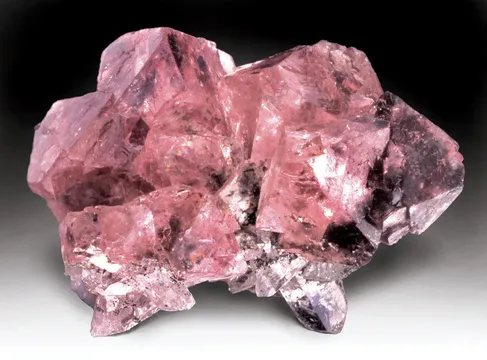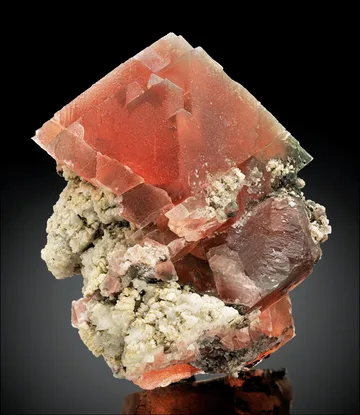
Simplon Railway Tunnel, Switzerland - Alpine locality famed for pale lilac anhydrite crystals on dolomite, a rare closed occurrence prized by collectors.
Key facts
The Simplon Railway Tunnel is one of the great accidental mineral localities of the Alps: not a mine, not a quarry, and not a place where collectors can now work a wall, but a deep railway excavation that briefly opened crystal-bearing Alpine fissures more than nine kilometers inside the mountain. Its specimens were saved from construction spoil during the driving of the tunnel between Brig in Valais and Iselle in Italy, especially from the Swiss north-section workings. To mineral collectors the name “Simplon” means, above all, anhydrite: glassy to pearly, striated, flat-prismatic crystals in pale lilac, lavender, violet, bluish, colorless, or whitish tones, commonly perched on white dolomite or ankeritic carbonate. The best pieces have the paradoxical look of Alpine cleft minerals preserved in an evaporite environment—sharp, transparent, and delicate, but born in Triassic anhydrite-bearing carbonate rocks caught up in the high-pressure architecture of the Pennine Alps.
The geological setting is as important as the beauty. The tunnel cuts through a stack of Alpine metamorphic rocks south of the Rhône Valley: gneisses, schists, quartzites, marbles, dolomitic rocks, and anhydrite-bearing Triassic horizons, all deformed into the nappe structure of the Simplon region. Where construction crossed the dolomite-anhydrite-muscovite rocks around the 9.5 km mark from the north portal, the workmen encountered the clefts that produced the classic red-violet to lilac anhydrites. Those fissures were later walled, lined, and sealed into a railway tunnel, making the locality a closed historical occurrence rather than a renewable collecting ground.
Regional View
Country View
Good Simplon specimens have a different personality from massive blue “angelite” anhydrite or evaporite-mine cleavage blocks. They are true display crystals: tabular to prismatic, often with conspicuous striation, sometimes twinned, and most desirable when the crystals stand free on a contrasting white carbonate base. Surviving examples are disproportionately held by museums, old European collections, and a few long-established private cabinets, which is why even small, clean, well-provenanced pieces are taken seriously by advanced collectors.

Photo: Wikimedia Commons
The locality’s historical pull is inseparable from the tunnel itself. The first tube of the nearly 20 km Simplon Tunnel was built at the turn of the twentieth century and opened in 1906; the second bore followed later. For decades it was the longest railway tunnel in the world, but for collectors its record is mineralogical rather than civil-engineering: a short-lived glimpse into Alpine clefts whose finest anhydrite crystals were collected, catalogued, traded, and museum-mounted while the tunnel was still a worksite.
Search for specimens: View all specimens from Simplon Railway Tunnel, Switzerland
The Simplon Railway Tunnel locality refers to minerals recovered from material excavated during construction of the railway tunnel system between Brig, Switzerland, and Iselle, Italy. The EarthWonders locality follows the classic Swiss north-section usage: Simplon Railway Tunnel, Termen, Brig, Valais, Switzerland, with the north portal near Biela east of Brig. The two tunnel tubes were driven in two main construction campaigns, 1898–1905 for the first major excavation phase and 1912–1921 for the second. The first tube was opened to railway traffic in 1906, after the project passed from the Jura–Simplon Railway era into Swiss Federal Railways control.
This is not an ore deposit in the commercial mining sense. The collectible minerals came from Alpine fissures, small mineralized seams, and cleft fillings exposed by tunneling through metamorphosed sedimentary and crystalline units. The rock package includes gneissic and schistose rocks, quartzites, marbles, dolomitic rocks, gypsum- and anhydrite-bearing Triassic horizons, and related Alpine structural slices. In collector language the important environment is the Triassic dolomite-anhydrite zone: carbonate-evaporite rocks metamorphosed and tectonically transported within the Simplon Alpine nappe system, locally opened by clefting and later sealed deep in the mountain.
The most celebrated mineralized interval lies around 9.4–9.7 km from the north portal, where Triassic dolomite and anhydrite-bearing rocks yielded the classic anhydrite assemblage. Published locality summaries place the famous red-violet anhydrite crystals around km 9.5 from the north portal; crystal drawings in early work by Preiswerk record specimens from about 7,500 m, 9,540 m, 9,560 m, and 9,573 m from the north portal, including colorless crystals with violet cores, prismatic crystals, tabular lamellar forms, and twinned white-to-pale-purple forms. EarthWonders and museum-linked records also document anhydrite with dolomite or ankerite from 9,564–9,575 m from the north portal, a range that corresponds closely to the classic productive zone.
The tunnel also cut other mineral-bearing intervals that are more important scientifically than aesthetically. Galena was recorded around 7,292–7,334 m from the north portal, with well-formed cube crystals to about 1.5 cm in association with quartz, adularia, and pyrite in the Berisal schists. Aikinite was noted between about 7,294 and 7,898 m as thin tabular to shingle-like, brass-yellow crystals only a few millimeters long, and was significant as an early Swiss cleft occurrence of the species. Siderite is recorded over long stretches, including 7,254–9,400 m in the Monte Leone nappe and 9,400–12,860 m in the Veglia zone, while smythite was recorded much farther north, around 4,641–4,646 m, as tiny plates in calcite. These occurrences rarely rival the anhydrite aesthetically, but they make the tunnel an unusually well-documented cross-section through Alpine mineralization.
The operators and construction history matter because every specimen is historical by definition. The Jura–Simplon Railway initiated the project and awarded the construction contract in 1898 to the Brandt, Brandau & Cie. tunnel-building consortium, associated with Alfred Brandt’s hydraulic rotary drilling system and the engineering firms and manufacturers that supported the work. After the Swiss railway nationalization of 1903, the Swiss Federal Railways completed the project and opened the tunnel in 1906. The second bore, completed later, expanded the railway capacity but did not create a modern collecting locality in the usual sense; the collectible material still circulates today as old specimens, museum duplicates, estate pieces, or examples preserved with antique labels.
Collecting access today is effectively closed. The productive fissures were exposed only during construction and were subsequently lined or sealed behind the finished railway infrastructure. This is an active international rail tunnel, not a field-collecting site. The only realistic collecting route is through the specimen market, institutional deaccessions where they occur, exchanges, and old collections. Provenance matters strongly: a Simplon anhydrite with an early label, museum number, collection history, or publication record is far more desirable than an unverified lavender anhydrite offered on color alone.
Anhydrite is the Simplon Railway Tunnel mineral, and the finest pieces are among the most famous anhydrites ever recovered: lustrous, striated, orthorhombic crystals ranging from colorless and very pale violet to lavender, lilac, red-violet, bluish, and opaque white, typically tabular or flat-prismatic and locally twinned. The classic material came especially from the Triassic dolomite-anhydrite rocks around km 9.5 from the north portal, with documented crystal habits from about 7,500 m and from the 9,540–9,573 m interval; some early descriptions and later locality summaries cite crystals up to roughly 30 x 10 cm, though most collectible surviving specimens are thumbnails to small cabinet pieces. Matrix specimens with white dolomite or brownish ankeritic carbonate are preferred, especially when the anhydrite is transparent, richly lilac to red-violet, sharp-edged, and visually elevated rather than lying flat in massive carbonate; ordinary pieces are paler, contacted, cleaved, or visually lost in matrix, while top pieces combine color, luster, striation, twinning or good termination, and unimpeachable old provenance.
Dolomite from the Simplon Railway Tunnel is best understood as the pale carbonate stage on which the celebrated anhydrite is displayed: white, gray, or faintly yellowish rhombohedral crystals, commonly somewhat saddle-shaped, recorded broadly through the tunnel and especially important in the Triassic carbonate-evaporite intervals that supplied the anhydrite specimens. It rarely competes with the anhydrite for attention, but fine Simplon dolomite matters when it forms a crisp, sparkling, white to cream matrix that sets off lilac anhydrite or when it appears as clean rhombohedra in the Alpine cleft assemblage with ankerite, muscovite, pyrite, gypsum, magnesite, or rare species such as dawsonite. Better pieces show distinct crystal faces, fresh color, and architectural contrast; ordinary pieces are simply dull carbonate matrix or iron-stained cleft filling without strong specimen balance.
Ankerite at Simplon appears as brownish, translucent to semi-translucent rhombohedral carbonate, either as isolated crystals or grouped crystals, with both flat and more normal rhombohedral habits reported. For collectors it is most desirable as an associated mineral on classic anhydrite specimens from the 9.5 km north-portal zone, where white dolomite and ankeritic carbonate can coat, support, or frame the lavender anhydrite crystals; EarthWonders-documented material from 9,564–9,575 m shows the classic anhydrite-dolomite/ankerite relationship. Good Simplon ankerite is not merely “brown carbonate”: it has recognizable rhombohedral form, translucency, and placement that improves an anhydrite composition, whereas lesser examples are massive, nondescript, or too visually similar to altered carbonate matrix to carry much locality significance on their own.
Beyond the three principal EarthWonders species, the Simplon Railway Tunnel has a surprisingly rich documented suite. Gypsum occurs in the north-portal sector around 9,400–9,680 m in Triassic dolomite with the anhydrite, as small drusy coatings and crystals, and in places as larger individuals. Calcite from the tunnel is notable for lilac to violet coloration and strong red fluorescence under both shortwave and longwave ultraviolet light. Celestine is recorded from about 9,738–9,770 m as colorless crystals with a pseudo-rhombohedral look. Dawsonite, from about 9,732 m in marble, is one of the locality’s great rarities: white radial spherical aggregates to about 22 mm with dolomite, pyrite, and muscovite, historically misidentified as natrolite and noted as an exceptional Swiss occurrence. Goyazite occurs near 9,500 and 9,564 m as dark yellow to brownish rhombohedra to about 2 mm on magnesite; the associated magnesite may be water-clear and prismatic. Other documented species include quartz, albite/pericline, adularia to microcline, muscovite, rutile including sagenitic forms, hematite including iron-rose habit, baryte, fluorite, galena, sphalerite, pyrite, pyrrhotite, arsenopyrite, stibnite, cosalite, aikinite, smythite, titanite, dravite to uvite tourmaline, and native sulfur. The broader Simplon pass area has type-locality minerals such as ganterite and martinandresite, but the railway tunnel itself is best regarded as a classic occurrence locality rather than a type locality for those species.
The first test of a Simplon specimen is provenance. The locality is closed, old, and famous; the best anhydrites were collected during railway construction, and the productive clefts are no longer accessible. A credible specimen should carry either an old label, a respected dealer or collection history, a museum association, a published reference, or a convincing chain of ownership. Be alert to vague labels such as “Simplon, Switzerland,” which may refer to the pass area, the Swiss north-section tunnel locality, the Italian south-section tunnel locality, or simply a regional label rewritten by a later owner. For high-value pieces, the distinction between Simplon Railway Tunnel north section, Simplon railway tunnel south section, and unrelated Alpine anhydrite localities is not pedantic—it is central to value.
Documented treatments are less the issue than condition and identity. Anhydrite has good cleavage, modest hardness, and a tendency to show edge bruising, cleavage flashes, contacted backs, or old repairs. A known Wikimedia Commons example of a classic Simplon anhydrite is explicitly described as repaired, which is not surprising for thin, tabular crystals from old collections. Repairs should not automatically disqualify a specimen, but they should be disclosed and priced accordingly. Look closely at terminations, reattached plates, glue lines along cleavage surfaces, and reconstructed matrix contact points.
The color is another point of judgment. Classic Simplon anhydrite ranges from nearly colorless to pale violet and strong lavender or red-violet. Early mineralogical work attributed the violet color to organic inclusions that disappear on heating with phosphorescence, so any “improvement” by heat would be destructive rather than beneficial. Avoid prolonged soaking, harsh cleaning, acids, ultrasonic cleaning, or heat. Dust with a soft brush or low-pressure air only, and store the specimen away from rapid humidity changes and mechanical vibration. The associated calcite may fluoresce bright red under both shortwave and longwave UV, but anhydrite itself should be handled as a display mineral, not as a laboratory curiosity.
The commonest market confusion is with other anhydrite sources. Naica anhydrite is typically blue and often massive to broad-bladed; St. Gotthard and other Swiss Alpine tunnel anhydrites may share an Alpine look but have different labels and collecting histories; Norwegian and other European violet anhydrites can mimic the color but not the Simplon provenance. The strongest Simplon pieces combine the correct old locality, tabular striated habit, lilac to red-violet color, carbonate matrix, and early documentation. A small but sharp and well-provenanced Simplon crystal can be more collectible than a larger unverified lavender anhydrite.
Market availability is thin. Museum-quality examples seldom appear, and many important pieces reside in institutional collections such as the Natural History Museum Basel, Yale Peabody Museum, Harvard, Bryn Mawr, and historic European collections. When fine specimens do surface, they are often treated as European classics rather than simply as species examples. The best buying opportunities are usually old collection thumbnails and miniatures: a single sharp lavender crystal, a small crystal on dolomite or ankerite, or a specimen with a pre-war label that documents the tunnel origin.
The Simplon story begins with a paradox: the mineral locality exists because engineers wanted to make the mountains disappear from the railway timetable. Before the tunnel, the Simplon route meant the old Alpine crossing between Brig and Domodossola, a pass road whose importance had already been recognized by Napoleon. Between 1801 and 1805 the pass was transformed into a military road, and by the nineteenth century it had become one of the major Alpine routes. But a railway climbing high over the pass would have been slow and expensive to operate. The solution chosen was a base tunnel—lower, longer, and far more ambitious—driven under the mountain rather than over it.
The work was planned with almost obsessive attention to alignment. Small observatories were built in line with the tunnel axis at the portals, equipped with telescopes and measuring instruments so that the headings, driven from opposite ends of a mountain nearly 20 km wide, would meet in the dark. Because the railway approaches curved near the portals, straight sighting galleries were made simply to preserve accurate lines of sight into the tunnel. To a mineral collector, it is worth pausing over that image: the same precise geometry that allowed two construction fronts to meet beneath the Alps also gave us the meter-by-meter specimen records—7,500 m, 9,540 m, 9,560 m, 9,573 m—from which Simplon anhydrites are still discussed.
The double-tunnel concept was chosen partly because the mountain was too hot. Engineers expected the rock temperature to rise dangerously, and later accounts record temperatures exceeding 50 C. The plan used two parallel single-track bores, separated by about 17 m and connected by crosscuts at regular intervals. During construction, one gallery could serve as a vast ventilation and service airway while the other advanced. Contemporary engineering descriptions speak of 50 cubic meters of air per second driven into the works, water sprays and cooling lines, and a contract requirement that working-place temperatures not exceed 25 C. At one point engineers calculated that about 1,500,000 calories per hour had to be removed from the rock, the broken muck, and the tunnel walls. In winter the ventilation air could take much of that load; in summer, the cooling water had to do the hard work.
The drilling machinery was itself a landmark. Alfred Brandt’s hydraulic rotary drilling system used water pressure rather than the hammering action of older compressed-air drills. A surviving Brandt drill from the Simplon work, preserved by the Swiss Museum of Transport, gives the scale of the operation: a metal-and-wood machine about 500 x 200 x 150 cm, mounted with its carriage and counterweight, working at roughly 100–150 atmospheres of water pressure. The hardened steel tubular bit, with a coarse-toothed crown, was forced steadily into the rock while water flushed the crushed material from a borehole about 1.2 m deep. In the Simplon headings, three such drills could be mounted on a column at the face, and a round required 9 to 12 holes before the dynamite charge could be fired.
The rhythm of the work was called an “attack.” Drill, charge, blast, clear the broken rock, move the drills back in. One attack took about six hours and advanced the heading roughly 1.25 to 1.5 m. Crews worked day and night in eight-hour shifts, on Sundays as well as weekdays, stopping only for the first day of Christmas, Easter, Pentecost, and for the feast of Saint Barbara, patroness of miners and workers with explosives. Those repeated attacks—thousands of them—are the reason any collector today can hold a Simplon anhydrite crystal. Somewhere in that sequence of blasted headings, the tunnel intersected sealed Alpine clefts in the anhydrite-dolomite rocks, and workmen or engineers had the presence of mind to save mineral specimens before the masonry lining erased the pockets forever.
On 24 February 1905 at 7:20 in the morning, the final partition was pierced. A Danish contemporary account described the last separating wall as only 2.5 m thick when the workers from the south side broke through. The trains would not run immediately—the tunnel still had to be finished and opened formally—but the mountain had been crossed. For mineral collectors, the date also marks the closing act of the specimen-producing period. The clefts that had produced red-violet anhydrite, dolomite, ankerite, gypsum, and rarities such as dawsonite and goyazite were no longer natural cavities available to chance discovery; they became brief interruptions in an engineering project, then disappeared behind brick, stone, concrete, and rail traffic.
The afterlife of the specimens is almost as compelling as their recovery. Natural History Museum Basel notes that its Swiss mineral collection includes around 800 objects obtained from the Simplon railway tunnel. Yale Peabody preserves an anhydrite formerly in the George Jarvis Brush collection and Ward’s Natural Science Establishment. Bryn Mawr holds a colorless to pale-purple specimen from the George Vaux collection. Harvard has catalogued Simplon anhydrite crystals, and the Musée de Minéralogie Mines Paris – PSL holds a small anhydrite with dolomite/ankerite acquired in May 1918. These are not merely pretty old minerals; they are surviving witnesses to a vanished underground moment, each one a fragment of Alpine cleft mineralization rescued from a railway bore before the tunnel walls were sealed.