Fibbia, Switzerland, Alpine cleft locality famed for hematite iron rose rosettes on adularia, with sculptural, metallic-black crystals prized by collectors.
Key facts
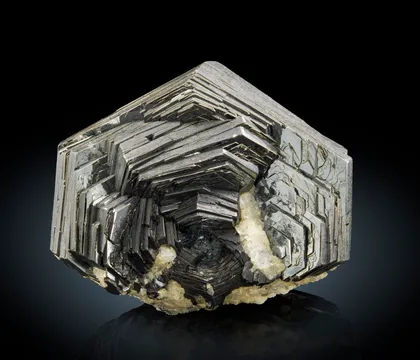
Fibbia is one of the classic Alpine cleft localities of the St. Gotthard region, a mountain locality rather than a mine, perched above the Gotthard Pass in Ticino and long revered by collectors for hematite “iron roses” on adularia. The appeal is not simply that hematite occurs here, but that the Fibbia clefts produced a recognizably Alpine style: compact metallic-black rosettes, thick tabular plates, brilliant pseudohexagonal crystals, and specimens in which the hematite sits cleanly on pale adularia, smoky quartz, muscovite, stilbite, rutile, or pale altered granite-gneiss matrix. In the best pieces, the rose is not just a cluster of plates but a poised, sculptural object—dark, lustrous, and architectural against a white feldspar base.
Geologically, Fibbia belongs to the central Gotthard massif, where Variscan granitoids and granitic gneisses were overprinted by Alpine deformation and later opened by fissure systems. These Alpine clefts are the key to the specimens: open cavities in fractured crystalline rock allowed quartz, adularia, hematite, rutile, apatite, zeolites, phenakite, xenotime-(Y), bazzite, and rare complex oxides to crystallize with the freedom of form that collectors prize. Scientific work on the area recognizes multiple vein generations, with retrograde Alpine mineralization and fluid evolution playing a central role in the final cleft assemblages.
Regional View
Country View
Historically, Fibbia stands among the great Swiss hematite localities because its specimens entered both private Strahler collections and institutional displays. The name “Fibbia” or “La Fibbia” on an old label may cover a broader Gotthard collecting district around the mountain, its flanks, and neighboring cleft zones; collectors should therefore read old labels carefully. Still, when the locality is correct, a Fibbia hematite rose has a look that is difficult to forget: silvery-black to gunmetal plates, often thick and sharply edged, sometimes sprinkled or overgrown with rutile, and most desirable when perched freely on clean adularia rather than buried in broken matrix.

Photo: Wikimedia Commons

Photo: Wikimedia Commons
Search for specimens: View all specimens from Fibbia, Switzerland
Fibbia is best understood as an Alpine cleft locality on and around the Fibbia mountain, southwest of the Gotthard Pass, in the Fontana–Airolo area of Leventina, Ticino. It is not an ore mine with mine levels, hoisting records, or tonnage production. The “deposit” is a network of mineralized fissures in Fibbia granite, Fibbia granitic gneiss, and associated Gotthard crystalline rocks. These clefts formed and reopened during Alpine deformation and retrograde metamorphism; later fluids deposited quartz, adularia, hematite, rutile, muscovite, zeolites, apatite, and rare accessories in open spaces. This is why the best specimens show free-standing, sharply formed crystals rather than massive ore textures.
The broader Gotthard massif is a compact but geologically intricate belt of pre-Variscan crystalline basement intruded by Variscan granitoids. In the pass region, the Fibbia and Gamsboden granites belong to an older intrusive phase, while Rotondo, Monte Prosa, and Winterhorn-aplite granites belong to a younger one. At Fibbia, the productive specimen zones are tied to the fractured granite-gneiss and to cleft-rich slopes rather than to a continuous vein that can be followed like an ore lode. Field and laboratory studies distinguish several vein generations in the Fibbia area; mineral assemblages change through time from earlier quartz–feldspar stages through later hematite-, chlorite-, muscovite-, rutile-, and zeolite-bearing stages.
The famous collecting ground includes the east and south sides of La Fibbia, the southwest flank, the sector from the summit area toward Pizzo della Valletta and the Gotthard hospice, the Laghi Scuri side, and nearby Gotthard cleft zones that have historically been labelled simply “Fibbia” or “Gotthard.” The east and south sides are especially important in older locality descriptions: adularia is common there, often as excellent crystals and twins, and the iron roses are described as thick-tabular, compact, closed to half-open rosettes, sometimes occurring in aggregates and sometimes carrying rutile.
There was no conventional mining history in the sense of ore extraction, but specimen production has a long Strahler history. The area was already known in the nineteenth century, when Kenngott described minerals from the Fibbia and associated “Gotthard iron roses.” Later collecting intensified where natural fissures, road construction, and tunnel work revealed fresh clefts. Surface-road work between Fibbia, Val Tremola, and the future Gotthard road-tunnel approach in the 1960s exposed many mineralized clefts between Fibbia and Monte Prosa. One 1962 cleft yielded hematite roses with sheaf-like stilbite. Work near the southern portal of the Gotthard road tunnel in the early 1970s again brought excitement, with sharp hematite roses and associated Alpine cleft minerals appearing from numerous pockets.
The classic specimen assemblage is hematite var. iron rose with adularia, quartz to smoky quartz, rutile, muscovite, stilbite, chabazite, fluorapatite, phenakite, bazzite, xenotime-(Y), anatase, albite, and chlorite. Fluorapatite from Fibbia can be unusually fine for Switzerland, with colorless to violet crystals and some pinkish material from the south side; violet apatite is noted as fading in daylight, so old specimens may be paler than when found. Xenotime-(Y) may reach remarkable size for Alpine material, and the locality has also yielded tiny but important beryllium and rare-element minerals.
Access today must be treated as regulated Alpine collecting, not casual rockhounding. In Canton Ticino, mineral, rock, and fossil collecting of scientific interest is subject to cantonal authorization, with annual, weekly, and other permit categories administered through the cantonal natural history authorities. Additional local restrictions may apply through municipalities, patriziati, avalanche-protection zones, military firing areas, and construction sites. The terrain itself is serious: some Fibbia east-flank routes are recommended only for climbers with suitable equipment, and older descriptions explicitly warn against visiting difficult ground alone. Even for a collector with permission, Fibbia is a high-Alpine, weather-sensitive locality where loose blocks, steep grass, old snow, and unstable cleft debris are part of the problem.
Fibbia hematite is the locality’s signature mineral, occurring chiefly as “Eisenrosen”—iron roses—made of lustrous, pseudohexagonal tabular crystals of hematite, from small compact rosettes to cabinet-scale groups; documented examples include miniatures around 4.6 x 3.0 x 2.6 cm with individual crystals to about 1.4 cm, tunnel-era roses to about 4 cm, and major museum-class roses as wide as 9 cm. The best pieces show a thick-tabular, sharply edged, metallic black to gunmetal rose perched freely on white to translucent adularia or pale granitic matrix, ideally with bright crystal faces, an undamaged rim, and a balanced composition; rutile, stilbite, quartz, muscovite, chabazite, fluorapatite, bazzite, and xenotime-(Y) are among the important associations. Ordinary Fibbia pieces may be embedded, contacted, dull, or merely bladey, while first-rank specimens have the unmistakable tension of an Alpine rose sitting proud of the matrix with mirrorlike faces and little distraction from chlorite or broken feldspar.
For Fibbia, collector references to “iron” should be read with care: the famous “iron rose” is hematite, Fe2O3, not native iron, and the published mineral lists for the locality document hematite var. iron rose rather than native Fe as a species. Specimens categorized under Iron from Fibbia are therefore best evaluated as iron-rose hematites in the old Swiss-German collecting sense: black, metallic, tabular hematite rosettes on adularia, quartz, muscovite, stilbite, or pale cleft matrix, generally thumbnail to miniature and small cabinet size, with the premium placed on sharp plate edges, a complete rosette outline, free-standing placement, high luster, and a trustworthy Fibbia or Gotthard-area provenance. Pieces sold only as “iron” without clarification deserve special label scrutiny, because true native iron would be a very different and unsupported claim for this locality.
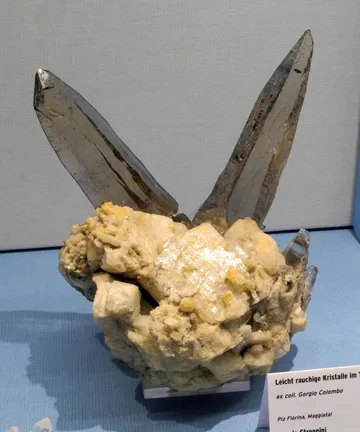
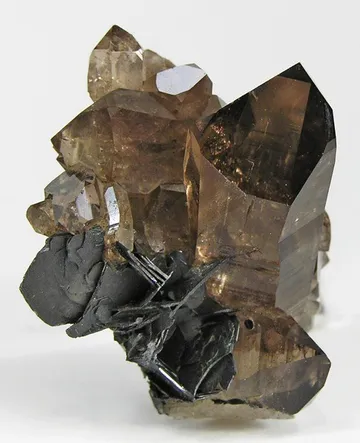
Beyond hematite, Fibbia is unusually rich for a small Alpine cleft field. Adularia is fundamental and can form superb twins, fourlings, Baveno twins, and rows of translucent to milky crystals. Quartz ranges from clear to lightly smoky, with darker smoky quartz uncommon and quartz groups less typical than isolated crystals; some material trends toward the Ticino habit on the south side. Rutile occurs in quartz and on hematite, often as golden to reddish fibers or tufts rather than classic sagenite webs. Fluorapatite is locally important and may be colorless, violet, or pinkish; chabazite, stilbite, heulandite, laumontite, albite, muscovite, chlorite, anatase, titanite, phenakite, bertrandite, bazzite, aeschynite-(Y), xenotime-(Y), cleusonite, crichtonite, dessauite-(Y), and senaite broaden the suite. Historically, “Hessenbergit” was introduced from tiny crystals found on and near Gotthard iron roses, but it is now treated as bertrandite rather than a valid separate species; “Wiserin” or “wiserine” is likewise a historical name, tied in older literature to xenotime or anatase confusion rather than a modern valid Fibbia species.
The first authenticity issue is nomenclature. “Iron rose,” “Eisenrose,” “Iron,” and “hematite rose” are often used loosely on labels and in trade descriptions. At Fibbia, the collectible mineral is hematite. A label implying native iron should be treated as a categorization or translation problem unless independently analyzed. The second issue is locality breadth. Old labels reading “Fibbia,” “La Fibbia,” “Gotthard,” “St. Gotthard,” or “Tessin” may refer to Fibbia proper, neighboring Fibbia slopes, Alpe di Fieud, Lucendro, Monte Prosa, or road/tunnel clefts in the wider pass district. That does not automatically make a specimen bad, but it matters: advanced collectors should preserve all old labels and prefer pieces with specific provenance.
Documented fakes are a real concern in the iron-rose world. The celebrated “Eisenrose vom Ritterpass,” long considered one of the great Swiss Alpine mineral objects, was later shown by X-ray imaging and tomography to be an assembled object made from individual hematite plates, adhesive, and internal metal supports. A genuine large Fibbia iron rose in the Naturhistorisches Museum Bern was used for comparison; unlike the fake, it showed homogeneous hematite. The lesson for Fibbia collectors is practical: large, improbably open roses on matrix should be examined for glued petals, repeated plate orientation, hidden supports, unnatural gaps filled with fragments, suspicious matrix contact, and modern repairs concealed under iron-stained debris.
Condition is the main market separator. Fibbia hematite plates are hard enough to survive, but rose edges chip readily, and the contact between hematite and altered granite, adularia, or zeolite-coated matrix can be fragile. Check the perimeter of every plate under magnification. Slight peripheral bruising is common; a fully complete rosette with undamaged bright edges is far less common. Matrix pieces may be trimmed, stabilized, repaired, or mounted; hot glue or acrylic stands are not unusual for display, but structural repairs to the rose itself should be disclosed.
Cleaning must be conservative. Hematite can be bright and durable, but associated adularia, stilbite, chabazite, chlorite seams, and altered cleft matrix may be vulnerable to aggressive acids, ultrasonic cleaning, or heavy mechanical work. Violet and pinkish fluorapatite from Fibbia and nearby Gotthard clefts is noted for possible fading in daylight, so apatite-bearing pieces should be stored away from prolonged strong light. Rare complex oxides such as cleusonite and related crichtonite-group minerals are analytical species, not visual certainties; do not accept a precise name in that group unless there is analytical support.
On the market, Fibbia is available but not common in top grade. Small hematite roses, adularia pieces, and mixed Alpine cleft specimens appear periodically from European dealers, old Swiss collections, and marketplace listings. Fine, centered roses on clean adularia, large cabinet specimens, rutile-rich pieces, and examples with bazzite, phenakite, xenotime-(Y), or unusual apatite associations are much scarcer. The highest-end Fibbia specimens compete with the best Alpine hematite from Lucendro, Binntal, Cavradi, and other Swiss localities, but Fibbia’s thick, compact rosettes on adularia give it a distinctive collecting identity.
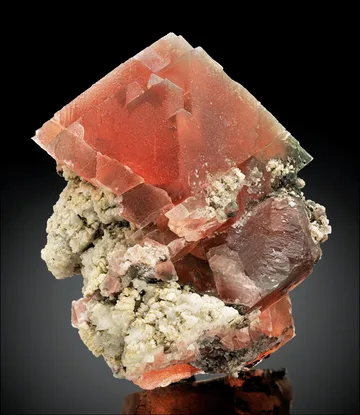
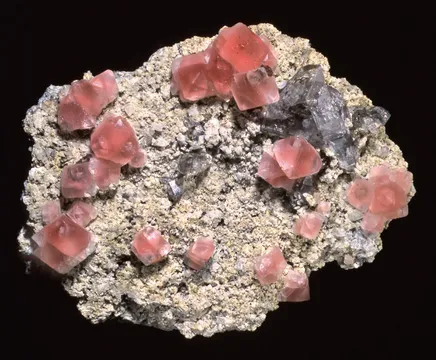
The modern Fibbia story has a construction-site prologue. Between 1962 and 1964, a surface road was driven from Fibbia through Val Tremola toward the line that would serve the Gotthard road-tunnel approach. Blasting did what generations of Strahlers hoped weather would do: it opened fresh clefts. Between Fibbia and Monte Prosa, pockets appeared carrying roughly fifteen species—fluorapatite, rutile, titanite, stilbite, phenakite, pink fluorite, and hematite among them. One 1962 cleft became especially memorable because the iron roses were dusted with sheaf-shaped stilbite, the kind of association that changes a specimen from merely classic to unmistakably local.
The name most strongly attached to Fibbia iron roses is Bruno Schaub-Gottschalk, the veteran Strahler from Steinerberg. His Fibbia work was not a weekend anecdote but a career of hard Alpine persistence. Contemporary accounts describe him working the La Fibbia locality for more than thirty years, finding iron roses, adularia, stilbite, bazzite, xenotime, apatite, smoky quartz, and, on one occasion, pink fluorite and phenakite. One account emphasizes the scale of effort behind the best clefts: Schaub spent three years clearing overlying debris before he could properly begin collecting. That is the hidden labor behind a perfect rose on a collector’s shelf—the specimen may look as if it simply blossomed, but the mountain made him remove the mountain first.
The great Schaub iron rose belongs to the mythology of Swiss hematite. A large rose found by Bruno Schaub at Fibbia in August 1977 entered the Naturhistorisches Museum Bern as a benchmark of authenticity, later used in direct comparison with the famous Ritterpass fake. Another account of the Gotthard “find of the century” describes a magnificent cluster of intergrown roses on matrix, 9 cm across, collected by Schaub-Gottschalk in 1979 from a cleft on Alpe di Fieud. Whether the label reads Fibbia, La Fibbia, Fieud, or Gotthard, the deeper story is the same Strahler culture: a known mountain, years of patient work, and a single cleft that suddenly produces a specimen large enough to become part of the literature.
Then there is the cautionary tale every iron-rose collector should know. The “Eisenrose vom Ritterpass” once stood among the apparent treasures of the Bern museum’s gem and mineral display, and older publications reproduced it as one of the most beautiful Alpine iron roses. Its history was already cloudy: it was said to have been acquired around 1932 after passing through Germany and Belgium, reportedly for a surprisingly low price, and no archive search found solid supporting documentation. In 1990 it was recognized as a fake and withdrawn from display. When EMPA later examined it with industrial X-ray tomography, the deception became anatomical. The rose was not a natural rosette at all; it contained individual hematite plates, adhesive, and two internal metal supports, the whole construction set into an artificial cavity in the base rock and camouflaged with mineral fragments. Beside it, the genuine Fibbia rose gave the quiet answer collectors want to hear: homogeneous hematite, no hidden architecture, no trick.