






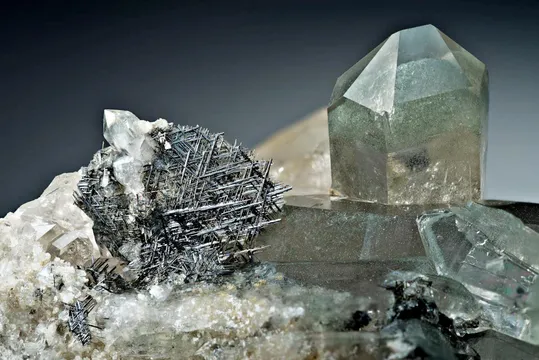
Vorderer Zinggenstock, Switzerland — Alpine cleft locality famed for historic quartz finds, smoky quartz, and pink fluorite octahedra, prized by collectors.
Key facts
Vorderer Zinggenstock is one of the great names in Alpine cleft mineralogy: not a conventional mine, but a high-granite mountain locality in the Grimsel–Oberaar sector of the Aar Massif where open fissures in Central Aar Granite and related granitoids yielded some of the most storied quartz and fluorite specimens in Switzerland. Its collecting fame rests on two very different chapters. The first is the immense rock-crystal discovery of 1719, a find so large that early accounts speak in tens of tons and whose surviving clear crystals are now among the oldest mineral specimens in the Natural History Museum Bern. The second is the Rufibach cleft, opened in the 1960s on the north slope, which produced the unmistakable modern collector’s look of the locality: glassy smoky quartz and gwindels, commonly on pale granite matrix, with raspberry-pink fluorite octahedra and modified, packeted fluorite surfaces.
The best Vorderer Zinggenstock specimens have the austerity collectors prize in Swiss Alpine material: hard, bright luster; undramatic but perfectly balanced granite matrix; smoky quartz that can be almost water-clear in zones despite the brown tone; and fluorite that supplies a concentrated flash of pink against quartz, adularia, chlorite, calcite, or bleached rock. The locality’s importance is therefore historical as well as aesthetic. It links 18th-century crystal extraction for the Milan lapidary trade, the classic Strahler culture of Haslital and Grimsel, museum-scale Alpine quartz, and a small number of benchmark fluorite–smoky quartz combinations that still define the Zinggenstock style.
Regional View
Country View
The mountain is also unusually well documented for an Alpine cleft locality. Historic descriptions, Caspar Wolf’s 1775 Alpine painting, a 1974 Swiss Federal Supreme Court decision involving the Rufibach cleft, and modern rediscovery work all converge here. The result is a locality whose specimens can often be read not only mineralogically but historically: old “Bergkristall” for the 1719 cavern, smoky quartz and pink fluorite for the Rufibach system, and scattered summit-area quartz varieties such as amethyst and sceptre quartz for the broader Vorderer Zinggenstock record.

Photo: Arkelin/Wikimedia Commons
Search for specimens: View all specimens from Vorderer Zinggenstock, Switzerland
Vorderer Zinggenstock belongs to the Zinggenstöcke of the Oberaar lake area, in the municipality of Guttannen, canton Bern. Mineralogically it is best understood as an Alpine cleft locality in the crystalline Aar Massif rather than as a mine. The host rocks are part of the Grimsel crystalline terrain, dominated regionally by late Variscan plutonic rocks including Central Aar Granite and Grimsel Granodiorite, subsequently deformed, uplifted, fractured, and opened during Alpine tectonism. In that setting, tension fissures and reopened fracture systems became mineral traps: silica-rich fluids deposited quartz, and later or associated pulses introduced fluorite, feldspar, carbonate, chlorite, sulfide traces, and beryllium minerals in selected pockets.
There are no ore bodies here in the usual mining sense. The valuable “ore” was crystal-bearing open space: clefts in granite, some small and others large enough to be treated almost like short underground workings. The historic 1719 crystal cavern was an extraction site for clear quartz, chiefly rock crystal, while the Rufibach cleft was a later, specimen-producing fissure system noted for smoky quartz and pink fluorite. The Fahner and Streun cleft, on the ridge between Vorderer and Hinterer Zinggenstock, also yielded very dark smoky quartz and raspberry-red fluorite in the second half of the 1950s. Summit-area records add quartz varieties including amethyst and sceptre quartz, but the classic collector association remains smoky quartz with pink fluorite from the Rufibach material.
The 1719 discovery changed the reputation of the Haslital. Earlier quartz collecting in the Bernese Oberland was known, but the great Zinggenstock cavern made the area a serious crystal district. The find is traditionally credited to the Strahler Peter Moor, his three brothers, and Melchior Brügger. Contemporary and later reports differ in tonnage, giving roughly 20 to 150 metric tons of quartz recovered; even the lower end represents an immense Alpine cleft. The cleft was worked into the 1730s, and much of the best clear material was sold southward to crystal grinders in Milan. The material was sorted by quality: flawless clear “Mailänderware,” lower-grade cracked or cloudy crystal, and smaller fragments or waste. Three large surviving crystals, taken as tax payment and deposited in Bern in 1721, passed eventually into the Natural History Museum Bern; together they weigh about 140 kg, and the largest is 55 cm high.
The old cavern was later visited by scholars, artists, and curious travelers, but the exact site was eventually lost. Nineteenth-century glacier advance and later moraine cover obscured the ground, and published heights and interpretations became unreliable. In 2019, Thilo Arlt and Matthias Bolliger reidentified the historic “Krystallgewölbe” after comparing documentary sources, early images, and field evidence. Their work placed the cavern at about 2015 m elevation and measured a system roughly 40 m long, with a front part up to about 8 m wide and more than 2 m high. Dendrochronological work on wooden support elements confirmed activity in the historically reported period.
The Rufibach cleft belongs to the modern collecting era. Ernst Rufibach and his brother Hans opened the cleft on the north slope of the Vorderer Zinggenstock in the 1960s, and documentary sources describe a large, difficult, ice-affected fissure system that extended tens of meters into the rock. Over years of work, the family and helpers recovered more than four tons of material, predominantly smoky quartz, including gwindels, rock crystal, faden quartz, and associations with abundant pink fluorite, minor adularia and calcite, and rarer pyrite and phenakite. The cleft was demanding and hazardous: ice-filled clay, water, unstable roof plates, theft attempts, and the weight of specimen recovery all shaped its history. Much of the Rufibach material remained important locally, forming the basis for displays in Guttannen and, more recently, for the preserved Rufibach collection associated with the kriSTALL Guttannen project.
Collecting access today must be treated conservatively. The Grimsel–Oberaar properties have a long relationship with Kraftwerke Oberhasli AG, and the Swiss legal history of the Rufibach cleft makes clear that crystals in an occupied or controlled cleft are not ownerless objects. Modern collecting in Bernese high-alpine protected or regulated areas may require landowner consent and cantonal authorization, particularly where tools, drilling, organized collecting, or work in a specific cleft is involved. The locality itself is steep, high, glaciated or recently deglaciated in parts, and geologically unstable; the classic Rufibach fissure system is not a casual collecting site. For collectors, the practical route to Vorderer Zinggenstock material is the market, old collections, museums, and documented estate material rather than field work.
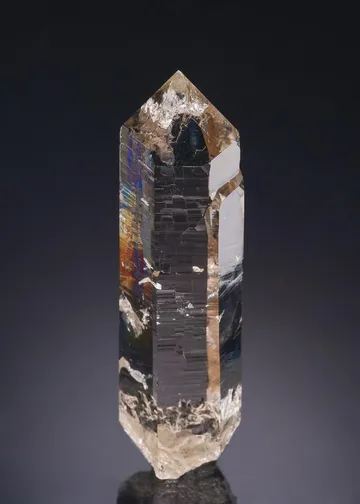
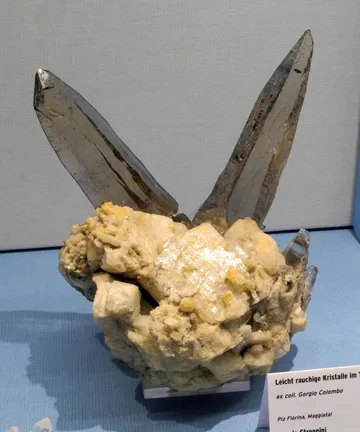
Smoky quartz from Vorderer Zinggenstock is the locality’s defining modern collector species, especially from the Rufibach cleft, where sharp prismatic crystals, doubly terminated individuals, plates on pale granite, and gwindels were recovered from an ice- and clay-filled fissure system. The best crystals are lustrous, transparent to gemmy in zones, and range from brown through very dark smoky tones; documented cabinet pieces show individual crystals around several centimeters, while larger single crystals from the broader Zinggenstock record reach well into the hand-size range. Good pieces separate themselves from ordinary Alpine smoky quartz by a combination of intact tips, minimal frost cracking, water-clear smoky interiors, natural matrix, and — at the highest level — an associated pink fluorite octahedron or a clean gwindel twist rather than a loose, repaired, or heavily bruised crystal.
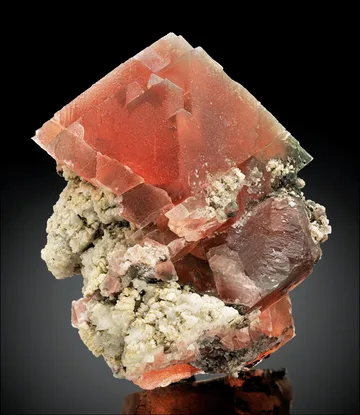
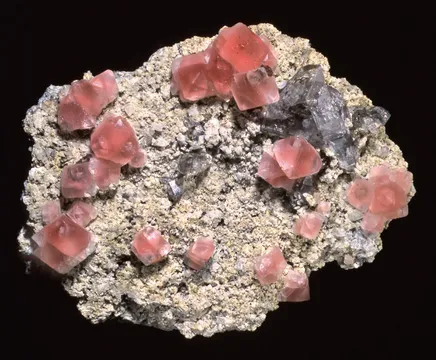
Fluorite from Vorderer Zinggenstock is famous chiefly as the pink to raspberry-pink Rufibach material, usually octahedral or modified octahedral, commonly with complex packeted or multifaceted surfaces and, in some pieces, violet edges. Most crystals are modest in size — commonly measured in millimeters to a few centimeters, with exceptional documented crystals to about 3 cm on edge — but they can be visually dominant because of the strong pink color against white to grey granite, smoky quartz, adularia, chlorite, or calcite. The most desirable pieces are not simply the largest fluorites; they are intact, well-placed crystals with strong color, recognizable Zinggenstock surface texture, and a balanced association with smoky quartz rather than isolated, abraded fragments or pale, indistinct coatings.
Quartz at Vorderer Zinggenstock spans the whole history of the locality: the monumental clear rock crystals of the 1719 cavern, smoky quartz and faden quartz from the Rufibach cleft, gwindels from the broader Zinggenstöcke cleft systems, and summit records of amethyst and sceptre quartz. The 1719 rock-crystal material was valued for clarity and size, enough that the best pieces entered the Milan lapidary trade and three great crystals survived as museum specimens in Bern. For collectors today, “quartz from Vorderer Zinggenstock” should be judged by the kind of quartz represented: clear rock crystal carries historical weight, smoky quartz carries the Rufibach identity, gwindels carry Alpine structural interest, and small amethyst or sceptre quartz specimens are locality rarities rather than the main production.
Other documented minerals from Vorderer Zinggenstock and its sublocalities include calcite, adularia or K-feldspar, chlorite-group minerals, pyrite, phenakite, and milarite. Phenakite is a notable rarity in the Rufibach assemblage, while milarite is recorded from Vorderer Zinggenstock/Zinggenstöcke material as small crystals rather than showy cabinet specimens. No verified type-locality mineral is documented from Vorderer Zinggenstock in the records consulted; its mineralogical importance instead lies in exceptional Alpine quartz production, the pink fluorite–smoky quartz association, and the unusually rich historical documentation of specific clefts.
The primary authenticity issue with Vorderer Zinggenstock specimens is locality precision. Labels may read “Zinggenstock,” “Rufibach,” “Rufibachkluft,” “Grimsel,” “Haslital,” “Bernese Oberland,” or simply “Switzerland.” These are not equivalent on the collector market. A pink fluorite on smoky quartz from the Rufibach cleft is more specific — and usually more desirable — than a general Grimsel smoky quartz. Conversely, the name “Zinggenstock” is sometimes used broadly for Zinggenstöcke material, including clefts not exactly on the Vorderer Zinggenstock. Old labels, provenance through the Rufibach family, Museum Kristella, Kristallmuseum Guttannen, or established Alpine dealers, and consistency with the known matrix and paragenesis all matter.
The best-recognized Zinggenstock fluorites are pink, commonly octahedral to modified octahedral, with packeted or complex surfaces. Brightly colored fluorite on smoky quartz from other Alpine localities can be confused with it, but Rufibach pieces tend to have a distinctive combination of pale leached granite matrix, smoky quartz, adularia or chlorite, and compact pink fluorite crystals. Serious collectors should be alert to repaired smoky quartz crystals, glued fluorite crystals, added fluorite on quartz, or specimens rebuilt from cleft fragments. Repairs are not inherently disqualifying in Alpine material, but they should be disclosed and priced accordingly.
Condition is a major factor. Many Zinggenstock smoky quartzes have internal frost cracks, healed contacts, small bruises at terminations, or edge chips from extraction and transport. This is partly a product of high-alpine cleft conditions: ice, clay, water, unstable roof plates, and the need to bring heavy plates down dangerous terrain. Clean tips, unrepaired attachment points, intact fluorite corners, and an undisturbed matrix relationship are premium features. Fluorite edges and octahedral points are vulnerable, and even small chips can significantly affect value because the crystals are usually not large.
There is also a documented historical date problem. Some dealer labels and marketplace descriptions describe Rufibach-pocket material as “early 1960s” or even as a 1962 find, while legal and locality records identify Ernst Rufibach’s major Zinggenstock smoky-quartz cleft discovery as 1966. A specimen is not automatically wrong because an old label carries a generalized date, but collectors should distinguish between a precise discovery date, a period of extraction, and a later collection or sale date.
Vorderer Zinggenstock material is not common on the market. Small smoky quartz specimens appear periodically, but fine combinations with pink fluorite, intact gwindels, or clear provenance are scarce. The classic Rufibach fissure is a finite historical source, and the preservation of major material in family and museum contexts further limits supply. Expect strong competition for balanced miniatures and small cabinet specimens with vivid pink fluorite, and a substantial premium for pieces that are unrepaired, accompanied by old documentation, or unmistakably from the Rufibach cleft.
The first great Zinggenstock story begins with water. In 1719, several men from Oberhasle were working about 50 feet — roughly 15 meters — from the hidden cavern, blasting hard granite in search of crystal. According to the account later quoted by Kasthofer, one worker took shelter near the still-concealed void and noticed that each blast made a fine jet of water spurt from a crack. They shifted the drill holes toward that sign. When the imprisoned water escaped through the broken walls, the crystal treasure flashed into view. Later tradition named the finders as Peter Moor, his three brothers, and Melchior Brügger. The cavern they opened would become one of the foundational events in Haslital crystal history.
The 1719 cavern quickly became more than a working cleft. It became a destination, a subject for naturalists, and eventually a problem of memory. In 1722, Moritz Anton Cappeler visited the area and drew the Unteraar Glacier, the Zinggenstock, and the crystal workings. In 1775, the Alpine painter Caspar Wolf traveled into the Grimsel world; a later reassessment of his painting of the crystal cave became one of the keys to relocating the lost site. By the 19th century, glacier advance and moraine cover had reshaped the terrain enough that the exact position slipped from reliable knowledge. The cavern had been famous, but the mountain had swallowed the address.
When Arlt and Bolliger reexamined the case three centuries later, one clue was that the often-cited elevation did not make sense. A supposed site around 2260 m seemed implausible in the field. The old painting, historical descriptions, and landscape relationships pointed lower, closer to the former glacier. In 2019 they found the “Krystallgewölbe” again at about 2015 m. Inside and around it were the details that made the old accounts tangible: support timbers, the watercourse described in the chronicles, a large worked cavern, and dendrochronological evidence tying the wood to the historical period. A lost 1719 Alpine crystal mine had become an archaeological locality.
The Rufibach chapter is more recent and more tragic. Ernst Rufibach and his brother Hans opened a major smoky-quartz cleft on the north slope of the Vorderer Zinggenstock in the 1960s. The system ran deep into the granite and was large enough to be worked for years, but it was not a romantic hollow lined with easy crystals. Quartz groups were locked in frozen clay and fluorite-rich sand. They first had to be thawed, then cleaned of dust and stone. Progress was slow enough that Rufibach “occupied” the cleft in traditional Strahler fashion by leaving his tools there, later adding an iron door built into the rock to keep out “Wilderer,” or poachers.
The same cleft later entered Swiss legal history. On 28 August 1970, while Rufibach and a colleague were in the cleft, a man named Hadorn came by with his two sons during a mountain walk. Rufibach showed the boys the cave and gave them small pieces of smoky quartz. Two weeks later, on 11 September 1970, Hadorn returned with Bruchez. They set out around 10 p.m., reached the cleft after about two hours, broke open three padlocks, loosened screws, entered the cave, and took both loose crystal pieces and material broken from a mineral group. The case eventually reached the Swiss Federal Supreme Court, which held that crystals in such a controlled cleft were not ownerless and that general tolerance of Strahler activity did not authorize violation of established Strahler rules or entry into an occupied, secured cleft.
The human cost of the Rufibach work was far greater than any court case. In 1971, during the recovery of a large, heavy specimen down steep bedrock, a rock avalanche struck the workers. Five people were killed: Hans Rufibach Sr., his twin sons Andreas and Alfred, and the befriended couple E. and L. Zeige. The tragedy is inseparable from the locality’s modern reputation. Many of the specimens collectors admire — smoky quartz plates, gwindels, fluorite combinations — came from a place where beauty, technical skill, family labor, theft, danger, and grief were all present in the same cleft.
_02.jpg)