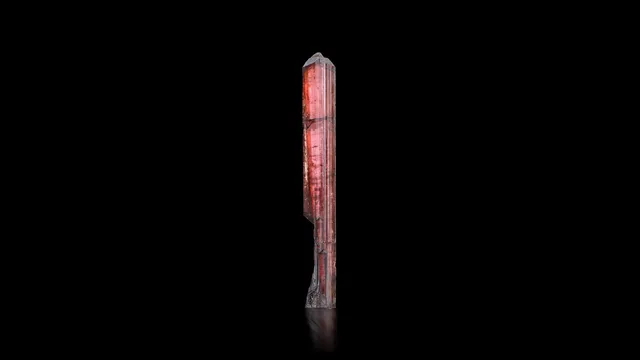
A collector's guide to Shengus, Pakistan: its geology, mining history and notable minerals, illustrated with the 375 specimens documented from this locality on EarthWonders.
Key facts
Shengus—often spelled Shingus on older labels—is one of the classic pegmatite names of northern Pakistan, a village locality on the Gilgit–Skardu Road in Roundu District where the Indus cuts hard through the Nanga Parbat–Haramosh syntaxis. For collectors, its importance is not as a single named mine but as a pegmatite district: numerous complex granitic pegmatites around the village and nearby tributary valleys have yielded aquamarine, spessartine, schorl, albite, muscovite, topaz, fluorapatite, elbaite, cassiterite, beryl varieties, and a suite of rarer Be-, Li-, Cs-, Ta-, and phosphate minerals. The geological setting is part of the Indo-Pakistan plate margin, where Precambrian gneisses of the Nanga Parbat complex and associated late granitic intrusions are exposed near rocks of the Kohistan island arc; in practical collecting terms, that means pegmatite dikes and lenses in high, fractured gneissic country, locally pocketed and locally rich enough to produce gem crystals.
Regional View
Country View
The best Shengus specimens have a recognisable look: pale to sky-blue aquamarine prisms, often glassy and elongated, rising from white albite or cleavelandite; orange-red to deep maroon spessartine scattered like embers over feldspar, muscovite, or beryl; black schorl providing the hard graphic contrast that makes Pakistani pegmatite specimens so displayable. Fine pieces are rarely just “one mineral.” The locality’s strongest specimens are combinations—beryl with garnet and schorl, spessartine on albite or muscovite, topaz on albite, cassiterite on quartz and albite, and rare salmon-pink väyrynenite crystals from small modern finds.
Historically, Shengus entered the international specimen trade during the modern opening of Pakistan’s northern gem pegmatites in the late twentieth century. By the early 1980s, exploration by Pakistani institutions, local miners, and foreign mineral dealers had established Shengus, Dassu, Stak Nala, Haramosh, Bulochi, and related districts as a new world-class pegmatite province. Shengus has remained more irregular than the largest producing areas, but that is part of its collector appeal: when a pocket is good, it can produce striking, highly individual combination specimens rather than uniform parcels of gem rough.
Shengus is a village locality in Roundu District, Gilgit-Baltistan, positioned along the Gilgit–Skardu Road near the Indus River. Older specimen labels commonly read “Shengus,” “Shingus,” “Haramosh Mts.,” “Skardu District,” “Baltistan,” or “Northern Areas,” reflecting both spelling variation and administrative changes in the region. The name is also used commercially in a broad sense: many specimens sold as Shengus are attributed to the wider pegmatite district around the village, including nearby areas such as Sabsar and the Baralooma valley.
The deposit type is complex granitic pegmatite, most readily understood as a pocket-bearing LCT-family pegmatite environment enriched in elements such as Li, Be, B, Cs, Mn, F, P, Sn, and Ta. In the Haramosh–Shingus–Bulechi–Stak Nala belt, pegmatites form extensive swarms in gneissic country rock. Documented bodies range from centimeter-scale veins to meter-scale dikes and lenses, with some outcrops extending for hundreds of meters. They occur as parallel and intersecting veins, arcuate or crescent-shaped lenses, and both discordant and locally concordant bodies. Many cut across foliation and were later folded, faulted, offset by wrench faults, mylonitized, or altered; feldspar kaolinization and limonite seam filling are common signs of weathering and fluid movement.
The internal structure of the pegmatites explains the specimens. The bodies typically show a fine-grained granitoid or aplitic outer zone and a coarser pegmatitic interior. In favourable sections, vugs and pockets from a few centimeters to nearly a meter across developed in the coarse zone. Those cavities hosted the euhedral crystals that collectors prize: albite plates, microcline and other feldspar, quartz, schorl, muscovite, aquamarine, spessartine, topaz, elbaite, fluorapatite, and rarer phosphates and beryllium minerals. The general rock-forming assemblage is dominated by feldspar, especially albite and microcline, with quartz, mica, and schorl; the show minerals occur only where the pocket chemistry and open space were right.
Shengus mineralization is not a metal mine in the usual sense, though cassiterite, columbite-tantalite minerals, microlite-group species, and other accessory oxides reflect the evolved chemistry of the pegmatites. Ore, in the local economic sense, has generally meant gem and specimen pockets: aquamarine and other beryl, topaz, tourmaline, garnet, fluorite, apatite, morganite, and marketable matrix specimens. Mining has therefore followed veins and pockets rather than large, continuous ore bodies.
The modern collecting history begins with the broader development of Pakistan’s northern gem sector. In 1979 the government of Pakistan began a program to investigate and promote the country’s gemstones, and the Gemstone Corporation of Pakistan became closely associated with exploration in the Karakorum and Haramosh regions. By the early 1980s, field work and local mining had made the Shengus area one of the recognised aquamarine sources, along with Dassu and Mount Haramosh. A mine camp was described beside the Gilgit–Skardu road near Shengus, about 50 metres above the Indus, with aquamarine-bearing pegmatites scattered over the mountains around it.
Actual mining has usually been small-scale, local, and specimen-driven. Reports from Baltistan describe independent or micro-scale miners working remote pegmatites with limited capital, inherited practical knowledge, and minimal mechanisation. Work has included surface digging along pegmatite outcrops and underground “fox-holing” into veins and pockets. Blasting, inadequate support, and difficult access have damaged specimens and made many workings unsafe. In the Shengus area specifically, mines on steep rock faces across the river have been reached by a wire-and-tray crossing operated by manual pulley, a reminder that “access” here is not a casual collecting convenience but a serious mountain-mining problem.
For collectors today, Shengus should be treated as a restricted commercial mining district, not an open collecting site. Specimens reach the market through local miners, Peshawar and Skardu dealers, Pakistani exporters, and international dealers. Visiting or collecting requires permission from landholders or mine operators, local knowledge, and attention to safety and regional travel conditions. The most important practical point is locality discipline: because “Shengus” is sometimes used broadly for nearby pegmatite fields, serious collectors should prefer pieces with older labels, dealer field provenance, pocket information, or a well-documented chain of ownership.
Notable finds have included the classic pale-blue aquamarine and spessartine combinations; red to maroon spessartine crystals on albite, feldspar, and muscovite; colourless to pale topaz on albite; rare salmon-pink väyrynenite crystals from small finds; unusual maroon-pink apatite on cleavelandite; black cassiterite pyramids on quartz and albite; rare hambergite crystals; and uncommon pegmatite rhodochrosite on feldspar or cleavelandite. The strongest Shengus specimens are pocket pieces: crystals isolated enough to show form, but still naturally arranged on the white feldspar–mica–quartz matrix that gives the locality its visual signature.
Spessartine is the species most responsible for the “Shengus look”: sharp orange-red to deep maroon garnets, commonly dodecahedral to trapezohedral, perched on albite, feldspar, muscovite, quartz, schorl, or directly on aquamarine. The locality has produced both single crystals of exceptional size for the district—documented examples around 4.7 cm across are notable—and highly aesthetic combination pieces where smaller garnets spray across white albite or cling to the sides of pale-blue beryl. Ordinary Shengus spessartine is dark, contacted, or lost in massive feldspar; the best pieces have lustrous, distinct, undamaged crystals with saturated colour, readable form, and strong contrast against pale matrix or blue aquamarine.
Aquamarine from Shengus is typically elongated, brilliant, and gemmy to translucent, usually pale blue to sky blue rather than deeply saturated, and it is most admired when it remains in matrix with albite, cleavelandite, schorl, muscovite, quartz, or spessartine. Documented specimens range from thumbnail and miniature crystals to cabinet pieces with aquamarine prisms around 10 cm long; classic examples include stepped terminations, parallel-growth crystals, and pale beryl rising like a glassy column from white albite. The finest Shengus aquamarines separate themselves by transparency, intact terminations, freestanding composition, and lively associations—especially sharp red spessartine or black schorl—whereas lesser pieces are pale, bruised, incomplete, or simply loose prisms without matrix character.
Albite is the white architecture of many Shengus specimens: platy cleavelandite, blockier feldspar surfaces, and sparkling pocket linings that carry aquamarine, spessartine, schorl, topaz, muscovite, cassiterite, fluorite, and väyrynenite. In the pegmatites it is both a major rock-forming mineral and a display matrix, and in pockets it may form blades, rosettes, or snowy cleaves around the show crystals. Collectors prize Shengus albite less as a standalone species than as the matrix that makes a specimen work; clean, bright, undamaged albite plates that cradle a sharp beryl, garnet, topaz, or rare phosphate are far more desirable than dull, kaolinized, broken feldspar.
Beryl at Shengus occurs principally as aquamarine, but the district has also yielded colourless goshenite and pink morganite, along with non-gemmy beryl in the pegmatite groundmass. In collector specimens it appears as hexagonal prisms in vugs and pockets, often with albite, quartz, muscovite, schorl, spessartine, cassiterite, or microlite-group minerals. Fine Shengus beryl is judged by the usual beryl standards—clarity, colour, termination, and lack of bruising—but locality character matters strongly here: a pale crystal becomes much more important when it is complete on albite, crossed by black schorl, or naturally accented with red spessartine.
Quartz is a major constituent of the Shengus pegmatites and an important matrix and companion mineral rather than the locality’s usual headline species. It occurs with albite, feldspar, muscovite, schorl, aquamarine, spessartine, fluorite, topaz, and cassiterite, and smoky quartz is documented in the Shengus assemblage. Good Shengus quartz specimens are those where the quartz contributes to the composition—clear or smoky crystals framing aquamarine, garnet, cassiterite, or fluorite—while ordinary quartz-heavy pieces tend to be massive, grey, contacted, or visually subordinate to feldspar and mica.
Muscovite from Shengus forms books, plates, and silvery to pale mica aggregates in the pegmatite pockets, commonly associated with albite, feldspar, quartz, schorl, spessartine, aquamarine, topaz, fluorite, cassiterite, and rare phosphates. It is rarely the most valuable species on a Shengus label, but it is critical to the display quality of many combination specimens, giving texture and sparkle between feldspar and gem crystals. The better pieces show crisp mica blades or rosettes that support garnet, beryl, or topaz without overwhelming them; lower-grade examples are friable, bruised, iron-stained, or packed with mica in a way that hides the more important crystals.
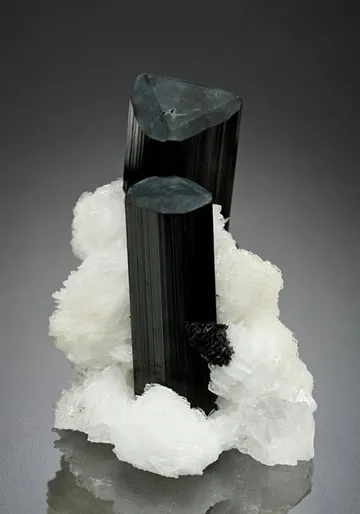
Schorl is the black tourmaline of the Shengus pegmatites, occurring as striated prisms, radiating marginal sprays, embedded crystals, and pocket associations with aquamarine, albite, quartz, muscovite, spessartine, topaz, fluorite, and other minerals. In some pegmatites, thin zones of radiating schorl occur near the outer margins; in specimen pockets, individual black prisms provide dramatic contrast against white albite and pale-blue beryl. The best Shengus schorl pieces have complete, lustrous, terminated crystals that enhance the composition, especially with aquamarine; ordinary examples are broken black rods or opaque masses with little form or balance.
Feldspar is the dominant framework of the Shengus pegmatites, chiefly albite and microcline, with orthoclase also appearing on specimen labels and in dealer descriptions. It forms blocky, cleaved, white to cream matrix, platy albite-rich areas, and pocket walls on which aquamarine, spessartine, muscovite, schorl, quartz, topaz, fluorite, apatite, cassiterite, and rhodochrosite may sit. Fine feldspar specimens from Shengus are really fine combinations: sharp, clean, sculptural feldspar carrying an important crystal; ordinary pieces are simply feldspar matrix, often kaolinized, iron-stained, fractured, or too massive to show the pocket mineralogy well.
The garnet suite at Shengus includes the celebrated spessartine as well as almandine and garnet-group labels on older or less analytically specific specimens. In the pegmatites, garnet occurs as reddish brown to orange-red crystals on albite, feldspar, muscovite, quartz, schorl, and beryl, with the best pieces showing sharp crystal form and lively colour rather than dark, embedded grains. For collectors, the distinction between a generic “garnet” label and a confirmed spessartine or almandine label matters: fine Shengus garnet specimens deserve careful identification, and the highest-value examples are those with confirmed species, saturated colour, undamaged faces, and strong pegmatite associations.
Väyrynenite is one of Shengus’s great rarities, a Mn-Be phosphate occurring as salmon-pink to reddish-orange, tabular to bladed, lustrous crystals, typically small but intensely sought after. Documented Shengus examples include loose and matrix crystals around 7 mm to 2.8 cm, with later market finds in the 1.5–2.0 cm range and associations that include cleavelandite, topaz, schorl, indicolite, eosphorite, fluorapatite, muscovite, beryl, and hydroxylherderite. The best pieces are transparent to translucent, well terminated, strongly coloured, and undamaged; ordinary or doubtful examples need particular scrutiny because small pink phosphate crystals can be confused visually with other rare pegmatite species without analysis or excellent provenance.
Topaz from Shengus occurs as colourless to pale crystals in the pegmatite pockets, most often seen with albite, schorl, quartz, muscovite, fluorite, lepidolite, and fluorapatite. Documented Shengus specimens include topaz on albite and topaz–schorl–albite combinations, and at least one recorded specimen shows strong orangish-yellow fluorescence under longwave ultraviolet and lemon-yellow fluorescence under shortwave, an unusual handling and identification note for the locality. Fine Shengus topaz is sharp, glassy, and naturally seated on white albite or a balanced pegmatite matrix; lower-grade pieces are etched, cleaved, incomplete, or difficult to separate visually from pale quartz or feldspar without careful inspection.
Apatite from Shengus is especially interesting because the district has produced pink to maroon-pink fluorapatite-style specimens distinct from the better-known Pakistani apatites of Chumar Bakhoor. Documented pieces include rich maroon-pink crystals on white cleavelandite, with miniature specimens around 4 cm across, and the broader Shengus assemblage places apatite with albite, elbaite, schorl, topaz, fluorite, lepidolite, quartz, and muscovite. The most desirable Shengus apatites have saturated reddish to violet-pink colour, crisp crystal form, and contrasting albite matrix; ordinary pieces are small, incomplete, pale, or overwhelmed by feldspar.
Elbaite is less abundant on the market from Shengus than schorl or aquamarine, but it is part of the locality’s complex pegmatite suite and appears in associations with albite, quartz, apatite, beryl, muscovite, and rare phosphate minerals. Shengus elbaite can occur as green, blue, pinkish, or zoned tourmaline, and indicolite-associated pieces are known in the väyrynenite assemblage. Good Shengus elbaite specimens need the qualities expected of fine tourmaline—termination, lustre, translucency, colour zoning, and matrix balance—while ordinary examples are often dark, incomplete, or better described simply as tourmaline unless analysis or reliable provenance supports the species name.
Cassiterite is a notable accessory oxide from the evolved Shengus pegmatites and occurs as black, lustrous, well-formed crystals on quartz, albite, muscovite, and beryl-bearing matrix. A standout documented museum-quality specimen from Shengus shows six black cassiterite crystals in sharp quadratic pyramids on quartz and white albite, with a main crystal about 3.7 cm. The best cassiterites here have glossy faces, distinct pyramidal form, strong contrast against pale albite or quartz, and intact crystal tips; ordinary pieces are massive, embedded, chipped, or visually lost among black schorl.
Fluorite from Shengus is uncommon but well documented, usually as green to pale mauve or transparent crystals with schorl, albite, quartz, muscovite, topaz, fluorapatite, lepidolite, feldspar, and microcline. Described specimens include a green transparent crystal showing cube and octahedron faces on an orthoclase-rich matrix with white muscovite, quartz, and schorl, as well as small fluorites on mica or quartz-bearing matrix. Fine Shengus fluorite is valued for clarity, colour, and association rather than size; the strongest pieces preserve sharp fluorite faces in an unmistakable pegmatite setting, while lesser examples are tiny, damaged, or difficult to distinguish from more famous Pakistani fluorite localities without a good label.
Rhodochrosite from Shengus is a true oddity for Pakistan’s pegmatites, occurring as pink to reddish crystals on cleavelandite, feldspar, and mica-rich matrix. Market-documented pieces include cabinet-size feldspar specimens with individual rhodochrosite crystals around 2 cm, and small groups of crystals sitting on bladed cleavelandite; the association is unusual enough that good examples attract attention well beyond their size. The best Shengus rhodochrosites have visible crystal form, pleasing colour, and clean feldspar or cleavelandite contrast, while condition must be inspected closely because cleavages and edge bruises can be easy to miss on first viewing.
Tourmaline at Shengus includes common black schorl and rarer coloured elbaite, including indicolite-bearing associations in some rare-phosphate specimens. It occurs as long striated prisms, radiating sprays, pocket crystals, and broken rods in albite-, quartz-, mica-, feldspar-, beryl-, and topaz-bearing pegmatites. The strongest Shengus tourmaline specimens are not merely black sticks; they are complete, lustrous, terminated crystals arranged with aquamarine, albite, or spessartine, or rarer coloured crystals with good zoning and matrix. Generic “tourmaline from Shengus” labels should be read carefully, since species-level identification between schorl and elbaite is not always evident from appearance alone.
Cleavelandite, the platy variety of albite, is one of the essential Shengus matrix minerals, forming white blades, sprays, and rosette-like aggregates in the pocket zones. It hosts or accompanies aquamarine, spessartine, topaz, fluorapatite, elbaite, väyrynenite, rhodochrosite, fluorite, muscovite, schorl, and quartz, often giving Shengus specimens their snowy, high-contrast background. The best cleavelandite pieces are crisp, bright, and sculptural, framing the main crystal without damage or excessive iron staining; ordinary material is friable, crushed, heavily kaolinized, or reduced to unattractive feldspar rubble.
Other minerals documented from Shengus and its broad pegmatite district include almandine, andradite, analcime, epidote, lepidolite, petalite, pollucite, hambergite, hydroxylherderite, eosphorite, microlite-group minerals, tantalite-(Mn), fluorostrophite or strontium-rich apatite material, morganite, goshenite, and spodumene. Among these, hambergite is one of the more collectible rare species, with sharp colourless to white crystals and twinned examples known from early-2000s and later finds; pollucite and petalite point to the evolved Li-Cs character of some pegmatites; and the rare phosphate assemblage around väyrynenite, eosphorite, apatite, and hydroxylherderite gives Shengus its importance for systematic collectors as well as display-specimen buyers.
Shengus specimens are common enough in the trade that a collector can usually find something from the locality, but truly fine pieces remain selective. Aquamarine, albite, muscovite, quartz, schorl, and spessartine combinations appear regularly; fine matrix aquamarines, large sharp spessartines, topaz combinations, fluorite, cassiterite, rhodochrosite, hambergite, and väyrynenite are much less available. The rarest and most locality-significant pieces are not necessarily the largest—they are the ones that show Shengus chemistry and pocket aesthetics together: aquamarine with spessartine, väyrynenite with cleavelandite and phosphate associates, cassiterite on albite and quartz, and unusual pink apatite or rhodochrosite on feldspar.
The main authenticity concern is locality breadth and mislabelling. “Shengus” has been used as a trade name for a wider area, and specimens may actually come from nearby Sabsar, Baralooma Valley, Bulochi, Haramosh, Stak Nala, or other Roundu and Skardu-region pegmatites. This is especially relevant for aquamarine, topaz, schorl, albite, fluorapatite, and garnet, which occur at multiple northern Pakistani localities. A specimen with a vague “Skardu” or “Pakistan” label should not be upgraded to Shengus without evidence; likewise, an old “Shengus” label may refer to the broader producing district rather than a precise village mine.
Treatments are more of a gem-cutting issue than a matrix-specimen issue, but repaired and assembled specimens should be watched for carefully. Pakistani and Afghan pegmatite minerals have sometimes been repaired, reattached, oiled, or mounted in ways that can hide contacts, especially long aquamarine, tourmaline, topaz, and delicate albite combinations. Examine beryl bases, garnet-on-beryl contacts, topaz attachments, and cleavelandite-supported rare minerals under magnification and UV. Glue lines, mismatched dust in crevices, unnatural alignment, excess resin shine, or a crystal that “floats” visually above crushed matrix are warning signs.
Condition issues are locality-specific. Many Shengus crystals were recovered from hard pegmatite pockets by blasting or rough hand work, so bruised aquamarine terminations, cleaved topaz, chipped garnets, broken schorl rods, and crushed albite are common. Feldspar is often partly kaolinized, and iron staining may settle into cleavages and mica. Cleavelandite and muscovite are fragile; ultrasonic cleaning is risky for combination pieces, repaired specimens, and anything with fine albite blades. Use gentle brushing, distilled water only when appropriate, and avoid prolonged soaking of friable feldspar or mica-rich matrix.
Fluorescence is not a universal Shengus diagnostic, but some documented material is notable under ultraviolet light. One Shengus topaz on albite has been recorded with orangish-yellow longwave fluorescence and lemon-yellow shortwave fluorescence, while pollucite from Shengus has been recorded as medium blue under shortwave UV. These behaviours can add interest, but they should not be used alone to prove locality or species.
For väyrynenite, rhodochrosite, hambergite, cassiterite, microlite-group minerals, pollucite, and unusual apatite, buy from dealers willing to stand behind species identity and locality. Colour and habit alone are not enough for rare pegmatite minerals, especially when small crystals occur in complex matrix. Analytical confirmation, publication history, museum comparison, or a reputable old label matters more than sales language.
In the early 1980s, when northern Pakistan’s pegmatites were still opening to the wider mineral world, Shengus was one of the few names attached to aquamarine. Giuseppe Agozzino, an Italian dealer and field explorer, later recalled beginning his Karakorum work in 1981 with help from Balti people. Between 1981 and 1984 he completed more than 20 gem-mineral explorations across the Haramosh Mountains, Shigar, Basha, and Braldu valleys. At that time, the principal aquamarine areas known to the Gemstone Corporation of Pakistan were Dassu, Shengus, and Mount Haramosh. Shengus was not a romantic single tunnel high on a glacier in that account, but a camp by the road from Gilgit to Skardu, next to the village and only about 50 metres above the Indus. Around it, aquamarine-bearing pegmatites were scattered through the surrounding mountains. The crystals he remembered were elongated, bright, gemmy, and pale—a description that still fits many of the best old Shengus aquamarines in collections.
The practical reality of mining at Shengus could be brutal. A Baltistan gemstone-sector field report describes the Shengus workings along the main Skardu–Gilgit road as being developed in “extremely dangerous vertical high rock faces” across the river. The approach was not a bridge in any normal sense: it was a single wire with a tray, pulled by hand, used to cross the Indus toward the mines. The field-party caption says it with grim economy: “What a bridge!” The mine itself was described with the same astonishment—an aquamarine working on the far side of the river, in a vertical hill, with no platform at the portal. Mine owners told the field party that two fatal accidents had occurred in the Shengus area from falls at vertical mine portals.
The same report records a second loss, quieter but painful to any collector: in some workings, excavated material was dumped directly into the river because no platform existed at the portal. That means potential specimens—feldspar plates carrying beryl, garnet, mica, or pocket minerals—could be broken, buried, or lost to the Indus before ever reaching a dealer’s table. It is a useful corrective to the polished view of Shengus in show cases: every undamaged matrix aquamarine or garnet plate from the locality survived not only geological violence, but extraction from steep, remote pegmatite workings where convenience, safety, and specimen preservation were often at odds.