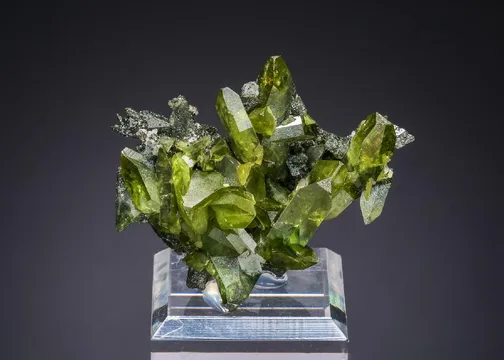
A collector's guide to Tormiq Valley, Pakistan: its geology, mining history and notable minerals, illustrated with the 141 specimens documented from this locality on EarthWonders.
Key facts
Tormiq Valley is one of the essential modern Alpine-type localities of northern Pakistan: a steep Karakoram tributary valley above the Indus, between Shengus and Skardu, where tectonic fracturing related to the Main Karakoram Thrust opened metamorphic fissures and clefts that later filled with free-grown crystals. Its best specimens have the visual language of the European Alps—iron roses on white feldspar, green titanite twins, glassy epidote and clinozoisite, adularia, albite, quartz, actinolite byssolite, chlorite, apatite and rare rutile—but with a distinctly Pakistani intensity of color and scale.
Collectors usually approach Tormiq through three interlocking specimen traditions. The first is the green titanite suite: sharp, lustrous, twinned crystals, often apple-green to yellow-green or honey-green, on calcite, albite, adularia, chlorite or epidote. The second is the oxide suite: hematite and ilmenite in Alpine “rose” habits, locally with rutile and quartz. The third is the epidote–clinozoisite material, including gemmy prismatic crystals and large, sculptural groups whose clarity and pleochroic green-brown tones can rival the classic Alpine fissure specimens from Austria and Switzerland.
Regional View
Country View
The locality sits in the Haramosh Mountains of Roundu District, Gilgit-Baltistan. Mindat records it at 35° 38' 26" N, 75° 18' 14" E, and describes it as a river valley tributary to the Indus. The lower valley includes granite, amphibolite and ultramafic rocks near the Indus, while the central and upper valley expose metasedimentary and metavolcanic rocks. That mixture of competent metamorphic host rocks, tectonic fissuring and late fluid movement explains why the locality yields open-space crystals rather than massive ore: the finest pieces are pocket-grown specimens, not mine-run ore.

Photo: Arif Rizvi / Wikimedia Commons
The historical moment for collectors began in earnest with the Pakistani Alpine-cleft material that reached the international market in the 1990s. Reports and show notes from that period and afterward repeatedly compare Tormiq to the European Alpine localities, not as a casual analogy but because the specimen style is genuinely parallel: feldspar-lined clefts, chlorite coatings, doubly terminated crystals, growth contacts against pocket walls, and the occasional floater. The material is now much scarcer than it once was. Surface-accessible pockets have been heavily worked, and important pieces appear today mostly through old collections, scattered new small-scale finds, and dealer inventories with older provenance.

Photo: Fabre Minerals
Search for specimens: View all specimens from Tormiq Valley, Pakistan
Tormiq is best understood as an Alpine-type cleft locality rather than a conventional ore mine. The productive zones are fissures and open cavities in metamorphic rocks of the Haramosh region, generated by deformation around the Main Karakoram Thrust. Regional geological work in the Chogo Lungma–Turmik area describes the northernmost Ladakh Terrane and the Shyok Suture Zone as a package of amphibolite, metabasaltic and metasedimentary hornblende-bearing schists, low-grade volcano-sedimentary rocks, limestone and ultramafic lenses. In the collecting literature, the Tormiq clefts are generally tied to this tectonically fractured setting, with likely host rocks including amphibolite-facies metavolcanites north of the valley and rocks related to the Askore Amphibolite near Stak La.
The valley is not a single named mine with a neat production ledger. It is a valley-scale mineral field with multiple clefts, pockets and small workings. The “ore bodies,” in collector terms, are discontinuous fissure systems: lens-like cavities, pocket seams and fracture networks that allowed late fluids to deposit feldspar, quartz, epidote-group minerals, titanite, oxides, apatite, calcite and chlorite-group minerals. Specimen pieces commonly show growth against pocket walls, chlorite dusting on crystal faces, white albite or adularia as the visual ground, and freestanding crystals where the cleft remained open long enough for euhedral growth.
Mining has been small-scale and specimen-driven. No large industrial operator is consistently associated with the Tormiq collector specimens in the published specimen literature; the material has come out through local miners, Pakistani dealers, visiting dealers and later the international show and auction circuit. By the early 1990s, Tormiq was already known in the Alpine-type trade. A 1994 European report on international new finds mentioned Pakistani Alpine material, including apatite, chloritoid, axinite with albite in pericline habit, and Tormiq-area carbonate material mis-sold as prehnite. In the mid-1990s, Tormiq hematite and ilmenite roses became a memorable part of the locality’s reputation. Later, titanite, epidote, clinozoisite, quartz-inclusion pieces, apatite and rutile kept the locality active in the connoisseur market.
The best-documented collecting episodes are pocket based. Hematite roses from a spring 2013 find produced lustrous, black-metallic crystals on sparkling albite, in some cases with small apple-green titanite tucked among the feldspar. A later October 2017 find produced rare quartz–hematite–rutile combinations, including water-clear quartz with internal metallic hematite plates and wine-red rutile needles. Dealer records also describe early-2000s apatite and diopside finds, circa-2005 blue-green diopside specimens, and a single unusual silvery-lilac fluorapatite pocket whose material reappeared in auctions years later from older collections.
Access today should be treated as local, permission-based and terrain-limited. These are high mountain clefts, not a fee-dig quarry. The old near-surface pockets have been substantially depleted, and productive collecting requires local knowledge, permission, safe mountain travel and realistic expectations. For most collectors, Tormiq is now a market locality: specimens are obtained through trusted dealers, old collections and auction appearances rather than personal collecting.
Titanite is the signature show mineral of Tormiq, occurring as sharp Alpine-type crystals in several habits, from thin tabular and disc-like forms to thicker wedge-shaped twins. The most desired pieces show vivid grass-green to apple-green color, glassy luster, crisp twinning and clean terminations, often on white calcite, albite, adularia, epidote or dark chlorite/clinochlore matrix; published dealer examples describe main crystals commonly around 1.4–2.7 cm, with larger matrix specimens showing multiple twins. Good Tormiq titanite is judged by color saturation without backlighting, lack of bruising on the thin edges, contrast against pale feldspar or calcite, and whether the crystal sits proudly rather than being buried in chlorite; ordinary pieces tend to be smaller, contacted, heavily coated or poorly positioned.
Tormiq hematite is best known as Alpine “iron roses”: lustrous, platy, metallic-black to steel-gray rosettes set on white albite, adularia or quartz-bearing matrix, sometimes with titanite, rutile, chlorite, muscovite or calcite. Mid-1990s material from upper Tormiq produced crisp, double-sided roses to about 3 cm on feldspar, and a spring 2013 find brought striking hematite-on-albite specimens, including roses around 3.3 cm across and 1.2 cm thick; later pieces include sharp hematite associated with rutile and quartz. The finest specimens have a sculptural rose fully exposed on sparkling white feldspar, mirror-like luster, undamaged blade edges and balanced placement; lesser pieces are flat, contacted, dull, confused with ilmenite-rich material, or visually lost in dark matrix.
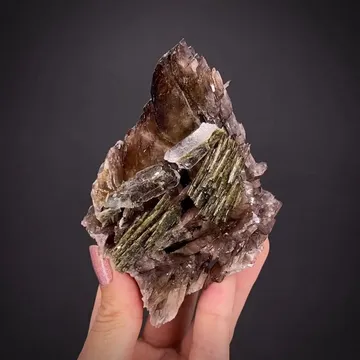
Epidote from Tormiq forms some of the locality’s most imposing Alpine-cleft specimens: elongated, glassy to highly lustrous crystals and parallel or interlocked groups in forest-green, pistachio-green, brownish-green and pleochroic green-brown tones. Documented market examples include floaters and sweeping groups around 11–13 cm overall, with individual dominant crystals reported near 9 cm, commonly with adularia, albite, quartz, axinite, apatite, calcite, hematite or byssolitic amphibole. Choice pieces show sharp doubly terminated crystals, transparency at the edges or under backlight, stepped growth, three-dimensional architecture and minimal repairs; average examples are more opaque, broken along terminations, flattened into incomplete sprays, or confused with neighboring clinozoisite without analytical support.
Tormiq clinozoisite is prized for glassy, gemmy, elongated to tabular crystals in pale brown, greenish-brown and olive tones, commonly resembling material from nearby Alchuri and Hashupa so closely that locality and species distinctions often require strong provenance and, for clinozoisite versus epidote, analytical caution. Collector references illustrate Tormiq crystals and groups in the roughly 3–9 cm range, while broader Pakistani Alpine cleft material can exceed 10 cm; individual dealer specimens emphasize complete, all-around, high-luster crystals rather than matrix-heavy plates. The best Tormiq clinozoisite has a clean single-crystal silhouette, transparency, intact chisel-like terminations and little edge wear; ordinary material is opaque, splintery, contacted or sold loosely under the clinozoisite–epidote series name.
Quartz is not the most abundant show mineral from Tormiq, but it gives the locality some of its most distinctive combinations: water-clear to pale smoky, etched or skeletal crystals, plus colorless crystals included by actinolite/byssolite, chlorite, hematite or rutile. A notable October 2017 small-cabinet specimen measured 6.5 x 4.0 x 3.2 cm and carried a pristine water-clear quartz crystal with stepped-growth faces, a 1.7 cm metallic hematite plate and wine-red cross-hatched rutile needles in the termination; other Tormiq pieces include single crystals around 7.5 cm with wispy acicular actinolite inclusions. Better quartz specimens are clean, glassy, sharply terminated and visibly included without being murky; commoner pieces are broken shards, etched fragments, or feldspar-matrix accents with only minor quartz.
Albite is the principal display matrix for many Tormiq classics, and the locality is especially associated with bright, white, sparkling albite and albite in pericline habit supporting hematite roses, ilmenite rosettes, titanite twins, fluorapatite, diopside, axinite, anatase, rutile and chlorite-group coatings. Mindat’s photo associations for Tormiq albite are dominated by ilmenite and titanite, which matches the market: the albite is often the snowy stage that makes the dark oxide rosettes and green titanites read from across a case. Fine albite pieces have sharp, lustrous, fresh-looking crystals and an architectural surface rather than a chalky crust; the best matrix specimens use albite as contrast without overwhelming the main mineral.
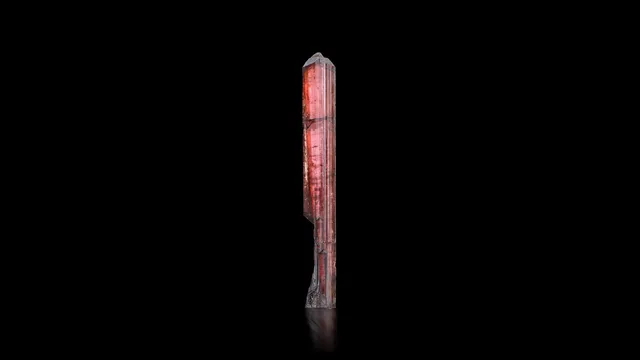
Rutile is one of Tormiq’s rarest and most dramatic species, usually encountered with hematite, quartz and albite rather than as abundant loose crystals. Documented examples include wine-red rutile needles included in quartz, rutile protruding from sharp hematite, and a remarkable 6.1 cm gemmy blood-red main crystal with side crystals and a small albite cluster; that latter specimen was important enough to justify professional repair after separation. Tormiq rutile separates itself from ordinary rutile by the combination of size, red translucency, high luster and Alpine association with hematite/albite or quartz; most pieces on the market are far smaller, included, partly contacted, or represented only as accessory needles.
Fluorapatite from Tormiq is scarce but highly characteristic when good, forming lustrous hexagonal crystals or intergrown masses in pale golden-yellow, cream-yellow and rarely unusual silvery-lilac tones, commonly on albite with chlorite inclusions or coatings. One documented lilac-toned miniature, 3.5 x 3.3 x 2.7 cm, was described as a nearly complete floater from an early-2000s single pocket and showed weak yellow fluorescence under shortwave ultraviolet; other examples show translucent pale yellow crystals to about 1.2 cm on albite. The better pieces have complete crystal form, bright prism faces, translucency when backlit and contrasting white feldspar; routine specimens are small, dull, heavily chloritized or merely accessory to titanite or feldspar.
Chlorite-group minerals, including clinochlore in some documented pieces, are part of the visual signature of Tormiq: dark green to black-green coatings, dustings, rosettes and bladed aggregates on albite, calcite and titanite. Rather than being only a nuisance coating, chlorite can sharpen the Alpine character of the specimen, outlining pale feldspar and setting off apple-green titanite; some titanite specimens show crystals partially powdered by tiny chlorite or perched on lustrous black-green clinochlore rosettes. The most attractive chlorite-bearing pieces use the coating as contrast while leaving the main crystal transparent and lustrous; less desirable pieces have chlorite smeared over terminations or filling the pocket so thoroughly that the main mineral is obscured.
Calcite at Tormiq is usually an associated Alpine-cleft mineral rather than the principal prize, but it can make excellent combinations with titanite, chlorite/clinochlore, actinolite byssolite and feldspar. Good examples include white rhombic calcite crystals carrying green titanite twins and dark chlorite, highly fluorescent calcite matrices beneath titanite–albite combinations, and translucent modified rhombs included with dark green fibrous actinolite, one documented small-cabinet example measuring 5.2 x 4.3 x 2.3 cm. The best calcite pieces are clean, translucent, sharply modified and compositionally useful; average pieces are contacted matrix calcite, etched supports, or secondary patches that matter chiefly because they host titanite.
Diopside from Tormiq is a collector’s side specialty, occurring as sharp, lustrous, gemmy to translucent crystals in rich blue-green to deep green tones, commonly on albite or in Alpine-type cleft associations. A documented ex-Rich Kosnar thumbnail, mined circa 2005, measured 3.0 x 2.6 x 1.7 cm and carried blue-green diopside crystals to 9 mm; other Tormiq/Baltistan examples include chrome-diopside crystals and groups with individual crystals to about 1.5 cm on albite. Fine pieces are judged by transparency under backlight, saturated green color, complete terminations and minimal edge abrasion; because the crystals are small and brittle, most market specimens show at least minor damage or contacts.
Other documented minerals from Tormiq broaden the locality well beyond its headline species. Mindat lists 36 valid minerals, including aegirine, anatase, antigorite, autunite, axinite-(Fe), brucite, chamosite, chloritoid, chromite, chrysotile, clinochlore including chromium-bearing clinochlore, dolomite, graphite, hedenbergite, ilmenite, kyanite, magnesite, magnetite, muscovite, oligoclase, pericline, quartz var. amethyst, scheelite, siderite, spinel, talc, topaz, tremolite, tschermakite and zoisite. No type-locality mineral is presently documented from Tormiq itself in the sources reviewed; the type-locality mineral billwiseite belongs instead to nearby Stak Nala in the Haramosh Mountains. The most important rarities for Tormiq collectors are not type minerals but locality rarities: pyrite on pericline and calcite from the Herb Obodda stock, large ilmenite roses on albite from old collections, uncommon axinite-(Fe) in Alpine habit, anatase on albite, and unusual fluorapatite pocket material.
The first authenticity issue with Tormiq is locality precision. Specimens from Tormiq, Alchuri and Hashupa can look extremely similar, especially epidote and clinozoisite, because all are Pakistani Alpine-type cleft localities in the broader Skardu-area trade. Old labels may say Tormiq, Tormik, Tormic, Tormig, Turmiq, Skardu District, Baltistan, Northern Areas, Roundu District or simply “Haramosh Mountains.” None of those spellings alone is a problem, but a serious specimen should have a coherent chain of provenance and an association that fits the locality.
The second issue is species distinction. Epidote and clinozoisite are especially vulnerable to casual naming, and visual separation can be unreliable. Hematite and ilmenite roses are also worth checking carefully; Tormiq produced both, both can sit on white albite, and some “iron rose” material in the trade has been discussed as titanium-rich or possibly ilmenite-rich. For high-value pieces, particularly unusual clinozoisite, ilmenite, rutile, anatase, axinite or fluorapatite, analytical confirmation adds real value.
Documented treatment and repair are not hypothetical. Dealer records describe a large Tormiq rutile repaired once in the middle after being separated, and titanite specimens are sometimes reattached after pocket breakage. This is not unusual for Alpine-cleft minerals from high mountain pockets, but it should be disclosed. Examine titanite twins along the twin plane and at the base, hematite roses through the center of the rosette, and rutile crystals at mid-crystal breaks. Repairs may be acceptable on important pieces, but undisclosed repair materially changes value.
Condition is a major determinant. Tormiq titanite has thin, vulnerable edges and terminations; hematite and ilmenite roses bruise along platy rims; epidote and clinozoisite groups often have edge chipping or repaired clusters; apatite and calcite can be contacted on hidden faces; and quartz may be partly etched or broken from pocket extraction. Many fine specimens are floaters or near-floaters, so do not assume every attachment scar is damage—but do distinguish natural pocket contact from fresh breakage.
Fluorescence is not a defining trait for the locality, but it is relevant in specific cases. Some calcite-bearing Tormiq pieces are described as highly fluorescent, and at least one unusual fluorapatite showed weak yellow shortwave fluorescence. Use UV cautiously and avoid overcleaning: chlorite dusting, actinolite fibers and pocket clay can be part of the specimen’s locality character, while aggressive acid or ultrasonic cleaning can dull calcite, dislodge byssolite, loosen repairs, or strip aesthetically important coatings.
Availability is uneven. Small titanites, hematite/albite pieces and epidote fragments still circulate, but top examples—clean titanite twins, large epidote floaters, undamaged iron roses on albite, true rutile, attractive clinozoisite singles and unusual apatites—are no longer common. Much of the best material now comes from older collections, and the market rewards specimens with older labels from recognized dealers or collectors such as Rich Kosnar, Herb Obodda, Jack Halpern, Steve Smale, Kay Robertson, Chet Lemanski or well-documented European dealer inventories.
One of Tormiq’s best stories is a quartz specimen that should not exist in such a tidy mineralogical package. From an October 2017 find came a 6.5 x 4.0 x 3.2 cm small-cabinet specimen described as a “triply rare” combination: clear quartz, hematite and rutile from a locality where sharp euhedral quartz is already uncommon, hematite is normally seen as iron roses, and rutile is rarer still. The quartz crystal was water-clear, lustrous, stepped and three-dimensionally clean, with jagged terminations; inside the termination sat a 1.7 cm metallic hematite plate and wine-red cross-hatched rutile needles. For Tormiq, a locality famous for green titanites and Alpine roses, that single crystal compressed the whole cleft system into one transparent window.
The spring 2013 hematite find has a different kind of drama: not one perfect thumbnail, but plates of black roses on snow-white albite. Dealer descriptions from that find dwell on the surprise of seeing multiple lustrous roses sitting well on crystallized albite, when a single rose on matrix would already have made the specimen worth keeping. One standout was an 11.6 x 8.5 x 3.2 cm plate with many hematites and small titanites, remembered as one of the finest Pakistani hematites the dealer had seen. Another had a 3.3 cm rose, 1.2 cm thick, balanced on sparkling albite with tiny green titanite visible among the feldspar. These are the pieces that made Tormiq hematite more than a locality footnote: the combination had the poise of a Swiss iron rose, but the freshness of a modern Karakoram pocket.
The rutile story is almost surgical. One Tormiq specimen was described as a 6.1 cm blood-red, gemmy, lustrous rutile with side crystals and a small white albite cluster—a size and quality so far beyond ordinary Tormiq rutile that the dealer wrote he had never seen another from the area “even close” to it. The specimen had been separated and then professionally repaired and filled in Federico Pezzotta’s laboratory. That detail matters because it captures the ethics of high-end specimen preparation: on a routine piece, repair would be a liability; on a unique rutile of this scale, the decision preserved a locality record that would otherwise have remained broken fragments.
There is also a cautionary 1994 market story. Yellow-green, slightly etched crystal coatings associated with platy hematite were being sold at the Munich show as prehnite, but later proved to be dolomite. The same report noted that true prehnite was known from the Tormiq area, with a Dauphiné-like style, but the misidentified dolomite episode is a useful reminder: Tormiq’s Alpine look is seductive, and the European-Alpine vocabulary can invite lazy naming. The best Tormiq labels are not just picturesque—they are mineralogically disciplined.
Tormiq Valley locality page, Mindat — Primary locality reference for coordinates, regional hierarchy, deposit description, rock types and the 36-mineral list.
Clinozoisite best-minerals page, Mindat — Useful discussion of Tormiq clinozoisite, its similarity to Alchuri and Hashupa material, and likely Alpine-vein geological context near the Main Karakoram Thrust.
Rolfo, F.; Lombardo, B.; Compagnoni, R.; Le Fort, P.; Lemennicier, Y.; Pêcher, A. (1997). “Geology and metamorphism of the Ladakh Terrane and Shyok Suture Zone in the Chogo Lungma–Turmik area, northern Pakistan.” Geodinamica Acta 10(5), 251–270. — Regional metamorphic framework for the Turmik/Tormiq area, including the Askore Amphibolite and Shyok Suture Zone.
Robertson, A. H. F.; Collins, A. S. (2002). “Shyok Suture Zone, N Pakistan: Late Mesozoic–Tertiary evolution of a critical suture separating the oceanic Ladakh Arc from the Asian continental margin.” Journal of Asian Earth Sciences 20, 309–351. — Regional tectonic context for the suture zone that frames the Haramosh–Skardu mineral belt.
Biedermann, A. R.; Pettke, T.; Reusser, E.; Hirt, A. M. (2015). “Magnetic anisotropy in clinopyroxene and orthopyroxene single crystals.” Journal of Geophysical Research: Solid Earth 120. — Includes diopside single-crystal samples from Tormiq, Baltistan, Pakistan, in its sample table.
Niedermayr, G. (1995). “Informationen für Sammler.” Carinthia II 185/105, 394–399. — Contemporary European collector report noting Pakistani Alpine material, axinite with albite in pericline habit from the Tormiq area, and dolomite material mis-sold as prehnite at Munich 1994.
Mineralogical Record digital issue, November–December 2005, Vol. 36 No. 6 — Includes discussion of Tormiq hematite roses and related Alpine iron-rose comparisons.
Mineralogical Record general index, Vols. 26–35 — Index entries document published notes and photographs for Tormiq augite and axinite-group material.
Mineralogical Record general index, Vols. 1–25 — Index entries record repeated show-report references to Pakistani material from Tormiq near Stak La along the Gilgit–Skardu road.
Epidote, Handbook of Mineralogy — General mineral reference that specifically notes exceptional epidote crystals from Tormiq, Pakistan.
Tormiq Valley, Haramosh Mountains, Roundu District, Gilgit-Baltistan, Pakistan — Mindat — Best single locality page for coordinates, geological summary and mineral list.
Epidote from Tormiq Valley — Mindat occurrence record — Useful species-specific occurrence page with photo-based associations.
Hematite from Tormiq Valley — Mindat occurrence record — Documents hematite associations, especially rutile, quartz, feldspar and albite.
Albite from Tormiq Valley — Mindat occurrence record — Shows albite’s role as the matrix mineral for ilmenite, titanite, axinite, diopside, fluorapatite and other species.
Ilmenite from Tormiq Valley — Mindat occurrence record — Important for understanding Tormiq’s ilmenite rosette material and its relationship to albite.
Clinozoisite best-minerals page — Mindat — Valuable context on Tormiq clinozoisite and its difficulty of separation from Alchuri and Hashupa material.
Tormik Valley — Wikimedia Commons — Landscape photograph of the valley by Arif Rizvi.
Titanite with clinochlore from Tormiq — Wikimedia Commons — Rob Lavinsky specimen photograph with detailed locality and habit notes.
Adularia, quartz and actinolite from Tormiq — Wikimedia Commons — Rob Lavinsky specimen photograph showing the feldspar–quartz–byssolite Alpine-cleft style.
Titanite with epidote from Tormiq — Fine Art Minerals — Dealer page illustrating modern Tormiq titanite aesthetics and associations.
Hematite with rutile from Tormiq — Fine Art Minerals — Useful example of hematite, rutile and albite association.
Titanite twin from Tormiq — Mineral Auctions — Recent auction record describing scarcity, crystal habit and market behavior of Tormiq titanite.
Titanite twins with calcite and clinochlore — Mineral Auctions — Large-cabinet example of the titanite–calcite–chlorite association.
Fluorapatite from Tormiq, rare color and style — Mineral Auctions — Detailed record of the unusual silvery-lilac fluorapatite pocket and shortwave fluorescence.
Calcite included with byssolite from Tormiq — Mineral Auctions — Good reference for rare crystallized calcite with actinolite byssolite inclusions.
Diopside from Tormiq, ex Rich Kosnar Collection — Mineral Auctions — Specific record for circa-2005 blue-green diopside from the locality.
Rutile from Tormiq — Saphira Minerals update — Important market description of a large repaired rutile with albite from Tormiq.
Hematite on albite with titanite — Saphira Minerals — Dealer records documenting the spring 2013 hematite/albite/titanite find.
Epidote examples from Tormiq — Saphira Minerals — Descriptions of large Tormiq epidote floaters and crystal groups.
Quartz with actinolite inclusions from Tormiq — Weinrich Minerals — Example of clear quartz with wispy actinolite inclusions from Tormiq.
Quartz, hematite and rutile from Tormiq — Mindat minID ERD-W75 — Detailed record of the rare October 2017 included-quartz combination.
Ilmenite with albite from Tormiq — Fabre Minerals — Clear specimen photo and dimensions for a Tormiq ilmenite-on-albite example.