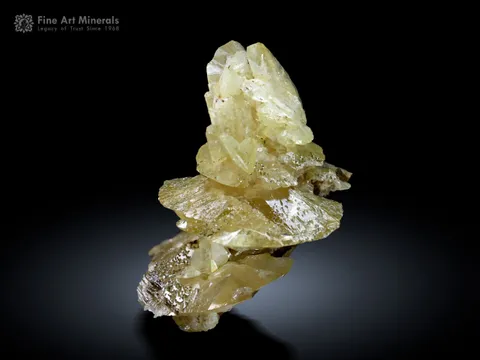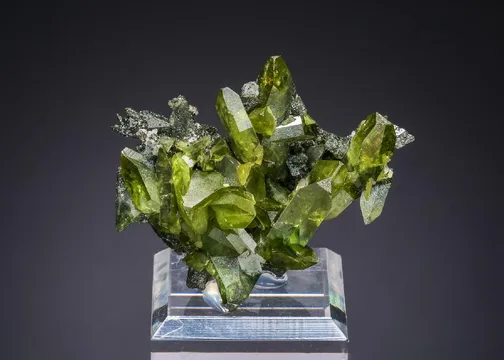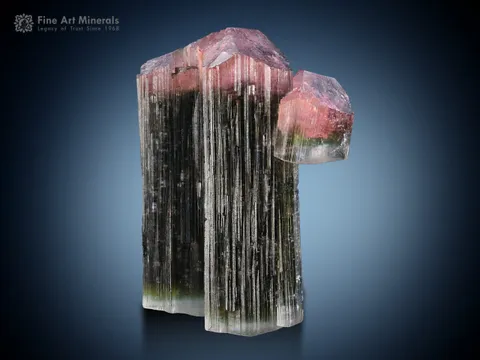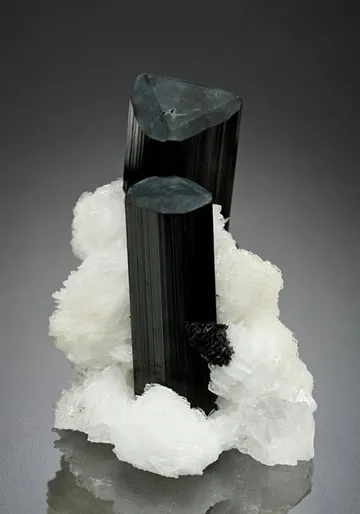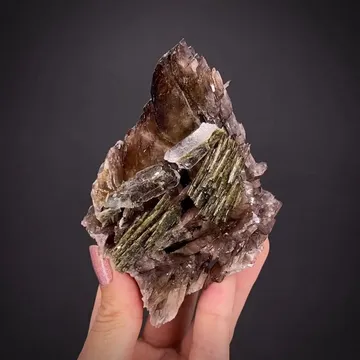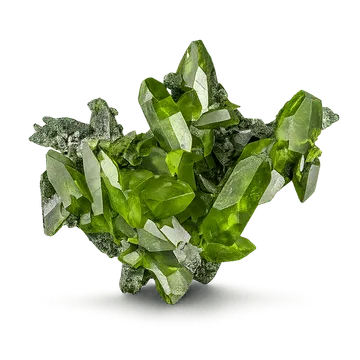
Titanite from Haramosh Mountains, Pakistan - vivid green crystals with sharp twins on clean matrix, alpine-twin elegance, and notable collector appeal.
Key facts
Titanite from the Haramosh Mountains is one of the great modern “Alpine-type” titanite appearances: sharp, lustrous green to yellow-green crystals set against white feldspar, pale quartz, calcite, and dark chlorite-rich matrix. The locality name most often encountered by collectors is Tormiq Valley, a Haramosh Mountains valley in Gilgit-Baltistan, where the best pieces have the visual grammar of the European Alps but the color saturation and dramatic contrast associated with Pakistan’s high-mountain cleft deposits.

Photo: Wikimedia Commons
The appeal is immediate: grass-green, olive-green, honey-green, and yellow-green crystals with bright, glassy to resinous luster, often as crisp contact twins or flattened wedge-shaped crystals. The finest examples are not simply “green titanites”; they are architectural specimens, with a bright crystal perched on sparkling adularia, albite, quartz, calcite, or dark green chlorite-group minerals. The best pieces have the same kind of alpine cleft tension collectors prize from Austria, Switzerland, and Italy: clean, open growth, sharp re-entrant twinning, strong display orientation, and a believable pocket-grown matrix.
The geological setting is equally important. The Tormiq Valley rocks include granite, amphibolite, ultramafic rocks near the lower valley by the Indus River, and metasedimentary and metavolcanic rocks in the central and upper valley. Fracturing related to the Main Karakoram Thrust created clefts in which alpine-type minerals developed. That tectonic and metamorphic context explains the recurrent associations: adularia, albite, quartz, calcite, clinochlore, chlorite-group coatings and inclusions, ilmenite, epidote, rutile, hematite, magnetite, and locally axinite-(Fe).

Photo: Wikimedia Commons
Collectors especially look for three things in Haramosh titanite: a well-defined twin, saturated but translucent green color, and a clean matrix that lets the crystal stand free rather than disappear into chlorite. Thick, gemmy crystals with intact terminations are scarcer than small embedded crystals. Floater crystals occur and can be very desirable when complete, but matrix pieces with white adularia or albite often display best because they give the green titanite a bright, alpine-style contrast.
Search for specimens: View all titanite specimens from Haramosh Mountains, Pakistan
The collectible titanite of the Haramosh Mountains is principally represented by Tormiq Valley, historically also seen on labels as Tormic, Tormik, Tormig, or Turmiq. Older specimen labels may use Skardu District, Baltistan, or Northern Areas; current locality references place Tormiq Valley in the Haramosh Mountains, Roundu District, Gilgit-Baltistan, Pakistan. For collectors, that label evolution matters: a fine old “Skardu District, Northern Areas” Tormiq titanite is not necessarily vague or suspect—it may simply carry the administrative language used before the present Gilgit-Baltistan/Roundu District convention became standard.
The deposit type is alpine-type cleft mineralization. These are not pegmatite pocket titanites in the tourmaline-aquamarine sense. They are cleft-grown crystals in a high-pressure, high-relief metamorphic mountain belt, where open fractures allowed fluids to deposit free-growing crystals on feldspar, quartz, calcite, chlorite, and related minerals. The Haramosh cleft style is why Tormiq titanites look so convincingly “Alpine”: flattened wedge forms, twins, chlorite dusting and inclusions, white adularia, quartz, and the occasional dark metallic contrast of ilmenite or hematite.
Mining and collecting have been small-scale, seasonal, and high-mountain in character rather than industrial. The production history visible in the collector market points strongly to the 1990s as the period when Tormiq began yielding superb crystallized titanites in quantity and variety. By the 2000s and 2010s, the locality was established among serious collectors as a Pakistani alpine-type classic, and fine pieces were already appearing with notable provenance: Herb Obodda, Kay Robertson, David Burgess, Jack Halpern, Bob Noble, and other collector/dealer histories are attached to documented specimens.
Production has not been steady in the way of a mechanized mine. Auction and dealer records in the 2020s repeatedly describe good Tormiq titanites as scarce, with the more accessible near-surface deposits largely worked. Small crystals, included crystals, and repaired or contacted pieces still circulate, but large, sharp, gemmy twins on attractive matrix are no longer casually available. This is why well-documented older pieces from established collections carry a premium: they combine locality, quality, and provenance from the period when Tormiq was actively entering the international market.
Collecting access should be treated as restricted and local-permission dependent. This is high mountain terrain in Gilgit-Baltistan, not a casual roadside collecting site for visiting hobbyists. The practical route for most collectors is through reputable dealers, old collections, and documented online sales rather than self-collecting.
Haramosh titanite is best known for twinned green crystals, commonly flattened to wedge-shaped or tabular forms. The finest twins show a clean spearhead or arrowhead geometry with a visible re-entrant angle, good termination, and bright luster across broad faces. Untwinned flattened crystals also occur, including doubly terminated floaters that can be extremely attractive when complete.
Color ranges from pale yellow-green through olive-green, grass-green, honey-green, and golden-green; less commonly described material includes pinkish tabular crystals and honey-colored steep wedges. The most desired color is a saturated green that remains translucent to gemmy at the edges. Chlorite inclusions are common and can either add depth and locality character or dull the crystal if too heavy. Some pieces show darker included bases with clearer green terminations, a look that is very characteristic of alpine-cleft material.
Typical collectible crystals are around 1–2 cm, with many thumbnails and miniatures built around crystals in that range. Documented specimens include 1.1 cm titanite twins on large matrix, 1.2–1.4 cm sharp green twins on clinochlore or chlorite, 1.6–1.8 cm crystals on cabinet pieces, 2 cm crystals in clusters, 2.7 cm crystals on albite, 4.1 cm twinned crystals on adularia, and larger flattened floaters around 4–5 cm in exceptional cases. For this locality, a sharp, undamaged, gemmy twin above 3 cm is a serious specimen; one above 4 cm with attractive matrix is a top-tier piece.
Associated minerals define much of the locality’s aesthetic. The classic matrix is white to porcelain-white adularia or albite, commonly with chlorite dusting. Quartz and calcite are frequent companions, and calcite may occur as small rhombic or wafer-like crystals. Clinochlore and broader chlorite-group material appear as dark green to black-green coatings, inclusions, or bladed aggregates. Ilmenite rosettes, hematite, magnetite, rutile, epidote, fluorapatite, muscovite, schorl, chalcopyrite, and axinite-(Fe) are part of the broader Tormiq mineral suite and help place titanite in its alpine-cleft context.
Quality is judged by the same standards used for the finest Alpine titanites, but with a Haramosh-specific eye. A top specimen should have a sharp crystal, strong luster, visible twinning or sculptural form, pleasing green color, and minimal bruising at the edges and terminations. Matrix balance matters greatly: a titanite standing proud on adularia is usually more desirable than a similar crystal half-buried in chlorite. Chlorite inclusions are not automatically a flaw, but they should enhance contrast rather than obscure the form. Tan pocket clay can be mistaken for damage; on some pieces it is simply included clay or pocket residue, so magnified inspection is useful before judging condition.
The main authenticity concern is not synthetic titanite; it is assembly, repair, and locality confusion. Pakistan’s mineral markets have produced superb natural specimens, but reconstructed and glued specimens are a documented broader problem in the region. A bright titanite crystal mounted on an unrelated white matrix should be examined carefully under magnification and, ideally, long-wave/short-wave UV to check for adhesive along the base. Natural Tormiq pieces commonly have chlorite at contact points and in pockets, so one must distinguish genuine chlorite-rich pocket growth from glue-darkened joins or suspicious filler.
Specific documented fake titanites from Tormiq are not a major published category, but the value of the best pieces makes repairs worth watching for. Thin flattened titanite crystals bruise easily; look for chips along the sharp wedge edges, broken tips, small rehealed-looking contacts, and surface etching that may hide impact points. Contact marks are common on floaters and matrix pieces alike, especially where crystals grew close to feldspar or chlorite. Minor edge wear may be acceptable on large crystals, but a sharp, gemmy twin with no obvious damage commands a strong premium.
Locality labels need scrutiny. Haramosh Mountains, Tormiq Valley, Skardu District, Baltistan, Northern Areas, and Gilgit-Baltistan can all appear on legitimate older labels, but “Pakistan titanite” alone is too broad. Pakistan also produces titanite from other localities, including Shigar-area alpine clefts and Zagi/Mohmand-region material with different habits and associations. A Tormiq/Haramosh attribution is strongest when the specimen shows the expected alpine-cleft association: green twinned titanite with adularia, albite, quartz, calcite, chlorite/clinochlore, or ilmenite-style matrix, accompanied by an older dealer or collector label.
Rarity is quality-dependent. Small, included, contacted, or isolated crystals still appear, but fine matrix pieces and large gemmy twins have become difficult to replace. Recent auction records show that good but imperfect miniatures may sell in the hundreds of dollars, while exceptional matrix pieces with large, sharp twins and strong provenance can move into the low thousands and may be valued higher by dealers at shows. Provenance to major collectors can matter, especially where the piece dates to the main period of Tormiq production.