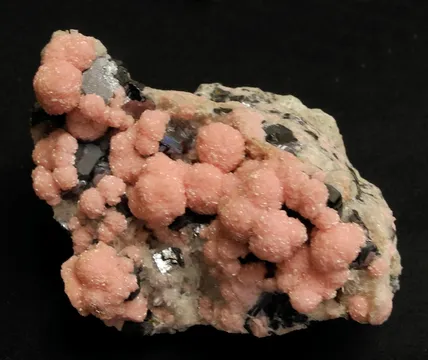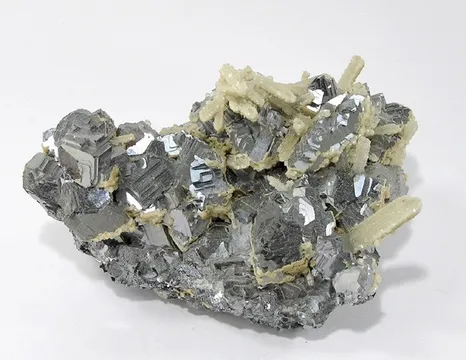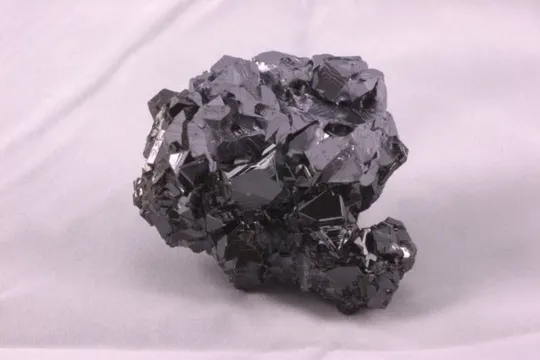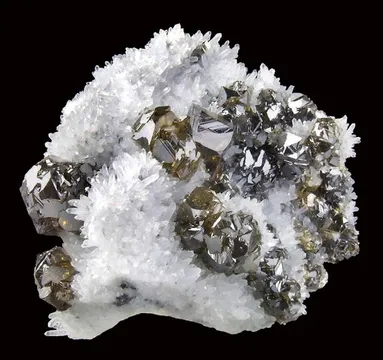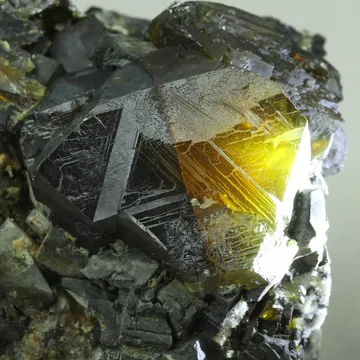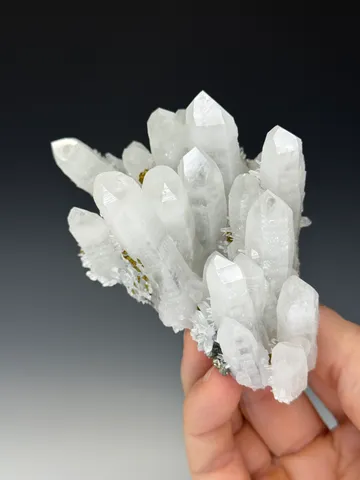
Septemvri Mine, Bulgaria — classic Madan locality famed for sharp galena and sphalerite crystals, quartz and calcite, with rare manganilvaite.
Key facts
Septemvri Mine is one of the classic specimen names of the Madan ore field in the central Rhodope Mountains of southern Bulgaria: a lead-zinc-silver hydrothermal system where sulfide veins and skarn-replacement bodies cut high-grade metamorphic rocks. For collectors, “Septemvri” usually means sharp Bulgarian galena and sphalerite combinations—silver-gray cubes, hoppered and stepped galena, black to olive-green sphalerite, glittering quartz, brassy chalcopyrite, pyrite, and late calcite—rather than a single simple mine opening. In the Bulgarian mining usage, Septemvri is an exploration-administrative mine complex that includes named deposits such as Sharenka, Baram, Mogilata, Osikovo, and Pechinsko.
The best Septemvri pieces have a distinct look. Galena commonly builds architectural clusters of stacked cubes and modified cuboctahedra, sometimes hollowed, hoppered, or skeletal; sphalerite may form lustrous black crystals or rarer translucent green cleiophane; quartz adds bright white to clear points and drusy coatings; chalcopyrite and pyrite supply gold-colored accents; and calcite may appear as cream, white, translucent, or manganese-bearing late carbonate. The Mogilata and Osikovo parts of the complex are especially important to serious collectors because they connect the famous display sulfides with the skarn mineralogy of Madan, including the type-locality mineral manganilvaite.
Regional View
Country View
The geological setting explains the variety. Madan’s principal ore bodies occur as veins, stockworks, and replacement bodies developed where ore-bearing faults intersect marble horizons within gneisses, amphibolites, mica schists, and marbles of the Rhodope massif. The main quartz-sulfide stage produced sphalerite, galena, chalcopyrite, and pyrite; a later carbonate-quartz stage with minor sulfides finished many cavities with calcite and quartz. In the skarn bodies, manganese-rich silicates and carbonates—johannsenite, manganese-bearing hedenbergite, rhodonite, rhodochrosite, manganilvaite, and related retrograde assemblages—show the more technical side of the locality.

Photo: Wikimedia Commons
The historic name is part of the locality’s collecting identity. From the beginning of exploration in 1953 until 1989 the mine was known as Deveti Septemvri, or “9th of September Mine”; after 1989 it has been recorded simply as Septemvri, or “September Mine.” Older labels, dealer catalogs, and museum tags may therefore read “9th September,” “Deveti Septemvri,” “Ninth of September,” or “September Mine,” all referring to the same Madan complex unless a more specific deposit such as Mogilata or Osikovo is given.
Search for specimens: View all specimens from Septemvri Mine, Bulgaria
Septemvri Mine lies in the Madan Municipality of Smolyan Province, in the Rhodope Mountains near Bulgaria’s border with Greece. The mine complex belongs to the Madan Pb-Zn-Ag ore field, one of Europe’s classic districts for crystallized galena, sphalerite, pyrite, chalcopyrite, quartz, and carbonates. Published coordinates for the broader Septemvri Mine are near 41.48797, 24.92354, while Mogilata, one of its named deposits, is recorded near 41.50314, 24.89454.
The deposit type is hydrothermal Pb-Zn-Ag mineralization expressed as veins, stockwork zones, and skarn-replacement ore bodies. Madan’s orebodies are structurally controlled by subparallel faults and lithologically focused by marble horizons. In the veins, galena tends to be more prominent; in the skarn-replacement bodies, sphalerite and the manganese-rich skarn assemblage become more important. Where ascending mineralizing fluids met reactive marbles, replacement could extend away from the principal veins, producing massive to banded ore, sulfide impregnations, and open cavities. Those cavities are the source of the collector-quality crystal groups.
The host-rock package is a metamorphic complex of gneisses, amphibolites, mica schists, and marbles, intruded or overlain regionally by Oligocene silicic dykes and volcanic rocks. The hydrothermal system is dated broadly around 30 million years, and published fluid-inclusion work on Madan indicates low-salinity, NaCl-dominated aqueous fluids in the roughly 260-350 °C interval during ore formation. The main ore assemblage is sphalerite-galena-chalcopyrite-pyrite with quartz, followed by carbonate-quartz mineralization with lesser sulfides.
Septemvri’s mine name is administrative as much as geographic. It includes the deposits Sharenka, Baram, Mogilata, Osikovo, and Pechinsko; older specimens may be labeled only “9th September Mine,” while better modern labels often specify Mogilata or Osikovo. The Mogilata deposit is especially important because it is a skarn-ore Pb-Zn deposit and one of the recorded type-locality areas for manganilvaite. Osikovo is likewise tied to manganilvaite and to attractive sphalerite, galena, quartz, and pyrite specimens.
Mining in the wider Madan district is ancient in origin, with Pb-Zn ores known from Thracian and Hellenic times. Industrial-scale mining expanded dramatically in the twentieth century: the district ultimately included more than 40 underground mines at its peak, and published summaries report more than 95 million tonnes of ore mined from the Madan ore field between 1941 and 1995. Septemvri itself entered the modern record under the Deveti Septemvri name at the start of exploration in 1953. After Bulgaria’s political and economic changes, many Madan underground mines became uneconomic and closed; the classic Septemvri specimen supply today is mainly old mine production, dealer stock, private collections, and occasional pieces surfacing through Bulgarian collectors and miners rather than public collecting.
Collecting access should be treated as closed and controlled. Septemvri is an underground mining complex, not a casual rockhounding locality. Modern collector material is encountered through dealers, older European collections, auction dispersals, and local Madan sources; any specimen said to be newly collected should have credible provenance and, ideally, a specific deposit name. The most desirable finds are those with complete cavity surfaces, little bruising, and unmistakable Septemvri morphology: stepped galena groups, green cleiophane on quartz, sphalerite-galena-calcite combinations, and sulfide-quartz-chalcopyrite pieces from Mogilata or Osikovo.
Septemvri galena is the mine’s signature collector mineral: bright to matte silvery-gray PbS in sharp cubes, modified cubes, cuboctahedra, spinel-law twins, stacked parallel-growth groups, and, most famously, hoppered or skeletal crystals with terraced architecture. Documented specimens range from thumbnails and miniatures with crystals around 1-2 cm to large cabinet plates exceeding 15 cm across; one well-known Wikimedia specimen from an Eastern European museum collection measures 16.0 x 10.8 x 6.8 cm and carries clusters of sharp galena among gemmy quartz with calcite on the back. The best pieces show three-dimensional, undamaged crystal buildup, clean silvery luster, visible modified corners or skeletal growth, and balanced associations with black sphalerite, quartz, chalcopyrite, pyrite, or calcite; ordinary examples are massive, bruised, too darkened, or lacking the open-space geometry that makes Septemvri recognizable.
Septemvri sphalerite is found as lustrous black, brownish-black, and locally translucent olive- to yellow-green ZnS crystals, with the green low-iron material commonly sold as cleiophane. Good specimens show sharp twinned crystals, complex flat-faced forms, and transparent to translucent greenish crystals to about 1-2 cm, often on quartz and accompanied by small cubic galena, chalcopyrite, calcite, or pyrite; Mogilata and Osikovo labels are especially desirable because they tie the specimen to named deposits within the Septemvri complex. The finest sphalerites separate themselves by glassy luster, crisp twinning, translucency or internal green flashes, and open display on pale quartz or calcite rather than being a dark massive base beneath showier galena.
Quartz from Septemvri is most important as the stage and contrast mineral for the sulfides: clear, white, and yellowish druses and short prismatic crystals coating matrix, lining cavities, or perched among galena, sphalerite, chalcopyrite, calcite, and pyrite. Documented pieces show quartz sprays to about 16 mm on black sphalerite with a perched chalcopyrite crystal, as well as quartz points scattered between hoppered galena crystals and over later calcite-rich surfaces. The best quartz-bearing Septemvri specimens are not valued simply for large quartz crystals but for how the quartz clarifies the paragenesis and composition—white points against silver galena, clear sprays on black sphalerite, or drusy coatings that reveal original pocket orientation—while ordinary examples are nondescript druse without good sulfide contrast.
Calcite at Septemvri is a late carbonate companion to the sulfides, occurring as cream, white, translucent, satiny, scalenohedral, clustered, wheat-sheaf, and locally manganese-bearing forms on quartz-pyrite or sphalerite-galena matrix. Collector pieces include calcite over dark sulfide-rich bases, calcite with sphalerite and galena from old 1990s production, and larger cabinet specimens with multiple calcite generations rising from quartz and pyrite. Strong pieces have fresh, undamaged terminations, visible zoning or repeated generations, and clear relationships to the galena-sphalerite-pyrite assemblage; weaker pieces tend to be chalky late calcite coatings that obscure the sulfides rather than enhance them.
Septemvri chalcopyrite is generally an accent mineral but a very effective one: brassy yellow to locally iridescent CuFeS2 crystals perched on sphalerite, quartz, galena, or pyrite within the classic Madan sulfide assemblage. Documented specimens show sharp chalcopyrite to about 10 mm on quartz-covered sphalerite, golden-yellow chalcopyrite scattered among deeply hoppered galena crystals, and deltoid-dodecahedral to ridged crystal forms on quartz. The best pieces place chalcopyrite high and visible—bright, sharp, and undamaged—where it punctuates the darker sphalerite and silvery galena; ordinary examples show only small brassy flecks or tarnished grains partly hidden in sulfide matrix.
Pyrite from Septemvri occurs as bright golden cubic crystals, clusters on galena or quartz, and small associated crystals in the sulfide-carbonate assemblage; it is most often seen with sphalerite, galena, quartz, chalcopyrite, and calcite rather than as a single-species showpiece. Documented examples include miniature to cabinet pieces with pyrite on gray metallic galena, pyrite-sphalerite-galena-quartz combinations, and calcite-pyrite-quartz groups with zoned calcite crystals; the broader Madan ore field is also the subject of recent crystallographic work on unusual rhombohedral pyrite, with Deveti Septemvri mentioned among less frequent mine attributions. Good Septemvri pyrite needs sharp, bright crystals and clean contrast with quartz or galena; dull, oxidized, or granular pyrite is common enough that it adds little unless the composition is aesthetically strong.
Other documented minerals from Septemvri and its included deposits include anglesite, ankerite, baryte, bornite, caledonite, cerussite, covellite, gypsum variety selenite, hemimorphite, linarite, malachite, marcasite, native silver, pearceite, rhodochrosite, rhodonite, wulfenite, and several skarn silicates. The most important rarity is manganilvaite, CaFe2+Fe3+Mn2+(Si2O7)O(OH), the manganese-dominant analogue of ilvaite, recorded from the Mogilata and Osikovo deposits of the Septemvri complex. The skarn assemblage tied to it includes johannsenite, manganese-bearing hedenbergite, actinolite, clino-suenoite, clino-ferro-suenoite, rhodonite, rhodochrosite, quartz, and manganese-bearing calcite, making Septemvri much more than a galena locality for collectors who value systematic mineralogy.
Septemvri material is abundant enough in the international market that good examples are obtainable, but the best pieces are not casual commodities. The most desirable specimens combine a specific old locality label, strong three-dimensional crystallization, fresh sulfide luster, and a named deposit such as Mogilata or Osikovo. “Madan, Bulgaria” alone is common on older labels and may be accurate in a broad sense, but it is less valuable than a specific Septemvri attribution. Be alert to spelling variants: Deveti Septemvri, 9th September, Ninth of September, September Mine, and Septemvri are all encountered; an occasional mistaken “19th September Mine” label is known in the market and should usually be read as a label error rather than a separate locality.
The main authenticity issue is skeletal galena. Mindat records a specific collector warning that some skeletal galena crystals from this mine have been suggested to be artificially produced by sandblasting. That does not mean all skeletal or hoppered Septemvri galena is suspect—the morphology occurs naturally and has been accepted on documented specimens—but collectors should inspect high-relief skeletal pieces with magnification. Natural pieces should show consistent crystal faces, growth steps, intergrown sphalerite or quartz in protected recesses, and no uniform abrasive frosting in hollows. An auctioned ex-Kay Robertson miniature was explicitly examined under the microscope and described as not doctored or sandblasted, a useful reminder that provenance and close inspection matter.
Condition is a serious buying point. Galena has perfect cleavage and high density, so edge bruises, cleaved corners, and shipping chips are common. Sphalerite can chip along exposed crystal edges, quartz tips may be nicked, and calcite can be rubbed or bruised. A minor contact on the back of a heavy sulfide piece is normal; obvious crushed crystal fields, bright broken galena cleavage faces on display surfaces, and heavily abraded quartz or calcite should be priced accordingly. Because galena is lead sulfide, normal hand washing after handling is prudent, and specimens should not be used for elixirs, children’s handling, or abrasive cleaning. Calcite-bearing pieces should never be acid cleaned, and pyrite-rich pieces should be kept dry and away from humid storage, although Septemvri pyrite is not generally notorious for rapid decay.
Market availability remains healthy through Bulgarian dealers, European auction houses, and recycled older collections. Miniatures and small-cabinet combinations of galena, sphalerite, quartz, pyrite, and calcite remain accessible; fine hoppered galena plates, large clean cabinet specimens, transparent green cleiophane, and pieces with strong chalcopyrite placement are much less common. Type-locality manganilvaite is a specialist’s mineral rather than a show specimen and is normally valued for documentation and association, not display aesthetics.
One small Septemvri galena sold through MineralAuctions carries a good collector’s tale in its labels. It came from the Kay Robertson Collection, with Robertson’s collection number 11773, and she had bought it from Ben de Wit at Tucson in 1989. The specimen was a 4.3 x 3.2 x 2.7 cm miniature made of sharp silvery-gray galena cubes, nearly a floater and crystallized almost all the way around. Its old label reportedly called the locality the “19th September Mine,” a mistake that has followed some Bulgarian material around the market; the auction description corrected the locality to Septemvri, or 9th of September Mine. The seller also addressed the locality’s most sensitive issue directly: the slight skeletal development was examined under the microscope and described as natural, not sandblasted.
A larger Septemvri combination from the Daniel “Dan” R. Kennedy Collection shows how far the locality’s top pieces have traveled in the high-end market. Sold by Heritage Auctions on March 8, 2025, the specimen measured 15 x 9 x 8.5 cm and combined sharp, lustrous, deeply hoppered galena crystals to 2.7 cm with golden-yellow chalcopyrite, white quartz points, and small clusters of sphalerite. It sold for $3,000, a strong public marker for what advanced collectors will pay when Septemvri galena has size, condition, pocket aesthetics, and memorable associations in one piece.
Another strand of the Septemvri story is scientific rather than commercial. The humble-looking skarn minerals from Mogilata and Osikovo became the basis for manganilvaite, a new mineral species of the ilvaite group described in 2005. The mineral is black and visually modest, but it records a specific manganese-rich hydrothermal evolution in the marble-hosted skarn orebodies. Its presence links display-case Bulgarian galena and sphalerite to the deeper mineralogical story of Madan: ore fluids, marble reaction, manganese silicates, and retrograde alteration operating inside the same mine complex.
Bonev, I. K., Vassileva, R. D., Zotov, N., and Kouzmanov, K. “Manganilvaite, CaFe2+Fe3+(Mn,Fe2+)(Si2O7)O(OH), a new mineral species of the ilvaite group, from Pb-Zn skarn deposits in the Rhodope Mountains, Bulgaria.” The Canadian Mineralogist, 43(3), 1027-1042, 2005. DOI: 10.2113/gscanmin.43.3.1027 — The original new-mineral description; it records manganilvaite from the Ossikovo and Mogilata deposits of the Madan ore district, tying the Septemvri complex to a type-locality mineral.
Zotov, N., Kockelmann, W., Jacobsen, S. D., Mitov, I., Paneva, D., Vassileva, R. D., and Bonev, I. K. “Structure and cation order in manganilvaite: a combined X-ray-diffraction, neutron-diffraction and Mössbauer study.” The Canadian Mineralogist, 43, 1043-1053, 2005 — Follow-up structural work on manganilvaite, including material from the Osikovo Pb-Zn skarn in the Rhodope Mountains.
Vassileva, R. D., Bonev, I. K., Marchev, P., and Atanassova, R. “2-1: Pb-Zn deposits in the Madan ore field, South Bulgaria: Madan District: Lat. 41°30′ N, Long. 24°56′ E.” Ore Geology Reviews, 27, 90-91, 2005. DOI: 10.1016/j.oregeorev.2005.07.026 — Compact geological summary of the Madan Pb-Zn-Ag system, including orebody morphology, host rocks, mineralization stages, ore minerals, resources, and hydrothermal-fluid data.
Vassileva, R. D., Atanassova, R., and Bonev, I. K. “A review of the morphological varieties of ore bodies in the Madan Pb-Zn deposits, Central Rhodopes, Bulgaria.” Geochemistry, Mineralogy and Petrology, Sofia, 47, 31-49, 2009 — Detailed review of Madan vein, stockwork, and skarn-replacement orebody shapes, with Mogilata and Osikovo discussed among representative replacement-body deposits.
Moëlo, Y. “Pseudo-cubic trigonal pyrite from the Madan Pb-Zn ore field (Rhodope Massif, Bulgaria): morphology and twinning.” European Journal of Mineralogy, 35, 333-346, 2023. DOI: 10.5194/ejm-35-333-2023 — Crystallographic study of unusual rhombohedral pyrite from the Madan ore field; Deveti Septemvri is mentioned among less frequent mine attributions for samples.
Petrussenko, S. “Minerals of the Madan ore field.” The Mineralogical Record, 22, 439-445, 1991 — Frequently cited locality article on Madan minerals, referenced in later work for the district’s cavity minerals and well-crystallized galena, sphalerite, pyrite, chalcopyrite, quartz, and carbonates.
National Museum of Natural History, Bulgarian Academy of Sciences — Minerals Collection — Notes the museum’s holotype manganilvaite from the Osikovo-Madan deposit and describes the associated skarn minerals johannsenite, hedenbergite, rhodonite, and rhodochrosite.
Wikimedia Commons: “Galena-223959.jpg” — Freely licensed Rob Lavinsky photograph of a large Septemvri galena with quartz and calcite, formerly from an Eastern European museum collection.
Mindat: Septemvri Mine, Madan Municipality, Smolyan Province, Bulgaria — The core locality page, with coordinates, alternate names, included deposits, mineral list, and the collector warning about possibly sandblasted skeletal galena.
Mindat: Mogilata deposit, Septemvri Mine — Essential sublocality page for the Mogilata skarn-ore deposit, including its mineral list and manganilvaite type-locality status.
Mindat: Madan ore field, Smolyan Province, Bulgaria — Broader district context, with extensive photo coverage and historical notes on the Madan mining area.
Mindat: Galena from Septemvri Mine — Species-specific occurrence page documenting galena’s importance, abundance, and common photo-based associations at Septemvri.
Wikimedia Commons: Galena from Septemvri Mine — Public image record for a large, classic Septemvri galena specimen.
Fabre Minerals: Galena with Sphalerite and Quartz from Septemvri Mine — Dealer reference specimen illustrating stepped, hollowed galena growths and the classic galena-sphalerite-quartz association.
Marin Mineral: Galena, Sphalerite, Quartz from 9th September Mine — Concise archived specimen record noting galena crystals to 2.2 cm from the locality.
Heritage Auctions: Galena, Chalcopyrite, and Quartz from Septemvri Mine — Public auction record for a major hoppered galena-chalcopyrite-quartz cabinet specimen from the Dan Kennedy Collection.
MineralAuctions: Galena stacked cubes, ex Kay Robertson Collection — Useful provenance and authenticity note for a natural skeletal Septemvri galena miniature with an old Tucson 1989 acquisition history.
Archive ouverte UNIGE: Manganilvaite new mineral description — Accessible bibliographic and abstract page for the 2005 Canadian Mineralogist description of manganilvaite.
European Journal of Mineralogy: Pseudo-cubic trigonal pyrite from the Madan Pb-Zn ore field — Recent crystallographic paper placing Madan pyrite specimens, including occasional Deveti Septemvri attributions, in a broader mineralogical context.