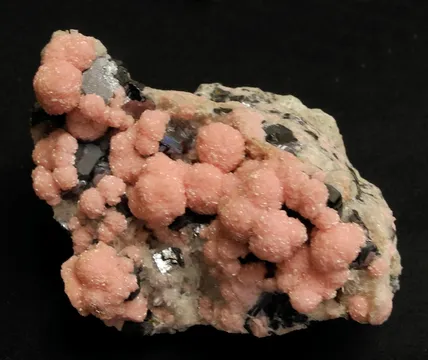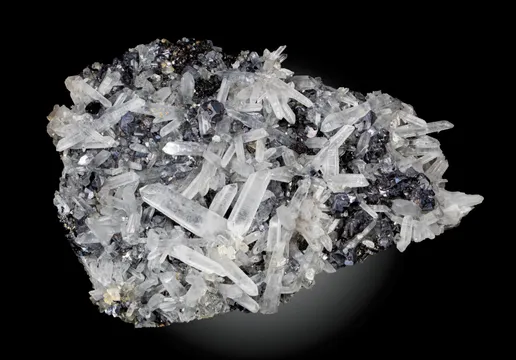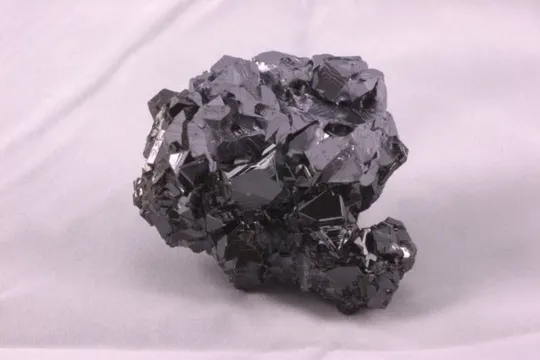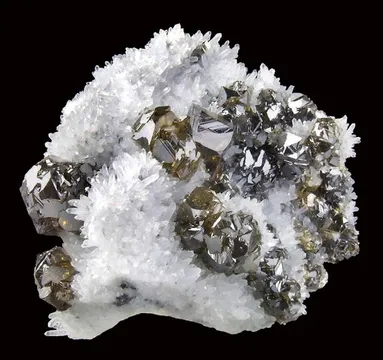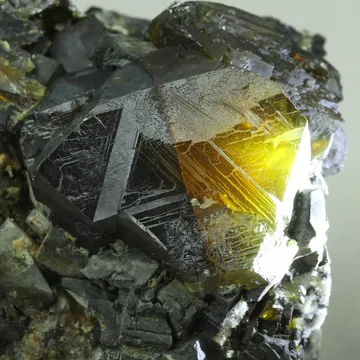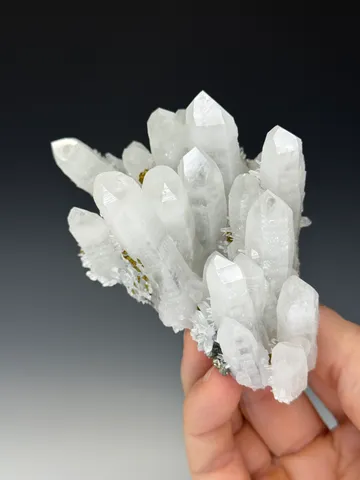
Borieva Mine, Bulgaria: premier Madan locality famed for mirror-bright galena crystals on quartz and calcite, with architectural forms prized by collectors.
Key facts
Borieva is one of the essential collector names in the Madan ore field of the Central Rhodopes, southern Bulgaria: a working lead-zinc mine complex whose best specimens combine serious ore-field geology with the sparkling aesthetics collectors want in the cabinet. The name is not just a single hole in the hillside. In Bulgarian usage, a mine name may cover an administrative or exploration unit, and Borieva includes the Borieva, Petrovitsa, and Yuzhna Petrovitsa deposits. That matters because many labels reading simply “Borieva Mine” may in fact represent pocket environments in Petrovitsa or Yuzhna Petrovitsa, both of which are mineralogically central to the locality.
The geological setting is classic Madan: Oligocene hydrothermal Pb-Zn mineralization localized along major fault structures in the Central Rhodope dome, hosted by metamorphic rocks including gneiss, schist, amphibolite, and marble. Ore occurred chiefly as veins, carbonate-replacement bodies, and local stockworks. Where ore fluids cut marble, the deposit could develop skarnified and metasomatic assemblages; where open fractures persisted, those same fluids left the collector-grade cavities that made Borieva famous.
For specimens, Borieva is above all a galena locality. The finest pieces show dazzling, mirror-bright, gunmetal to silvery galena crystals—cubes, cuboctahedra, modified cubes, spinel twins, skeletal or stepped growths—on quartz, calcite, chalcopyrite, pyrite, and black sphalerite. The best examples are not just shiny: they are architectural. Galena crystals may rise as terraces, line up in stacked twinned forms, sit dramatically on quartz needles, or contrast against iridescent chalcopyrite. Quartz and calcite are not afterthoughts here; they are part of the signature. Transparent to pale, chlorite-tinted quartz sprays and unusual amber-to-cream calcite habits give many specimens the “Madan look” without making them anonymous.
Regional View
Country View
The mine also has an unusually good scientific record for a collector locality. Fluid-inclusion work on Yuzhna Petrovitsa quartz has tied the quartz-sulfide paragenesis to a boiling, low-salinity hydrothermal system, with the main quartz-galena-sphalerite stage deposited near the thermal peak of the system. More recent geochronological work on Petrovitsa titanite has added a deeper view of the district’s pegmatite and skarn history. For the collector, those papers explain why the specimens look the way they do: repeated opening, sealing, cooling, replacement, and late-stage overgrowths produced the complex sulfide-carbonate-quartz combinations that make Borieva pieces so recognizable.

Photo: Wikimedia Commons

Photo: Wikimedia Commons
Search for specimens: View all specimens from Borieva Mine, Bulgaria
Borieva lies in Madan Municipality, Smolyan Province, in the Rhodope Mountains of southern Bulgaria, roughly south of the town of Madan. The locality belongs to the Madan ore field, a major Bulgarian Pb-Zn district whose productive deposits are controlled by long fault zones. Borieva’s administrative mine area includes Petrovitsa, Yuzhna Petrovitsa, and Borieva proper, so specimen labels may be accurate at the mine-complex level while omitting the more precise deposit or mine section.
The deposit is a hydrothermal lead-zinc system with vein and replacement mineralization. In the broader Madan field, ore bodies occur as veins, carbonate-replacement bodies, and less common stockworks. Veins are typically the most widespread ore form, while replacement bodies developed where ore-bearing structures intersected marble layers. The main ore minerals are galena and sphalerite, accompanied by quartz as the dominant gangue and by pyrite, chalcopyrite, arsenopyrite, calcite, manganiferous calcite, dolomite, rhodochrosite, and locally rhodonite in metasomatic bodies. Borieva’s best specimens come from the same interplay of open-space vein growth and replacement-zone chemistry: metallic sulfides, clear quartz, and carbonates were able to crystallize into cavities rather than only massive ore.
Yuzhna Petrovitsa has been especially important scientifically because quartz from vein and metasomatic bodies there preserves multiple fluid-inclusion generations. The documented paragenetic sequence includes an early quartz-pyrite stage, followed by quartz-galena and quartz-galena-sphalerite stages, then manganese carbonate and calcite stages, with later quartz-arsenopyrite and sulphosalt-bearing mineralization in some parts of the district. The main quartz-galena-sphalerite stage is the collector’s sweet spot: it is the stage that produced many of the bright galena and black sphalerite combinations on quartz that define Madan specimens.
Petrovitsa adds another dimension. Studies of pegmatites and skarnified mineralized marbles in the Petrovitsa Pb-Zn deposit document titanite in both magmatic and hydrothermal generations, associated in the rocks with feldspars, epidote, clinopyroxene, chlorite, hematite, zircon, apatite, allanite, and monazite. These are not generally showy cabinet minerals from Borieva, but they are important for understanding the altered marble and skarn environment behind the familiar galena-quartz-carbonate specimens.
Mining history at Borieva is bound to the industrial history of Madan. The region’s lead-zinc deposits were worked before the socialist-era GORUBSO organization transformed the district into one of Bulgaria’s great non-ferrous-metal producers. Historical accounts record Borieva as one of the early mining settlements of the region, associated with pre-GORUBSO development in the 1930s, followed by postwar expansion under GORUBSO. Photographic and municipal historical material identifies Borieva in 1973 as the largest mine in the GORUBSO mining basin. Modern Bulgarian government records show GORUBSO-Madan AD as the holder of an exploration permit for the Borieva-East area, and the contemporary mining company structure has remained important to the local economy.
Collector access should be understood accordingly: Borieva is not a casual collecting dump locality. It is an active or historically active industrial mine complex with underground workings, ore transport infrastructure, controlled access, and real mine hazards. Visits require permission from the operator and compliance with mine-safety rules. Occasional organized public mine events have been reported in the Madan area, including open-door access to Petrovitsa for demonstrations of modern underground equipment, but that is not the same as permission to collect. Loose, undocumented material from roadsides or dumps should be treated cautiously unless provenance is clear.
The notable specimen finds include mirror-bright galena on quartz, galena-sphalerite-quartz-calcite combinations, galena with iridescent chalcopyrite and pyrite, and unusual calcite pockets. A July 2017 pocket produced miniature calcites described as yellow to amber stepped scalenohedra built from many small flattened rhombohedra, sitting on sharp prismatic quartz tinted green by chlorite inclusions. Recent market material has also included large-cabinet Borieva galena plates with calcite and quartz, some reportedly from miners revisiting old underground workings during the COVID period. The finest pieces are those in which the pocket geometry is preserved: sharp galena faces, undamaged quartz points, contrasting black sphalerite, crisp pyrite or chalcopyrite accents, and enough matrix to show the specimen’s natural architecture.
Galena is the flagship mineral of Borieva, and the best pieces explain why Madan is regularly treated as one of the great modern galena districts. Borieva galena occurs as brilliant metallic cubes, modified cubes, cuboctahedra, stepped crystals, skeletal forms, and spinel-twinned or elongated groups, commonly associated with quartz, calcite, sphalerite, pyrite, and chalcopyrite. Published and dealer-documented examples range from thumbnail and miniature crystals to cabinet specimens around 14 to 19 cm, with individual galena crystals recorded to several centimeters; one classic 5.4 cm specimen carries an architectural galena crystal 4.5 cm across, while other pieces show cubes to about 50 mm. The best Borieva galenas have razor-sharp edges, mirror luster, three-dimensional composition, contrasting quartz or black sphalerite, and intact terminations; ordinary pieces are flatter, bruised, dull, overly massive, or lack the sculptural stepped and twinned character that makes the mine memorable.
Quartz from Borieva is the principal stage and frame on which the sulfides perform. In Yuzhna Petrovitsa, quartz is documented in several generations, including early quartz with pyrite, main-stage quartz with galena and sphalerite, and later clear quartz overgrowths; research samples include Q3 quartz crystals to about 2.5 cm and late quartz overgrowths on ore from different mine levels. Collector specimens show transparent to colorless, pale gray, or greenish-gray quartz, the green hue commonly due to chlorite inclusions or dusting, and it appears as prismatic sprays, needle quartz, drusy beds, and occasional Japan-law twins reported from Borieva dealer material. The best quartz specimens are those where sharp, undamaged points create height and contrast around galena or sphalerite rather than serving merely as broken vein fill.
Calcite at Borieva ranges from common white or cream gangue to distinctive collector material, especially when it forms sculptural habits with galena and quartz. Documented Borieva and Yuzhna Petrovitsa pieces include cream to orange calcite growing in stacked, chip-like towers or “fingers,” as well as yellow to amber stepped scalenohedral crystals built from many flattened rhombohedra in a July 2017 pocket. Calcite is also recorded as manganese-bearing calcite in the Borieva complex, especially from Yuzhna Petrovitsa, tying it to the manganese-carbonate part of the Madan paragenesis. Good Borieva calcite specimens stand apart by color, transparency, luster, and form—amber stepped crystals or balanced calcite-galena-quartz compositions—while ordinary pieces are merely massive, etched, or damaged carbonate on sulfide ore.
Pyrite is both an early paragenetic mineral and a bright accent mineral at Borieva. Fluid-inclusion and paragenetic work on Yuzhna Petrovitsa distinguishes an early quartz-pyrite stage before the main quartz-galena-sphalerite ore stage, and collector specimens show pyrite as brassy cubes or sparkling aggregates with galena, chalcopyrite, quartz, calcite, and sphalerite. In combinations, pyrite often reads as a texture and color note rather than the main event: small golden crystals against mirror galena, dark sphalerite, or iridescent chalcopyrite. Better pyrite pieces show sharp brassy crystals in clear association with the Borieva sulfide assemblage; lesser examples are dull, oxidized, or too fine-grained to carry aesthetic weight.
Sphalerite from Borieva is typically black to very dark brown and is best known as a sharp contrast mineral with galena and quartz rather than as the locality’s dominant display species. It occurs in the main quartz-galena-sphalerite stage, as discrete tetrahedral to complex crystals, small dark crystals around galena, and richer aggregates with quartz and calcite. A well-documented Borieva sphalerite specimen found in 2008 shows a sharp parallel-growth crystal with a prominent tetrahedral face, about 2.4 × 1.7 cm on a 3.6 cm specimen, set in a matrix rich in small quartz crystals and cube-octahedral galena. The best Borieva sphalerites have crisp faces, visible tetrahedral geometry, and good luster against quartz or galena; average pieces disappear visually into dark sulfide matrix unless the crystals are isolated and well lit.
Other documented minerals from the Borieva Mine complex include chalcopyrite, arsenopyrite, dolomite, rhodochrosite, rhodonite, manganese-bearing calcite, hematite, tetrahedrite-subgroup minerals, chlorite, epidote, clinozoisite, hedenbergite, johannsenite, ilvaite, kaolinite, muscovite or sericite, albite-oligoclase, anorthite, K-feldspar including adularia, apatite, titanite, rutile, zircon, monazite-group minerals, allanite-group minerals, amphibole-supergroup minerals, clinopyroxene-group minerals, graphite, bianchite, rozenite, and boyleite. Borieva is not the type locality for boyleite, but the mine is a verified occurrence of this rare hydrated zinc sulfate, ZnSO4 · 4H2O, and the locality is tied to Bulgarian work on boyleite and zincian rozenite from the Madan district. These sulfate species are alteration products of sulfide-rich mine environments and are far more important scientifically than as durable display specimens.
Borieva specimens are generally recognizable by their Madan-style contrast: mirror galena, dark sphalerite, brassy pyrite, iridescent chalcopyrite, clear to greenish quartz, and cream to amber calcite. The common collecting problem is not identification but exact labeling. “Borieva Mine” may cover material from Petrovitsa or Yuzhna Petrovitsa, and older labels may use spellings such as Borieva, Borieva Reka, Petrovitsa, Yuzhna Petrovitza, Madan, Rhodope Mountains, or Smolyan Oblast. A specimen labeled simply “Madan” may be excellent, but locality-specific collectors should prefer pieces with a more precise mine or deposit history.
Condition is critical. Galena is soft and cleaves easily, so edge bruising, contacted corners, rubbed high points, and broken stepped growths are common. Mirror luster makes small damage more obvious under display lighting. Quartz points can be chipped along the outer edges of cabinet plates, and calcite towers or stepped scalenohedra are especially vulnerable to broken tips. On mixed sulfide specimens, check contact points between galena, quartz, and calcite with a loupe; a piece that looks pristine from the front may have repaired or bruised terminations hidden along the display edge.
The most important authenticity issue for collectors is the broader Madan hollow or reverse-skeletal galena problem. Documented fake Madan hollow galenas were produced by microabrasion or similar methods, leaving diagnostic spherical pits, embedded abrasive material, and artificially hollowed interiors. The best-known reports focus on Madan material generally and especially other Madan localities, not on a Borieva-only fake episode, but the warning applies to any spectacular hollow galena sold under a Madan-area label. Natural skeletal and stepped Borieva galena does exist; the red flag is an implausibly hollow cube with smoothed internal walls, rounded interior edges, abrasion texture, or a “too perfect” empty framework.
Market availability is better than for many classic European lead-zinc localities because Borieva and the wider Madan field continued to produce modern specimens, and dealer inventories still show everything from modest thumbnails to expensive large-cabinet galenas. Ordinary small combinations are obtainable, but the truly top pieces—large, bright, architectural galena on quartz with minimal damage—are now treated as serious cabinet specimens and can command strong prices. The most desirable Borieva specimens balance size, luster, crystal definition, and association; a clean miniature with one superb galena crystal may be more satisfying than a large but battered plate.
Handling is straightforward but should be careful. Galena contains lead, so wash hands after handling and keep dust away from food surfaces; avoid trimming or sawing without proper precautions. Do not clean galena aggressively: its softness and cleavage make it easy to damage, and acids that may remove carbonate or oxidation can ruin associated calcite and alter the specimen’s natural balance. Hydrated sulfate rarities such as boyleite, bianchite, and rozenite are sensitive mine-alteration minerals and should be kept dry, stable, and away from unnecessary handling.
The human geography around Borieva is as striking as the specimens. Borieva was once described as the oldest mining town in the region, founded in the 1930s by MAD “Pirin.” At its height, about 3,000 people lived there; today the figure is closer to 300. The settlement was not merely a cluster of workers’ barracks. In the 1950s, miners there built their own cinema in the center, and the social infrastructure of mining life—free meals, accommodation, heating, lighting, and medical care—formed part of the bargain that drew people into the underground world of the Rhodopes. One account notes that as early as 1938, the Borieva Reka mine provided free meals to all miners at the beginning and end of their shifts, plus 250 g of cheese as a snack during each shift.
Borieva’s ore did not just come out of the mountain; it traveled across it. Before the modern GORUBSO era, the Bulgarian-German company Granitoid is credited with building a funicular railway from Borieva toward Kardzhali. Decades later, the ropeway remained part of the district’s industrial landscape. In June 2001, a worn 5.6 km ore ropeway carrying wagons from Borieva to the Rudozem flotation plant broke. Five full ore wagons fell near the Koynartsi hamlet. Two local residents were nearby, and one wagon reportedly crashed only a few meters from them; there were no casualties. After the accident, ore transport was shifted to trucks.
There is also a direct bridge between Borieva and Bulgarian geology. Platon Tchoumatchenco, later a respected geologist and paleontologist, worked before university as a collector in the underground workings of the Petrovitsa mine, part of the first Borieva mining administration of GORUBSO-Madan, from January to August 1954. His childhood passion for mineral collecting was not a romantic sideline: it became underground labor, and that labor helped clear a social path toward university study at a time when his White Russian family background carried political disadvantages.
Modern Borieva still has the hard edge of a working mine. In 2015, reports described gas incidents involving GORUBSO miners at Borieva, with workers hospitalized and ventilation named in the dispute between miners and management. In 2016, a fatal accident occurred in the Petrovitsa section when rock mass suddenly slipped during loading from an ore pass and buried a 46-year-old mine locomotive operator. Those incidents are a sober counterweight to the sparkling cabinet pieces: every undamaged galena plate represents not only a pocket but also the industrial risk of reaching it.
In August 2019, GORUBSO-Madan opened the depths of Petrovitsa in Borieva quarter for a public “open day.” Visitors were invited underground to see new-generation mine equipment—loaders, drilling jumbos, and underground trucks—and to learn about lead-zinc ore extraction in real mine conditions. For collectors, that sort of glimpse is rare. Most Borieva specimens arrive as polished market objects: trimmed, photographed, priced, and cataloged. The open-day account reminds us that the specimens begin in a working system of headings, levels, machinery, ventilation, ore passes, and men who know the mountain from the inside.
Bilyana Kostova, Thomas Pettke, Thomas Driesner, Paraskev Petrov, and Christoph A. Heinrich, “LA ICP-MS study of fluid inclusions in quartz from the Yuzhna Petrovitsa deposit, Madan ore field, Bulgaria,” Schweizerische Mineralogische und Petrographische Mitteilungen / Swiss Bulletin of Mineralogy and Petrology, 84, 25–36, 2004. A key paper for understanding Borieva-area quartz, the main quartz-galena-sphalerite stage, and the temperature-salinity evolution of the ore-forming system.
B. Kostova, “Fluid inclusion types in ore-paragenetic quartz from the Yuzhna Petrovitsa Pb-Zn deposit, Madan ore field,” Review of the Bulgarian Geological Society, 64, 1–3, 2003. A concise abstract documenting Yuzhna Petrovitsa fluid-inclusion types, salinities, and homogenization temperatures in ore-related quartz.
Georgi Milenkov, Rossitsa D. Vassileva, Sylvina Georgieva, Valentin Grozdev, and Irena Peytcheva, “Trace-element signatures and U-Pb geochronology of magmatic and hydrothermal titanites from the Petrovitsa Pb-Zn deposit, Madan region, Central Rhodopes (Bulgaria),” Geologica Balcanica, 51(2), 79–91, 2022. The principal modern publication on titanite generations from Petrovitsa pegmatites and skarnified mineralized marbles.
Nikola Zidarov and Ognyan Petrov, “Boyleite and Zincian Rozenite – Two New Sulfate Tetrahydrate Minerals from Madan Ore District, Central Rhodopes, South Bulgaria,” Comptes rendus de l’Académie bulgare des Sciences, 63(1), 113–120, 2010. The publication record tied to Borieva’s rare hydrated zinc sulfate occurrence and zincian rozenite work in the Madan district.
“Boyleite from Borieva Mine, Madan Municipality, Smolyan Province, Bulgaria,” Mindat occurrence record. Verifies boyleite, ZnSO4 · 4H2O, from the Borieva Mine complex with the Zidarov and Petrov reference.
Thomas P. Moore, “What’s New in the Mineral World,” Mineralogical Record Online Report 64, 2022. Notes a 19 cm Borieva galena specimen and places Madan among the world’s finest contemporary galena sources.
Thomas P. Moore, “What’s New in the Mineral World,” Mineralogical Record Online Report 48, 2017. Records the July 2017 Borieva calcite pocket represented by yellow to amber stepped scalenohedral calcites on chlorite-tinted quartz.
Jessica Simonoff and Lance Kearns, “Skeletal Galena Crystals from Madan, Bulgaria—Natural or Fake?,” Mineral News, December 2010; summarized in public mineral-forum records. Important for authenticity screening of hollow or reverse-skeletal Madan galenas.
Mindat: Borieva Mine, Madan Municipality, Smolyan Province, Bulgaria — The main locality record, including coordinates, mineral list, sublocalities, commodities, and references.
Mindat photo gallery: Borieva Mine — Useful for comparing habits and associations across many documented Borieva specimens.
Wikimedia Commons: Category Borieva Mine — Openly licensed photographs of classic Borieva galena, galena-quartz, galena-sphalerite, and galena-chalcopyrite specimens.
Geologica Balcanica: Petrovitsa titanite geochronology and trace-element study — Best source for Petrovitsa pegmatite, skarn, titanite, and hydrothermal-geochronology context.
Kostova et al. 2004: LA ICP-MS study of fluid inclusions in quartz from Yuzhna Petrovitsa — Essential technical study of quartz-hosted inclusions and main ore-stage fluid evolution.
Review of the Bulgarian Geological Society: Fluid inclusion types in Yuzhna Petrovitsa ore-paragenetic quartz — Short but specific account of fluid-inclusion petrography and temperature-salinity data.
Bulgarian Ministry of Energy: Borieva-East exploration permit, 2019 — Primary government record for modern exploration in the Borieva-East area by GORUBSO-Madan AD.
Madan Travel: Borieva 1973 — Municipal historical image note identifying Borieva as the largest mine in the GORUBSO mining basin in 1973.
Mineralogical Record Online Report 64 — Market and collector commentary on large-cabinet Borieva galena.
Mineralogical Record Online Report 48 — Collector-market note on the July 2017 Borieva calcite pocket.
Friends of Minerals Forum: Hollow Galena from Madan, Bulgaria — Detailed collector discussion of the hollow-galena fake problem and SEM evidence.
Weinrich Minerals: Galena with Quartz fake, Madan, Bulgaria — Dealer archive example documenting a hollowed galena on quartz sold as a classic Bulgarian fake.