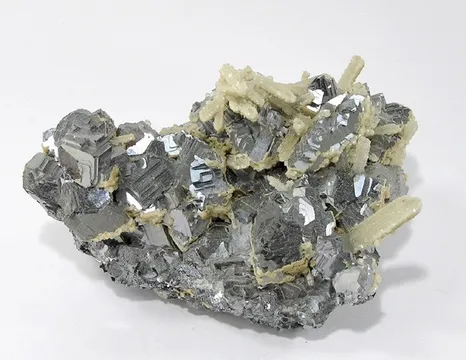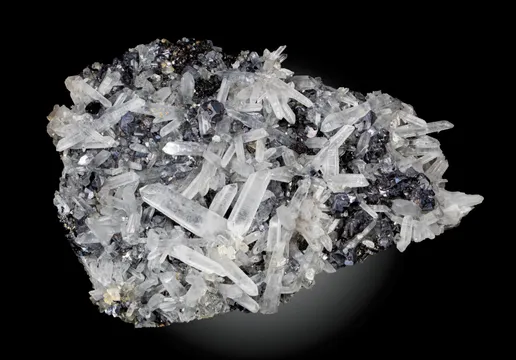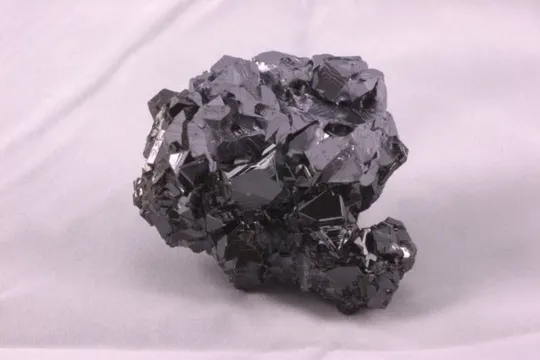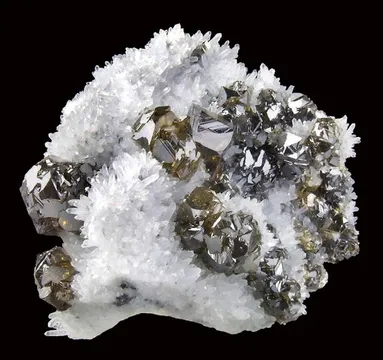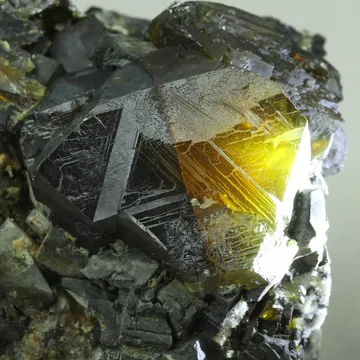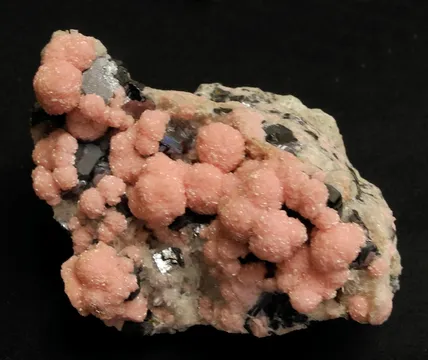
Gyudyurska mine, Bulgaria: Rhodope locality producing galena, sphalerite, chalcopyrite, pyrite, quartz; prized for crisp pocket specimens and the Rhodope look.
Key facts
Gyudyurska is one of the most collector-relevant mines of the Zlatograd–Erma Reka part of Bulgaria’s Central Rhodope lead-zinc province, a southward extension of the celebrated Madan ore field. It is not a single-cabinet curiosity locality but part of a working, historically deep, polymetallic system in which galena, sphalerite, chalcopyrite, pyrite, quartz, calcite, and late secondary zinc sulphates record both ore formation and the mine’s long afterlife in circulating underground waters. The mine lies near Erma Reka in Zlatograd Municipality, Smolyan Province, in metamorphic rocks of the Rhodope Massif; the ore belongs to the broader Madan style of steep hydrothermal veins, stockwork zones, and marble-hosted replacement skarn-ore bodies. For specimen collectors, Gyudyurska matters because it has produced handsome, hard, metallic sulfide combinations: mirror-bright cuboctahedral and spinel-law-twinned galena, lustrous black sphalerite tetrahedra, brassy to iridescent chalcopyrite, pyrite, and sprays or crusts of quartz, typically in compact but visually forceful combinations.
Regional View
Country View
The best Gyudyurska specimens have the unmistakable Rhodope look: dense sulfide architecture relieved by clear to white quartz, with galena faces flashing silver and sphalerite forming sharp black tetrahedra rather than shapeless ore. The most memorable pieces from the mine’s modern collecting history are not merely ore specimens but pocket specimens, formed in open spaces where the sulfides had room to develop crisp faces. A documented 2010–2011 pocket in the Gidiurska/Gyudyurska workings produced sharp, extremely lustrous cuboctahedral galenas on quartz, including museum-size pieces, and was large enough for eight miners to collect in it at one time.
Gyudyurska has also entered the mineralogical literature for subtler reasons. Galena from the mine was included in classic work on primary fluid inclusions; sphalerite from the Shumachevski Dol–Gyudyurska system has been used for modern thermometric and chemical studies of Rhodope ore fluids; and the mine is the Bulgarian occurrence of osakaite, Zn4(SO4)(OH)6 · 5H2O, documented as pale blue stalactitic material in the South Petrovitsa part of the mine. That late secondary sulfate assemblage—osakaite with namuwite and lahnsteinite—makes Gyudyurska a locality of interest not only for display-specimen collectors but also for specialists in mine-environment minerals and hydration-dehydration behavior.
Search for specimens: View all specimens from Gyudyurska mine, Bulgaria
Gyudyurska mine is recorded at Erma Reka, Zlatograd Municipality, Smolyan Province, Bulgaria, in the Rhodope Mountains, with the mine locality lying roughly 30 km by mountain pass from Madan. In collector usage the name appears in several spellings—Gyudyurska, Gjudurska, Gjurdurska, Gidiurska, and Giudiurska—so old labels should be read with some tolerance, provided the geography and associations agree. Mindat records the mine as underground-connected with the Borieva and Krushev Dol mines, reflecting the continuity of the ore system across the district rather than an isolated pocket occurrence.
Geologically, Gyudyurska belongs to the Central Rhodope Pb-Zn hydrothermal systems. The broader Madan deposits are hosted by a metamorphic complex of gneisses, amphibolites, micaschists, and marbles, cut by NW–SE to NNW-trending ore-controlling structures. Bulgarian studies of the Madan ore field distinguish three principal morphogenetic ore-body styles: steep simple veins along faults; deeper complex stockwork zones made of sulfide veinlets and disseminations in altered rock; and replacement skarn-ore bodies formed where ore-controlling faults intersect marble horizons. That setting explains the collector assemblage: sulfides and quartz formed in open spaces within veins and replacement cavities, while skarn and marble relationships created larger, irregular voids capable of yielding crystal-lined pockets.
The economic mineralization is a polymetallic Pb-Zn-Cu-Ag system. The government concession record for the South Petrovitsa section of the Gyudyurska deposit identifies lead-zinc ores and calculates concession payments on lead, zinc, copper, and silver contained in the ore. The same record gives average contents used for minimum-payment calculations of 5.04% lead, 2.64% zinc, 0.11% copper, and 22 g/t silver for undug quantities up to 35,000 tonnes. Those figures are not specimen grades, but they are useful context for why galena, sphalerite, chalcopyrite, and silver-bearing galena are central to the mineralogy.
Historically, the Erma Reka–Zlatograd mines sit in an old mining landscape. Local reporting describes Gyudyurska as the oldest section in the Zlatograd ore district, with a portal inscription dated 10 October 1928 at the South Petrovitsa entrance, and with older German equipment still remembered in the workings. Modern industrial development was shaped by GORUBSO, the postwar Bulgarian-Soviet mining organization founded in 1950 after earlier German and Bulgarian company activity in the district. The Erma Reka concentrating plant began operation in 1963, and the Zlatograd enterprise later emerged from the restructuring of GORUBSO-Madan, with the Zlatograd company registered as a joint-stock company in 2002.
Recent concession history is specific enough to matter for locality labels. The South Petrovitsa section of the Gyudyurska deposit was granted in 2004 to Gorubso-Zlatograd AD for 12 years, its term was extended in 2014 by another 15 years, and in 2019 the rights and obligations were transferred to Rodopi Eco Projects EOOD. The current official concession register lists Rodopi Eco Projects EOOD as concessionaire for extraction of metallic minerals—lead-zinc ores—from the South Petrovitsa section of the Gyudyurska deposit in Zlatograd Municipality, with a concession term of 324 months.
Collecting access should be treated as industrial and permission-only. Gyudyurska has been a working underground mine, and modern reporting describes continuous three-shift operation in the Gyudyurska section under Gorubso-Zlatograd, with more than 80 people working in galleries extending over 50 km through the old mine area. Underground collecting in active or abandoned Rhodope mines is dangerous, controlled, and in many cases prohibited; the specimens in commerce generally came out through miners, local dealers, or arranged visits rather than casual public collecting. The common hazards are exactly those a collector would expect in a deep sulfide mine: flooded levels, old timbering, collapse zones, shafts, mechanical haulage, and oxidizing sulfide dust.
The most important modern specimen episode tied to Gyudyurska is the large galena pocket photographed and described by Spirifer Minerals from the 2010–2011 period. It yielded sharp, highly lustrous cuboctahedral galenas on quartz, with some museum-size examples, and enough space inside the pocket for eight miners to work at once. Commercial listings and gallery records show the output range: miniature to cabinet pieces with galena cuboctahedrons to about 2.1 cm, spinel-law-twinned galena to about 3.2 cm, black lustrous sphalerite crystals to about 1.5–1.6 cm, isolated sphalerite tetrahedra to about 2.9 cm, and large-cabinet combination specimens more than 15 cm across. The most desirable pieces are those with freestanding crystals rather than massive ore: galena on quartz, sphalerite on quartz with chalcopyrite highlights, and balanced multi-sulfide combinations where the minerals are readable at a glance.
Chalcopyrite from Gyudyurska is the bright accent mineral in the mine’s sulfide assemblage, occurring as brassy to slightly iridescent crystals on or among black sphalerite, silver galena, pyrite, calcite, and quartz. Dealer-documented specimens show chalcopyrite as crystallized matrix or as lustrous golden patches intergrown with sphalerite tetrahedra, and a large-cabinet Weinrich specimen from Gjudurska described sharp black sphalerite crystals to 1.5 cm across a brassy, somewhat iridescent chalcopyrite matrix with minor galena. Gyudyurska chalcopyrite is at its best when it is fresh, metallic, and compositionally important to the piece rather than a dusting: sharp brassy faces that frame sphalerite or galena, isolated highlights on white quartz, or broad crystallized areas that give contrast without overwhelming the galena-sphalerite structure.
Quartz at Gyudyurska is the stage on which the metallic species perform, most often appearing as white to colorless crusts, needles, spears, and prismatic crystals associated with galena, sphalerite, chalcopyrite, pyrite, dolomite, and calcite. Gallery records include a 6.1 x 4.0 cm nest of doubly terminated quartz needles grown on a sphalerite base, and a 15.3 x 8.3 x 7.6 cm combination in which a large quartz crust supports isolated black sphalerite tetrahedra intergrown with chalcopyrite and a separate cubic galena. The best quartz pieces from this mine are not judged as stand-alone quartz in the Alpine sense; they are prized when clean, bright quartz gives scale, contrast, and open-space texture to sharp galena or sphalerite, especially in pocket specimens where the quartz is not crushed or dulled by later handling.
Galena is the signature display mineral of Gyudyurska, occurring as highly lustrous silver-gray cuboctahedrons, cubes, skeletal crystals, and spinel-law twins on quartz and sphalerite. The mine’s best-known modern pocket produced sharp cuboctahedral galenas on quartz, including museum-size specimens, and dealer records describe crystals to about 2.1 cm on matrix as well as well-formed spinel-law twins to about 3.2 cm on sphalerite. Good Gyudyurska galena has mirror-bright faces, crisp edges, visible crystal geometry, and a strong relationship to quartz or sphalerite; ordinary pieces are duller, massive, bruised, or too densely packed to show the crystal habit that makes Rhodope galena so desirable.
Sphalerite from Gyudyurska is typically black, lustrous, and tetrahedral, often with striated faces and close association with galena, chalcopyrite, pyrite, and quartz. Mindat gallery records and dealer descriptions document sharp tetrahedral black crystals to about 1.6 cm scattered on matrix, isolated sphalerite tetrahedra to about 2.9 cm on quartz crust with chalcopyrite and galena, and combination pieces where sphalerite provides the dark reflective mass against which brassy chalcopyrite and silver galena stand out. The most desirable Gyudyurska sphalerites are well-isolated, bright, undamaged tetrahedra on contrasting quartz or in balanced sulfide combinations; blocky, massive black ore with little crystal definition is much less compelling.
Other documented Gyudyurska minerals include pyrite, calcite, cerussite, lahnsteinite, namuwite, and osakaite. Pyrite is especially notable because Gyudyurska is one of the named Madan sources of pseudo-cubic trigonal rhombohedral pyrite: selected crystals from the district range from 1 to 6 cm, and one Gyudyurska crystal figured in the 2023 study was 3.3 cm long, with small cubic pyrites to 3 mm disrupting the rhombohedral edges and sub-millimeter graphite flakes observed frequently on Gyudyurska pyrite-R surfaces. The rarest mineralogical story is the secondary zinc sulfate assemblage from the South Petrovitsa deposit: osakaite was discovered as light blue stalactites with a light blue-green sticky crust, up to about 1 cm wide, in level 675 about 1 km into the main gallery; osakaite was considered the primary natural hydrate, while namuwite and lahnsteinite formed by dehydration during exposure to drier room conditions.
The first authenticity issue with Gyudyurska is locality spelling and district confusion. Labels may read Gyudyurska, Gjudurska, Gjurdurska, Gidiurska, Giudiurska, Erma Reka, Zlatograd, Madan, South Petrovitsa, or simply “Madan, Bulgaria.” Because the Madan-Zlatograd district contains several visually similar Pb-Zn mines—Krushev Dol, Borieva, Petrovitsa, 9th September, Strashimir, and others—older labels that give only “Madan” are inherently less precise. A specimen attributed to Gyudyurska is most convincing when it has an old dealer label, mine-specific provenance, or a combination of habits known from the locality: sharp cuboctahedral or twinned galena on quartz, black tetrahedral sphalerite, chalcopyrite, pyrite, and calcite/dolomite.
A documented mislabeling concern involves green sphalerite from the Zlatograd district. Mindat notes that very green sphalerite with quartz and galena, reportedly mined in 1969, has been reassigned to the Stephan Stevanov mine rather than Gyudyurska, even though similar material had appeared as nearby Gjudurska. This matters because “Madan green sphalerite” has market power; unusually green, transparent sphalerite should not be accepted as Gyudyurska without strong provenance. By contrast, the usual Gyudyurska sphalerite in verified examples is black and highly lustrous.
There is also a market-specific concern around skeletal galena. Spirifer’s Madan field report explicitly distinguished natural skeletal galenas from pieces “sculptured” like some seen on the market. Skeletal galena is a legitimate Rhodope habit, but collectors should inspect suspiciously uniform, aggressively undercut, or tool-marked pieces, especially when the specimen lacks a credible chain of custody. Natural pocket pieces typically retain associated quartz, sphalerite, pyrite, or calcite and show growth features consistent across the faces; artificially enhanced galena may have unnaturally fresh broken surfaces, inconsistent luster, or cavities that look mechanically excavated rather than crystallographic.
Condition issues are straightforward but important. Galena is heavy, relatively soft, and easily bruised along edges; small chips on cuboctahedral corners are common and should be disclosed rather than ignored. Sphalerite cleaves and chips readily, so the best black tetrahedra should be checked under a loupe for missing tips and rubbed edges. Quartz needles and spears on Gyudyurska combinations are prone to breakage, and calcite or dolomite coatings can be scratched or etched by improper cleaning. Avoid acidic cleaning on mixed sulfide-carbonate specimens unless you are intentionally removing calcite and understand the risk to aesthetics and provenance.
Handling requires ordinary sulfide caution. Galena is lead sulfide, so specimens should not be used for jewelry, elixirs, children’s handling, or any application involving abrasion or ingestion; wash hands after handling dusty pieces, and avoid dry brushing that creates powder. The osakaite-namuwite-lahnsteinite assemblage is a special case: these hydrated zinc sulfate minerals are products of mine waters and dehydration behavior, and the 2022 study indicates that namuwite and lahnsteinite can form from osakaite during storage in drier atmospheric conditions. Such material is scientifically interesting but not a durable display mineral in the usual cabinet sense; it should be kept stable, cool, dry but not desiccated to extremes, and away from repeated handling.
Market availability is better than for many obscure Bulgarian mines but much thinner than for generic “Madan” material. Fine Gyudyurska galena and sphalerite combinations appear periodically through specialist dealers and archived collections, especially from 2010–2012-era finds, while lower-priced small cabinet pieces still surface with galena, quartz, pyrite, sphalerite, and chalcopyrite. The top tier—large, undamaged, highly lustrous galena on quartz, or balanced sphalerite-chalcopyrite-galena combinations with sharp crystals—is much less common and should be bought on condition, provenance, and aesthetics rather than locality name alone.
In one of the most vivid accounts from the mine, reporter Desi Radikova descended into Gyudyurska in 2013 and described a working industrial world still threaded through with prewar and postwar memory. The article calls Gyudyurska the oldest section of the Zlatograd ore district and places the reader at the South Petrovitsa entrance, where a sign reads “10 October 1928.” From there the route goes underground toward horizon 823, then after ten minutes on foot to a 211 m shaft. Water dripped from overhead, rails disappeared under puddles, and stepping off the rails was risky. The descent was made in an elevator cage fitted with a German emergency brake known locally as the “parachute,” a pair of paw-like mechanisms designed to catch the cage if the hoist failed.
The story attached to that brake is the sort of detail miners preserve for generations. According to the mine guides, a German engineer demonstrated the safety system by putting his own family, children included, into the cage and ordering the hoisting ropes cut. The “parachutes” caught after a fall of only about 10 cm. In 2013 the ropes were still serious business: each was about 350 m long, replaced every two years, and checked every six months. The hoist machinery itself was described as Siemens equipment installed in 1941, with two large drums, an electric motor, gearbox, manual brake, signal systems, and a depth indicator. The operator interviewed in the report had worked there for a decade; the mine specialists guiding the reporter had spent 18 and 30 years, respectively, in the Erma Reka mining world.
On the road to South Petrovitsa, the same report paused at an object that would seem improbable in a mineral guide but belongs completely to Gyudyurska’s landscape: a 120 m iron bridge erected in 1956. It was described as riveted, assembled without crane or welding, and used in the past by 50-ton machines carrying ore from the Severna Gradishte mine toward Yuzhno Gradishte. The local guides told a story that when a single part failed to fit during assembly, the foreign designers shipped the entire structure back to Germany, corrected it, returned it, and mounted it in place, where it continued to function.
There is also a wartime legend in the mine’s oral history. Toward the end of August 1944, the report says, the Germans intended to blow up what they had built in the district, with explosives loaded into a wagon coming along the cableway from Kardzhali. The plan was stopped by Rhodope locals, who cut the line so the dynamite never arrived. Whether read as industrial history or mining folklore, the episode captures the peculiar continuity of Gyudyurska: German equipment, Bulgarian miners, Soviet-era reconstruction, post-socialist concession history, and modern specimen collecting all occupying the same underground maze.
Collectors know another Gyudyurska story, this one from the specimen trade. During a 2012 Madan trip report, Spirifer Minerals published photographs and notes from an earlier 2010–2011 pocket in the Gidiurska mine. The pocket was huge, and the phrase that stuck was that eight people could collect there at the same time. It produced sharp, extremely lustrous cuboctahedral galenas on quartz, including museum-size specimens. Photographs showed galena in situ on the pocket walls, freshly collected specimens, miners working in the pocket, and thousands of specimens attributed to that single find. For a district famous for galena, that is the kind of pocket that fixes a mine name in collector memory.
A later Spirifer field visit in 2013 did not focus on collecting inside Gyudyurska, but it added another layer to the locality’s visual record. The party visited the Erma Reka area, including Gidiurska mining facilities, an old flotation dump, shafts, the headframe, the main entrance, and ore carts being unloaded. Their captions record odd, concrete sights: a lake on the old flotation dump and the “strange location of a shaft - in the river.” Such details are useful because they remind collectors that Gyudyurska is not an abstract label from a show flat; it is a working Rhodope mining landscape of portals, haulage, flotation waste, road cuts, village memory, and the occasional extraordinary pocket opened in the dark.
Petrov, P., Stanimirova, T., & Stariradeva, S. (2022). “First occurrence of the mineral osakaite Zn4(OH)6(SO4)•5H2O for Bulgaria.” Review of the Bulgarian Geological Society, 83(3), 35–38. Documents osakaite from stalactites in the Gyudyurska mine, South Petrovitsa deposit, together with namuwite and lahnsteinite produced by dehydration.
Piperov, N., Petrov, P., & Atanassova-Vladimirova, S. (2023). “Thermometric and chemical studies of fluid inclusions in sphalerite from Rhodope lead-zinc deposits: Shumachevski Dol – Gyudyurska (Madan District) and Kenan Dere (Laki District), Bulgaria.” Geologica Balcanica, 52(1), 49–63. Uses sphalerite inclusions from the Shumachevski Dol–Gyudyurska system to interpret ore-fluid temperature, salinity, pressure, pH, and sphalerite deposition mechanisms.
Moëlo, Y. (2023). “Pseudo-cubic trigonal pyrite from the Madan Pb–Zn ore field (Rhodope Massif, Bulgaria): morphology and twinning.” European Journal of Mineralogy, 35, 333–346. Includes Gyudyurska as one of the named sources of rhombohedral pyrite from the Madan ore field and figures a 3.3 cm Gyudyurska crystal.
Vassileva, R. D., Atanassova, R., & Bonev, I. K. (2009). “A review of the morphological varieties of ore bodies in the Madan Pb-Zn deposits, Central Rhodopes, Bulgaria.” Geochemistry, Mineralogy and Petrology, 47, 31–49. The key geological framework for the Madan-style vein, stockwork, and replacement skarn-ore bodies that explain Gyudyurska’s specimen-forming cavities.
Bonev, I. K. (2007). “Crystal habit of Ag-, Sb- and Bi-bearing galena from the Pb-Zn ore deposits in the Rhodope Mountains.” Geochemistry, Mineralogy and Petrology, 45, 1–18. Important district-level study of galena morphology and trace-element relationships in Rhodope Pb-Zn deposits; Gyudyurska galena is also tied to this reference in locality databases.
Piperov, N. B., Penchev, N. B., & Bonev, I. K. (1977). “Primary fluid inclusions in galena crystals. II. Chemical composition of the liquid and gas phase.” Mineralium Deposita, 12(1), 77–89. Classic fluid-inclusion paper cited for Gyudyurska galena occurrence records.
Mindat reference page for Petrov, Stanimirova & Stariradeva (2022). Useful bibliographic cross-reference linking the 2022 osakaite paper to Gyudyurska occurrences of osakaite, namuwite, and lahnsteinite.
Mindat locality page: Gyudyurska mine, Erma Reka, Zlatograd Municipality, Smolyan Province, Bulgaria — Core locality entry with coordinates, mineral list, alternate geographic context, and literature references.
Mindat gallery for Gyudyurska mine — Valuable for seeing the documented visual range of Gyudyurska specimens, including galena, sphalerite, quartz, chalcopyrite, and pyrite combinations.
Osakaite from Gyudyurska mine — Occurrence page summarizing the South Petrovitsa osakaite find, including the level 675 location and stalactitic habit.
Namuwite from Gyudyurska mine — Occurrence page for the dehydration-related namuwite associated with the osakaite stalactites.
Lahnsteinite from Gyudyurska mine — Occurrence page for lahnsteinite in the same hydrated zinc sulfate assemblage.
Petrov, Stanimirova & Stariradeva (2022), osakaite paper PDF — Primary source for the Bulgarian osakaite occurrence and its dehydration products.
Piperov, Petrov & Atanassova-Vladimirova (2023), sphalerite fluid-inclusion paper PDF — Best technical source for hydrothermal-fluid interpretation in the Shumachevski Dol–Gyudyurska system.
Moëlo (2023), pseudo-cubic trigonal pyrite from Madan — Detailed crystallographic treatment of the unusual rhombohedral pyrite, including Gyudyurska material.
Vassileva, Atanassova & Bonev (2009), Madan ore-body morphology PDF — Geological background for the vein, stockwork, and replacement styles that control pockets and ore textures.
Bonev (2007), galena crystal habit in Rhodope Pb-Zn deposits PDF — Specialist paper on Rhodope galena habits, trace elements, and open-space crystallization.
Official Bulgarian concession register: South Petrovitsa section of the Gyudyurska deposit — Government record for the current concession, concessionaire, ore type, metals, and term.
Zlatograd municipal economy page — Local-government context for the importance of lead-zinc mining and Gorubso-Zlatograd in the municipality.
Zlatograd newspaper article on Gorubso-Zlatograd history — Useful historical account of GORUBSO, the Erma Reka concentrator, privatization, and the modern Zlatograd enterprise.
Rodopi Vest 2013 report from Gyudyurska — Vivid Bulgarian field report from inside the mine, with details on the 1928 portal, shaft, hoist, bridge, and working conditions.
Spirifer Minerals: Trip to Madan, Bulgaria — Important collector field report documenting the huge 2010–2011 Gidiurska galena pocket and broader Madan collecting context.
Spirifer Minerals: Madan, Bulgaria, part I — Photo-rich field note including Erma Reka/Gidiurska facilities, headframe, main entrance, flotation dump, and ore carts.
Minerals Bulgaria archive: Melted-habit galena, sphalerite, chalcopyrite, pyrite from Gyudyurska — Dealer archive showing a large Gyudyurska sulfide combination and documenting market-scale cabinet material.
Minerals Bulgaria archive: Truncated galena, iridescent sphalerite, pyrite, calcite from Gyudyurska — Dealer record useful for typical Gyudyurska galena-sphalerite-calcite-pyrite combinations.
Weinrich Minerals archive: Sphalerite with galena and chalcopyrite from Gjudurska — Large-cabinet dealer record describing sharp black sphalerite to 1.5 cm on iridescent chalcopyrite matrix.
Spirifer Minerals archive: Galena on sphalerite from Gidiurska — Dealer record for lustrous 3.2 cm spinel-law-twinned galena on sphalerite.
Minfind archive: Galena from Gidiurska Mine — Archived sale listing documenting cuboctahedral galena to 2.1 cm from the mine, with notes on condition.
Mineral Masterpiece archive: Galena, sphalerite, quartz from Gjudurska — Older dealer-gallery entry noting mirror-bright galena on quartz needles from a 2010 find.