A collector's guide to Madan ore field, Bulgaria: its geology, mining history and notable minerals, illustrated with the 224 specimens documented from this locality on EarthWonders.
Key facts
Madan is one of the great European sulfide localities: a compact but geologically varied Pb-Zn-Ag district in the central Rhodope Mountains of southern Bulgaria, close to the Greek border, where ore veins and marble-hosted replacement bodies cut a high-grade metamorphic terrane of gneisses, amphibolites, mica schists, and marbles. To collectors, its name means architectural galena, lustrous sphalerite, brassy chalcopyrite, striated pyrite, quartz sprays, calcite, manganocalcite, rhodochrosite, and a supporting cast of manganese skarn minerals that gives the district a personality quite different from the classic carbonate-hosted Pb-Zn camps of the Alps, the Balkans, or the American Midwest.
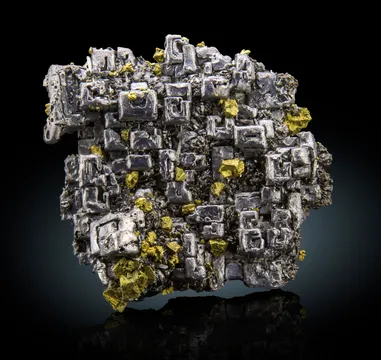
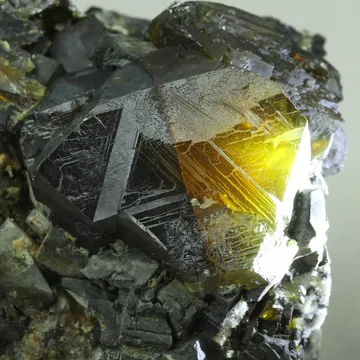
The best Madan specimens are not merely “ore.” They are constructed pieces: silvery cubic to cubo-octahedral galena set on black or green sphalerite, frosted or glassy quartz needles, bronze-yellow chalcopyrite, and pale carbonate gangue. Many show the high-contrast Rhodope look that made Madan material familiar on the European show circuit: bright metallic crystals on white quartz or pale calcite, sometimes with the deep olive-green transparency of cleiophane sphalerite. The most distinctive galena can be stepped, cavernous, skeletal, or almost “melted” in appearance; the most memorable sphalerite may be gemmy green, lustrous black, or complexly twinned; and the pyrite has recently attracted crystallographic attention for unusual pseudo-cubic trigonal rhombohedral forms.
Regional View
Country View
Madan’s collector importance rests on the unusually specimen-friendly nature of parts of the ore system. The veins produced open-space fillings with druses, crustifications, breccias, and crystal-lined cavities; the replacement bodies developed around marble horizons and manganese-rich skarns, locally leaving cavities that grew well-crystallized sulfides, quartz, and carbonates. That combination explains why the district yielded both large production tonnage and cabinet-quality display specimens. It also explains why good Madan labels are so variable: “Madan ore field” may be all that survives, while better labels name Krushev Dol, Petrovitsa, Borieva, Gyudyurska, Septemvri, Osikovo, Mogilata, Konski Dol, or other deposits and mine sections within the district.

Photo: Wikimedia Commons
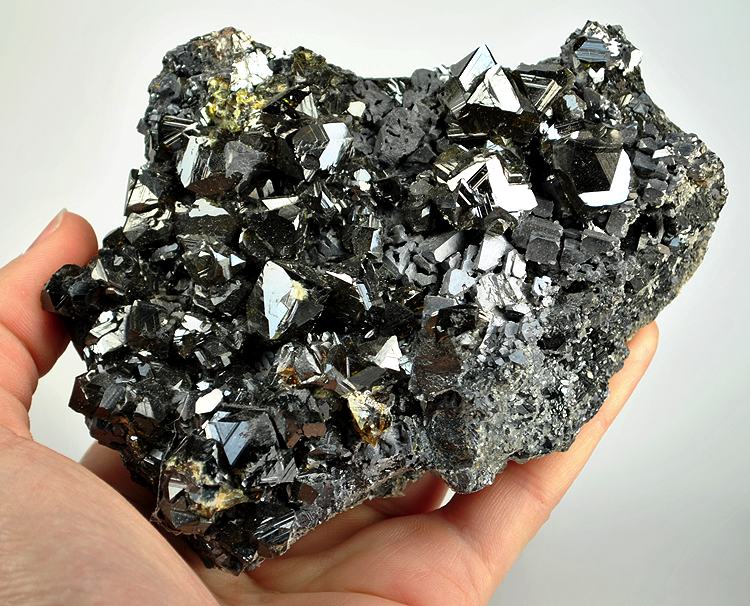
Photo: Wikimedia Commons
Search for specimens: View all specimens from Madan ore field, Bulgaria
The Madan ore field lies in the Central Rhodope Mountains, about 70 km south of Plovdiv, within the broader Central Rhodope Dome system. It is the best-known and largest of the Pb-Zn ore fields associated with that dome and has long been treated in the geological literature as one of Bulgaria’s principal base-metal districts. The economically important ores are hydrothermal Pb-Zn-Ag vein and replacement deposits of Tertiary age, with hydrothermal muscovite ages around 30.0–30.6 Ma reported for the mineralizing event.
Structurally, Madan is controlled by major north-northwest to south-southeast fault zones cutting metamorphic rocks of the Rhodope complex. The ore bodies occur in three main morphogenetic styles. The first is steep vein mineralization, commonly cited as 1–3 m wide and locally much wider, with some structures traceable for kilometers. The second is stockwork mineralization, developed as disseminated networks of sulfide-bearing veinlets in hydrothermally altered rock. The third, and mineralogically crucial, is skarn-related replacement mineralization where steep ore faults intersect marble horizons; replacement can extend outward from the veins into carbonate host rock, producing bed-like, mushroom-shaped, columnar, or irregular orebodies.
The district’s geological flavor is manganese-rich. Before the main sulfide event, manganese-bearing clinopyroxene skarns developed in marble horizons, with johannsenite-hedenbergite compositions important in the skarn assemblage. Retrograde alteration then introduced or transformed the assemblage into manganoan amphiboles, pyroxenoids such as rhodonite, bustamite, and pyroxmangite, manganilvaite, carbonates, and quartz. The principal ore stage deposited sphalerite, galena, chalcopyrite, and pyrite in quartz-sulfide assemblages, followed by later carbonate-quartz mineralization with lesser sulfides. Galena is characteristically more dominant in the veins, while sphalerite becomes more abundant in many skarn-related replacement bodies.
Historically, Madan is not a young mining camp. Lead-zinc mineralization was known in antiquity, with regional accounts tying early lead extraction to Thracian and Hellenic times and local history preserving much older mining traditions around the Sharenka area. Medieval mining tools have been reported from old workings, and extraction continued through later historical periods. The modern industrial history begins in earnest during the twentieth century, when the Rhodope Pb-Zn deposits were brought into systematic exploration and production.
The socialist-era mining expansion transformed both the district and the town. After World War II, the Bulgarian-Soviet GORUBSO enterprise became the central mining organization for the Rhodope base-metal deposits. The 1950s saw rapid development: old workings were modernized, new mines such as Gradishte, Petrovitsa, Krushev Dol, Konski Dol, Sharenka, Varba, Spoluka, Ribnitsa, and Izvorite were built or expanded, and flotation or enrichment plants at Madan, Rudozem, and Rovino came into operation. A 14 km ropeway connecting Borieva and Rudozem was constructed in the mid-1950s, part of a mine-and-plant infrastructure that made Madan a major industrial center rather than simply a remote mountain locality.
Production statistics underline the scale. Geological summaries report more than 95 million tonnes of ore mined from the Madan ore field between 1941 and 1995, averaging about 2.54% Pb and 2.10% Zn. Broader Rhodope mining-history accounts give even larger regional totals for GORUBSO-controlled Pb-Zn production, with Madan providing a very large share of the lead and zinc extracted. By the late socialist period the district had become a defining mining landscape of southern Bulgaria, supporting mines, processing plants, mining settlements, technical schools, and a workforce measured in thousands.
For collectors, the productive names to know include Krushev Dol, Petrovitsa, Borieva, Gyudyurska, Septemvri, Osikovo, Mogilata, Konski Dol, and associated deposits in the Madan administrative-mining network. Krushev Dol is especially associated with fine green cleiophane sphalerite, galena, quartz, chalcopyrite, and pyrite combinations, including material from a notable 2006 sphalerite find. Septemvri, formerly known as Deveti Septemvri or “9th of September,” is famous for galena, quartz, sphalerite, pyrite, and the much-discussed skeletal or cavernous galena habit. Borieva is important for galena and sphalerite, and in recent mineralogical work it is one of the most frequently cited sources for unusual rhombohedral pyrite. Osikovo and Mogilata, within the Septemvri mine area, are mineralogically important skarn-related deposits and co-type localities for manganilvaite.
Collecting access should be understood as industrial rather than recreational. The classic Madan specimens came from underground mining, not casual surface collecting, and the active or recently active workings are private mine sites with normal safety, legal, and operational restrictions. Collector specimens typically reach the market through miners, local contacts, established Bulgarian dealers, and older collections, not through open public digging. The town itself preserves its mining identity through museum displays, the Rhodope Crystal collection, and the Spoluka underground mining museum project, but museum access is separate from access to working mines.

Photo: Wikimedia Commons
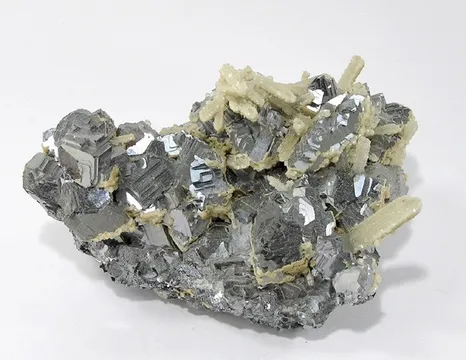
Galena is the signature display mineral of Madan, occurring as bright silver-gray cubes, cubo-octahedra, spinel-law twins, modified blocky groups, and the district’s celebrated stepped, skeletal, cavernous, or partially dissolved-looking forms; crystals on cabinet pieces commonly range from a few millimeters to several centimeters, with documented specimen descriptions noting individual galena crystals around 2–3 cm and occasional larger architectural groups, especially from Borieva, Krushev Dol, Petrovitsa, Konski Dol, and the Septemvri mine system. The strongest pieces are not simply big galena clusters but balanced assemblages: mirror-bright or satin-metallic galena perched on quartz needles, black sphalerite, olive-green cleiophane, chalcopyrite, calcite, or rhodochrosite, with three-dimensional separation and crisp edges. Ordinary Madan galena can be massive, bruised, granular, or too crowded in sulfide matrix; better specimens have open composition, undamaged crystal faces, visible growth zoning or terracing, and enough associated quartz or sphalerite to identify the Rhodope style at a glance.
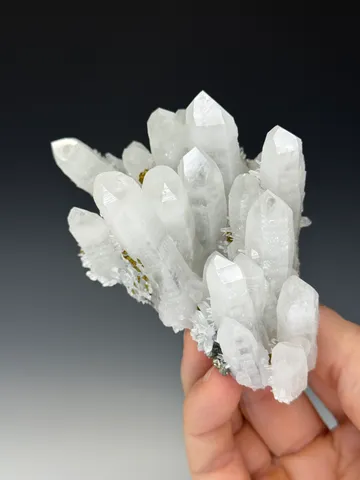
Quartz is one of the essential gangue minerals at Madan and is often the stage on which the sulfides perform: white to colorless crystals occur as dense druses, needle-like sprays, radial clusters, crusts, and transparent to milky points lining cavities in vein and replacement ore. In the most collectible combinations, quartz forms clean white contrast beneath silvery galena, black or green sphalerite, pyrite, chalcopyrite, calcite, or rhodochrosite; in some Krushev Dol and Septemvri pieces, slender quartz needles emphasize the relief of galena cubes or nestle around gemmy cleiophane. Rock crystal is common enough in the district to have been studied as a gemological material from Krushev Dol, but collector-grade quartz from Madan is valued less as isolated quartz and more as an aesthetic gangue: sharp, bright, undamaged sprays that give lift and contrast to the sulfide assemblage separate the best pieces from simple quartz-coated ore.
Sphalerite from Madan ranges from lustrous black, iron-rich crystals and massive sulfide matrix to the prized low-iron green cleiophane variety, which may be translucent to transparent, olive-green to yellow-green, and sharply crystallized in complex tetrahedral, dodecahedral, octahedral-looking, or twinned forms. Krushev Dol and Septemvri are especially important for aesthetic sphalerite combinations, with documented cabinet specimens showing gemmy green crystals on quartz, calcite, or sulfide matrix, and a 2006 Krushev Dol find noted for scintillating, twinned olive-green sphalerite associated with spinel-twinned galena. Good Madan sphalerite is judged by luster, transparency, color, crystal definition, and contrast: a sharp green cleiophane group on white quartz or pale calcite is far more desirable than a dark, crowded mass, while black sphalerite becomes collectible when it provides a glossy sculptural matrix for galena, chalcopyrite, pyrite, or quartz.
Calcite at Madan is part of the late carbonate-quartz and manganese-rich skarn-retrograde story, appearing as white, tan, pale pink, manganiferous, drusy, tabular, rhombohedral, and polycrystalline growths with sulfides and quartz. Collector pieces include calcite on sphalerite, calcite with quartz, calcite coatings on galena, and manganocalcite masses and crystal groups; some reported collector specimens from Madan calcite are fluorescent under both longwave and shortwave UV, and manganese-bearing calcite from the district is represented in Bulgarian museum displays. The most desirable calcite specimens are clean, well-separated, and visibly integrated into the sulfide association—calcite that sharpens the contrast against black sphalerite or silver galena is far preferable to stained, bruised carbonate crust, though tan hematite-stained calcite on crystallized sphalerite is also part of the district’s recognizable look.
Chalcopyrite is a major accessory ore mineral in Madan’s quartz-sulfide stage and a key visual accent on collector specimens, typically appearing as brassy yellow to iridescent metallic crystals and aggregates among galena, sphalerite, pyrite, quartz, and calcite. Its best expressions include sharp brassy crystals to centimeter scale, glittering coatings on galena, and sculptural combinations where yellow chalcopyrite breaks up the gray-black sulfide palette; Borieva, Septemvri, Krushev Dol, and the broader Madan district have all supplied handsome chalcopyrite-bearing association pieces. Fine Madan chalcopyrite is not usually about giant isolated crystals; it is about placement, color, and contrast—crisp, lustrous brassy crystals on black sphalerite or silver galena with clean quartz are much more attractive than dull tarnished patches or massive chalcopyrite mixed into ore.
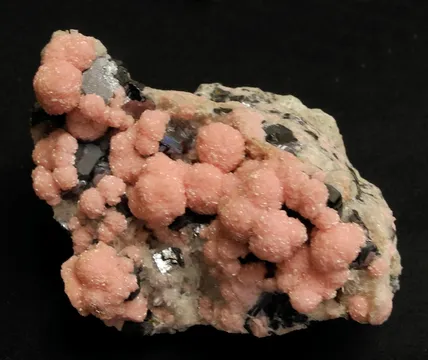
Rhodochrosite is a manganese-carbonate expression of Madan’s Mn-rich hydrothermal system, occurring as light pink to salmon-pink spherical, radial, rosette-like, or drusy aggregates on quartz, galena, pyrite, and sulfide matrix rather than as the large transparent rhombs associated with some classic American or South African localities. Documented Madan specimens include ball-shaped salmon-pink rhodochrosite clusters with quartz and galena, small “rose”-shaped groups around 1 cm across on quartz, and rare rhodochrosite-on-galena combinations from the Septemvri mine area. The best pieces are uncommon and immediately appealing: fresh pink color, discrete rounded groups, and a clean association with galena or quartz make a Madan rhodochrosite specimen stand out, while dull pale carbonate crusts can be difficult to distinguish from other manganese-bearing carbonates without analytical context.
Pyrite from Madan is more varied than many collectors realize: in ordinary association pieces it appears as bright brass-yellow cubes, pyritohedra, striated crystals, druses, and small metallic accents with galena, sphalerite, quartz, chalcopyrite, and calcite, but the district has also yielded unusual rhombohedral-looking pseudo-cubic trigonal pyrite crystals up to several centimeters across. The recent crystallographic study of more than 200 Madan pyrite samples emphasized Borieva as a particularly important source for twinned rhombohedral material, while other labels include Gyudyurska, Deveti Septemvri, and Krushev Dol. Strong collector pieces show sharp form, fresh luster, and separation from the sulfide matrix; ordinary examples tend to be crowded brassy druse, edge-worn crystals, or pyrite that serves only as an accessory rather than the visual focus.
Beyond these familiar display minerals, Madan has a deep mineralogical list rooted in both Pb-Zn hydrothermal ores and Mn-rich skarn alteration. Documented species include arsenopyrite, pyrrhotite, marcasite, cobaltite, tennantite-tetrahedrite series minerals, pearceite, acanthite, native silver, native gold, cerussite, anglesite, linarite, malachite, baryte, dolomite, siderite, ankerite, rhodonite, bustamite, pyroxmangite, johannsenite, hedenbergite, actinolite, chlorite-group minerals, titanite, monazite-group minerals, gypsum, namuwite, and osakaite. The district’s most important type-locality mineral is manganilvaite, the Mn analogue of ilvaite, described from skarn-related Pb-Zn deposits including Osikovo and Mogilata in the Madan ore district; for systematic collectors, top-quality manganilvaite on johannsenite or in Mn-skarn assemblage is far rarer than the showy galena-sphalerite combinations that made the locality famous.
Madan material is abundant enough that good specimens remain regularly available, but the quality range is very wide. Common pieces consist of mixed galena, sphalerite, quartz, chalcopyrite, pyrite, and calcite with moderate damage, crowded growth, or only one attractive face. Better pieces have sculptural balance, sharp sulfide crystals, clean contrast, and a specific mine or deposit label. Top pieces—especially gemmy green cleiophane from Krushev Dol or Septemvri, large architectural galena from Borieva or the Septemvri system, strong skeletal galena, unusual pyrite, or rhodochrosite-on-galena—are much less common than the generic “Madan ore field” label suggests.
The principal authenticity issue is skeletal or reverse-skeletal galena, particularly material attributed to the Septemvri mine. Collector debate has documented concern that some hollow or cavernous galena cubes may have been artificially modified by abrasive blasting, drilling, or other mechanical treatment. Natural stepped and cavernous galena does occur from Madan, and some specimens show quartz, chalcopyrite, pyrite-lined microvugs, or overgrowth textures that support natural formation. The problem is that the habit is visually dramatic and easily imitated by selectively removing softer galena from cube centers. When buying expensive skeletal galena, inspect under magnification for unnaturally rounded interiors, uniform abrasion, matte freshly exposed surfaces, damaged inclusions, inconsistent luster, tool marks, and suspiciously isolated “perfect” hollow cubes. Provenance, old collection history, and a reputable dealer’s return policy matter.
Madan galena is dense and relatively soft, with perfect cubic cleavage, so crystal corners and edges bruise easily. Even attractive specimens may have contacted or nicked terminations, especially on galena and sphalerite. Sphalerite cleaves readily and can show small chips on high points; bright chalcopyrite may tarnish or darken; pyrite is generally stable in display conditions but should still be kept dry because any sulfide specimen with microfractures or mixed marcasite/pyrite should be protected from humidity. Quartz sprays are often delicate and can be snapped at the edges of combination pieces. Calcite and rhodochrosite are softer carbonates and should be kept away from acids, even weak cleaning acids.
Cleaning requires restraint. A quick water rinse and soft brush may be safe for robust quartz-sulfide specimens, but aggressive chemical cleaning can damage carbonates, brighten or alter sulfide surfaces unnaturally, and erase the subtle patina that helps distinguish older Madan pieces. Never use acid on specimens containing calcite, manganocalcite, rhodochrosite, or delicate carbonate coatings. Because galena is a lead sulfide, normal specimen handling is safe when sensible precautions are used: wash hands after handling, keep dust out of the air, avoid grinding or trimming without proper controls, and keep small chips away from children and pets.
Madan calcite and manganocalcite may fluoresce, especially where manganese is present. Display pieces with pale carbonates should be tested gently under longwave and shortwave UV, but UV response should not be assumed for every specimen. Pink manganese-bearing carbonates can fade or lose freshness under harsh display lighting over long periods, so rhodochrosite, manganocalcite, and pale carbonate-rich specimens are best displayed away from direct sunlight and excessive heat.
Label discipline is important. “Madan” can mean the town, municipality, ore field, mine area, or a dealer shorthand for any of several deposits in the district. Older labels may use “Deveti Septemvri,” “9th of September,” or “Septemvri” for the same mine system, and mine names may reflect administrative units rather than a single geological orebody. If a specimen has a specific mine label—Krushev Dol, Borieva, Petrovitsa, Osikovo, Mogilata, Gyudyurska, Konski Dol, Septemvri—preserve it carefully; that information can materially affect both scientific interest and market value.
One of the best origin stories from the modern Madan mining revival begins not in a laboratory but at the mouth of a cave used by shepherds. In the village of Boevo, Hassan Kerminov, the village elder, showed ore pieces to Strashimirov; part of a lead-zinc-rich layer reportedly appeared above the entrance of a cave where cattle were sheltered in bad weather. Strashimirov took the crystals to his friend, mining engineer Ivan Savov, who immediately understood the implication and exclaimed, “This is a great treasure if these ore reserves are in industrial quantities.” The assay was startling: 10–15% lead and 20–23% zinc, with other valuable elements present. That moment, half pastoral and half industrial, neatly captures the Rhodope mining story—ore literally visible in the mountain wall, recognized first by local eyes, then translated into a modern mining proposition.
After World War II, the Rhodope deposits became the focus of a large Bulgarian-Soviet geological effort. The complex geological expedition included about 130 Soviet specialists working alongside Bulgarian geologists, chemists, and technicians. Their task was broad, but the lead-zinc results in the Rhodopes quickly dominated the story. The expedition established 42 ore deposits, and roughly three quarters were in the field around Madan. Soviet geologists were impressed enough to give the mountains a memorable nickname: the “Bulgarian Urals.” For collectors who know Madan as a source of galena and sphalerite miniatures, that phrase may sound grandiose, but the production statistics and underground infrastructure show why it stuck.
The creation of GORUBSO in May 1950 turned a mining district into a mining society. The enterprise’s full name, “Gornoe rudnoe bolgaro-sovetskoe obshtestvo,” reflected its Bulgarian-Soviet origin, with equal capital shares of 5 billion levs from each side. In just a few years, old mines were refurbished and more than ten new mines or mining sections were developed, including Gradishte, Laikov Chukar, Petrovitsa, Krushev Dol, Konski Dol, Sharenka, Varba, Spoluka, Ribnitsa, and Izvorite. Enrichment plants began operating in Madan, Rudozem, and Rovino in 1951, 1953, and 1956. The physical footprint grew rapidly: industrial buildings, mining settlements, roads, processing plants, and a workforce shaped by mechanization, drainage, ventilation, and electric blasting.
One of the most vivid pieces of that infrastructure was the 14 km ropeway built in 1954–1955 between Borieva and Rudozem, followed by another between Karaaliev Dol and Rudozem. It is easy to imagine ore buckets moving through the Rhodope air, connecting underground sulfide veins to flotation plants and metallurgical supply chains. The numbers tell the same story in another language: ore extraction rose from 248,000 tonnes in 1950 to 1.367 million tonnes in 1955. By 1965, Bulgaria was reported as eighth in the world for lead extraction and twelfth for zinc, with 3.128 million tonnes of ore mined that year at 2.53% lead and 2.28% zinc. For about a quarter century, GORUBSO maintained output above 3 million tonnes of ore annually.
By 1988, the scale was extraordinary. GORUBSO employed 13,716 people, including 9,523 workers, 771 specialists, 502 managers, students, security staff, and nearly two thousand non-production employees. Nineteen mines with 51 sections and four enrichment plants were operating. This was not just a mining company; it was the organizing structure of towns, labor migration, schools, hospitals, housing, and identity across the central Rhodope mining belt. Madan’s transformation from a small settlement into a mining town is inseparable from this industrial period.
The post-1989 story is rougher. Metal prices fell, the planned economy disappeared, and GORUBSO entered the privatization turbulence of the 1990s. One account called the old enterprise a “socialist dinosaur,” while another participant said it had been “carved up and sold for a song.” In 1999 thousands of employees were released, and the former giant was split into territorial successor companies. For mineral collectors, those years also helped move older Bulgarian material into Western collections and show circuits. Specimens that had once circulated locally, in institutional collections, or through mine contacts began appearing in dealer stocks, private collections, and online offerings.
Madan has also worked to preserve the underground memory of the district. The Spoluka mine, whose production had stopped in 1972, was later adapted as an underground mining museum. Visitors put on helmets, enter a preserved mine working, and can see rail track, equipment, supports, compressors, tools, and mining spaces rather than merely photographs. In the Rhodope Crystal Hall, nearly 600 mineral specimens from the region have been displayed, and museum staff have emphasized that the crystals need a stable, shaded environment—darkness, no sharp temperature swings, and no direct sunlight, particularly for manganese-bearing specimens that can lose color. It is an unusually fitting warning in a town where crystals came from hundreds of meters underground and where the difference between a fresh Madan specimen and a tired one can be the difference between mountain darkness and careless display.
Vassileva, R. D., Bonev, I. K., Marchev, P., & Atanassova, R. (2005). “2-1: Pb-Zn deposits in the Madan ore field, South Bulgaria.” Ore Geology Reviews, 27, 90–91. DOI: 10.1016/j.oregeorev.2005.07.026. Concise but important geological summary of the Madan ore field, including deposit type, production, structural controls, orebody morphology, mineral stages, and main ore minerals.
Marchev, P., Kaiser-Rohrmeier, M., Heinrich, C., Ovtcharova, M., von Quadt, A., & Raicheva, R. (2005). “Hydrothermal ore deposits related to post-orogenic extensional magmatism and core complex formation: The Rhodope Massif of Bulgaria and Greece.” Ore Geology Reviews, 27, 53–89. Regional synthesis placing Madan among the Rhodope Pb-Zn-Ag deposits related to post-orogenic extension, dome uplift, and magmatism.
Moëlo, Y. (2023). “Pseudo-cubic trigonal pyrite from the Madan Pb-Zn ore field (Rhodope Massif, Bulgaria): morphology and twinning.” European Journal of Mineralogy, 35, 333–346. DOI: 10.5194/ejm-35-333-2023. Detailed crystallographic study of unusual rhombohedral pyrite from Madan, with discussion of Borieva, Gyudyurska, Deveti Septemvri, and Krushev Dol material.
Bonev, I. K., Vassileva, R. D., Zotov, N., & Kouzmanov, K. (2005). “Manganilvaite, CaFe2+Fe3+(Mn,Fe2+)(Si2O7)O(OH), a new mineral species of the ilvaite group, from Pb-Zn skarn deposits in the Rhodope Mountains, Bulgaria.” The Canadian Mineralogist, 43, 1027–1042. DOI: 10.2113/gscanmin.43.3.1027. Original description of manganilvaite, including material from the Osikovo and Mogilata deposits in the Madan ore district.
Manganilvaite data page, Mindat. Useful mineralogical summary of the type occurrence, associated minerals, type material repository, and paragenetic setting for manganilvaite.
Manganilvaite occurrence record from Osikovo deposit, Septemvri Mine, Mindat. Confirms Osikovo as a type-locality occurrence and provides the key Canadian Mineralogist citation.
National Museum of Natural History, Bulgarian Academy of Sciences — Minerals Collection. Notes the museum’s holotype material of manganilvaite from the Osikovo-Madan deposit and emphasizes the importance of Madan-region hydrothermal ore specimens in the collection.
Petrussenko, S. (1991). “Minerals of the Madan Orefield, Bulgaria.” Mineralogical Record, 22, 439. Frequently cited collector-mineralogical reference for the Madan ore field.
Bonev, I. K. (1993). “Non-equilibrium highly anisometric crystals and whiskers of galena.” Mineralogical Magazine, 57, 231–240. Important reference for unusual Madan galena morphologies, including highly anisometric and whisker-like forms.
Vassileva, R. D. “Tennantite-tetrahedrites from Madan Pb-Zn hydrothermal deposits (Bulgaria): crystal morphology and mineral textures.” Mineralogica, 2012 conference volume. Notes late main-stage tennantite-tetrahedrite formation with galena, sphalerite, pyrite, and chalcopyrite in Madan hydrothermal veins.
Petrov, P., Stanimirova, T., & Stariradeva, S. (2022). “First occurrence of the mineral osakaite Zn4(OH)6(SO4)•5H2O for Bulgaria.” Review of the Bulgarian Geological Society, 83(3), 35–38. DOI: 10.52215/rev.bgs.2022.83.3.35. Documents osakaite from the Gyudyurska mine in the Madan ore field area, including light blue stalactitic material from level 675.
“Gemmological samples: rock crystal from two localities in the Rhodopes, Bulgaria.” Historia naturalis bulgarica, 38, 2019. Includes rock crystal from the Krushev Dol Pb-Zn deposit and notes the common association of Madan quartz with calcite, chalcopyrite, galena, pyrite, and sphalerite.
“В Мадан превърнаха пещера в музей на рударството в Родопите” — Bulgarian News Agency Bulgarian news video on the transformation of Sharenka cave near Madan into a mining museum site in the Rhodopes.
“TUC5167 RHODOCHROSITE with GALENA, Madan Ore Field Bulgaria” — Crystal Classics Short specimen video showing a rhodochrosite with galena specimen from the Madan ore field.
Mines Archive — Madan Travel Historical media archive with photographs of Madan, Borieva, Strashimir, and mining industry scenes from the 1960s and 1970s.
Madan ore field, Smolyan Province, Bulgaria — Mindat The central locality database page, with mineral list, photographs, sublocalities, references, and collector notes.
Septemvri Mine, Madan Municipality, Smolyan Province, Bulgaria — Mindat Important sublocality page for the former Deveti Septemvri mine, including mineral list and the collector warning about skeletal galena.
Krushev Dol Mine, Madan Municipality, Smolyan Province, Bulgaria — Mindat Key sublocality for green cleiophane sphalerite, galena, quartz, chalcopyrite, and pyrite combinations.
Borieva Mine, Madan Municipality, Smolyan Province, Bulgaria — Mindat Important source for galena, sphalerite, and unusual Madan pyrite material.
Osikovo deposit, Septemvri Mine, Madan Municipality, Smolyan Province, Bulgaria — Mindat Skarn-related deposit and type-locality occurrence for manganilvaite.
Madan ore field category — Wikimedia Commons Open image category with photographs of Madan galena, sphalerite, quartz, chalcopyrite, rhodochrosite, calcite, and other specimens.
“Photos of Fake Skeletal Galena” — Amir C. Akhavan, Mindat article Collector reference illustrating the controversy over hollow skeletal galena from Madan, especially Septemvri material.
“Have the reverse-skeletal Madan galenas been faked?” — Mindat discussion Long-running collector discussion of natural versus modified skeletal galena, useful for understanding authentication concerns.
“Galena from the Madan ore field” — Turnstone Rock of the Month Accessible locality-focused essay on Madan galena, unusual crystal habits, and the geological setting of the ore field.
Madan Museum of Ore Mining and Mining Industry — Show Mines of Bulgaria Practical overview of the Madan mining museum, Rhodope Crystal Hall, and Spoluka mine-museum context.
“Spoluka” Mining Museum — Madan Travel Local tourism page for the underground mining museum in Madan, with project and access context.
“Social Economy of the Rhodope Mountains Mining Industry” — Dimitar Sabev Rich historical source on GORUBSO, Rhodope mining development, production, labor, and post-socialist restructuring.
“Mining in the Rhodopes” — Minerals Bulgaria Readable overview of the modern Rhodope mining scene, including Gorubso-Madan and the role of KCM processing.
Sphalerite cleiophane search results — Fabre Minerals Archived dealer descriptions of green cleiophane sphalerite from Septemvri and Krushev Dol, useful for specimen-style comparison.
Madan ore field minerals — John Betts Fine Minerals Online Museum Photo archive including Madan galena, sphalerite, chalcopyrite, quartz, pyrite, and manganilvaite specimens.