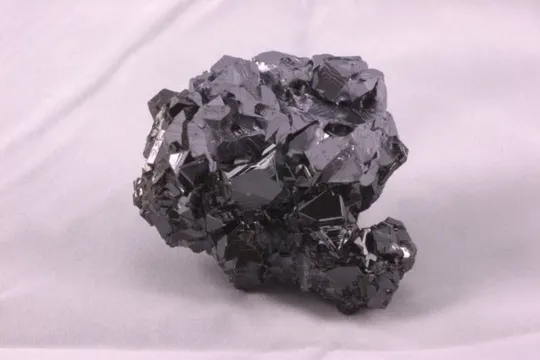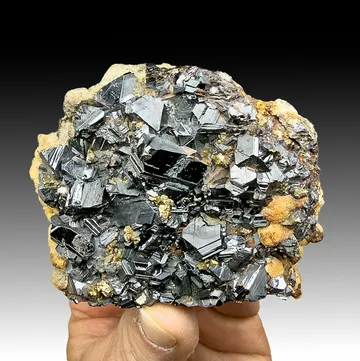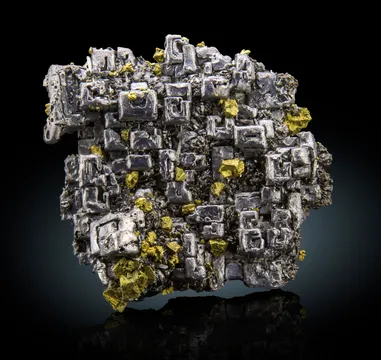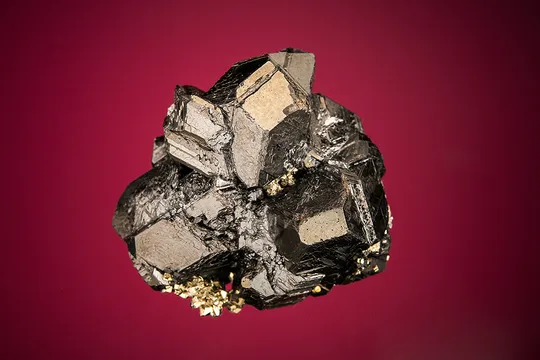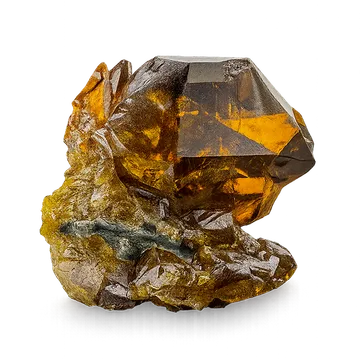
Madan Ore Field, Bulgaria: sphalerite specimens in dark resinous forms contrasting with galena and quartz, a premier European sulfide-collection locality.
Key facts
Sphalerite from the Madan Ore Field belongs to one of Europe’s great sulfide-specimen traditions: dark, lustrous zinc sulfide from a long-worked Rhodope mining district where galena, quartz, pyrite, chalcopyrite, calcite, dolomite, manganocalcite, rhodochrosite, and skarn silicates combine in exceptionally displayable specimens. The appeal is rarely a single mineral in isolation. Madan sphalerite is at its best when it forms the dark, resinous-to-submetallic architecture beneath bright galena cubes, sharp quartz, brass-yellow chalcopyrite, or warm carbonate crusts—classic lead-zinc mine aesthetics with a distinctly Bulgarian accent.

Photo: Wikimedia Commons
Geologically, Madan is not a simple “vein locality” in the collector’s shorthand sense, even though veins are one of its dominant ore forms. The ore field lies in the Central Rhodope Dome of southern Bulgaria, where lead-zinc mineralization cuts metamorphic rocks—gneisses, amphibolites, mica schists, and marbles—and also replaces carbonate horizons to produce skarn-related ore bodies. That dual personality matters to collectors. Vein specimens tend to emphasize galena, quartz, pyrite, and sharply formed sulfide combinations; replacement and skarn-related cavities can yield more sphalerite-rich material, often with manganiferous gangue minerals and the textural complexity that gives Madan specimens their depth.
The most characteristic Madan look is a contrast of black to very dark brown sphalerite against bright lead-gray galena or white quartz. Some specimens show translucent olive-green, honey-brown, or golden-brown sphalerite, and these are especially attractive when the crystals are sufficiently open, lustrous, and backlit at the edges. Crystals may be tetrahedral, complexly modified, clustered, or tiered; the best pieces show crisp form rather than merely massive black sulfide.

Photo: Wikimedia Commons
Historically, Madan is a mining town as much as a mineral locality. Lead mining in the region is traced back to antiquity, while modern industrial mining became the engine that supplied generations of specimen collectors. The ore field produced the familiar Bulgarian sulfide combinations that entered collections throughout Europe and North America in the late 20th and early 21st centuries. For sphalerite collectors, Madan is not chiefly a “gem sphalerite” locality in the Spanish sense, nor a locality for giant isolated crystals; it is a classic source of handsome cabinet and small-cabinet sulfide associations, with enough variation in color and habit to reward close locality labeling by mine or deposit.
Collectors look for undamaged, three-dimensional clusters with bright luster, well-developed sphalerite faces, and clean contrast. The most desirable sphalerite specimens are those in which the sphalerite is a real visual participant rather than a dull black base: olive-green or brown transparent crystals on quartz, sharp black tetrahedra with chalcopyrite, lustrous sphalerite beneath cubo-octahedral galena, and old-collection pieces from Krushev Dol, Petrovitsa, Borieva, Gyudyurska, or Deveti Septemvri. Pieces retaining precise mine attribution are more desirable than those labeled only “Madan, Bulgaria,” because the ore field is large and mineralogically varied.
Search for specimens: View all sphalerite specimens from Madan Ore Field, Bulgaria
The Madan Ore Field is in Smolyan Province, southern Bulgaria, in the central Rhodope Mountains near the Greek border. In geologic terms it occupies the southwestern part of the Central Rhodope Dome, one of the principal lead-zinc districts of the Rhodope Massif. The ore field is commonly treated with the neighboring Laki, Davidkovo, Ardino, Zlatograd, and Thermes areas as part of a broader Central Rhodope lead-zinc province, but Madan is the name collectors most readily associate with the polished, dark sulfide combinations from Bulgaria.
The deposit system is hydrothermal lead-zinc mineralization with three main ore-body styles: veins, stockworks, and carbonate-replacement skarn ore bodies. Veins are widespread and can be laterally extensive; the larger ore zones are tied to regional fault systems, including major structures that localize deposits such as Osikovo, Mogilata, Karaaliev Dol, Petrovitsa, Yuzhna Petrovitsa, and Erma Reka. Where fluids encountered marble horizons, metasomatic replacement produced skarn-related ore bodies rich in manganese-bearing calc-silicates and carbonate gangue. That is one reason Madan specimens so often combine normal sulfide minerals with rhodochrosite, manganocalcite, rhodonite, johannsenite, and other manganese-rich gangue minerals.
The principal ore minerals are galena and sphalerite, with pyrite and chalcopyrite as common associates and arsenopyrite, pyrrhotite, tennantite-tetrahedrite, marcasite, and rare silver- and bismuth-bearing sulfosalts occurring more locally. In broad collector terms, galena tends to dominate many vein specimens, while sphalerite can be especially important in skarn-related replacement bodies. Gangue is not an afterthought here: quartz, calcite, manganocalcite, dolomite, rhodochrosite, rhodonite, and johannsenite all help define the visual vocabulary of Madan specimens.
Modern specimen labels often cite individual mines or deposits within the ore field. Important names for collectors include Krushev Dol, Petrovitsa, Borieva, Gyudyurska, and Deveti Septemvri, also known as the 9th of September or Septemvri Mine. Krushev Dol and Petrovitsa are particularly familiar from specimen commerce, while Borieva is well represented in sphalerite, galena, quartz, chalcopyrite, calcite, pyrite, and dolomite associations. Deveti Septemvri is famous among collectors for galena-rich sulfide specimens, including skeletal or stepped galena combinations in which sphalerite is commonly present.
Madan is not a casual collecting locality. It is an underground mining district with active and former industrial workings, private concessions, and real mine hazards. Contemporary lead-zinc mining in the area is associated with concession areas such as Krushev Dol and Petrovitsa, and ore is processed through flotation operations rather than by collector-oriented surface digging. Collectors should treat underground access as closed unless explicit permission has been granted by the operator or lawful land and mineral-rights holder. Most specimens reach the market through miners, local dealers, older Bulgarian collections, or established mineral dealers who have sourced material from the district.
Production history spans ancient lead working, 20th-century industrial expansion, and continuing modern extraction. The modern GORUBSO mining enterprise became central to the region’s postwar development, and mining infrastructure shaped the town’s identity. Madan’s mining heritage is now visible not only in specimens but also in the Crystal Hall “Rhodope Crystal” and the Spoluka underground mining museum. For collectors, that continuity is important: Madan is not an exhausted romantic ruin, nor simply a modern industrial mine. It is a living ore district with a deep historical tail and a specimen record that continues to circulate in the marketplace.
Madan sphalerite most commonly appears as black to very dark brown crystals with resinous, adamantine, or submetallic luster. On many specimens it forms clustered tetrahedral to complex modified crystals, granular crystalline masses, or tiered, stepped surfaces. In strong light, some apparently black crystals reveal brown, amber, or olive internal tones along thin edges or broken areas. More transparent examples—especially olive-green, honey-brown, golden-brown, or cognac-colored crystals—are scarcer and more immediately desirable.
The collector’s “classic” Madan sphalerite habit is a dark tetrahedral or complexly modified sulfide cluster associated with galena and quartz. Good crystals may be sharp but are often intergrown, producing a rugged three-dimensional architecture rather than isolated textbook forms. Some pieces show sphalerite crystals perched on quartz plates or intergrown with cubo-octahedral galena. Others carry chalcopyrite crystals scattered like brass-yellow sparks over dark sphalerite, a color contrast that is especially characteristic of attractive Madan cabinet specimens.
Typical specimen sizes range from thumbnails and miniatures to small-cabinet and cabinet pieces. Individual sphalerite crystals are often in the millimeter to low-centimeter range, though clusters and massive crystalline areas can be much larger. Dealer descriptions and museum photographs show Madan specimens from roughly 4 cm thumbnails to 12 cm or larger cabinet pieces; the best cabinet specimens succeed not by having the largest single sphalerite crystal, but by balancing crystal quality, luster, association, and composition across the entire piece.
Associated minerals are central to evaluation. Galena is the most important visual partner: bright, lead-gray cubes, cubo-octahedra, skeletal crystals, and stepped forms can sit on or among dark sphalerite. Quartz is common as white to clear prismatic crystals or as drusy beds. Chalcopyrite adds metallic yellow contrast; pyrite contributes brassy cubes, pyritohedra, or more unusual habits; calcite and manganocalcite add pale to tan or pinkish carbonate surfaces; dolomite, rhodochrosite, and rhodonite tie the specimens to Madan’s manganese-rich skarn environment. Fine pieces may also carry subtle accessory minerals, but the mainstream collector market is dominated by sphalerite-galena-quartz-chalcopyrite-calcite combinations.
Quality is determined first by luster and definition. Dull, massive black sphalerite from Madan is common and usually serves as matrix. Collectible sphalerite should show recognizable faces, sparkle, translucency, or compositional contrast. Olive-green and honey-brown crystals command attention because they break the stereotype of “black Bulgarian sulfide.” Sharp black crystals can still be excellent when they are glossy, undamaged, and positioned prominently rather than buried under galena.
Condition matters because sphalerite is relatively soft and has perfect cleavage. Edge bruising, cleaved corners, and rubbed high points are common, especially on older specimens or pieces collected from industrial mine environments. Madan galena can also show abrasion, bruising, or handling wear, and the bright metallic faces make damage obvious. Quartz points and chalcopyrite accents are fragile. A specimen with a few peripheral contacts may still be very desirable if the main display face is intact and the sphalerite has strong form.
The most distinct Madan “signature” is the interplay of high-relief metallic sulfides in a manganese-rich hydrothermal-skarn setting. The district’s better sphalerites do not look like the transparent, gemmy Spanish cleiophane suites, nor like the large reddish-brown Elmwood-type sphalerites of Tennessee. Madan’s strength is association: black, brown, olive, or honey sphalerite in dramatic sulfide assemblages, with enough quartz and carbonate contrast to make a cabinet specimen read well from several feet away and still reward microscopic inspection.
The main authenticity concern for Madan sulfide specimens is not treated sphalerite itself, but altered or artificially enhanced galena in combination pieces. The district is famous for skeletal and stepped galena, especially from the Septemvri area, and there has been collector discussion over whether some skeletal galena crystals were artificially produced or exaggerated by sandblasting. This issue matters to sphalerite buyers because many Madan sphalerites are sold as galena-sphalerite-quartz combinations; a suspicious galena centerpiece can affect the integrity and value of the whole specimen.
Natural skeletal galena does occur from Madan, so the point is not to reject every stepped galena specimen. Instead, examine the surfaces. Natural growth should show coherent crystal geometry, consistent luster, and believable relationships with later quartz, sphalerite, chalcopyrite, or carbonate. Artificially abraded pieces may show matte, uniformly frosted recesses, unnatural pitting, rounded blasted edges, or selectively hollowed faces without supporting paragenetic evidence. If a seller describes a Madan galena-sphalerite specimen as “natural and unaltered,” ask whether it was inspected under magnification and whether any cleaning beyond normal washing was done.
For sphalerite itself, watch for the usual problems: cleaved crystals, bruised edges, old repairs, concealed glue in sulfide clusters, and heavy oiling or wetting to improve luster for photographs. Sphalerite’s luster can be spectacular under strong lighting, so online photos may exaggerate contrast. Request side-lighted images and, for dark crystals advertised as olive, honey, or cognac, ask for a transmitted-light or backlit view. True transparency should appear in the crystal, not only as reflected glare on a black surface.
Label precision has real value. “Madan, Bulgaria” is acceptable for older material, but “Krushev Dol Mine,” “Borieva Mine,” “Petrovitsa,” “Gyudyurska,” or “Deveti Septemvri Mine” is better when credible. Because the ore field contains many deposits and mines, a precise label helps interpret color, habit, association, and market desirability. Old labels from European collections, dealer labels from recognized mineral houses, and mine-specific provenance all add confidence.
Availability is steady but uneven. Common Madan sulfide combinations appear regularly in the market, especially small-cabinet galena-quartz-sphalerite pieces and chalcopyrite-bearing specimens. Top examples with prominent, lustrous sphalerite, transparent olive or honey crystals, excellent galena association, or old and precise provenance are much less common. The very best pieces are not expensive merely because they are from Madan; they are expensive because they overcome the locality’s common problems—dark massing, busy composition, contact damage, and vague labels.
Handle Madan sphalerite as a moderately delicate sulfide. Avoid ultrasonic cleaning, harsh acids, wire brushes, and abrasive dusting. A soft brush, compressed air used carefully, and gentle handling are preferable. Keep specimens dry and stable; associated pyrite and marcasite are not automatically unstable, but any sulfide specimen with mixed minerals benefits from moderate humidity control and avoidance of heat. Display lighting should emphasize the resinous faces of sphalerite without overheating the specimen.
Madan’s mineral story begins long before modern specimen labels. Local historical accounts trace lead-ore extraction in the region to the 5th–4th centuries BC, during the time of the Thracian Koilaletes. The town’s very name is tied to mining: Madan is derived from the Arabic-Turkish “Maden,” meaning mineral, ore, or mine. That etymology still feels apt when one looks at the district’s specimens—galena and sphalerite are not incidental products of the landscape but part of the town’s identity.
The old workings left details that are unusually concrete. In the Borieva mine area, ancient coins have been reported from old mine galleries, including coins from Thasos and other coinage attributed to the 3rd–4th centuries BC in local accounts. The municipal history of Madan records finds from old Borieva galleries at horizons 845 and 1013: rice knives, wooden troughs, minted money, and even a child’s skull. Such details give the locality an archaeological texture that most specimen labels cannot carry. A sphalerite from Borieva is not just “Bulgaria, ZnS”; it comes from a mine name tied to centuries of underground work.
The industrial era made Madan a modern mining town. GORUBSO, the Bulgarian-Soviet mining organization founded in 1950, became the dominant mining presence in the region. By the 1980s the enterprise employed thousands across several mines in the area, and the town’s social geography followed the ore. The modern collector specimens—galena cubes on black sphalerite, chalcopyrite on quartz and sphalerite, carbonate-touched sulfide plates—are descendants of that industrial system. Many were saved because miners, dealers, and local collectors recognized beauty in cavities opened for ore.
In 1984 Madan opened the Crystal Hall “Rhodope Crystal,” a museum collection devoted to mineral specimens from the region’s mines. The hall stores 581 mineral specimens and is one of the town’s best-known landmarks. For collectors, its importance is symbolic as well as educational: it places the local specimens in the town itself rather than exporting all mineral memory to foreign collections. Reports from the hall emphasize galena and sphalerite among the distinctive crystalline forms of the district, alongside quartz varieties such as amethyst, smoky quartz, and morion, plus chalcopyrite, agates, and other regional minerals.
A newer chapter is the Spoluka underground mining museum. The Spoluka mine, near the town of Madan, produced lead, zinc, gold, silver, copper, and cadmium and was worked out by around 1972. It opened as a museum in 2023. Visitors enter a tunnel marked with the date 1961 and walk about 140 meters underground past tracks, wagons, safety equipment, pneumatic systems, a preserved vertical shaft, a ventilation chimney, and the mine yard. It is a rare chance to connect cabinet specimens with the physical setting of underground mining: the rails, compressed-air tools, and damp passageways that made the crystals accessible.
Even the district’s tourism follows the minerals. Madan promotes both the Crystal Hall and underground mining heritage, and the town has organized Crystal Days with exhibitions of crystals extracted from local mines. That public celebration says something important about Madan specimens. They are not anonymous export commodities; they are part of a mining culture that still recognizes a polished galena face, a dark sphalerite cluster, or a sparkling quartz plate as a local inheritance.