A collector's guide to Krushev dol Mine, Bulgaria: its geology, mining history and notable minerals, illustrated with the 312 specimens documented from this locality on EarthWonders.
Key facts
Krushev dol is one of the defining specimen mines of the Madan ore field in the Central Rhodopes: an active underground Pb-Zn deposit whose collector reputation rests on unusually aesthetic quartz-sulfide pockets rather than on rare-species micromounts alone. The mine lies near Madan in Smolyan Province, within a district of Tertiary hydrothermal lead-zinc-silver veins, stockworks, and marble-hosted replacement bodies developed in high-grade metamorphic rocks. For collectors, that geology translates into the classic Madan look: white to clear quartz crystals carrying bright galena, black to olive-green sphalerite, brassy chalcopyrite, sharp pyrite, and late calcite or dolomite.
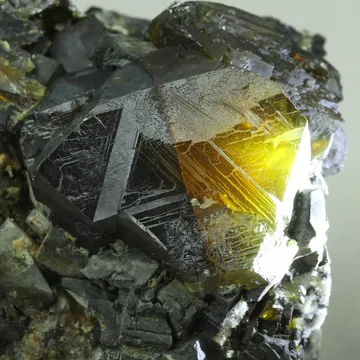
The best Krushev dol specimens are immediately recognizable. Galena can form thin, mirror-bright spinel-law twins and hoppered architectural crystals standing upright among quartz points; sphalerite ranges from dark tetrahedra to gemmy olive-green cleiophane; quartz often appears as radiating, frosty-to-transparent sprays that give the sulfides a bright alpine-cavity style rather than the massive look of ordinary ore. The mine is historically important both as part of the long-worked Madan mining district and as the source of celebrated early-2000s and 2011–2012 specimen pockets, including a large cleiophane find that gave Krushev dol a place beside the better-known Septemvri cleiophane producers.
Regional View
Country View

Photo: Wikimedia Commons
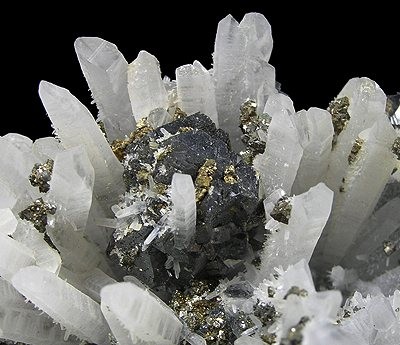
Photo: Wikimedia Commons
The district has produced specimens continuously enough that Krushev dol is familiar on the modern market, yet the finest pieces are still pocket-specific. A routine specimen may simply be a dark sulfide-and-quartz combination; a memorable one has the clean geometry that made Madan famous: upright galena plates, freestanding sphalerite, quartz that is transparent rather than chalky, and enough open space between crystals to let the piece read as a miniature landscape instead of broken ore.
Search for specimens: View all specimens from Krushev dol Mine, Bulgaria
Krushev dol is a Pb-Zn deposit in the Madan ore field of the Rhodope Mountains, recorded at about 41.44546, 24.93553. The local name appears in Bulgarian as рудник Крушев дол, and the name is commonly translated as “Valley of the pears.” In specimen labels it is often written in several transliterations — Krushev dol, Krushev Dol, Kroushev Dol, or Krusov dol — and older labels may simply say Madan, Rhodope Mountains, Bulgaria.
Geologically, Krushev dol belongs to the hydrothermal Pb-Zn-Ag system of the Central Rhodopes. Published summaries of the Madan field describe steep NNW-SSE ore-controlling faults, veins commonly on the order of one to several metres wide, disseminated stockwork zones, and replacement bodies where mineralized structures intersect marble horizons. The vein orebodies tend to be galena-rich, while sphalerite is especially important in skarn and replacement bodies. The host rocks are the metamorphic rocks typical of this part of the Rhodope massif, especially gneisses and marbles; underground observations from Krushev dol also describe biotitic gneiss, marble, and a graphite-bearing marble horizon dipping more steeply than some neighbouring marble layers.
The paragenesis gives collectors a useful framework for understanding the specimens. The ore system began with manganese-bearing skarn development in marble, followed by retrograde alteration and then the main quartz-sulfide stage carrying sphalerite, galena, chalcopyrite, and pyrite. A later carbonate-quartz stage with minor sulfides produced much of the pale gangue and overgrowth that finishes many specimens. Fluid-inclusion work on the Madan ore field places the quartz-galena hydrothermal system roughly in the 260–350 °C range, and isotopic studies tie the mineralization to late Oligocene tectonic, magmatic, and hydrothermal activity during uplift of the Central Rhodopian metamorphic core complex.
Mining in the Madan district is ancient in reputation and modern in scale. The lead-zinc ores are described in the geological literature as known since Thracian and Hellenic times, worked again in medieval periods, and mined intensively in the modern era. From 1941 to 1995 the Madan field as a whole produced more than 95 million tonnes of ore grading approximately 2.54% Pb and 2.10% Zn. Krushev dol has remained one of the active names in that field, along with Petrovitsa and other mines, and modern company information places Krushev Dol among the concession areas connected with Gorubso-Madan and related operations. Current industrial descriptions give annual ore production for the Madan operations in the hundreds of thousands of tonnes, with lead-zinc ores processed by flotation into concentrates.
Krushev dol is an underground industrial mine, not a casual collecting locality. Significant specimens have come from working levels, pockets encountered during mining, mine personnel, local collectors, old stocks, and Bulgarian dealers. Unauthorized underground collecting would be dangerous and inappropriate. Collectors should treat the locality as a specimen-source name, not a field-trip invitation, and should value labels that distinguish Krushev dol from the many nearby Madan mines whose galena-sphalerite-quartz assemblages can look deceptively similar.
The most important specimen episodes include the mid-2000s galena-quartz production, which yielded sharp spinel-law twins, platy galena groups, and quartz-rich combinations, and the large 2011–2012 cleiophane pocket that brought gemmy green to yellow-green sphalerite from Krushev dol into the international collector market. Other pockets have produced pyrite on quartz, chalcopyrite-rich combinations, calcite and manganese-bearing calcite, and occasional rare beryllium silicates such as helvine and bertrandite.
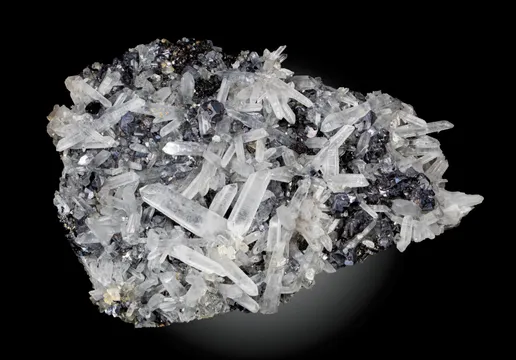
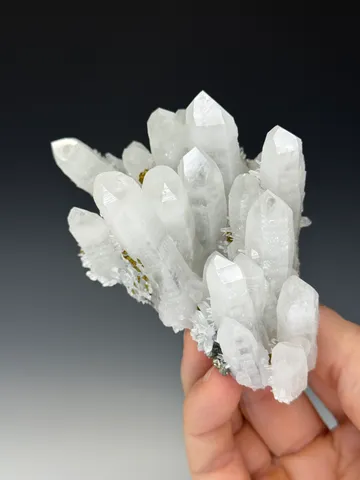
Quartz is the stage on which most Krushev dol specimens perform: pale, white, frosty, or water-clear prisms forming sprays, crusts, and open druses around the sulfides. Madan quartz has been studied as rock crystal suitable for small faceted stones, and Krushev dol rough from the deposit has yielded eye-clean faceted examples, although its greatest collector value is as matrix for galena, sphalerite, pyrite, chalcopyrite, and calcite. Good Krushev dol quartz specimens show upright transparent to translucent points rather than bruised white rubble; documented specimen pieces include quartz crystals reaching about 5–6 cm, while the finest combination pieces use those crystals to frame metallic galena plates or gemmy cleiophane. Ordinary pieces are massive quartz with broken sulfides; the better pieces have clean terminations, open spacing, and the distinctive bright white contrast that makes Madan sulfides so displayable.
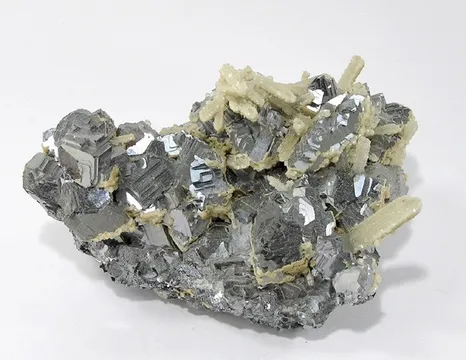
Galena is the signature species of Krushev dol and is documented as a world-class species occurrence for the mine. The collector forms include mirror-bright cubo-octahedra, modified octahedral crystals, hoppered or skeletal-looking architectural growths, and especially thin platy spinel-law twins set among quartz. Some early market specimens from the 2006 period show galena crystals to nearly 3 cm, while larger cabinet pieces carried dozens of lustrous plates on quartz-covered matrix. The finest Krushev dol galenas are judged by brilliance, sharpness, and balance: a thin plate that stands upright on a white quartz bed with no bruised edges is far superior to a heavier, duller mass. Associations with sphalerite, calcite, chalcopyrite, and pyrite are common, but the best pieces keep the galena visually dominant without burying it in sulfide clutter.
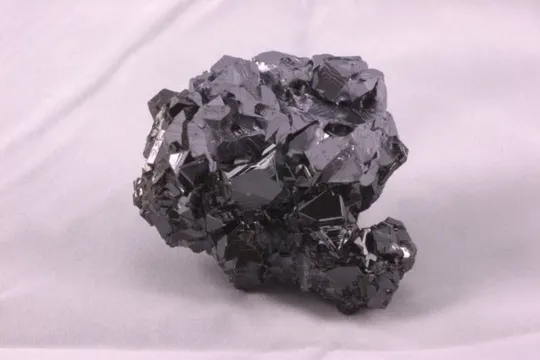
Krushev dol sphalerite ranges from black, sharply tetrahedral crystals in ordinary galena-quartz combinations to the much more coveted olive-green, yellow-green, yellowish, and brownish cleiophane. The celebrated cleiophane production from a large pocket reported around the winter of 2011–2012 produced numerous specimens, many originally on very large matrix blocks that required major trimming; individual clean, lustrous crystals were reported up to about 2 cm. The locality’s cleiophane is especially attractive when perched on white quartz and accompanied by small cubo-octahedral galena crystals or bright chalcopyrite, a contrast that separates Krushev dol examples from less lively dark sphalerite ore pieces. Good sphalerite here should have glassy luster, intact crystal faces, and some translucency under strong light; the best cleiophanes read green or yellow-green rather than simply black.
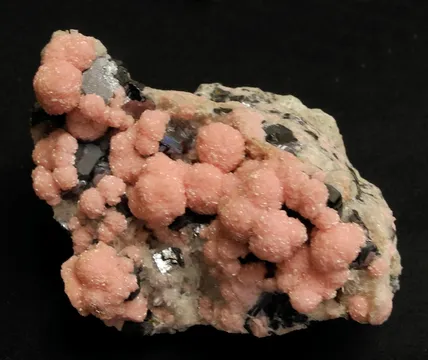
Calcite is a frequent but unevenly developed accessory at Krushev dol, appearing as cream to white crystals, disc-like forms, scalenohedra, and late carbonate coatings on quartz and sulfides. Dealer and database records document calcite with galena, sphalerite, chalcopyrite, and quartz, including hollow calcite perimorph-style specimens associated with gem cleiophane and galena. Manganese-bearing calcite is also documented from the mine and can add pinkish to reddish warmth, sometimes in strong contrast to dark sulfides and white quartz. The collector challenge is selectivity: many Krushev dol calcites are dull, bruised, or secondary-looking, while good ones show definite crystal form, clean colour, and a role in the composition rather than simply filling space between more important sulfides.
Pyrite from Krushev dol is typically a bright golden accent to quartz and sphalerite, but strong examples can stand on their own. Documented specimens show lustrous striated cubes and modified crystals, including crystals around 1–2 cm set among the distinctive white Madan quartz, and recent records also describe larger pyrite crystals in association with calcite, hematite staining, galena, chalcopyrite, sphalerite, and quartz. A particularly interesting Krushev dol paragenesis involves pyrite growing from or replacing chalcopyrite, leaving brassy shells or mixed pyrite-chalcopyrite centres on galena-sphalerite-quartz matrix. Better pyrite pieces keep a sharp, brassy metallic surface and crisp form; tarnished grains scattered through quartz are common but much less collectible.
Chalcopyrite is not usually the headline mineral at Krushev dol, yet it is one of the most important visual accessories and occasionally forms attractive specimens in its own right. It appears as brassy golden crystals with sphalerite, galena, pyrite, quartz, and calcite; market records include crystals to about 2 cm on galena-rich matrix, and other specimens show chalcopyrite involved in unusual overgrowth or replacement textures with galena and pyrite. The best chalcopyrite pieces are fresh, bright, and sharply crystallized, preferably placed on dark sphalerite or pale quartz where the colour contrast is obvious. Ordinary chalcopyrite at Krushev dol is minor glitter in the sulfide mass; desirable pieces make the chalcopyrite part of the architecture rather than just a coating.
Beyond the principal display minerals, Krushev dol has a compact but interesting documented species list. Dolomite, rhodochrosite, manganese-bearing calcite, malachite, graphite, epidote, johannsenite, rhodonite, and muscovite all fit the mine’s manganese-bearing skarn and carbonate-replacement setting. The notable rarities are the beryllium minerals helvine and bertrandite, proved from Krushev dol material kept in the Earth and Man National Museum in Sofia and later documented in collector and publication records; helvine occurs with quartz and bertrandite has been recorded as microscopic prismatic crystals. Millerite has also been reported from Krushev dol material in studies of the Madan ore field, adding a nickel-bearing rarity to a district better known for lead, zinc, manganese, and beryllium mineralization.
The first authentication issue with Krushev dol is locality precision. Madan specimens from Krushev dol, Septemvri, Borieva, Gyudyurska, Konski dol, Petrovitsa, and related mines can share the same visual vocabulary: quartz, galena, sphalerite, chalcopyrite, pyrite, calcite, and carbonate matrix. A label that only says “Madan, Bulgaria” should not automatically be upgraded to Krushev dol. Conversely, a Krushev dol label is most convincing when it came through a reliable Bulgarian source, a known dealer archive, an older collection label, or a specimen record tied to a specific find such as the 2006 galena production or the 2011–2012 cleiophane pocket.
Mislabeling is especially relevant for cleiophane. For many years, gem green Madan sphalerite was strongly associated with Septemvri, and Krushev dol cleiophane became important only after the large pocket that introduced a new source of gemmy green to yellow-green sphalerite on white quartz. Good Krushev dol cleiophane should not be assumed merely from colour; look for provenance and for the typical quartz-galena associations described for that find.
Condition is a major value factor. Galena has perfect cubic cleavage and shows edge bruising easily, especially on thin spinel-law twins and hoppered crystals. Quartz sprays commonly lose terminations during extraction or trimming. Sphalerite can chip along edges and is brittle despite its high luster. Calcite is softer and acid-reactive, so specimens containing calcite or carbonate perimorphs should never be cleaned casually with acid. Many Krushev dol specimens were trimmed from large ore and pocket masses; sawn backs, repaired bases, and contact points are not automatically disqualifying, but damage on the display crystals matters.
There is no well-documented tradition of systematic treatment specific to Krushev dol in the way there is for some heavily altered or dyed minerals, but cleaning and trimming are routine. Iron-oxide films and clay can be removed from quartz-sulfide pockets, and some pieces show bright contrast because they have been properly cleaned. Be cautious with ultrasonic cleaning: thin galena plates, attached quartz points, and calcite can all suffer. Handle galena-bearing specimens sensibly, wash hands after prolonged handling, and keep sulfide specimens dry and away from humid storage.
Availability is healthy at the miniature to small-cabinet level. Quartz, galena, sphalerite, and calcite combinations appear regularly from Bulgarian and international dealers, while sharp spinel-law galena, gem cleiophane, and balanced multi-species combinations command a premium. Pyrite and chalcopyrite are less common as headline species but are important in association. The market rewards open, three-dimensional pieces with intact quartz, bright metallic luster, strong green or yellow-green sphalerite translucency, and a label that preserves the exact mine name.
The most memorable modern Krushev dol story begins in the winter of 2011–2012, before many collectors outside Bulgaria understood that the mine could rival Septemvri for cleiophane. Tomasz Praszkier of Spirifer Minerals travelled from Poland to Madan with his friend and preparation specialist Jurek, expecting fresh Bulgarian material after hearing that exceptional specimens had been coming out since December 2011. They arrived in March after one of the snowiest and coldest Rhodope winters in half a century. Snow still lay around the town, the weather was sunny and cold, and Madan was not working as usual: miners were on strike because wages had reportedly gone unpaid for months. Krushev dol and Borieva were idle, and the visitors spent time with the protesters in the town square.
Underground access was impossible, but the news from below was extraordinary. A huge pocket in Krushev dol, described as about 15 metres across, had produced the first cleiophane specimens known from that mine. The find mattered for more than novelty. It produced hundreds of good specimens, and the crystals were clean, sharp, lustrous, and comparatively large, with the best reaching about 2 cm. Many of the original pieces were enormous by collector standards, reportedly 10 to 40 kg each before trimming. The colours ran from yellowish and brownish to yellow-green and green; some crystals were merely translucent, others fully gemmy. Most importantly for display, the sphalerite sat on white quartz and was commonly joined by small lustrous cubo-octahedral galenas and occasional golden chalcopyrite. That combination gave the pocket a Krushev dol personality of its own.
The scale of the haul was almost industrial. Praszkier reported that, with help from Bulgarian friends, they obtained what was probably around 1000 kg of the top specimens from the find. The pocket itself had already been exhausted by the time they arrived, and only a few low-quality mobile-phone photographs had been taken during extraction. The rest of the story played out above ground: huge rough cleiophane specimens waiting for trimming and cleaning, first prepared pieces photographed on white backgrounds, and the sudden arrival of Krushev dol cleiophane as a serious market category.
Another Krushev dol episode came from the galena pockets that followed or accompanied the same burst of activity. The mine produced sharp, large, highly lustrous spinel-law twinned galena crystals with quartz, including at least one museum-size piece singled out as outstanding. These were not quiet sulfide lumps; the best looked engineered, with thin metallic plates stepping across quartz like a line of polished steel fins. For many collectors, this is still the Krushev dol ideal: galena that has both the reflectivity of fresh ore and the geometry of a crystallography model.
The surrounding Madan district gave the same trip its warning label. After failing to enter Krushev dol during the strike, the visitors explored the closed 9th September mine, walking kilometres through old tunnels, descending to lower levels, passing collapsed and flooded sections, and eventually reaching stopes rich in pockets. There they saw natural skeletal galena, small cleiophane pockets with green quartz, and large stopes known for galena and calcite. The account is valuable to Krushev dol collectors because it shows how close and visually overlapping these Madan sources can be — and why exact labels matter. A specimen can look perfectly “Madan” and still not be Krushev dol.
A more recent academic field visit shows the active mine from another angle. A Society of Economic Geologists student group from Masaryk University went underground at Krushev dol with Gorubso-Madan permission, guided by company geologist Vitko Petrov and chief engineer Veli Djukov, with Rossitsa Vassileva, Georgi Milenkov, and Yana Georgieva helping arrange and guide the visit. Their notes emphasize the working-mine geology behind the collector pieces: galena and sphalerite as principal ore minerals; pyrite, chalcopyrite, and bornite as additional sulfides; biotitic gneiss and marble as common host rocks; and a graphite-bearing marble horizon dipping 35–45 degrees. For a collector holding a polished, trimmed miniature on a shelf, it is a useful reminder that the specimen began in a living industrial mine, deep in a structural and stratigraphic system still being studied.