A collector's guide to Starnitsa deposit, Bulgaria: its geology, mining history and notable minerals, illustrated with the 28 specimens documented from this locality on EarthWonders.
Key facts
Starnitsa is one of those small Rhodope localities whose reputation among collectors rests not on giant crystals or broad production, but on a paragenesis so odd that experienced mineral people have argued over it under a microscope. The deposit lies in the Davidkovo ore field, near the village of Starnitsa in Banite Municipality, Smolyan Province, within the Central Rhodopes of southern Bulgaria. Geologically it belongs to the Oligocene Pb-Zn systems of the Central Rhodopian Dome: hydrothermal veins and local stockworks cutting high-grade metamorphic rocks, developed in the same regional metallogenic province that made Madan, Laki, Ardino, and related Rhodope ore fields famous.
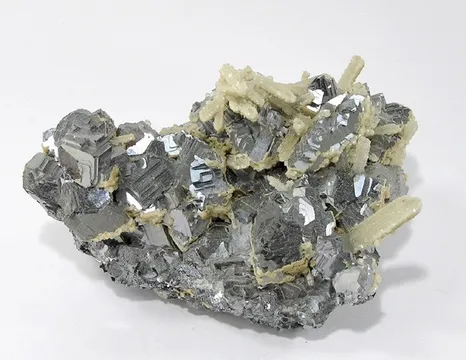
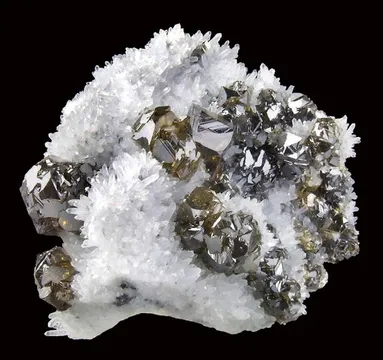
For collectors, Starnitsa means pink rhodochrosite with stilbite. That pairing is the locality’s signature. Good pieces show mounded, sparkling pink rhodochrosite rosettes or compressed rhombohedral aggregates, commonly over quartz and sulfide matrix, with small cream-white to colorless stilbite blades scattered across the surface or tucked on the underside. Colorless quartz points, golden chalcopyrite, dark sphalerite, and occasional galena complete the classic look. The best specimens are not usually “world-class rhodochrosite” in the Sweet Home or N’Chwaning sense; they are coveted because the association is beautiful, distinctive, and genuinely surprising.
Regional View
Country View
The Starnitsa habit is generally small-cabinet to miniature in character. Instead of a single dominant crystal, most good specimens are textural pieces: a pink crust or hummocky blanket of rhodochrosite, pin-pricked by glassy quartz and relieved by pale stilbite blades. That makes Starnitsa material especially appealing in a systematic collection, where it tells a very specific story about the late, open-space stages of a base-metal vein system in the Rhodopes.

Photo: Rob Lavinsky, iRocks.com, via Wikimedia Commons
Search for specimens: View all specimens from Starnitsa deposit, Bulgaria
Starnitsa is recorded as a deposit in the Davidkovo ore field, about 3 km west of the village of Starnitsa; the commonly cited coordinates point to the village rather than precisely to the mine workings. The broader Davidkovo ore field includes a suite of deposits and prospects around Davidkovo, among them Bahteritsa, Chestoka, Katrandzhika, Schtipcheniovo, Starnitsa, Belevsko, Krastatitsa, Lesiche, Krushevo dere, and Mecha dupka. In the Central Rhodope framework, Davidkovo is the more vein-dominant counterpart to the larger Madan and Laki systems, where both veins and marble-hosted replacement bodies are important.
The deposit belongs to the Oligocene Pb-Zn mineralization of the Central Rhodopian Dome. The host environment is a high-grade metamorphic terrane of gneisses, granite-gneisses, schists, amphibolites, and marble horizons, cut by fault-controlled hydrothermal veins. Published summaries of the Davidkovo field describe veins and rare linear stockworks developed at intersections of NW-, E-, and NE-trending fault structures in the lower plate of the dome. The regional ore systems formed during post-orogenic extension and exhumation of the Rhodope metamorphic core complex, broadly in the 33–30 Ma interval for the economically important Central Rhodope Pb-Zn deposits.
The ore and gangue suite at Starnitsa is compact but diagnostic. The principal collector species recorded directly from the deposit are rhodochrosite, quartz, sphalerite, chalcopyrite, galena, and the stilbite subgroup. Regionally, Davidkovo veins are part of a paragenetic sequence that includes quartz-pyrite, quartz-galena-sphalerite, rhodochrosite-manganocalcite-calcite, late quartz, and zeolite stages including heulandite-stilbite. This late zeolite overprint is the key to Starnitsa’s collecting identity: it allowed delicate stilbite blades to appear with, and in places on, pink manganese carbonate in open cavities.
Mining history at Starnitsa is less well documented than at Madan, Laki, or the best-known Rhodope mines. The Central Rhodope Pb-Zn province has a long mining history, with ancient activity in parts of the region and major modern development from the twentieth century onward, especially under the state mining organization GORUBSO after 1950. The Davidkovo field was studied as a distinct lead-zinc district by Bulgarian geologists, notably in work on ore chemistry and zonation, but Starnitsa itself appears in collector literature chiefly as a specimen locality rather than as a major producing mine. No present-day, operator-run collecting access is documented for the locality; serious collectors should treat all underground workings and mine dumps as potentially unsafe, private, or regulated, and acquire material through established specimen channels unless they have explicit local permission.
The notable specimen finds are the rhodochrosite-stilbite-quartz assemblages that began circulating internationally by the early 2000s and became familiar through Mindat, dealer catalogues, and auction descriptions. Old collection pieces from the Brian Kosnar and W. S. Logan collections show that the association was already recognized in the collector market by 2010 and earlier, while later dealer offerings describe newer finds of pink rhodochrosite rosettes on quartz with stilbite, pyrite, sphalerite, and chalcopyrite. Fine examples are judged less by the size of individual crystals than by balance: saturated pink rhodochrosite, visible stilbite blades, sparkling quartz, intact edges, and enough sulfide contrast to make the paragenesis immediately legible.
Starnitsa rhodochrosite is typically pale to rich pink, forming sparkling rosettes, rounded “bubbly” aggregates, compressed rhombohedra, and very fine bladed or scaly crusts over quartz-sulfide matrix. Specimens commonly fall in the miniature to small-cabinet range, with documented examples around 4.5 x 4.2 x 2.6 cm, 6.2 x 4.3 x 3.2 cm, 7.2 x 5.9 x 2.2 cm, 8.7 x 6.9 x 2.7 cm, and larger cabinet pieces known from auction archives. The best pieces are bright, fresh pink rather than tan or dull, with rhodochrosite forming coherent mounded coverage rather than thin powdery patches; the elite association is rhodochrosite carrying small cream or colorless stilbite blades, clear prismatic quartz points, golden chalcopyrite, and dark sphalerite.
Stilbite from Starnitsa is the locality’s great surprise: small, vitreous to pearly, cream-white to colorless blades, laths, or stacked double-ended crystals, usually only millimeters across, perched on pink rhodochrosite or present on the underside of rhodochrosite-quartz pieces. Public mineralogical records usually list the material as “Stilbite Subgroup” rather than a fully analyzed species name, and that caution matters; nevertheless, its appearance and optical work on collector material support the identification of the little blades as stilbite rather than the barite some specialists initially suspected. Good Starnitsa stilbite pieces are those where the zeolite is not merely present but visibly part of the composition, scattered over pink carbonate or contrasting cleanly against rhodochrosite, quartz, chalcopyrite, and sphalerite.
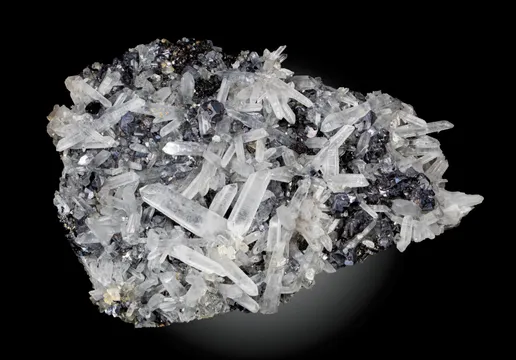
Quartz at Starnitsa is the structural and visual backbone of many specimens, appearing as colorless to translucent prismatic crystals, sharp points, drusy coatings, and mounded quartz matrix beneath rhodochrosite. Dealer and collection records note glassy quartz points to about 1.2 cm on some small-cabinet pieces, while newer material shows sharp transparent quartz forming the base for pink rhodochrosite rosettes and black sphalerite. The most desirable quartz is clean, bright, and undamaged, especially where it rises through the rhodochrosite as individual points rather than disappearing as gray matrix; quartz also helps verify the classic Starnitsa paragenesis when it appears with rhodochrosite, stilbite, chalcopyrite, sphalerite, and galena.
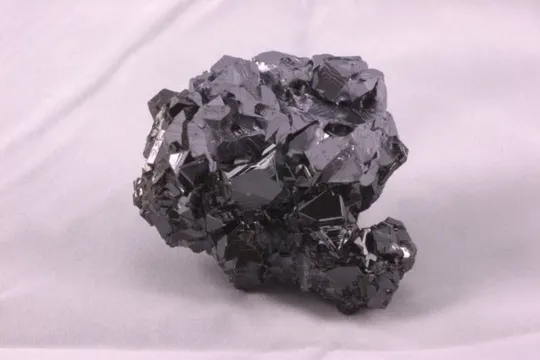
Other minerals documented directly from Starnitsa include sphalerite, chalcopyrite, and galena. Sphalerite is typically a dark brown to black accent in the rhodochrosite-quartz assemblage, sometimes visible as striated crystals among quartz points; chalcopyrite provides small brassy to golden metallic crystals or sphenoids, often on the underside or in recesses; galena is less frequently featured in specimen descriptions but belongs to the Pb-Zn ore suite. No valid type-locality mineral is credited specifically to Starnitsa in the standard locality records; its rarity value is not a new species, but the unusually attractive coexistence of a manganese carbonate with a zeolite in display-quality specimens.
The main authenticity issue for Starnitsa is not deliberate fakery so much as misidentification and vague locality labelling. Pieces have circulated as “Madan, Bulgaria,” “Davidkovo,” “Rhodope Mountains,” or simply “Bulgaria,” and the more precise Starnitsa attribution matters because the rhodochrosite-stilbite association is the locality’s calling card. When possible, preserve old dealer labels and collection numbers, especially for specimens from early-2000s to 2010-era circulation or named collections such as Brian Kosnar or W. S. Logan.
Stilbite identification deserves special care. The crystals are small, pale, and blade-like, so a quick glance can lead to confusion with barite or other pale gangue minerals. A good Starnitsa specimen should show the stilbite as discrete, lustrous to pearly blades or laths sitting on or among the rhodochrosite, not merely as pale massive material. If the association is central to value, magnification is essential; for high-end examples, analytical or at least well-documented provenance is worth having.
Condition is often the practical limiting factor. The rhodochrosite commonly forms delicate rosettes, tiny blades, or granular sparkling crusts that abrade along exposed edges. Stilbite blades are small and can be bruised or knocked away, while quartz points may have chipped terminations. Minor side contacts are common and not necessarily disqualifying, but rubs across the display face, dulled rhodochrosite, missing stilbite patches, or broken quartz points reduce desirability quickly. Avoid aggressive cleaning: acids can attack carbonate, and ultrasonic cleaning is a poor choice for friable rhodochrosite-stilbite surfaces. Dry dusting with a soft brush and minimal handling are safest.
No widely documented treatments or manufactured fakes are tied specifically to Starnitsa. The more realistic problem is over-selling: ordinary pink carbonate on quartz may be marketed as rarer Starnitsa combination material even when the stilbite is absent or unconvincing. Conversely, true Starnitsa pieces can look modest in photographs because pale stilbite on pink rhodochrosite has low contrast. Serious collectors should evaluate the specimen under magnification and good side lighting, looking for intact, sparkling carbonate and actual zeolite crystals rather than relying on label claims alone.
Market availability is intermittent. Small pieces from Bulgarian sellers and European dealers appear periodically, and several miniature to small-cabinet examples have passed through auctions and dealer inventories, generally as association specimens rather than top-rank rhodochrosite. Cabinet-sized examples with broad pink coverage and obvious stilbite are scarcer. The best Starnitsa pieces are bought by collectors who appreciate paragenesis, so they may be overlooked by buyers chasing large rhodochrosite crystals—but when the color, quartz, sulfides, and stilbite all line up, they are quietly excellent locality specimens.
On Sunday morning, December 7, 2014, at eight o’clock, Raymond Dedeyne was behind his table at the Harelbeke mineral fair in Belgium, not entirely pleased to be there. As he put it, he was a hardcore collector better suited to standing in front of a dealer’s table than behind one, but surplus specimens have to go somewhere. Before the public arrived, he made the rounds among fellow sellers and found an old acquaintance from Brussels liquidating part of a personal collection. Among the former Eastern Bloc pieces was a 10 x 14 cm rhodochrosite labelled “Madan, Bulgaria,” reportedly bought years earlier at a then-Czechoslovak mineral fair.
At first, the specimen was not a show-stopper. The pink carbonate looked cauliflower-like, reminiscent of Maramureș in Romania or Chalkidiki in Greece, and Dedeyne joked that it would not score highly on the “Lavinsky scale” of superlatives. But the color was good—manganese had clearly done its work—and the price was low enough to justify a risk. Later that day, with time to look closely, he found a small golden-yellow crystal in the middle, probably chalcopyrite rather than pyrite, and then the real puzzle emerged: many tiny, millimeter-scale, well-formed, glossy, colorless crystals scattered over the front and back. They were lath-like, often double-terminated, and sometimes stacked into little bundles pinched in the middle. His first thought was stilbite. His second thought was: surely not.
He showed the piece to MKA colleagues Rik Dillen and Iván Blanco, and they too leaned toward stilbite. Then came the counterattack. A French dealer known for Maramureș expertise looked at both Dedeyne and the specimen with suspicion; he had never heard of stilbite from Romania or Bulgaria. Two more French-speaking specialists were summoned, and all three insisted the mystery crystals were barite, not stilbite. Dedeyne recalled catching fragments of emphatic French—“stilbite point du tout” and “barytine définitivement oui”—while a flood of technical language washed over him. By the end of the fair day, he had nearly accepted the verdict: ordinary rhodochrosite with ordinary barite, probably from somewhere in Maramureș rather than Madan.
The next morning, Monday, December 8, Iván emailed before Dedeyne had time to check the matter himself: rhodochrosite with stilbite really did occur at Starnitsa, in the Davidkovo ore field of the Rhodope Mountains. The linked images matched Dedeyne’s specimen so closely that the locality question changed at once. Rik also reaffirmed the stilbite hypothesis. But three confident barite opinions still weighed heavily, so Dedeyne wanted a quantitative test, not another opinion.
Herwig Pelckmans took up the problem. On Saturday, December 13, before an MKA crystallography class, the micromounters examined the specimen and agreed with about 95 percent confidence that the little crystals were stilbite; the “pyrite-like” crystal was probably chalcopyrite, with sphalerite beneath. Dedeyne still wanted the last fraction of certainty. Pelckmans proposed refractive-index work, because barite and stilbite are far enough apart optically to separate cleanly. A plastic spatula failed to detach a crystal—proof, Dedeyne noted, that specimens can be sturdier than one expects—so a steel knife was used.
On Monday, December 15, Pelckmans reported the result. Using the Becke-line method in aniseed oil of refractive index 1.55, he observed that the refractive index of the crystal fragment was lower than that of the liquid. Stilbite fits that result; barite does not. The verdict was clear: the strange little blades were stilbite. Dedeyne could claim, with some pride, a not-at-all-common specimen of rhodochrosite with stilbite from Starnitsa, Davidkovo, Bulgaria—and the episode became one of the best collector stories attached to the locality, a reminder that even a modest-looking pink specimen can overturn expert certainty when the paragenesis is strange enough.