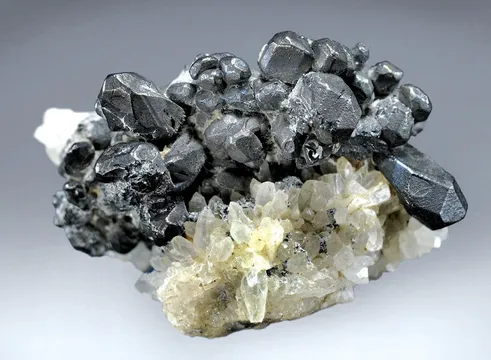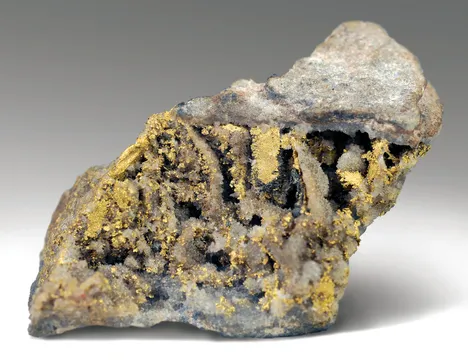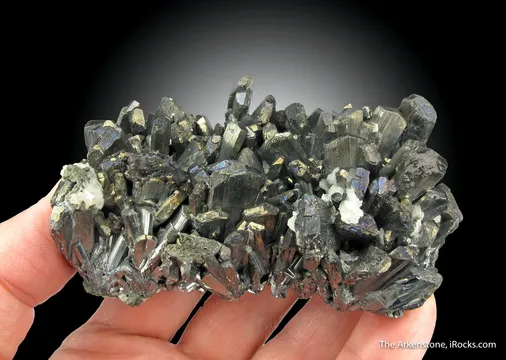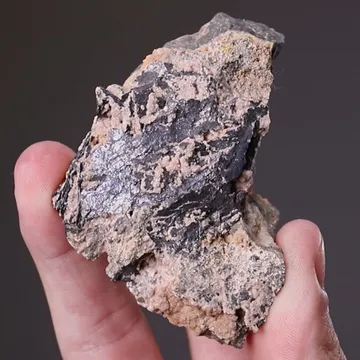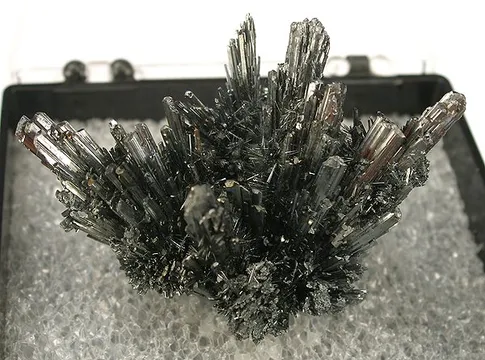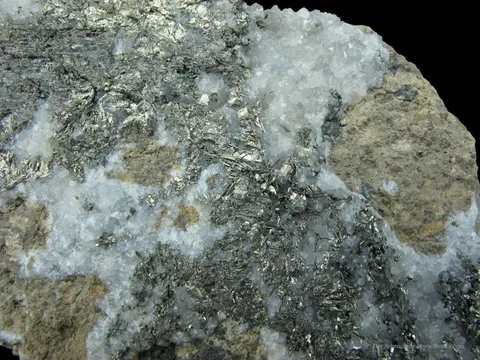
Roșia Poieni Mine, Romania - a large porphyry Cu-Au system in the Apuseni; rare vivianite prisms, enargite, and gold-bearing sulfides appeal to collectors.
Key facts
Roșia Poieni is not a classic cabinet-crystal mine in the old Transylvanian sense; it is a giant, working porphyry copper-gold system cut into the Apuseni Mountains, close to the legendary Roșia Montană district. For collectors, that industrial scale is precisely what makes the locality interesting. The mine exposes a complete magmatic-hydrothermal system: a potassic copper core, phyllic overprints, advanced argillic caps, high-sulfidation epithermal veins, and late fractures that have yielded unexpectedly fine specimen minerals. Its best pieces are not abundant, but they have a distinctive look: dark blue to sea-green vivianite prisms in late vugs and veinlets, sharp pyrite on altered microdiorite, enargite in quartz-pyrite assemblages, and very scarce visible gold from a deposit whose gold is more often an assay constituent than a display mineral.
Geologically, the locality belongs to the South Apuseni “Golden Quadrilateral,” the most storied metallogenic province in Romania. Roșia Poieni is centered on the Fundoaia microdiorite and associated Poieni andesitic rocks, altered by a long-lived hydrothermal system. The main ore is low-grade but huge: chalcopyrite, pyrite, and magnetite occur as disseminations, nests, and veinlets through the altered intrusive complex, with gold carried chiefly in the sulfides. Above and across that porphyry stage, acidic epithermal fluids produced the advanced argillic suite that makes the locality mineralogically richer than a simple copper pit: alunite, kaolinite, dickite, pyrophyllite, diaspore, zunyite, woodhouseite-svanbergite minerals, enargite, luzonite, covellite, and related sulfosalts and tellurides.
Regional View
Country View
The mine’s collecting reputation rose sharply when vivianite specimens from the open pit began circulating: lustrous, transparent to translucent crystals, commonly on pyrite and quartz, in colors ranging from blue-green to deep inky blue. The setting is emphatically modern and industrial, however. Roșia Poieni is an active open-cast operation, not a casual collecting ground, and specimens reaching the market generally come through workers, local contacts, old collections, or later dealer dispersals rather than from organized collector access.
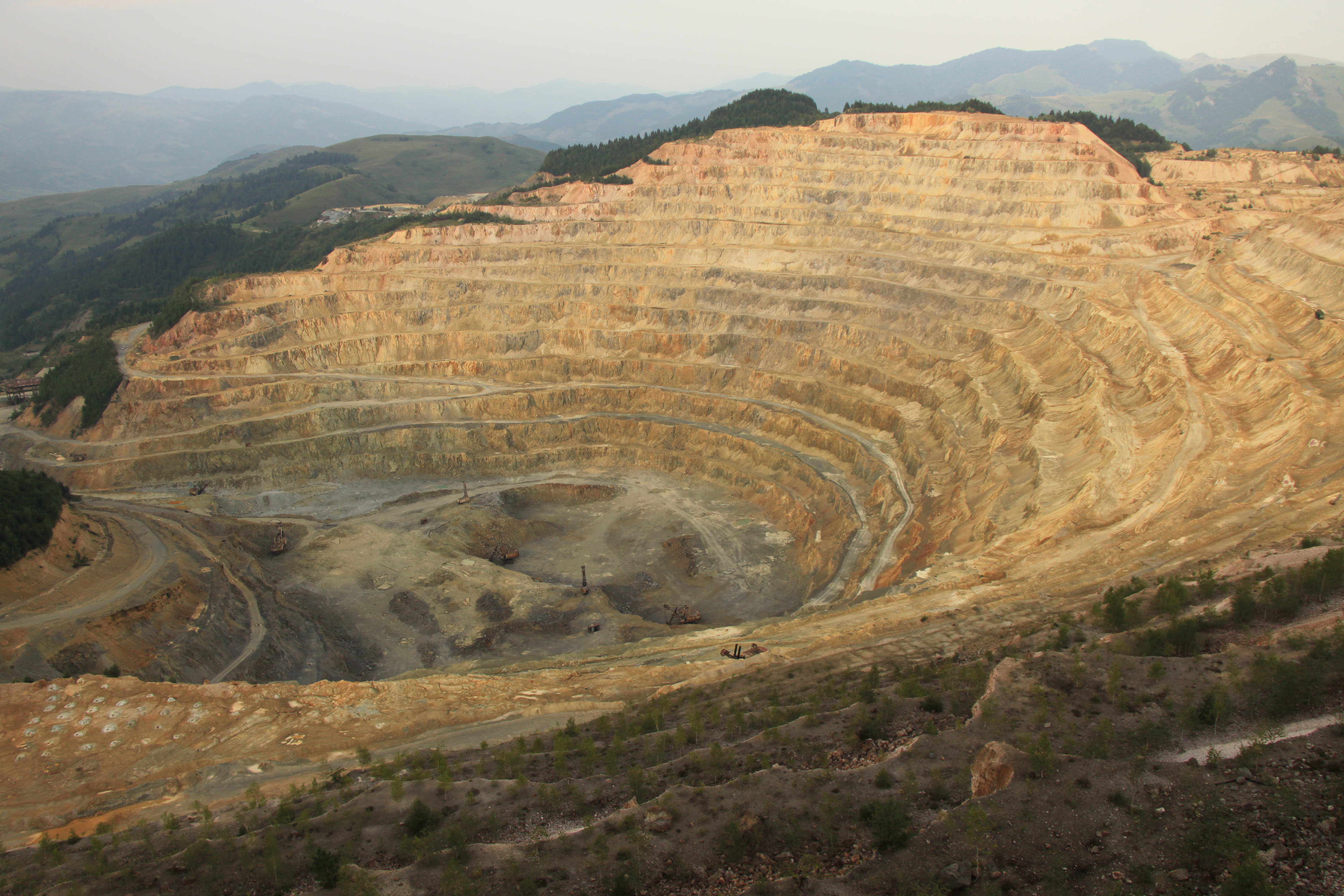
Photo: Wikimedia Commons
Search for specimens: View all specimens from Roșia Poieni Mine, Romania
Roșia Poieni is an active open-cast copper mine at Mușca, Lupșa Commune, Alba County, in the Apuseni Mountains of western Romania. The mine lies only a few kilometres northeast of Roșia Montană, but it is a different ore system and should be kept distinct on labels. Roșia Montană is the famous ancient-to-modern Au-Ag epithermal district historically known as Verespatak; Roșia Poieni is the porphyry Cu-Au-Mo system worked by large-scale open-pit methods.
The deposit is built around Neogene subvolcanic intrusive rocks. The important intrusive center is the Fundoaia microdiorite, emplaced into the older Poieni andesitic host rocks and associated breccias. Hydrothermal alteration is strongly zoned. The deeper and central parts preserve potassic alteration with Mg-biotite, K-feldspar, quartz, chlorite, and anhydrite, accompanied by magnetite, chalcopyrite, pyrite, and minor bornite. Around and above this core, phyllic alteration is expressed by quartz, illite-phengite-sericite, illite-smectite, kaolinite, and abundant pyrite. The upper parts of the system carry an advanced argillic overprint with alunite, kaolinite, dickite, pyrophyllite, diaspore, zunyite, woodhouseite-svanbergite-series minerals, pyrite, enargite, and luzonite. Propylitic alteration forms the broader outer halo.
The ore is not a vein mine in the traditional collector sense. It is a stockwork and disseminated porphyry body: fine veinlets, nests, and disseminations of chalcopyrite, pyrite, and magnetite run through altered microdiorite and andesite. Research on the stockwork showed that the vein network is highly clustered, with copper-bearing veins and quartz-pyrite veins organized differently at different levels of the open pit. At the scale of hand specimens this explains why a single broken block may show several mineralizing events at once: early quartz and sulfides, later pyrite-dominant fractures, high-sulfidation enargite-luzonite veins, and late open spaces capable of carrying vivianite.
Mining development began after major exploration and drilling programs in the 1960s and 1970s. The copper complex was established under Romania’s state mining system, and large-scale open-pit production is generally associated with the late communist and post-communist period. Cupru Min S.A. Abrud is the present operator. The operation includes the Roșia Poieni open pit, the Dealul Piciorului processing plant, waste-rock dumps, and tailings facilities, the best known of which is the Valea Șesii basin near the former village of Geamăna.
Specimen production has been opportunistic. The most collector-relevant finds came from vugs and late veinlets exposed by open-pit mining, especially the lower southwestern part of the pit where vivianite was described as a late hydrothermal phase. The scientific description records prismatic crystals up to 6 cm, together with quartz, pyrite, chalcopyrite, enargite, and yellowish argillic material in vugs and veinlets within altered microdiorite. Thin vivianite films were also noted along fine fissures in silicified dark-gray microdiorite and on cleavage planes in hydrothermalized Cretaceous sedimentary rocks. Good specimen material is therefore a by-product of active benching and blasting, not the result of accessible pocket mining.
Collecting access today should be treated as closed unless explicit permission is obtained from the operator. This is a working open pit with blasting, heavy equipment, unstable benches, waste dumps, tailings infrastructure, and environmentally sensitive areas. The nearby Geamăna/Valea Șesii tailings landscape is visually famous, but it is not a collecting site and should be approached only from safe public viewpoints and with respect for local restrictions.
Vivianite is the collector mineral of Roșia Poieni: a late hydrothermal phosphate occurring chiefly in the lower southwestern part of the open pit as dark-blue prismatic crystals up to about 6 cm, with larger crystals in veinlets and vugs on altered microdiorite and breccia; the documented associations are quartz, pyrite, chalcopyrite, enargite, and yellowish argillic material, while thinner films coat fine fissures in silicified dark-gray microdiorite and cleavage planes in hydrothermalized sedimentary rocks. The best specimens show transparent to translucent, lustrous blades or prisms with saturated blue-green to deep blue color and a natural contrast against bright pyrite or pale quartz; ordinary pieces tend to be darker, flatter coatings, broken sprays, or crystals so embedded in clayey matrix that the form is lost.
Gold at Roșia Poieni is geologically important but specimen-rare. The deposit is a Cu-Au porphyry in which gold is mainly carried in chalcopyrite and pyrite within the potassic and phyllic ore zones, with later structurally controlled epithermal veins adding quartz, sphalerite, galena, tetrahedrite-tennantite, chalcopyrite, native gold, and carbonate. Visible collector pieces are therefore exceptional: look for small but distinct yellow native gold on carbonate, quartz, or sulfide-bearing matrix, rather than assuming that every copper-rich rock from the mine is a gold specimen. The best examples are label-secure pieces with visible metal, attractive contrast, and old or dealer-documented provenance; ambiguous “Verespatak” labels need special scrutiny because that historical name is strongly associated with nearby Roșia Montană, not automatically with Roșia Poieni.
Other documented minerals from Roșia Poieni make the locality far richer than a two-species specimen mine. The sulfide and sulfosalt suite includes chalcopyrite, pyrite, bornite, covellite, digenite, enargite, luzonite, sphalerite, galena, molybdenite, arsenopyrite, acanthite, hessite, argyrodite, canfieldite, proustite, goldfieldite, tennantite-(Zn), tetrahedrite-(Zn), and tellurobismuthite. The alteration assemblage is equally diagnostic: alunite, kaolinite, dickite, pyrophyllite, diaspore, anhydrite, gypsum, quartz, K-feldspar/adularia, albite, chlorite, epidote, rutile, hematite, magnetite, and zunyite are all recorded. Zunyite and the woodhouseite-svanbergite phosphates are especially telling because they point directly to the advanced argillic, acid-sulfate overprint above the porphyry system. Well-crystallized enargite with pyrite is a notable rarity for specialists, and the Zn-dominant tetrahedrite-tennantite entries make the locality worth checking carefully when a sulfosalt specimen is unusually well documented.
Roșia Poieni specimens should be bought with careful label discipline. The mine is very close to Roșia Montană, and older Transylvanian gold labels can be vague, historical, or dealer-normalized. “Roșia Poieni, Mușca, Lupșa, Alba County” is the locality wording to prefer for mine material. “Roșia Montană” or “Verespatak” may indicate the neighboring Au-Ag district instead; it should not be silently transferred to Roșia Poieni without additional provenance.
Vivianite from Roșia Poieni is light-sensitive. Fresh blue-green to dark-blue crystals can darken with cumulative exposure, so serious collectors should display them away from direct sun and intense case lighting, and preferably rotate them into darker storage. Avoid heat, ultrasonic cleaning, aggressive washing, and prolonged soaking. The crystals are hydrated, brittle, and easily bruised along cleavage; clay-rich matrix can undercut the bases of crystals if over-cleaned.
The most common condition issues are broken vivianite terminations, rubbed crystal edges, loose grains of pyrite or quartz in friable argillic matrix, and iron-stained or clay-coated surfaces that tempt overcleaning. A perfectly clean, glassy, undamaged jackstraw cluster from this mine is much scarcer than a dark or partial spray. On gold specimens, the metal is typically small; examine pieces under magnification for natural attachment, matrix consistency, and any signs of glued flakes or unrelated gold pressed into carbonate or quartz. No major, well-publicized Roșia Poieni fake industry is associated with the locality, but the combination of rare visible gold and confusing regional labels makes due diligence essential.
Market availability is uneven. Vivianite appears periodically and is the main Roșia Poieni species a collector is likely to encounter; top examples with color, luster, transparency, and pyrite/quartz contrast are far less common than the number of small dark fragments might suggest. Gold from the mine is much rarer as a display specimen. Enargite, pyrite, and other sulfide pieces are specialist material and usually enter the market through Romanian or European collections rather than regular mine-run supply.
The most haunting story attached to Roșia Poieni is not a crystal pocket but a valley. In the 1970s, as the state prepared the copper mine, Geamăna was still a village in the Apuseni Mountains. Photographs from the period show a rural settlement with a church spire catching the evening light. Then the valley was chosen for mine tailings. In 1977, government prospectors arrived and told villagers to prepare to leave. About 300 families were dispersed, and many accounts describe compensation as inadequate or uneven. When the dam sealed the valley and the mine began sending tailings toward it, the change was not sudden like a flood; it was slower and more unsettling. A gray slurry crept through lanes, over gardens, around houses, and eventually toward the church.
By 1986, when tailings disposal into Valea Șesii was underway, more than 1,000 people had lived in the area. Later reports describe only about 20 residents still occupying houses on higher ground around the spreading basin. The old village center disappeared beneath the tailings. The church, originally above the village, became the remaining landmark: first a building standing in a ruined landscape, then a roofline, then chiefly a tower and spire. From a collector’s point of view, it is a sobering reminder that a mineral locality is never only chemistry and crystal form. The same ore system that produced beautiful vivianite and scarce gold also produced one of Romania’s best-known mining landscapes.
One of the most memorable voices from Geamăna is Nicolaie Prața, a local resident interviewed by Romanian journalist Dorin Țimonea. Prața remembered the first signs of trouble not as engineering works but as living things failing: cherries and sour cherries drying, streams reddening one by one. He kept papers and notes like a private chronicle of the village’s destruction, counting houses left in hamlets that were no longer truly on the map. His sentence about the church has become the kind of line that stays with a reader: after the church is covered completely, the village will be dead. He even wrote appeals beyond Romania, including to the Queen of England, because, as the story goes, he had heard that justice was sacred there.
RFE/RL photographer Amos Chapple later met villagers who remained as the tailings lake continued to rise. Maria Prața, then in her seventies, remembered childhood poverty with disarming bluntness: sleeping in a stable, “me on one side, the cows on the other.” She was not simple-mindedly anti-mine; she acknowledged that the mine gave people work. But she and others held deep bitterness over one promise: the graves of their ancestors were supposed to be moved. Many were not. Ana Prața prepared a grave for herself and her husband on higher ground, a precaution against the fate of her parents’ and grandparents’ graves below the slurry.
There is a specimen story here too, quieter but important for collectors. Vivianite was recognized at Roșia Poieni not as a casual surface stain but as a real hydrothermal mineral occurrence. The described crystals came from the lower southwestern part of the open pit, in late veinlets and vugs in altered microdiorite, together with quartz, pyrite, chalcopyrite, and enargite. That matters because it places the blue phosphate within the same complex porphyry-to-epithermal architecture that ore geologists study at the mine. The best vivianites are therefore not random curiosities from a copper quarry; they are late-stage, open-space products of a cooling and overprinted magmatic-hydrothermal system.
Milu, V., Milesi, J.-P., & Leroy, J. L. (2004). “Rosia Poieni copper deposit, Apuseni Mountains, Romania: advanced argillic overprint of a porphyry system.” Mineralium Deposita, 39(2), 173–188. The key modern paper on the deposit’s alteration zoning, from potassic core to advanced argillic overprint.
Popescu, G. C., Ilinca, G., & Neacșu, A. “Mineralogy of Vivianite from Rosia Poieni; Metallogenetic Significance.” Pangeea, 15, 1–5. The essential locality-specific paper for vivianite, documenting crystal size, position in the open pit, associations, and late hydrothermal interpretation.
Kouzmanov, K., Pettke, T., & Heinrich, C. A. (2010). “Direct Analysis of Ore-Precipitating Fluids: Combined IR Microscopy and LA-ICP-MS Study of Fluid Inclusions in Opaque Ore Minerals.” Economic Geology, 105(2), 351–373. A major fluid-inclusion study using pyrite, enargite, and quartz from high-sulfidation veins overprinting the Roșia Poieni porphyry system.
Kouzmanov, K., Wallier, S., Rey, R., Pettke, T., Ivășcanu, P., & Heinrich, C. A. (2004). “Fluid processes at the porphyry-to-epithermal transition, Rosia Poieni copper-gold deposit, Romania.” SEG 2004 extended abstracts, 383–386. A concise conference treatment of the porphyry-to-epithermal transition at the mine.
Kouzmanov, K., von Quadt, A., Peytcheva, I., Harris, C. R., Heinrich, C. A., & Roșu, E. (2005). “Rosia Poieni porphyry Cu-Au and Rosia Montana epithermal Au-Ag deposits, Apuseni Mts., Romania: timing of magmatism and related mineralisation.” Geokhimiya, Mineralogiya i Petrologiya, 43, 113–117. Important for separating the Roșia Poieni porphyry system chronologically from neighboring Roșia Montană.
André-Mayer, A.-S., & Sausse, J. (2007). “Thickness and spatial distribution of veins in a porphyry copper deposit, Rosia Poieni, Romania.” Journal of Structural Geology, 29(10), 1695–1708. A structural study of the vein network that helps explain the clustered stockwork character seen in ore and specimens.
André-Mayer, A.-S., & Sausse, J. (2012). “Fissural permeability in the Roşia Poieni copper deposit: Influence on ore repartition at the open pit scale.” Romanian Journal of Mineral Deposits, 86. Useful for the relationship between fracture geometry, permeability, and ore distribution in the open pit.
Ciocă, M. E., Munteanu, M., Qi, L., & Costin, G. (2014). “Trace element concentrations in porphyry copper deposits from Metaliferi Mountains, Romania: A reconnaissance study.” Ore Geology Reviews, 63, 22–39. Places Roșia Poieni in the wider Metaliferi porphyry-copper context and discusses trace elements in sulfides.
Damman, H., Kars, S. M., Touret, J. L. R., Rieffe, E. C., Kramer, J. A. L. M., Vis, R. D., & Pintea, I. (1996). “PIXE and SEM analyses of fluid inclusions in quartz crystals from the K-alteration zone of the Rosia Poieni porphyry-Cu deposit, Apuseni Mountains, Rumania.” European Journal of Mineralogy, 8(5), 1081–1096. A foundational analytical reference for inclusions in quartz from the potassic zone, cited in later Roșia Poieni fluid studies.
United States Geological Survey. “Porphyry copper assessment of Europe, exclusive of the Fennoscandian Shield: Chapter K in Global Mineral Resource Assessment.” A broad resource-assessment context that identifies Roșia Poieni among Europe’s major porphyry copper systems.
EarthWonders specimen record: “Gold on Calcite — Roșia Poieni Mine, Alba County, Romania.” A documented collector specimen entry noting a 3.8 cm gold-on-calcite specimen and published provenance to Mineralogical Record coverage of Austrian collections.
Mindat — Roșia Poieni Mine, Mușca, Lupșa, Alba County, Romania The most useful collector-facing locality page, with coordinates, mineral list, photos, and literature references.
Mindat — Vivianite from Roșia Poieni Mine Species-specific occurrence page documenting vivianite, photo associations, and the dedicated vivianite reference.
Pangeea — “Mineralogy of Vivianite from Rosia Poieni; Metallogenetic Significance” The best primary source for vivianite occurrence details at the mine.
ResearchGate — Milu, Milesi & Leroy, “Rosia Poieni copper deposit… advanced argillic overprint of a porphyry system” Core geological reference for alteration zoning and ore assemblages.
Archive ouverte UNIGE — Kouzmanov, Pettke & Heinrich, “Direct Analysis of Ore-Precipitating Fluids…” High-level research on ore fluids in pyrite, enargite, and quartz from Roșia Poieni.
ScienceDirect — André-Mayer & Sausse, “Thickness and spatial distribution of veins…” Technical reference for the clustered vein architecture of the porphyry stockwork.
Geological Institute of Romania PDF — “Fissural permeability in the Roşia Poieni copper deposit” Open-access structural and permeability study with open-pit levels and fracture data.
Wikimedia Commons — Roșia Poieni open-pit copper mine Licensed photograph showing the scale and setting of the open pit.
Wikimedia Commons — Category: Geamăna, Alba Photographs of the Geamăna/Valea Șesii landscape associated with Roșia Poieni tailings.
Radio Free Europe/Radio Liberty — “Romania’s Sinking Village” Photo essay and field reporting on Geamăna, the tailings basin, and remaining villagers.
Historia — “Geamăna, satul din Apuseni ‘furat’ de sterilul de la mina de cupru din Roşia Poieni” Romanian-language reportage with local testimony and historical details.
World Bank document — Risk reduction of mining accidents in the Tisza Basin component Background on waste dumps, tailings facilities, and environmental risk at Roșia Poieni.
Revista Minelor / University of Petroșani — 2024 review including Roșia Poieni current state Recent mining-engineering overview with reserves, production context, tailings figures, and operator information.
Cupru Min S.A. — 2025 public Seveso information document Operator documentation relevant to the active industrial site and explosives depot.