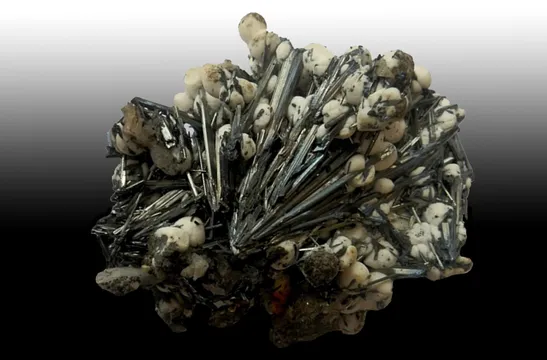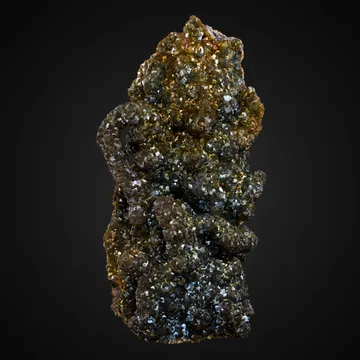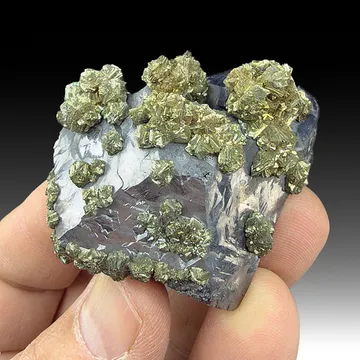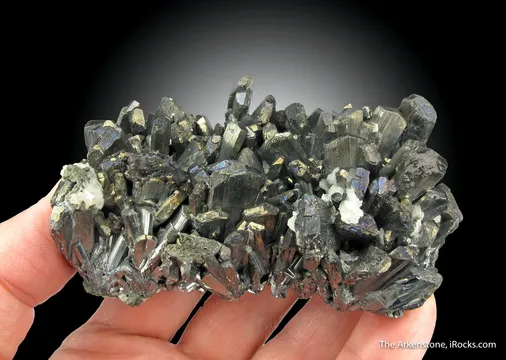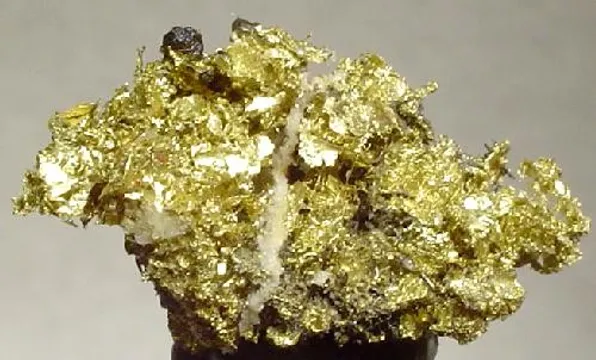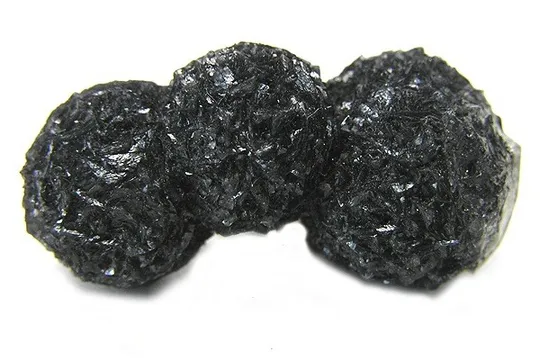
Baia Mare, Romania — Neogene mining district on the Gutâi Mountains, home to stibnite, baryte, calcite, sphalerite, galena, and rarities prized by collectors.
Key facts
Baia Mare is not a single-pocket locality in the narrow collector sense; it is the name collectors use for the great Neogene mining district on the southern flank of the Gutâi Mountains in Maramureș, northwestern Romania. The district’s classic mines—Herja, Săsar–Dealul Crucii, Baia Sprie, Șuior, Cavnic, Ilba, Nistru, and Băiuț among them—worked epithermal Au-Ag and base-metal veins related to Miocene to Pannonian calc-alkaline volcanism. For mineral collectors, “Baia Mare” means a whole visual language: metallic sulphides and sulfosalts on bright carbonates, stibnite sprays and hedgehogs, transparent to red baryte, black-and-white calcite spheres, rhodochrosite from Cavnic, quartz druses, galena, sphalerite, tetrahedrite, berthierite, jamesonite, semseyite, and a remarkable suite of antimony-rich rarities.
The district’s best specimens are instantly recognizable. They are rarely slick, modern, over-cleaned showpieces; they have the old European mine look—dark, lustrous metallic needles set into white calcite, black sphalerite against pale carbonates, baryte plates standing like panes of glass, and dense sulfosalt sprays with just enough disorder to feel grown rather than arranged. Baia Mare specimens reward close looking: what first appears to be a grey-black metallic mass may prove to be stibnite, berthierite, jamesonite, fizélyite, boulangerite, semseyite, or several of them together.
Regional View
Country View
Historically, Baia Mare stands among the classic mining districts of the Carpathians. Medieval documents record organized mining administration around Baia Mare, and by the modern industrial period the mines were tied into a large nonferrous-mining and smelting economy. The district also became one of Romania’s great mineralogical classrooms. Several valid mineral species were first described from mines in the Baia Mare area, and the County Museum of Mineralogy “Victor Gorduza” in Baia Mare preserves thousands of regional specimens, including nationally important “mine flowers” from the closed workings.

Photo: Didier Descouens via Wikimedia Commons

Search for specimens: View all specimens from Baia Mare, Romania
The Baia Mare Neogene metallogenetic district lies along the southern edge of the Gutâi Mountains, in the northwestern segment of the Eastern Carpathian volcanic chain. The district includes tens of epithermal deposits carrying Pb-Zn-Cu with Au and Ag, as well as Au-Ag veins with subordinate base metals. Its broad geological framework consists of pre-Neogene basement sedimentary rocks, Neogene sedimentary cover, and Neogene volcanic and subvolcanic rocks. The ore systems are related to intermediate calc-alkaline arc-type magmatism and to hydrothermal activity that followed or accompanied the volcanic evolution.
Structurally, the deposits are controlled by major east-west to ENE-WSW fault systems on the southern slope of the Gutâi Mountains. In collector terms, that structural control matters because it produced a chain of vein camps rather than one mine: Ilba–Nistru in the west; Săsar–Dealul Crucii at Baia Mare itself; Herja near Chiuzbaia; Baia Sprie and Șuior to the east; Cavnic farther along the district; and Băiuț–Cisma at the eastern end. Older labels may use Hungarian or German names—Nagybánya for Baia Mare, Kisbánya for Herja, Felsőbánya for Baia Sprie, Kapnikbánya for Cavnic, and Kereszthegy for Dealul Crucii—so label interpretation is part of collecting the district.
The ore bodies are principally hydrothermal veins, vein swarms, stockworks, breccia zones, and locally complex pipe or breccia structures. In the Herja deposit, the best-known source for many Baia Mare stibnites in present-day commerce, mineralization is associated with a complex Pannonian intrusive stock and an extensive vein network. Modern summaries describe Herja as a low-sulfidation epithermal system with propylitic, argillic, phyllic, and potassic alteration; its mineralization evolved from base-metal sulphides into later antimony-rich assemblages. Sphalerite and galena dominate much of the ore, with pyrite, chalcopyrite, pyrrhotite, marcasite, tetrahedrite-group minerals, stibnite, and an exceptional Pb-Sb sulfosalt suite.
The Săsar–Dealul Crucii area, immediately tied to Baia Mare city, is more strongly Au-Ag in collector memory and mining history, though it also yielded important antimony sulphosalts. Dealul Crucii is especially important as the type locality of fülöppite, a rare Pb-Sb sulfosalt. Old workings at Dealul Crucii are among the district’s most evocative historical remains: artificial cavities developed in Pannonian andesites, medieval galleries, soot-darkened passages, and the so-called Smoke Gallery connected to old extraction and ventilation systems.
Baia Sprie, just east of Baia Mare, is one of the most mineralogically important camps in the whole district. It is the classic Felsőbánya of old labels and literature, famous for stibnite with baryte, red baryte, quartz, scheelite, wolframite, bournonite, and several minerals first described there. Its stibnites tend toward long acicular crystals, commonly in association with transparent baryte, whereas Herja’s collector stibnite is more characteristically radial, compact, and hedgehog-like. Cavnic adds another major strand to the Baia Mare story: rhodochrosite, large tetrahedrite, chalcopyrite, baryte, gypsum, and complex polymetallic vein material. Ilba and Nistru supplied Pb-Zn-Cu assemblages, including sphalerite, galena, chalcopyrite, pyrite, and in some collections attractive vivianite or carbonate associations.
Mining in the Baia Mare region is deeply old, but the secure documentary picture becomes especially strong in the medieval and early modern periods. A 14th-century royal document refers to Baia Mare and Săsar under historical names and describes local mining administration, including a mine leader and officials charged with supervising operations and collecting the king’s tribute. By the 18th and 19th centuries, the mines, mints, smelters, offices, and laboratories of the region were part of a sophisticated metallurgical system. In 1900, the Baia Mare Mine and Ironworks Office oversaw mines and offices including Baia Sprie, Cavnic, Băiuț, Rodna Veche, Ferneziu, Valea Roșie, Dealul Crucii, and the analysis office in Baia Mare.
The 20th century transformed the district again. After nationalization in 1948, the mines became part of Romania’s state nonferrous mining system. Production at several older mines increased substantially during the socialist industrial period; Herja, Baia Sprie, Cavnic, Băiuț, Șuior, and associated flotation and metallurgical plants fed the regional economy for decades. The decline came after 1990, and most of the classic specimen-producing mines were closed or placed into final closure programs in the mid-2000s. By January 1, 2007, many operations in the Baia Mare–Baia Sprie–Cavnic–Herja system had ceased activity, with environmental monitoring and closure works replacing mining.
Collectors should treat Baia Mare today as a closed-mine district. Underground collecting access is not a realistic modern field opportunity and should not be assumed legal or safe. Acid mine drainage, unstable workings, old shafts, contaminated dumps, and formal closure works make casual collecting a poor proposition. The specimens that matter in serious collections generally came out during mining—especially through the 20th century and the final active decades—and now circulate through old Romanian collections, European dealer inventories, museum deaccessions, and inherited miner or engineer collections.
The notable finds were varied by mine. Herja yielded radial stibnite, galena, sphalerite, siderite, calcite, black calcite, black-and-white calcite spheres, marcasite after pyrrhotite, jamesonite “mineral wool,” berthierite, boulangerite, semseyite, and fizélyite. Baia Sprie produced long stibnite with baryte, red baryte, quartz, scheelite, wolframite, bournonite, and many of the district’s type-mineral classics. Cavnic is remembered for rhodochrosite, tetrahedrite, chalcopyrite, baryte, calcite, quartz, gypsum, and sulphide-rich cabinet pieces. Săsar and Dealul Crucii supplied quartz, amethyst-bearing associations, marcasite, pyrite, sphalerite, chalcopyrite, fülöppite-bearing sulfosalt material, and Au-Ag vein specimens. Taken together, these mines explain why the Baia Mare name on a label carries both beauty and ambiguity: it may mean the municipality, the mining district, a dealer shorthand, or a lost sublocality.
Stibnite from the Baia Mare district is one of the defining Romanian classics, but its look depends strongly on the mine. Herja material is the familiar form on many “Baia Mare” labels: dark steel-grey to grey-black metallic crystals in compact radial balls, hedgehog sprays, short prismatic bundles, and dense acicular thickets, often on calcite, siderite, quartz, baryte, sphalerite, galena, berthierite, jamesonite, boulangerite, or other Pb-Sb sulfosalts. Baia Sprie stibnite more often carries the collector image of very long acicular crystals with transparent baryte, while Băiuț is noted for thicker lustrous prisms. Good Baia Mare stibnite is three-dimensional, sharp-tipped, and visually separated from its matrix; ordinary pieces are flatter, crushed at the tips, overly massive, or only vaguely labelled “Romania” or “Baia Mare” without a mine. Cabinet specimens occur, but many of the most convincing pieces are miniatures and small cabinets whose individual crystals are only a few centimeters long yet arranged into lively, unmistakably Carpathian sprays.
Baia Mare’s other documented minerals include a remarkable set of type-locality and near-type-locality species. Baia Sprie is the type locality for andorite, dietrichite, felsőbányaite, klebelsbergite, monsmedite, semseyite, and szmikite; Dealul Crucii is the type locality for fülöppite; Herja is the type locality for fizélyite and the historical “parajamesonite” material later shown to be jamesonite; Cavnic is historically central to rhodochrosite and has also been discussed in relation to early rhodonite and whewellite records. Beyond the type minerals, the district is rich in galena, sphalerite, pyrite, marcasite, chalcopyrite, pyrrhotite, tetrahedrite–freibergite, bournonite, boulangerite, berthierite, jamesonite, chalcostibite, realgar, orpiment, cinnabar, quartz, calcite, siderite, rhodochrosite, baryte, gypsum, scheelite, wolframite, vivianite, and cronstedtite. The County Museum of Mineralogy in Baia Mare specifically highlights exceptional regional examples of andorite, fizélyite, semseyite, klebelsbergite, fülöppite, berthierite, cinnabar, pyrrhotite, rhodochrosite, scheelite, wolframite, vivianite, and cronstedtite.
Baia Mare labels deserve careful reading. A precise old label giving Herja, Baia Sprie, Cavnic, Săsar, Dealul Crucii, Ilba, Nistru, Băiuț, or Cisma is far more useful than a modern “Baia Mare, Romania” label. The broad Baia Mare designation is historically understandable, but it can hide important differences in habit and value: Herja radial stibnite is not the same collecting object as Baia Sprie stibnite with baryte, and Cavnic rhodochrosite or tetrahedrite should not be blurred into a generic district name if the old locality is known.
Mislabelling is especially common with Romanian stibnite and antimony minerals. Herja, Baia Sprie, Băiuț, Cisma, and other Maramureș mines have all circulated under vague or exchanged labels, and some pieces are sold simply as “Baia Mare” because dealers inherited a regional label without the mine. For stibnite, morphology helps but is not proof: Herja is typically radial and compact, Baia Sprie often more acicular with baryte, and Băiuț can show thick glossy prisms, but overlap exists. Matrix, old labels, collection history, and associated minerals matter.
There are documented fakes and deceptive specimens tied to the Romanian mineral market. One published warning described Chinese stibnite crystals glued onto Romanian matrix, synthetic potassium dichromate sold as realgar, and calcite dyed to resemble rhodochrosite. Researchers studying Herja calcite spheres also reported fake centimeter-scale black or grey “calcite spheres” seen at a Cluj-Napoca mineral fair in 2016; X-ray diffraction identified them as synthetic aluminum oxide with subordinate spinel balls, coated with glued debris and needles of jamesonite. These reports do not mean that every Baia Mare specimen is suspect, but they do mean that improbable combinations, unnaturally perfect repairs, dyed pink carbonates, and matrix-crystal mismatches should be inspected with a loupe and, when expensive, analytical caution.
Condition is a central issue. Stibnite is soft, brittle, and strongly cleavable; crushed tips, rubbed edges, collapsed sprays, and old trimming damage are common. Baryte plates from Baia Sprie and Cavnic are easily chipped. Calcite, especially stalactitic or spherical Herja material, cleaves and bruises readily. Sulfosalt “wool” and fibrous jamesonite-type material can shed, mat, or collect dust. Pyrite and marcasite associations should be checked for instability, especially on specimens stored in damp conditions. Sulphide-rich Baia Mare pieces should be kept dry, handled minimally, and never cleaned aggressively.
Fluorescence is not usually the point of Baia Mare collecting, though individual calcite specimens may respond modestly depending on activators and impurities. The district’s main appeal is morphology and association, not ultraviolet display. Stibnite, realgar, orpiment, cinnabar, and sulphosalt-rich pieces should be treated as display minerals rather than handling minerals: do not lick, grind, tumble, ultrasonically clean, acid-clean, or allow dust to accumulate where it can be inhaled. Realgar and orpiment should be protected from strong light.
Market availability remains moderate because large quantities of material left the mines over decades, but the quality curve is steep. Ordinary sulphide-and-calcite specimens, damaged stibnite sprays, and vague “Baia Mare” pieces appear regularly. Fine Herja stibnite with sharp radial architecture, Baia Sprie stibnite with transparent baryte, Cavnic rhodochrosite with strong color and clean crystals, well-crystallized tetrahedrite, credible fülöppite or fizélyite, and old-labelled type-locality rarities are much harder. Closed-mine status and the shrinking supply of well-provenanced old material have made the best Baia Mare specimens increasingly collection-driven rather than show-bin material.
The old mines around Baia Mare are not only places on labels; they are built into the city’s identity. A 14th-century royal document refers to Baia Mare and Săsar under their historical names and describes a working mining administration: a magistrum montis chosen annually, a town ruler and council with authority over mining disputes, and officials responsible for supervising work and raising the king’s tribute. That is the background behind the old European feel of Baia Mare specimens. They come from a mining landscape where ore, town government, minting, smelting, and law grew together.
Dealul Crucii gives that history a physical shape. The old grotto on the hill above Baia Mare is an artificial mining cavity cut in Pannonian andesites, known in medieval documents as Naghwerem. It has five entrances—one horizontal entrance and four shafts—and reaches about 409 m in development with 67 m of vertical range. Around 80 m from the entrance, a thick soot layer marks the zone known as the Smoke Gallery. The soot may relate to fire-setting, mine ventilation, or fumes drawn from the Werner Shaft machinery in the Lobkovitz Gallery roughly 200 m lower. In one portion the gallery widens and rises far beyond an ordinary mine passage, with heights of 5 to 15 m and widths of 1 to 10 m. The surviving details are wonderfully concrete: old smoke openings in the roof, wooden chestnut supports, suspended footbridges, steps, wall sockets, and roof-support pillars made from stacked stone.
Herja’s story is different: industrial, mineralogical, and human. Local memory remembers it as a major mine rather than a minor collector locality. In its prime it employed large numbers of people from Baia Mare and nearby villages; in the late 20th century its ore and specimens moved through the state mining system, and the mine became one of the classic sources of Romanian stibnite, galena, black calcite, and antimony sulfosalts. The post-1990 contraction came in waves. Workers left through layoffs, severance programs, retraining, or migration. By the time the final closures arrived in the mid-2000s, the mining landscape that had fed generations of collections was becoming heritage rather than production.
The strangest Herja story belongs to the calcite spheres. In 1958, unusual white, black, and bicolor calcite balls were found in the lower parts of geodes in veins such as Șălan, Clementina, and Ignațiu. The miners were surprised enough by them that, according to later recollection, they “used to play with them.” Some spheres were white, some black, some half black and half white, the dark color caused by fine sulphosalt inclusions. One approximately half-black, half-white calcite sphere became part of Romania’s national patrimony in the County Museum of Mineralogy “Victor Gorduza” in Baia Mare. During the night of January 25–26, 2014, that specimen was stolen from its secure place; when the 2019 scientific study of the spheres was published, it was still missing.
The museum records preserve other details that sound almost fictional until one remembers Herja’s open-space mineralization. One white-dominated calcite sphere measuring 4.5 × 4.5 × 5 cm made a noise when shaken, suggesting a hollow interior with solid inclusions. Another black calcite sphere, 6 × 6 × 6 cm, was built from rhombohedra up to 10 mm across and dusted with tiny siderite spheres and probable marcasite. These are not the biggest Baia Mare specimens, but they may be among the most memorable: mineral objects that seem less like ore and more like sealed geological toys.
The district also carries the darker modern story of mining’s environmental legacy. On January 30, 2000, a tailings dam at the Aurul S.A. gold retreatment operation near Baia Mare failed, releasing roughly 100,000 m3 of cyanide- and heavy-metal-bearing water and mud into the river system. The plume moved through the Lăpuș and Someș, into the Tisza and onward toward the Danube. For mineral collectors, that episode is not a specimen story, but it is part of the same landscape: the transition from centuries of underground mining to closure, remediation, contested heritage, and the modern responsibility of preserving mineral history without romanticizing its costs.
V. Bologa and G. Udubașa, “Minerals and Mineral Varieties First Described in the Baia Mare Mining District,” Romanian Journal of Mineralogy, vol. 77, supplement, 1996 — Key source for Baia Mare type-locality minerals, including Baia Sprie, Dealul Crucii, Herja, and Cavnic records.
Réka Kovács and Călin G. Tămaș, “New Geochemical Data and Mineralogical Interpretation for Cisma Ore Deposit, Gutâi Mountains,” Romanian Journal of Mineral Deposits 91, no. 1–2, 43–47, 2018 — Concise geological summary of the Baia Mare Neogene metallogenetic district and its western-to-eastern metallogenetic fields.
Gheorghe Damian, “The Genesis of the Base Metal Ore Deposit from Herja,” Studia UBB Geologia 48, no. 1, 85–100, 2003 — Important ore-genesis paper identifying Herja as a low-sulfidation epithermal base-metal system tied to Pannonian magmatism and hydrothermal alteration.
N. J. Cook and G. S. Damian, “New Data on ‘Plumosite’ and Other Sulphosalt Minerals from the Herja Hydrothermal Vein Deposit, Baia Mare District, Rumania,” Geologica Carpathica 48, 387–399, 1997 — Classic Herja sulfosalt reference covering jamesonite-group material, “plumosite,” stibnite-bearing assemblages, and the exceptional Pb-Sb mineralogy of the mine.
Ioan Mârza, Călin Gabriel Tămaș, Romulus Tetean, Alina Andreica, Ioan Denuț, and Réka Kovács, “Epithermal Bicolor Black and White Calcite Spheres from Herja Ore Deposit, Baia Mare Neogene Ore District, Romania—Genetic Considerations,” Minerals 9, no. 6, 352, 2019 — Detailed treatment of Herja’s famous black, white, and bicolor calcite spheres, including mineral inclusions, museum specimens, historical recollections, and fake-sphere reports.
Dana Pop and Dan Costin, “Review of the Morphology of Stibnite from Baia Mare Region in the Collections of the Mineralogical Museum of the Babeș-Bolyai University, Cluj-Napoca, Romania,” Muzeul Brukenthal – Studii și Comunicări – Științe Naturale 29, 13–35, 2004 — Museum-based stibnite morphology study documenting Baia Mare-area specimens from Baia Sprie, Cavnic, Herja, and Băiuț.
Gheorghe Ilinca, Dana Lüttge, Dan Costin, and Florentina Tatiana Puică, “The Relationship Between the Crystal-Chemistry and the Morphology of Stibnite from Baia Mare Area,” GEO2005 Proceedings, Geological Society of Romania, 40–48, 2005 — Follow-up technical contribution on Baia Mare stibnite morphology and chemistry.
Réka Kovács, Călin G. Tămaș, and coauthors, “Valentinite and Colloform Sphalerite in Epithermal Deposits from Baia Mare Area, Eastern Carpathians,” Minerals 10, no. 2, 121, 2020 — Useful for late antimony mineralization, oxidation products, and Baia Mare epithermal paragenesis.
Marinel Kovacs, Ágnes Gál, and coauthors, “Mineral- and Rock Type Localities in Romania and Their Potential Geoheritage Value,” Geoheritage, 2024 — Modern geoheritage overview highlighting Baia Mare-area type localities, Dealul Crucii, Baia Sprie, Herja, Cavnic, and the Baia Mare mineralogical museum.
County Museum of Mineralogy “Victor Gorduza” Baia Mare — Mineral Collection — Museum source documenting the size and composition of the Baia Mare regional collection and its standout specimens.
County Museum of Mineralogy “Victor Gorduza” Baia Mare — Permanent Exhibitions — Valuable for collector-level descriptions of regional species, including stibnite, baryte, rhodochrosite, tetrahedrite, jamesonite, berthierite, cronstedtite, and type-mineral displays.
“QPJ2378 STIBNITE, Herja, Romania” — Crystal Classics, Vimeo — Rotating dealer video of a Herja stibnite specimen from the Baia Mare district.
“Stibnite with Baryte from Baia Sprie Mine, Romania” — Fabre Minerals, Vimeo — Video of a Baia Sprie stibnite-and-baryte specimen, useful for comparing the Baia Sprie habit with Herja radial stibnite.
Museum of Mineralogy Baia Mare — Virtual Museum — Official virtual museum resource showing representative “mine flowers” and regional specimens, including Baia Sprie stibnite.
Mindat — Baia Mare, Maramureș County, Romania — Broad locality page for Baia Mare and its subordinate mines, species, and references.
Mindat — Herja Mine, Baia Mare, Maramureș County, Romania — Essential locality page for Herja, especially stibnite, galena, calcite, berthierite, jamesonite, semseyite, and fizélyite.
Mindat — Dealul Crucii adit, Baia Mare, Maramureș County, Romania — Useful for the Săsar–Dealul Crucii area and fülöppite type-locality context.
Wikimedia Commons — Category: Herja Mine — Image archive of Herja specimens, including stibnite, semseyite, fizélyite, berthierite, calcite, jamesonite, and related species.
Wikimedia Commons — Category: Minerals of Baia Mare — Small but useful media category for Baia Mare-area mineral photographs.
County Museum of Mineralogy “Victor Gorduza” Baia Mare — The key institution for seeing and understanding the district’s mineral heritage in Romania.
County Museum of History and Archaeology Baia Mare — Mining and Civilization in Maramureș PDF — Rich historical source on Baia Mare mining administration, tools, mints, mine offices, and museum collections.
Speologie.org — Grota din Dealul Crucii — Field description of the medieval Dealul Crucii mining cavity, Smoke Gallery, dimensions, entrances, and surviving workings.
UN Digital Library — Cyanide Spill at Baia Mare, Romania: UNEP/OCHA Assessment Mission — Primary international report record for the 2000 Baia Mare cyanide spill.
EUR-Lex — Communication on Safe Operation of Mining Activities Following Recent Mining Accidents — European Commission document summarizing the Baia Mare spill volume, cyanide load, and downstream impact route.