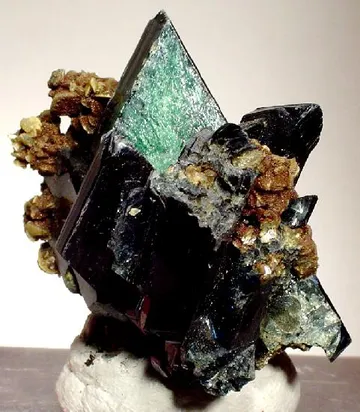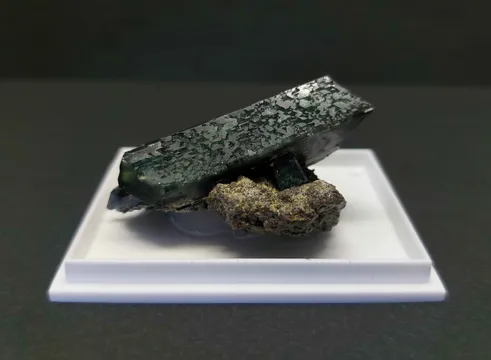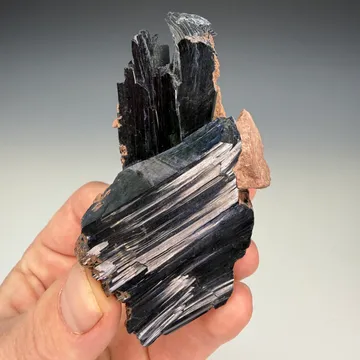
Vivianite: color-changing, pleochroic crystals from Bolivia, prized for prisms and velvety luster on matrix; rare, collectible, with light-sensitive care.
Key facts
Vivianite [Fe3(PO4)2·8H2O] is an iron phosphate beloved by collectors for its elegant prisms, dramatic pleochroism, and remarkable color evolution. Fresh crystals can be nearly colorless to pale green; with exposure to light and oxygen they deepen through teal, blue-green, and rich forest green, often eventually turning very dark as vivianite partially oxidizes to metavivianite. This chameleon-like behavior is part of its appeal—but also a care challenge.
Crystals are typically elongated monoclinic prisms or blades, sometimes in radiating sprays or parallel bundles. Lustrous, transparent to translucent prisms from Bolivia set the modern standard, while fibrous nodules from lignite and bog-iron deposits (Germany, Crimea) show striking radial patterns. Vivianite forms in low-temperature, reducing environments—hydrothermal cavities in sulfide-tin districts, sedimentary iron deposits, fossil bones, peat, or mine timbers. Associated species include siderite, pyrite, marcasite, quartz, calcite, goethite/limonite, and other iron phosphates (beraunite, rockbridgeite).
Despite its softness (Mohs 1.5–2) and sensitivity to light, exceptional vivianites deliver a unique, velvety luster and gemmy depth of color that few minerals can match. Fine, intact, transparent crystals on aesthetic matrix are scarce and command strong prices; nodular and fibrous examples are more accessible and often collected for their patterns and color.
Vivianite has transitioned from a “curiosity” to a mainstream display mineral thanks to major Bolivian finds (1990s–2010s) that produced large, lustrous crystals with superb transparency and saturation. These discoveries redefined the species, placing top vivianite alongside contemporary classics.
Collectors prize vivianite for:
While thumbnails and small sprays remain affordable, world-class matrix pieces with intact, gemmy crystals are fiercely competed for and often repaired (disclosed) due to fragility. Interest is sustained by variety: from Bolivian prisms to Yukon sprays and European lignite nodules, it’s a species that rewards depth and breadth in a collection.
Below are renowned sources known to produce specimens that set standards for the species. Each entry links to a deeper dive for collectors.
Tomokoni, Potosí Department, is widely considered the premier source for large, transparent, richly colored vivianite crystals. Prisms reaching 10–20 cm (and larger) occur in vugs of oxidized tin-sulfide ore, often standing dramatically on ochre goethite/limonite or intergrown with siderite and quartz. The best pieces combine:
Because pockets frequently collapsed, many fine specimens are repaired; pristine, unrepaired matrix pieces are rare and highly prized. Tomokoni material set the contemporary benchmark for the species.
The historic Huanuni tin district (Oruro Department) has produced excellent vivianites since the late 20th century. Typical crystals are slender, lustrous prisms and blades—often arranged in sprays or parallel groups—with saturated blue-green color that glows when backlit. Associations include quartz, siderite, pyrite, and limonite.
Collectors value Huanuni for elegant, balanced compositions and “alive” color. While sizes can be slightly smaller on average than Tomokoni, the aesthetics and crystal quality make Huanuni a core Bolivian classic for the species.
Llallagua’s famed Siglo Veinte tin mine yielded classic vivianites—stout prisms and clustered blades on iron-oxide matrix, often with siderite. Color ranges from teal to deep green; strong pleochroism and internally “glassy” zones are common. Historic pieces from the mid- to late-1900s remain sought after for their robust crystal forms and old-mine provenance.
Color and Pleochroism:
Clarity and Luster:
Crystal Form and Aesthetics:
Size:
Condition:
Provenance:
Repairs:
“Re-bluing”/Reduction Treatments:
Polishing and Coatings:
Vivianite is among the most care-sensitive display minerals. Good habits preserve both color and integrity.
Light:
Oxygen and Environment:
Handling:
Cleaning:
Display Tips:
Following these guidelines will help you enjoy vivianite’s unique beauty while preserving its color and condition for years to come.