Deva, Romania locality guide: Sacaramb telluride locality famed for nagyagite and sylvanite, rhodochrosite, and a rich mining history treasured by collectors.
Key facts
For mineral collectors, “Deva, Romania” is best understood as the classic old European label for the Săcărâmb ore field—Nagyág in the historic Hungarian literature—north of the city of Deva in Hunedoara County, on the southern side of the Metaliferi Mountains of the Apuseni range. This is one of the great telluride localities of the world: a low-sulfidation epithermal Au-Ag-Te vein system developed in Neogene calc-alkaline volcanic rocks, centered on a compact andesitic volcanic structure cut by a crowded array of veins. Its reputation rests above all on nagyagite, sylvanite, petzite, krennerite, stützite, muthmannite, and museumite, together with rhodochrosite, quartz, sphalerite, galena, bournonite, alabandite, and other sulfosalts.
What makes the locality so arresting is the way its mineralogy, mining history, and early chemical science are entangled. Săcărâmb was a major gold producer for roughly two and a half centuries, but much of that gold was locked in tellurides rather than visible native metal. The mine therefore became a natural laboratory for the recognition of chemically bound gold and tellurium. Nagyagite itself was first described from this place, and the old name “Nagyág” remains embedded in the mineral’s name.
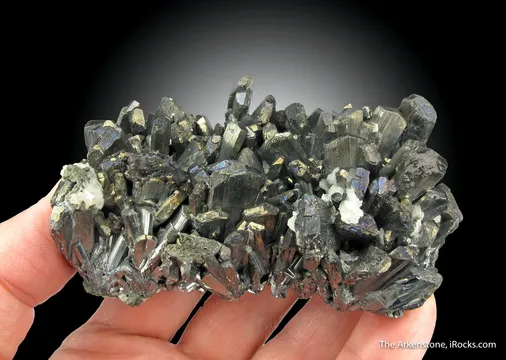
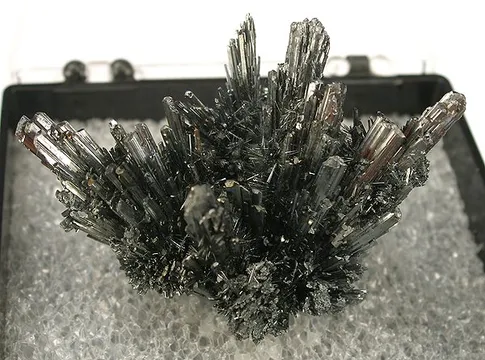
The best specimens have an unmistakable old-European character: metallic gray to black, highly lustrous, thin lamellar or skeletal plates of nagyagite; sometimes bright, oriented blades standing on quartz; sometimes large, flattened crystals perched on pale pink rhodochrosite; and, at the highest level, combination pieces with darker lanceolate sylvanite. Fine examples are not showy in the manner of modern gem minerals. Their appeal is denser and more historical: a silver-black metallic flash, a blush of rhodochrosite, an old handwritten label, and a locality name that sits near the beginning of telluride mineralogy.
Regional View
Country View
The specimen trade still often uses compact historic labels such as “Sacarîmb (Nagyág), Deva, Hunedoara, Romania,” even though the modern administrative locality is Săcărâmb, Certeju de Sus commune, Hunedoara County. That label is not merely a convenience: Deva was the regional mining and administrative center, and many old collections, dealers, and museum catalogues preserve the older locality language.
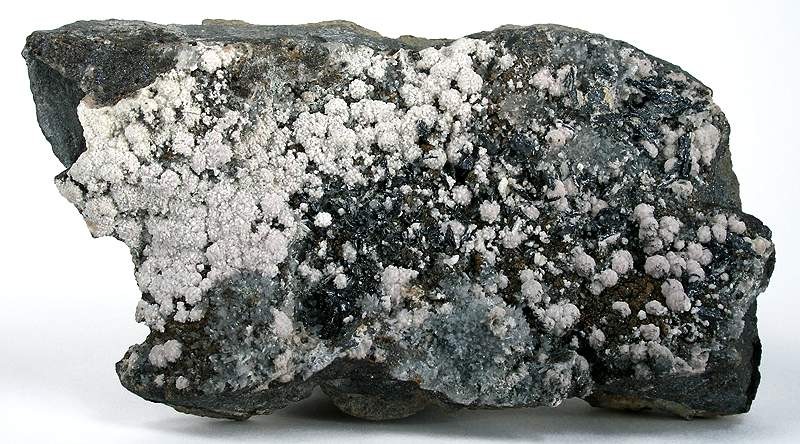
Photo: Wikimedia Commons
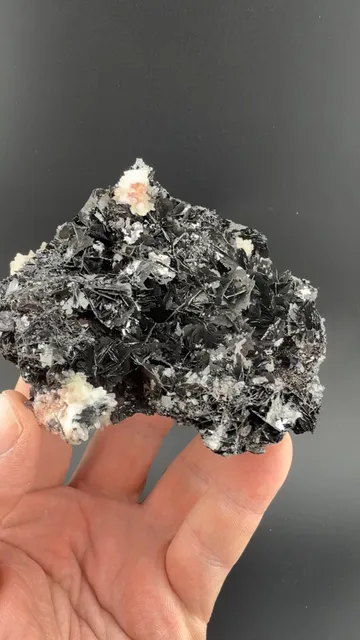
This large, rich plate shows exactly why Săcărâmb material has remained desirable: black-gray metallic nagyagite crystals scattered through quartz and pale pink rhodochrosite on ore matrix. The specimen record notes freestanding crystals to 4 mm and emphasizes that the crystals were not etched from calcite, a point that matters greatly to collectors because etched nagyagite can lose its natural surface patina.

Photo: Wikimedia Commons
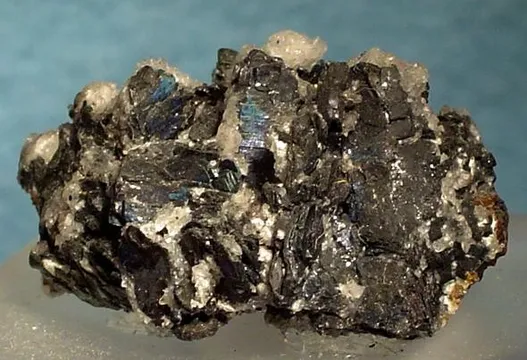
Combination pieces with both nagyagite and sylvanite are especially evocative of the locality. This old-time specimen is recorded as a two-sided piece, 5.4 x 5.2 x 2.8 cm, with laminar nagyagite crystals to 2.6 cm and hair-like sylvanite to 1.9 cm, a scale and association that move it well beyond the average systematic thumbnail.
Search for specimens: View all specimens from Deva, Romania
The collectible “Deva” nagyagite locality is the Săcărâmb, formerly Nagyág, Au-Ag-Te vein deposit in Hunedoara County. Geologically, Săcărâmb belongs to the Golden Quadrilateral of the South Apuseni Mountains, one of Europe’s most productive historic precious-metal provinces. The deposit is interpreted as a low-sulfidation epithermal gold-telluride system and is exceptional within the district for the abundance and variety of tellurides.
The ore is hosted mainly in the central neck of a Neogene stratovolcano and related andesite stocks. Published geological work describes the volcanic structure as a compact Săcărâmb andesitic body with associated stocks at Sarcău, Haitău, Frăsinata, and Săcărâmb, surrounded by lava flows and intruded through the Fața Băii sedimentary formation. The metamorphic basement at the southern edge of the area includes sericite schists, chlorite schists, metarhyolites, and marbles. For collectors, that volcanic setting matters because the classic specimens came from narrow hydrothermal veins and vein margins rather than from broad disseminated ore.
The vein system is famously dense. Modern summaries describe more than 230 veins concentrated in a small area, with ore bodies developed to roughly 600 m depth. Older district-scale work emphasizes the “closely packed” character of the veins and estimates their cumulative length at hundreds of kilometers. The principal vein groups are commonly given as Nepomuc, Magdalena, Longhin-Antilonghin, and Erzbau, with two dominant structural trends: NE-SW for Nepomuc and Magdalena, and NW-SE for Longhin-Antilonghin and Erzbau. The collectible tellurides belong to this vein environment, not to a single simple “pocket” in the sense familiar from pegmatites.
The paragenesis is complex but can be simplified for specimen purposes. Early pyrite and manganese sulfide mineralization is followed by base-metal sulfides and sulfosalts, then by gold-, silver-, and lead-tellurides, with quartz, rhodochrosite, other carbonates, and clay minerals as gangue. At deposit scale, published work describes a vertical zonation: base metals, sulfosalts, and tellurides nearer the upper levels; the richest telluride expression in the middle levels; and stronger base-metal mineralization at depth. That middle-level telluride zone is the heart of the classic specimen suite.
Mining began in the mid-18th century, with large-scale work at Săcărâmb recorded from about 1747. The historical mining levels are part of the locality’s identity: Maria at 784 m, Bernat at 723 m, Josephi or Ferdinand at 637 m, Franz or Carol at 494 m, and Franz Joseph or Nicolae at 335 m are cited in the geological literature as the five principal horizons, spanning roughly 450 m vertically. These names are worth knowing because they appear on old labels and in European collection records.
Production figures vary by source and by the period counted, but the broad picture is consistent: Săcărâmb was a major long-lived producer of gold, silver, and tellurium. Geological estimates commonly cite about 30 metric tons of gold, about 55 metric tons of silver, and roughly 60 metric tons of tellurium over the historic producing period; some modern technical documents for the broader Certej area cite more than 40 metric tons of gold extracted from the Săcărâmb deposit and describe it for over a century as among Europe’s most profitable mines. The difference is a reminder that “Săcărâmb” appears in historical, geological, and modern project literature with slightly different boundaries and accounting conventions.
The later Certej mining district, adjoining and partly overlapping the old Săcărâmb mining landscape, was operated by Romanian state mining entities in the 20th century and closed in January 2006 as part of Romania’s mine-closure program during European Union accession. The modern Certej project has involved Deva Gold and later VarDev, with the state company Minvest retaining a minority interest. This modern project history is important for access: the old mining field is not an open public collecting locality in the romantic 19th-century sense. It includes old workings, dumps, tailings, private or concession-controlled ground, and environmental liabilities. Serious collectors should treat any field access as requiring explicit local permission and should not assume that historical dumps are legally or safely collectible.
Specimen-wise, the material seen today is overwhelmingly old stock: 19th-century and early-20th-century pieces from European collections, museum deaccessions, and older dealer inventories, supplemented by material recovered from historic dumps or rediscovered in institutional collections. The most desirable pieces are not merely “nagyagite present” labels. They are well-crystallized specimens with metallic luster, visible lamellar plates, attractive contrast against rhodochrosite or quartz, and, ideally, old documentation tying them to Nagyág/Săcărâmb rather than a vague Romanian telluride locality.
Nagyagite from the Deva-labeled Săcărâmb locality is the defining collector species: black-gray to metallic gray, soft, platy, and commonly developed as thin lamellae, flattened crystals, or skeletal parallel growths on quartz, rhodochrosite, sphalerite-rich ore, and occasionally with sylvanite. Most collectible examples are small-cabinet, miniature, or thumbnail specimens with visible crystals in the millimeter range; museum and fine private-collection pieces may show lamellar crystals around 1 cm, and exceptional old pieces are recorded with crystals exceeding 2 cm. Good specimens are separated from ordinary ones by three things: crystals that are truly free and lustrous rather than dull black smears in ore; matrix contrast, especially pale pink rhodochrosite or clean quartz; and reliable old provenance to Săcărâmb/Nagyág. Combination specimens with lanceolate or hair-like sylvanite are scarcer and especially desirable, while acid-etched examples need close scrutiny because preparation can alter the surface and diminish the historic patina that collectors prize here.
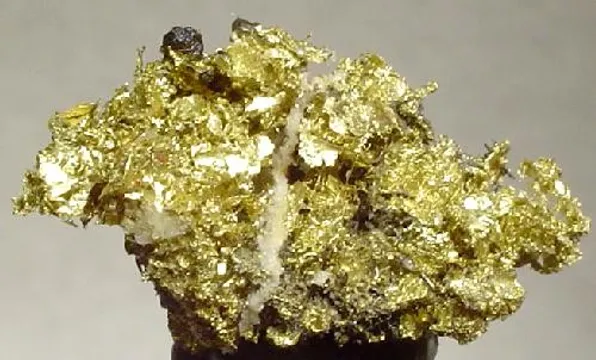
Other minerals make Săcărâmb much more than a one-species locality. It is cited as a type locality for a remarkable group of species, including alabandite, krautite, krennerite, muthmannite, nagyagite, petzite, stützite, and museumite. Sylvanite is one of the most important companion tellurides and occurs as bright elongated, acicular, dendritic, or skeletal crystals on quartz; petzite, hessite, krennerite, stützite, altaite, coloradoite, native tellurium, and bismuth tellurides are part of the broader telluride assemblage. The sulfosalt suite is also strong, including members and relatives of the tetrahedrite-tennantite, bournonite-seligmannite, Pb-As/Sb, lillianite, sartorite, Ag-, Tl-, and Te-Bi-bearing groups. Attractive non-telluride specimen material includes rhodochrosite, quartz, alabandite, sphalerite, galena, pyrite, calcite, and bournonite, but the locality’s highest collecting importance remains its type-species and telluride assemblage.
Deva/Săcărâmb specimens demand careful locality discipline. Old labels may read Nagyág, Nagyag, Sacarîmb, Sacaramb, Szekerembe, Săcărâmb, Deva, Transylvania, Hungary, Austria-Hungary, or Romania, depending on when and where the specimen entered a collection. These are not automatically contradictory; they reflect changing political geography, orthography, and dealer shorthand. The strongest labels give both the historic and modern locality, or preserve a credible old collection chain.
The chief authenticity issue is not usually an elaborate fake but overconfident identification. Many black metallic tellurides and sulfosalts from Săcărâmb can resemble one another in hand specimen, especially when the crystals are tiny or embedded in dark ore. Nagyagite, sylvanite, petzite, hessite, altaite, and sulfosalts may all occur in intimate association. For high-value specimens, especially those advertised as exceptional nagyagite crystals, collector-grade documentation should include old labels, a reputable dealer history, museum provenance, or analytical confirmation. This is particularly true for small systematic pieces where the visible “crystal” is a black metallic film or cleavable grain rather than a recognizable lamellar crystal.
Condition is a serious value factor. Nagyagite is very soft, with a hardness near 1 to 1.5, and its lamellar crystals cleave and abrade easily. Even fine specimens may show rubbed high points, edge chipping, or dulling from old handling. Avoid repeated brushing, ultrasonic cleaning, or any aggressive mechanical preparation. Handle specimens over a padded surface and store them so that the metallic plates do not touch box lids, cotton fibers, or neighboring specimens.
Preparation history matters. Some nagyagite specimens have been etched from calcite, and at least one well-documented display specimen is specifically praised because its freestanding crystals were not etched out. Acid etching may reveal crystals, but it can also change the natural patina and leave an unnatural look. This is not necessarily “fake,” but it should be disclosed and valued differently from naturally exposed crystal groups on quartz or rhodochrosite.
Expect scarcity. Ordinary ore chips with minor nagyagite are available from time to time, but aesthetic, well-crystallized, matrix specimens from old collections are genuinely rare. Pieces with visible crystals around a centimeter, combination specimens with sylvanite, or examples carrying 19th-century collection labels are premium material. The market rewards specimens that are small but sharp far more than larger massive pieces with uncertain species identity.
There are no routine fluorescence expectations for nagyagite itself. The practical handling concern is chemical and physical fragility rather than display under ultraviolet light. Because specimens may contain tellurides, sulfosalts, lead minerals, arsenic-bearing phases, and other ore minerals, avoid inhaling dust, do not trim dry indoors, wash hands after handling, and keep friable material away from children and food-preparation areas.
The founding story of Săcărâmb reads like a folktale because, in part, that is how it survived. In one version recorded in the 18th century, a Romanian named Ion Armindean came to the elder Born, who was then working a rich silver mine at Certej, and reported a strange flame that appeared daily above a crack in the forest. Born decided the report was worth testing. He drove a gallery toward the spot, worked in vain for years, and was close to abandoning it when a final attempt crossed the vein. The ore he found was rich in gold but appeared as black lamellae—so deceptive that it was first taken for an iron ore with mica. Only the fire test revealed its true value. Ignaz von Born retold the episode in a letter sent from Săcărâmb in the summer of 1770, writing that the discovery persuaded his father to pursue the mine more urgently.
A second version, considered more authentic by some later authors, strips away the dancing flame but keeps the essential drama. In this account, preserved through Andreas Stütz, the Romanian did not point vaguely to a supernatural light. He showed Born a piece of ore. Born tested it at Alba Iulia, recognized its gold content, and returned to the discovery site, which was marked by an old mining sculpture. Whether the first clue was a flame in the forest or a hand specimen carried to an experienced mining man, the result was the same: a compact mountain village entered the mineralogical literature of Europe.
The mineral that fooled the early miners also puzzled chemists. The Săcărâmb and broader Transylvanian gold telluride ores helped reveal that gold could occur chemically bonded in minerals rather than as visible native metal. In 1782, Franz Joseph Müller von Reichenstein, studying Transylvanian gold ores, wrestled with an unfamiliar metallic substance that resembled antimony but behaved differently. One striking test became famous: in concentrated sulfuric acid it produced a carmine-red color unlike that of any known element. Müller first called the unknown substance “metallum problematicum.” Later, Martin Heinrich Klaproth confirmed the new element and named it tellurium, from tellus, earth. For collectors, that story gives Săcărâmb material an importance beyond rarity: a black telluride blade from this district belongs to the history of chemistry as well as to mineralogy.
By the end of the 18th century Săcărâmb had become a cosmopolitan mining settlement. Romanian, German, Hungarian, Slovak, Italian, and other mining families lived and worked around a cluster of churches, cemeteries, mine monuments, crosses, and school buildings. The mine levels themselves preserve that layered European world in their names—Maria, Bernat, Josephi or Ferdinand, Franz or Carol, and Franz Joseph or Nicolae—stacked down the volcanic structure from 784 m to 335 m elevation. These are not just archival details. They explain why a specimen with a faded “Nagyág” label may carry, in miniature, the history of a multilingual mining town.
The later history is darker. In 1971, wet tailings from the Săcărâmb mine, stored near Certeju de Sus, failed catastrophically. VarDev’s modern project history gives the death toll as 89 lives, and Romanian accounts describe the event as one of the major mining disasters of the region. The old tailings and waste dumps later attracted renewed geological interest because they still contain tellurium, gold, and silver that earlier processing did not recover. For today’s collector, the story is a necessary corrective to romance: the same district that produced beautiful telluride specimens also left dangerous workings, unstable dumps, and a serious environmental legacy.
Sergiu Drăgușanu, Mădălina-Paula Andrii, and Călin Gabriel Tămaș, “New SEM-EDS and EPMA data on Te-bearing minerals from Săcărâmb, Apuseni Mountains, Romania,” Romanian Journal of Mineral Deposits, 93(1-2), 2020, pp. 31-40 — A recent analytical study confirming nagyagite, native tellurium, and altaite in rhodochrosite-bearing ore from Săcărâmb, including microchemical variation within nagyagite lamellae.
Nigel J. Cook, Cristiana L. Ciobanu, Nicu Căpraru, Gheorghe Damian, and Petru Cristea, “Mineral assemblages from the vein salband at Sacarimb, Golden Quadrilateral, Romania: II. Tellurides,” Geochemistry, Mineralogy and Petrology, 43, 2005 — A key paper on the telluride assemblage, reporting ubiquitous nagyagite and locally abundant sylvanite, petzite, hessite, stützite, and native tellurium in vein-salband mineralization.
Cristiana L. Ciobanu, Nigel J. Cook, Nicu Căpraru, Gheorghe Damian, and Petru Cristea, “Mineral assemblages from the vein salband at Sacarimb, Golden Quadrilateral, Romania: I. Sulphides and sulphosalts,” Bulletin of Mineralogy, Petrology and Geochemistry, 43, 2005 — Companion study documenting the sulfide and sulfosalt context in which many of the tellurides occur.
Gheorghe Udubașa and Sebastian S. Udubașa, “Au-Ag telluride deposits in the Metaliferi Mts: Effects of local geology or of a ‘hydrothermal ichor,’” Romanian Journal of Mineral Deposits, 81, 2004, pp. 39-46 — Useful for production estimates, the principal historical mining horizons, and the scale of the Săcărâmb vein array.
Gheorghe Popescu, Mihaela Cioacă, Antonela Neacșu, Dan Filipescu, and Eugen Orlandea, “New data regarding the resources of tellurium and its distribution in the waste dumps and tailing dam from the Certej-Sacaramb ore deposit, Metaliferi Mts., Romania,” Geologica Balcanica, 39(1-2), 2010, pp. 321-322 — A concise resource-focused account of tellurium in the Săcărâmb dumps and Certej tailings, with useful deposit-scale geological summary.
C. J. Stanley, A. C. Roberts, and D. C. Harris, “New data for nagyagite,” Mineralogical Magazine, 58(392), 1994, pp. 479-482 — A short but important modern mineralogical note on nagyagite involving crystal-structure and electron-probe data from the type locality.
G. Simon, D. H. M. Alderton, and T. Bleser, “Arsenian nagyagite from Sacarimb, Romania: a possible new mineral species,” Mineralogical Magazine, 58(392), 1994, pp. 473-478 — Documents arsenic-rich nagyagite from Săcărâmb and highlights rapid chemical changes in the mineralizing fluids.
Luca Bindi and Curzio Cipriani, “Museumite, Pb5AuSbTe2S12, a new mineral from the gold-telluride deposit of Sacarîmb, Metaliferi Mountains, western Romania,” European Journal of Mineralogy, 16, 2004, pp. 835-838 — The type description of museumite, a Săcărâmb gold-telluride rarity found as microscopic grains in cavities and vugs of large nagyagite crystals.
“Mineral- and Rock Type Localities in Romania and Their Potential Geoheritage Value,” Geoheritage — A modern geoheritage treatment placing Săcărâmb among Romania’s most important mineral type localities.
Princeton University Mineral and Gem Collection: Nagyágite specimen 3201 — A museum specimen record for nagyagite from Nagyág/Săcărâmb, described as lamellar crystals to 1 cm with rhodochrosite on quartz druse.
DMB2289 NAGYAGITE, Sacarîmb, Romania — Crystal Classics — A short specimen video of a nagyagite example from Săcărâmb, useful for seeing the metallic luster and relief of the crystals under moving light.
“Aici era El Dorado al Europei. Adevărata poveste a aurului aflat în cantităţi uriaşe în Munţii Metaliferi VIDEO” — Adevărul / Daniel Guță — Romanian photo-and-video reportage on the Săcărâmb mining landscape, its folklore, and the old gold district around the Metaliferi Mountains.
Mindat: Săcărâmb, Certeju de Sus, Hunedoara County, Romania — The central locality page for mineral species, photographs, coordinates, and type-locality status.
Mindat: Nagyágite mineral page — Species data for nagyagite, including formula, physical properties, name origin, and type locality.
Wikimedia Commons: Minerals of Săcărâmb — Open image archive of Săcărâmb specimens, including numerous nagyagite and sylvanite photographs from Rob Lavinsky/iRocks.
USGS Professional Paper 1802-R: Tellurium — Broader tellurium resource context, including production and mineralogical notes on Săcărâmb as a historic telluride deposit.
VarDev: Certej Project History — Modern project-owner summary of the Certej district, including closure history and the 1971 tailings-dam tragedy.
Eldorado Gold / Certej Technical Report — Technical-report background on the Certej project, regional infrastructure, and historical mining chronology.
Fabre Minerals: Romanian reference specimens — Dealer archive with useful descriptions and size data for old Săcărâmb nagyagite and sylvanite specimens.
Carpathia Minerals: Nagyágite from Sacaramb — Example of current European-market availability and pricing for a historical nagyagite specimen from the type locality.
Digi24: Tellurium in Romania — Romanian investigative report on tellurium resources, Săcărâmb production, and modern concession issues.