Alba County, Romania — Roșia Montană gold-silver-telluride locality renowned for native gold on quartz, historic labels, and classic Transylvanian specimens.
Key facts
Alba County occupies a privileged place in European mineral collecting because it contains the Roșia Montană–Bucium sector of the Metaliferi Mountains, the northern part of the celebrated “Golden Quadrilateral” of the Apuseni Mountains. For collectors, “Alba County” usually means the old gold localities around Roșia Montană, historically Verespatak or Vöröspatak, where low- to intermediate-sulfidation epithermal Au-Ag mineralization cuts Neogene dacites, maar-diatreme breccias, and Cretaceous sedimentary rocks. The specimens that made the district famous are not merely gold-bearing ore; the best pieces show crisp native gold and electrum as leaves, dendrites, reticulated “graphic” growths, and small sharp crystals on white to gray drusy quartz, with dark sulfides and silvery tellurides adding the unmistakable Transylvanian character.
The geological interest is as strong as the aesthetics. Roșia Montană is a gold-silver-telluride system in which early gold-rich quartz-adularia assemblages were followed by later Ag-rich, Te-Ge-bearing veins and breccias. Hessite, petzite, sylvanite, altaite, alburnite, tetrahedrite, galena, sphalerite, pyrite, marcasite, rhodochrosite, rhodonite, calcite, and quartz all belong to the locality’s documented mineralogical story. The county also includes Bucium, with related Rodu-Frasin epithermal Au-Ag deposits and the Bucium-Tarnița porphyry Cu-Au system, as well as Baia de Arieș, Zlatna, and the great Roșia Poieni porphyry copper mine near Abrud. Yet the old collector cachet still radiates from Roșia Montană: antique labels, Austro-Hungarian locality names, and the distinctive mellow yellow of silver-rich gold on fine quartz.
Historically, Roșia Montană is exceptional. Under the Roman name Alburnus Maior, it became one of the most important gold-mining centers of Roman Dacia after 106 CE, and its surviving underground workings are among the most extensive and technically diverse Roman gold-mining complexes known. That long mining history explains why old specimens occur with labels in German, Hungarian, Latinized, and modern Romanian forms: Verespatak, Vöröspatak, Goldbach, Alburnus Maior, Roșia de Munte, and Roșia Montană may all point back to the same collecting tradition.
Regional View
Country View
For a mineral cabinet, Alba County is best approached as a historical gold-telluride province rather than a single mine name. Roșia Montană supplies the iconic gold and telluride specimens; Bucium demonstrates the same volcanic-epithermal fertility continuing southward; Baia de Arieș adds another old gold-and-base-metal center; and Roșia Poieni gives the county a modern porphyry-copper dimension. The serious collector should therefore read old labels carefully: a specimen sold as “Transylvania,” “Verespatak,” or “Offenbánya” may be far more specific than it first appears.

Photo: Wikimedia Commons

Photo: Wikimedia Commons
Search for specimens: View all specimens from Alba County, Romania
Alba County’s classic collector specimens come chiefly from Roșia Montană, in the Metaliferi Mountains of the South Apuseni range. The deposit is hosted by a maar-diatreme complex intruding Cretaceous black shales, sandstones, and conglomerates, with the principal Au-Ag mineralization associated with the Neogene Cetate and Cârnic dacite bodies and the surrounding phreatomagmatic breccias. The system is usually described as epithermal, low to intermediate sulfidation. Mineralization occurs as disseminations, stockworks, breccias, and veins, with quartz-adularia alteration followed or overprinted by carbonate-clay-sulfide assemblages.
The best-known ore centers at Roșia Montană include Cetate, Cârnic, Cârnicel, Orlea, Jig, Igre, Țarina, and related breccia-hosted zones. Early Au-rich stages yielded native gold and electrum with quartz, adularia, pyrite, and Ag sulfosalts. Later Ag-rich stages produced a more complex assemblage: acanthite, tetrahedrite, galena, sphalerite, chalcopyrite, hessite, petzite, sylvanite, altaite, cervelleite, alburnite, rhodochrosite, rhodonite, calcite, and quartz. The Cârnicel vein is particularly important mineralogically because it yielded alburnite, Ag8GeTe2S4, and because published work documents Ag-Te-Ge mineralization there in association with hessite and other tellurides.
The old mining history is unusually deep. Roșia Montană was Alburnus Maior during Roman Dacia, and Roman workings are preserved in the Cârnic, Lety, Orlea, and Cetate massifs. Roman miners exploited high-grade ore using galleries, inclined workings, helicoidal shafts, stopes, drainage works, and water-lifting systems. Later medieval, Habsburg, Austro-Hungarian, Romanian state, and modern operations repeatedly cut through and around the ancient workings. This long sequence is why old specimens may carry labels from very different political periods yet still refer to the same goldfield.
Modern industrial mining at Roșia Montană took the form of state-run operations, especially the Cetate open pit, which operated in the late twentieth and early twenty-first centuries. The state operation Roșiamin, associated with Minvest Deva, ceased production in 2006. A proposed large-scale open-pit redevelopment by Roșia Montană Gold Corporation became one of Europe’s most contentious mining projects; the area was inscribed as the Roșia Montană Mining Landscape on the UNESCO World Heritage List and the List of World Heritage in Danger in 2021. As a practical matter for collectors, this is not an open collecting district. Underground workings, archaeological areas, heritage structures, mine dumps, and active or licensed mining perimeters should be treated as restricted unless explicit local permission has been obtained.
Bucium, south of Roșia Montană, is geologically and historically tied to the same metallogenic belt. The Rodu-Frasin Au-Ag deposits occur in altered dacitic vent-breccia and related volcanic rocks, with veins, stockworks, and disseminated mineralization comparable in broad style to Roșia Montană. The Bucium-Tarnița porphyry Cu-Au occurrence represents the deeper, porphyry-style side of the system. Baia de Arieș, another old Alba County mining center, is documented for native gold with quartz and a base-metal sulfide assemblage including chalcopyrite, pyrite, arsenopyrite, sphalerite, galena, and associated gangue minerals. Roșia Poieni, near Mușca and Abrud, is a major porphyry copper deposit rather than a classic cabinet-specimen gold locality; its mineralogy includes chalcopyrite, pyrite, magnetite, bornite, molybdenite, enargite-luzonite, alunite, kaolinite, dickite, pyrophyllite, diaspore, and supergene copper minerals such as malachite and azurite.
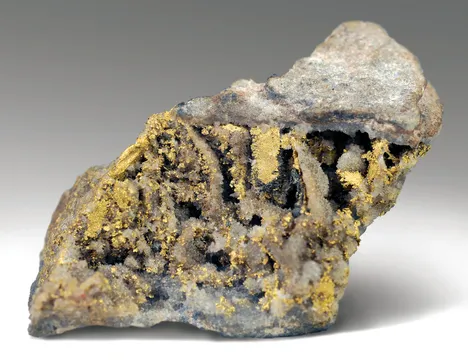
The most desirable old Alba County pieces are almost always from Roșia Montană and usually date from older underground or early modern workings rather than recent casual collecting. Fine gold specimens from the nineteenth century and earlier are recorded with leaves, flattened octahedral aggregates, spinel-law twinning, dendritic and arborescent forms, reticulated graphic textures, and drusy quartz matrices. Some later pieces, including late twentieth-century and early twenty-first-century finds, occur as smaller crystallized gold on quartz or sulfide-bearing matrix. For tellurides, collector-quality specimens are far less common and should be judged with caution: the locality is famous for telluride mineralogy, but many of the important phases are microscopic or intergrown and require analytical confirmation.
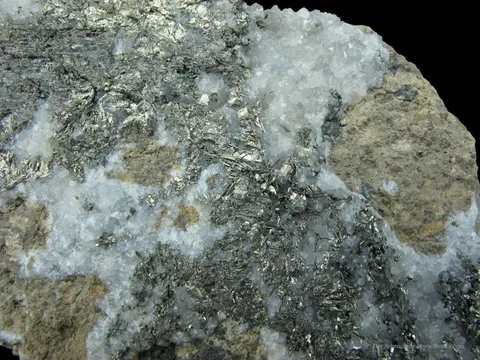
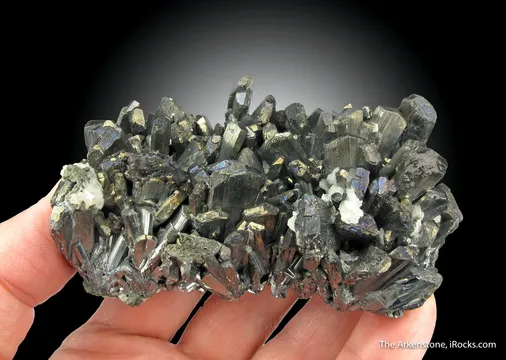
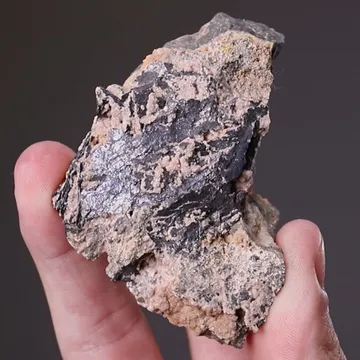
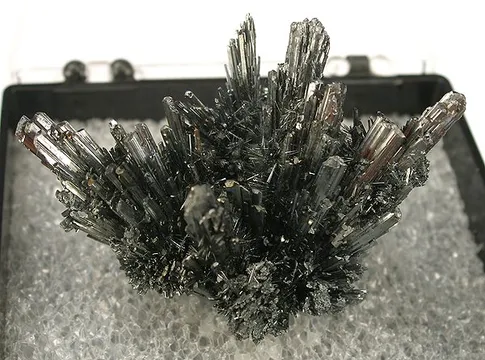
Hessite from Alba County is most securely tied to the Ag-rich telluride stages of Roșia Montană, especially the Cârnicel vein and related late mineralization in the Cârnic area, where it occurs with tetrahedrite, galena, sphalerite, pyrite, marcasite, altaite, sylvanite, petzite, alburnite, rhodochrosite, rhodonite, calcite, and quartz. In published polished-section work, much of the hessite is microscopic to very small, appearing as metallic gray inclusions, grains, and intergrowths rather than showy freestanding crystals; in collector specimens it is most often encountered as silvery-gray telluride patches or masses with other tellurides and native gold on quartz. The best Alba County hessite specimens are not merely “gray metallic ore”: they carry strong Roșia Montană provenance, convincing telluride association, visible contrast against quartz or carbonate gangue, and ideally analytical or old-label support, because hessite, petzite, sylvanite, altaite, and even tarnished sulfides can be visually treacherous here.
Quartz is the visual and geological stage on which Alba County’s classic gold specimens are built. At Roșia Montană it occurs in quartz-adularia alteration, quartz-carbonate-sulfide veins, stockworks, and breccia fillings, commonly with native gold or electrum, pyrite, galena, sphalerite, tetrahedrite, rhodochrosite, calcite, rhodonite, and tellurides. Collector pieces range from microdrusy white quartz crusts supporting leaf gold to vein quartz with vugs, gold stringers, and sulfide specks; amethystine quartz has also been reported from veins in the Cârnic massif. The best Roșia Montană quartz is rarely sought as a quartz-only specimen; its value lies in sharp drusy texture, attractive contrast, old provenance, and its role as matrix for well-developed gold, hessite-bearing telluride ore, or manganese carbonate-silicate gangue.
Gold is the signature mineral of Alba County, and Roșia Montană gold has a recognizable old-European look: mellow yellow to slightly pale electrum-rich color, leaf and lamellar growths, mossy-arborescent sprays, dendrites, skeletal plates, reticulated graphic forms, flattened octahedral aggregates, and small elongated crystals on quartz. Documented specimens include antique pieces found around the mid-nineteenth century, leaves a few centimeters across, crystallized leaflike gold to about 1.5 cm, and elongated crystals approaching 1 cm on old Verespatak matrix; published photographic plates of Roșia Montană gold show skeletal lamellar intergrowths, elongated crystal assemblages, dendritic aggregates, and graphic textures with centimeter-scale bars. The finest pieces combine abundant crystallized gold, bright luster, undamaged leaves, visible crystal structure, and a contrasting quartz or volcanic-rock matrix, while ordinary examples are more likely to be small disseminations, thin smears, or ambiguous yellow metal in quartz without strong form or provenance.
Other minerals give Alba County unusual depth beyond its gold. Alburnite, Ag8GeTe2S4, was described from the Cârnicel vein at Roșia Montană and remains the county’s most important type-locality mineral; it occurs as microscopic rounded grains, veinlets, and irregular inclusions hosted mainly by tetrahedrite, hessite, and rhodochrosite. The same late Ag-Te-Ge environment includes altaite, sylvanite, petzite, cervelleite, Te-rich argyrodite-related material, and rare Ge-bearing sulfosalts. Rhodochrosite and rhodonite are important gangue minerals in some Roșia Montană veins, while sphalerite, galena, tetrahedrite, chalcopyrite, pyrite, marcasite, acanthite, native silver, calcite, adularia, dolomite, siderite, barite, and manganese oxides round out the classic assemblage. Elsewhere in the county, Baia de Arieș adds old gold-quartz and base-metal sulfide specimens, Bucium contributes related Au-Ag mineralization, and Roșia Poieni contributes porphyry Cu-Au mineralogy with primary sulfides, advanced argillic alteration minerals, and colorful supergene copper species.
The chief authenticity issue for Alba County is not an epidemic of documented fake Roșia Montană gold, but the difficulty of provenance and visual identification. Old labels may use Verespatak, Vöröspatak, Goldbach, Transylvania, Hungary, Austria-Hungary, or Romania; all can be legitimate depending on date, but they need to make historical sense. A nineteenth-century “Verespatak, Ungarn” label is plausible; a modern, vague “Romanian gold” label attached to a high-priced piece deserves more scrutiny. Strong specimens should show coherent matrix, believable quartz or volcanic host, and gold morphology consistent with the locality’s leaves, dendrites, lamellae, spinel-twinned plates, and crystalline aggregates.
Telluride identifications require particular caution. Hessite, petzite, sylvanite, altaite, and tarnished sulfides can all appear as gray to silvery metallic material, and many of the important Roșia Montană telluride phases occur as microscopic inclusions in polished sections. Unless a specimen has reliable analytical work, a conservative label such as “Ag-Au tellurides” or “hessite-bearing telluride ore” may be more honest than a species-specific claim. Alburnite is a valid type-locality species from Roșia Montană, but it is microscopic and should not be expected as a visually identifiable hand-specimen mineral.
Condition matters greatly. Roșia Montană gold leaves and dendrites are easily bent, rubbed, or detached; bright high points can be flattened by handling, and quartz matrices may shed fragile druse. Old specimens may have repair, glue, trimmed matrix, or historical mounting residues, none of which necessarily destroys desirability but all of which should be disclosed. Gold itself is stable and needs no coating or cleaning beyond careful dust removal. Acid treatment is risky because it may disturb carbonates, sulfides, or tellurides and can alter the historical surface of antique pieces.
Market availability is limited and uneven. Small Roșia Montană gold-on-quartz pieces appear periodically from old collections, European dealers, and auction houses, but rich antique miniatures and cabinet specimens command strong prices. Hessite-rich and telluride specimens are scarcer in reliable, well-documented form than the number of locality mentions might suggest. Quartz-only specimens from Alba County have modest collector demand unless they carry gold, tellurides, rhodochrosite, amethystine color, or old labels. Because active and heritage-protected areas are not casual collecting grounds, most desirable material on the market should be treated as historical, collection-recycled, or dealer-dispersed rather than newly field-collected.
At Roșia Montană, the collector’s story begins underground. The Romans arrived after Trajan’s conquest of Dacia in 106 CE and turned Alburnus Maior into an imperial gold engine. UNESCO records more than 7 km of ancient workings known to date, cut through four small mountains: Cârnic, Lety, Orlea, and Cetate. These were not random holes following glittering seams. They included trapezoidal galleries carved with remarkable precision, inclined communication galleries with rock-cut stairways, helicoidal shafts, superimposed stopes, and drainage systems using wooden waterwheels powered by human tread.
The most haunting survival from those mines is not gold, but writing. Wax-coated wooden tablets, found in the eighteenth and nineteenth centuries, preserved contracts and legal documents from the mining community. Several were discovered in the Cătălina-Monulești gallery, and one study notes a tablet found on 24 July 1855 in the Saint Catherine mine. For a locality guide, those tablets matter because they give the old specimens a human scale: behind a leaf of gold on quartz stood a world of leaseholders, laborers, investors, migrants, contracts, debts, and legal promises sealed in wax in a frontier mining town.
Cârnic has its own drama. The mountain is riddled with Roman and later workings, and the UNESCO descriptions emphasize a mining architecture so specific in its combination of features that it is considered pioneering in early mining technology. In the Piatra Corbului, or Raven Stone, area, local interpretation preserves the memory of fire-setting: heating hard rock and then shocking it with water, sometimes described in local accounts as water mixed with vinegar, to fracture near-surface ore. The modern mineral collector sees the final product in hand specimens; the ancient miner first had to make the mountain crack.
The eighteenth and nineteenth centuries brought another landscape: not just galleries, but water, timber, stamps, and sound. Roșia Montană’s artificial lakes, the tăuri, stored water that powered ore-crushing stamps. Local heritage sources describe more than 240 stamp installations along the Roșia valley before nationalization, driven by water controlled by private mine owners working individually or in associations. It is easy to imagine why old specimens survived from this period: gold was not hidden invisibly in low-grade rock alone, but sometimes appeared as beautiful crystallized metal that a miner, mine captain, or visiting montanist could recognize as worth saving.
The twentieth-century shift to open-pit mining changed the look and fate of the district. Cetate became a large open pit, operated during the modern state-mining era, while the underground Roman and preindustrial landscape became both a scientific treasure and a point of conflict. In 2006, the state operation closed, leaving Roșia Montană suspended between an old mining economy, a proposed large open-cast future, and a heritage movement that eventually carried the site to UNESCO inscription in 2021. For collectors, that history gives the specimens a double charge: they are mineralogical objects and witnesses from a district where the meaning of gold was argued in courts, streets, villages, museums, and mine galleries.