






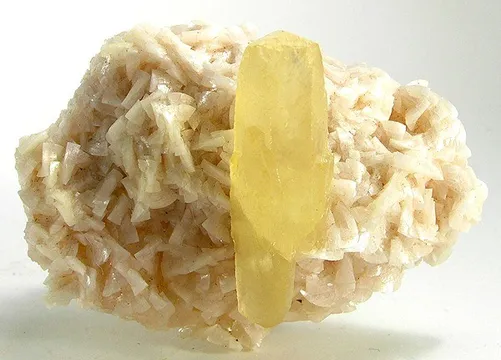
Rensselaer Quarry, USA — famed for brassy pyrite and marcasite in oil-stained dolostone, with epitaxial marcasite overgrowths on pyrite.
Key facts
Rensselaer Quarry is one of the classic small Midwestern carbonate-quarry localities whose reputation rests not on abundance, but on a very distinctive look: brassy pyrite and marcasite grown in petroleum-rich cavities in fossiliferous dolostone. The quarry lies at Pleasant Ridge, east of Rensselaer in Jasper County, northwestern Indiana, and has also appeared on labels as the Rensselaer Stone Company Quarry and the Pleasant Ridge Quarry. Modern locality records place the mineralization in Paleozoic carbonate sediments of the Middle Devonian Muscatatuck Group, although the earliest crystallographic paper on the pyrite-marcasite overgrowths cautiously described the host as Silurian(?) carbonate. That historical ambiguity is worth noting because the specimens themselves tell the more important collecting story: open pockets in oil-stained dolostone lined with calcite, dolomite, pyrite, marcasite, and uncommon sphalerite or galena.
Regional View
Country View
To collectors, Rensselaer matters above all for the strange beauty of FeS2 polymorphs in association: pyrite octahedra and modified cubes, marcasite blades and cockscombs, and especially epitaxial marcasite overgrowths on pyrite. Kenneth J. Brock and Larry D. Slater’s 1978 American Mineralogist paper made the locality scientifically notable by describing marcasite overgrowing pyrite in fixed crystallographic orientation in petroleum-filled cavities. Their observations give the locality a sharper identity than the usual “Indiana calcite and sulfides” label: Rensselaer is a place where the stable and metastable iron-sulfide forms meet on the same specimen, sometimes in the same crystal group, and do so with enough regularity to make the pieces immediately recognizable.

Photo: Wikimedia Commons
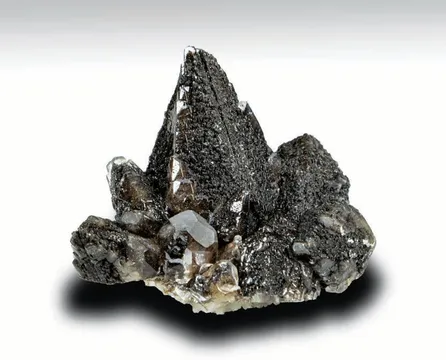
The best Rensselaer specimens have a heavy, dark Midwestern quarry character: grey to brown dolostone matrix, dark oil staining or bitumen inclusions, warm brassy sulfides, and calcite that may be clear, smoky, blackened, or hydrocarbon-coated. Fine pieces are not merely “a pyrite” or “a marcasite,” but miniature geological events: octahedral pyrite partly armored with bright marcasite, sharp cockscomb marcasite rising from oil-stained carbonate, or calcite scalenohedra made strange by included petroleum and fluorescent response.
Search for specimens: View all specimens from Rensselaer Quarry, USA
Rensselaer Quarry is an aggregate quarry at Pleasant Ridge, about three to four miles east of Rensselaer, Jasper County, Indiana, on the northern side of Indiana Route 114. Mindat gives coordinates near 40° 56' 9" N, 87° 4' 18" W and records the site as a quarry with the historical names Rensselaer Stone Company Quarry and Pleasant Ridge Quarry. The quarry worked dolostone for aggregate; the commodity record includes aggregates, dolostone, and mineral specimens. The operation is no longer a normal collecting locality: modern records describe the quarry as flooded to within a couple of feet of the surface, and specimen notes from recent years repeatedly describe it as closed, abandoned, flooded, or extinct.
The rock is a petroleum-rich carbonate, with the current locality description assigning the mineralization to Paleozoic carbonate sediments of the Middle Devonian Muscatatuck Group. The Muscatatuck Group in Indiana is a Middle Devonian package of dolomites and limestones that, in northwestern Indiana, forms part of the carbonate succession around the Michigan Basin margin. At Rensselaer, this carbonate host is critical to specimen appearance. The cavities are not clean, dry, white-lined Midwestern vugs; they are oil-stained pockets where natural bitumen permeated the dolostone and was present in many crystal openings. Calcite crystals frequently contain bitumen inclusions, and dealer and collector descriptions repeatedly note hydrocarbon-coated calcite rhombs, black organic carbon in calcite, and petroleum residue in small vugs.
The ore assemblage is compact but memorable: calcite, dolomite, pyrite, marcasite, sphalerite, and galena are the valid minerals recorded for the quarry. Brock and Slater’s field observations describe isolated cavities in fossiliferous dolostone containing thick petroleum and abundant iron sulfide, with cavity walls lined by intergrown pyrite octahedra or euhedral FeS2 crystals accompanied by calcite or dolomite; small irregular masses of galena were also observed rarely. Later specimen records and gallery entries add the practical collecting picture: pyrite with marcasite overgrowths, marcasite with calcite, calcite with bitumen, sphalerite as rare brown to gray-brown botryoids, and occasional galena associated with the same sulfide-carbonate pocket system.
The quarry’s most important mineralogical feature is its apparent vertical zoning of iron sulfides. Brock and Slater reported marcasite largely restricted to upper strata and pyrite to lower strata, with the celebrated epitaxial marcasite-on-pyrite specimens coming from a relatively thin transition zone. When the right cavity was hit, however, the yield could be extraordinary: they noted that an occasional cavity containing epitaxial overgrowths might produce several hundred such crystals. That is the geological reason Rensselaer specimens range from fairly plain dolostone plates with scattered sulfides to highly collectible crystal groups showing pyrite, marcasite, and calcite together in a single paragenetic story.
Mining history at the locality is tied to Rensselaer Stone Company and aggregate production rather than metallic ore mining. The quarry was already known to collectors well before the mid-1980s; Brock’s 1986 Rocks & Minerals article opened by noting that, for at least twenty years, the remote dolostone quarry in Jasper County had supplied specimens that gradually entered finer mineral collections across the Midwest. Records on Mindat cite an MSHA inspection report from 1973, the 1978 American Mineralogist crystallographic study, and the 1986 Rocks & Minerals locality article. Federal Mine Safety and Health Review Commission records also show Rensselaer Stone Co. Inc. associated with a limestone mine case in the early 1990s, documenting the quarry’s continued industrial identity beyond its mineral-collector fame.
Access today should be regarded as unavailable unless explicit permission is obtained from the landowner and any responsible operator or site manager. The flooded condition, industrial quarry hazards, unstable faces, water-filled workings, and sulfide decay issues make casual collecting inappropriate. Most specimens now on the market are older material: collected before flooding, dispersed from Midwest collections, or sold from estates and dealer back stock.
Calcite from Rensselaer is not the clean golden showroom calcite of some other Indiana quarries; its character is darker, oilier, and more idiosyncratic. Documented habits include scalenohedrons with bitumen, clear prismatic-tabular crystals to about 2.4 cm, rhombic compound crystals in mounded groups, unusual forms with circular cross-sections, rare beryl-like twelve-faced prisms with pinacoid faces, and spiky starburst clusters of high-organic-carbon calcite. The best specimens are those in which the hydrocarbons are an asset rather than a stain: transparent to translucent calcite showing included bitumen, calcite set against sharp brassy pyrite or cockscomb marcasite, or pieces with documented yellow-orange to pink-red fluorescence under ultraviolet light. Ordinary examples are small, heavily coated, or visually muddy; better pieces have sharp terminations, visible internal zoning or inclusions, contrasting sulfide association, and enough freshness that the hydrocarbon-rich surface has not become merely dirty-looking.
Pyrite is the structural backbone of the Rensselaer sulfide suite. Brock and Slater described the typical crystals as dull octahedra modified by cube and pyritohedron faces, commonly 2 to 3 cm across, with individual crystals up to 8 cm reported; cube faces may show faint striations parallel to edges shared by cube and pyritohedron faces. Collector specimens show additional habits prized on the market: sharp cuboctahedra, rich crusts of bronzy pyrite pyritohedrons, elongated pyrite “bars,” skeletal-faced compound crystals, and pyrite substrates carrying epitaxial marcasite. The strongest examples have complete or near-complete pyrite crystals perched on oil-stained calcite or dolostone, sharp brassy faces, preserved marcasite overgrowths, and minimal pyrite disease; lesser pieces tend to be massive, dull, contacted, or partly decomposed.
Marcasite is the locality’s signature mineral, especially when it shows the epitaxial relationship to pyrite. Non-epitaxial crystals were described as lusterless tabular crystals up to about 2 cm, commonly in multiply twinned cockscomb habit, while epitaxial overgrowths on pyrite have bright mirror-like faces and occur as twinned prismatic crystals aligned along pyrite octahedron edges; mature overgrowths may approach 1 cm, while embryonic forms can be less than 1 mm across. Collector descriptions add cockscomb groups, blades, “worms,” “mushroom” forms, flat plates of sharp crystals around 3 mm with scattered calcite rhombs, and marcasite on dolomite or calcite with bitumen. Good Rensselaer marcasite is sharply crystallized, lustrous, stable, and clearly associated with pyrite or hydrocarbon-bearing calcite; the finest pieces show the crystallographic drama of marcasite over pyrite rather than a simple brassy crust.
Other documented Rensselaer minerals are few but important for locality specialists. Dolomite is part of the host and pocket assemblage, occurring with calcite and sulfides. Galena is recorded from the quarry and was described in the early study as rare, small, irregular masses rather than the main collecting attraction. Sphalerite is the notable rarity: fine specimens are distinctly uncommon, with documented material described as brown to gray-brown botryoidal sphalerite on brassy marcasite and ironstone matrix. No type-locality minerals are documented from Rensselaer Quarry in the standard locality records, but the site has an outsized scientific role because of the well-described epitaxial marcasite-on-pyrite occurrence.
Rensselaer specimens require more caution than most Indiana calcite pieces because the best locality attributes—iron sulfides and hydrocarbons—are also the principal preservation risks. Pyrite and marcasite from the quarry have a documented reputation among collectors for “pyrite disease,” with superb marcasite and pyrite-marcasite pieces reportedly deteriorating into powder. Surviving specimens should be kept dry, cool, and well ventilated, away from high humidity, cardboard boxes that trap acidic vapors, and adjacent specimens that could be damaged by sulfuric acid products from decaying sulfides. Avoid washing sulfide-rich specimens with water; if cleaning is necessary, treat it as a conservation problem rather than a routine mineral-prep task.
Mislabelling is a real issue. Rensselaer pyrite and marcasite have been confused with or broadly labelled as “Tri-State,” “Fort Wayne Ardmore Quarry,” or simply “Indiana pyrite.” Authentic Rensselaer material usually has a recognizable combination of oil-stained dolostone or calcite, modified pyrite octahedra or cuboctahedra, marcasite overgrowths or cockscombs, and dark hydrocarbon residues. Labels using “Rensselaer Stone Co. Quarry,” “Pleasant Ridge Quarry,” or “Rensselaer Quarry, Pleasant Ridge, Jasper County, Indiana” are all plausible; labels that omit Pleasant Ridge are common but should be judged against specimen style and provenance.
Condition must be evaluated with a loupe and, if possible, a humidity history. Warning signs include white to yellowish powder, sulfurous or acidic odor, crumbling edges, rusty halos, swelling cracks, and damaged paper labels near the specimen. Pyrite crystals can also be contacted or cleaved, especially on older collected pieces; calcite commonly shows bruising, cleaves, and hydrocarbon coatings that may be natural rather than damage. Do not over-clean the black or brown bituminous material: on Rensselaer pieces it is part of the locality signature, and removing it can erase provenance character as well as expose unstable sulfide surfaces.
Fluorescence is a useful bonus but not guaranteed. Documented Rensselaer calcite may fluoresce orange-yellow under short-, medium-, and long-wave ultraviolet light, while at least one terminated calcite has been photographed with moderate pink-red fluorescence under both long-wave 365 nm and short-wave 254 nm UV. Fluorescence should be considered an added collecting attribute, especially on calcite-pyrite combinations, rather than the primary basis for value.
On the market, Rensselaer is a finite old-stock locality. Commoner pieces are small calcites or modest pyrite/marcasite plates; better specimens include sharp cuboctahedral pyrite on hydrocarbon-coated calcite, cockscomb marcasite groups, and especially epitaxial marcasite on pyrite with good stability. Sphalerite-bearing specimens are much scarcer. Values depend heavily on freshness: a sharp, stable, well-provenanced pyrite-marcasite specimen is far more desirable than a larger but visibly decaying sulfide plate.
At the March 1987 meeting of the Indiana Chapter of Friends of Mineralogy, Dr. Kenneth Brock of Indiana University Northwest gave collectors a close look at the Pleasant Ridge quarry through slides and field observations. The newsletter account preserves the feel of the place better than a dry species list: the quarry was unique, interesting, and filthy. Mineralized cavities carried so much petroleum that the black organic material was not a minor stain but a collecting condition. The carbonates included dolomite and calcite, with the calcite showing rare forms—black crystals with oil inclusions, trigonal scalenohedra, and twelve-faced prisms resembling beryl. Then came the sulfides: massive galena, crusts of sphalerite, pyrite as elongated bars and cube-octahedron combinations, and finally the “real prize,” marcasite in worms, mushroom forms, cockscombs, blades, and epitaxial growths on pyrite.
The field experience was memorable enough that later dealer notes repeat the human detail rather than just the mineral description. One field collector recalled that the rock was always full of hydrocarbons, and after a day at the site, clothing could be badly stained by the black oozing material. That is exactly the sort of detail that explains why old Rensselaer specimens look the way they do: calcite rhombs darkened by hydrocarbon films, little black residues lodged in vugs near the base of specimens, and otherwise bright brassy sulfides rising out of matrix that looks as though it came from an oil reservoir rather than a tidy calcite quarry.
The scientific story is just as vivid. In the transition zone between marcasite-rich upper strata and pyrite-rich lower strata, a single productive cavity could contain several hundred epitaxial crystals. At hand-specimen scale, these are handsome pyrite-marcasite combinations; at microscope and crystallographic scale, they are tightly ordered growths, with marcasite twins fixed to pyrite in a consistent orientation. Brock and Slater emphasized how unusual that was: marcasite, the metastable FeS2 polymorph, had grown as an overgrowth on pyrite, the stable polymorph. For a collector, that means the best Rensselaer pieces are not simply attractive Midwestern sulfides—they are cabinet specimens of a mineralogical paradox.
There is also a quieter, modern collector’s story: loss. Rensselaer has become a locality where old-timers speak of specimens in the past tense. In a 2022 Mindat discussion, Kevin Conroy called the quarry “notorious for pyrite disease” and wrote that he had collected superb marcasite specimens, but almost all of them began turning into dust. Phil Richardson answered with the lament every sulfide collector understands: so many fantastic Rensselaer pyrite and marcasite specimens had deteriorated before he photographed them. That fragility has changed how surviving pieces are viewed. A stable Rensselaer pyrite-marcasite is not just a specimen; it is a survivor from a locality where chemistry has continued long after collecting ended.
_(19187301252).jpg)