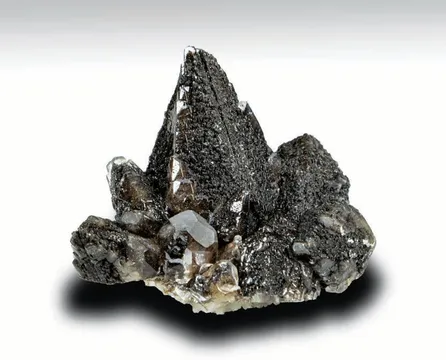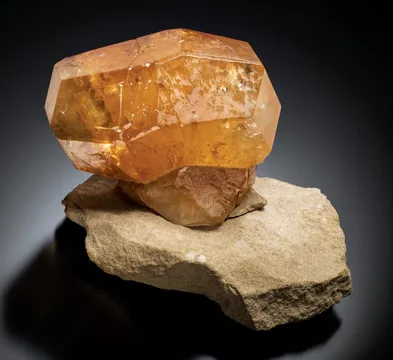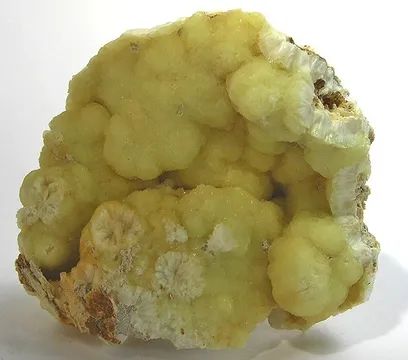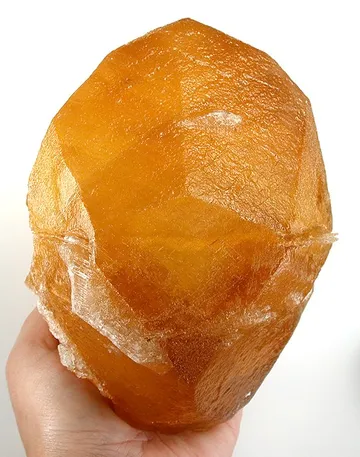
Corydon Stone Co. Quarry, USA — southern Indiana carbonate-vug locality known for pink dolomite, calcite, and purple fluorite cubes; historic, access limited.
Key facts
Corydon Stone Co. Quarry is one of southern Indiana’s classic carbonate-vug localities: a working crushed-limestone quarry northwest of Corydon in Harrison County, opened in the mid-twentieth century and long prized by Midwest collectors for clean, displayable calcite and dolomite specimens. The quarry cuts a Mississippian limestone section at the edge of Indiana’s karst country, with St. Louis Limestone at the lower levels, Ste. Genevieve Limestone through much of the productive quarry face, Paoli Limestone above, and locally higher Chesterian shale, sandstone, coal, and fossiliferous limestone beds near the top. The collectible minerals are not an ore body in the mining sense; they are cavity minerals developed in open spaces, seams, fractures, vugs, and cave-related zones within a commercial aggregate operation.
The locality’s reputation rests on a handsome and very recognizable assemblage: lustrous pink to salmon dolomite lining limestone cavities, cream to yellow and white calcite perched over it, and scattered fluorite—most often small purple, yellow, clear, or brown-zoned cubes. Good Corydon specimens have the color contrast collectors remember: pale calcite crystals rising out of a glittering pink dolomite carpet, sometimes with a sharp purple fluorite cube tucked into the association. The finest pieces are not enormous by world standards, but they are very “Indiana”: fresh limestone matrix, open vugs, curved dolomite saddles, glassy calcite, and a low-temperature Mississippi Valley–style mineral suite in miniature.
Regional View
Country View
Historically, Corydon is important because it remained in collector memory through repeated club trips, field reports, show specimens, and newsletter accounts. The quarry has not been a casual public collecting site for years; access has depended on the operator and on carefully arranged club or professional visits, and specimen collecting is now generally closed to ordinary collectors. That restriction has helped make older, well-documented Corydon pieces increasingly desirable, especially specimens with collection dates, club-trip provenance, or old Midwest labels.
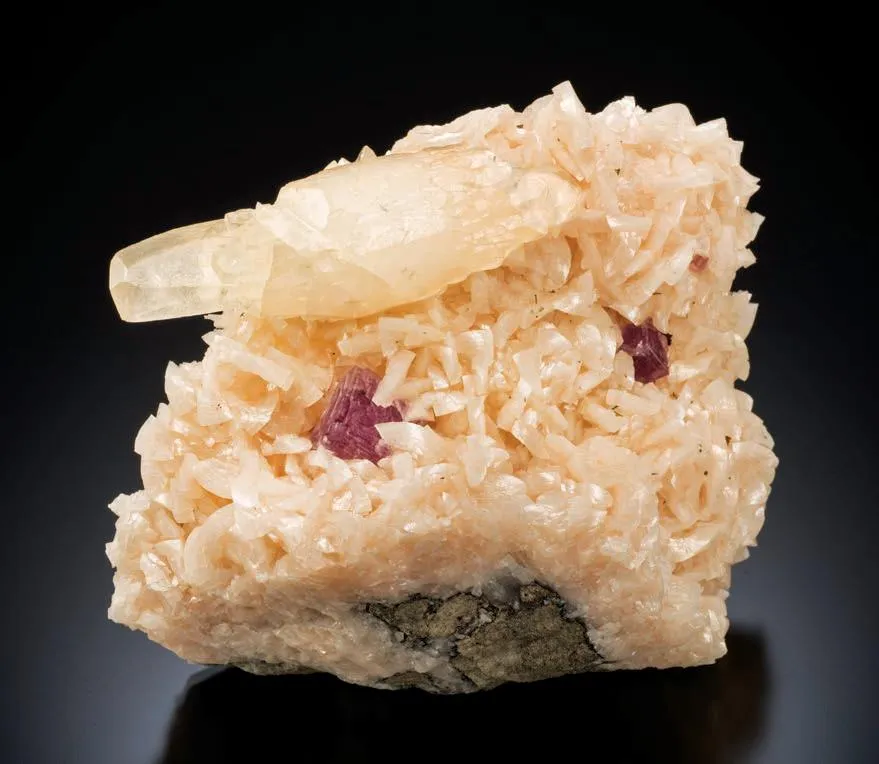
Photo: EarthWonders
The best-known Corydon look is captured perfectly by older specimens collected in the 1970s through the 2010s: a limestone vug lined with pale peach to pink dolomite, a prominent flattened or dogtooth calcite crystal projecting from the surface, and purple fluorite accents. It is the sort of specimen that rewards close looking rather than distant spectacle—the fluorite may be only a centimeter or less, but when it is sharp, well placed, and not buried in dolomite, it gives the piece its locality signature.
Search for specimens: View all specimens from Corydon Stone Co. Quarry, USA
Corydon Stone Co. Quarry, also recorded as Corydon Crushed Stone and Lime Quarry and in modern operation as the IMI Corydon aggregate site, lies northwest of Corydon, Harrison County, Indiana, at 1100 Quarry Road. Historical and modern quarry directories place it about 2 to 2.5 miles northwest of town, in the Corydon West quadrangle, and describe it as a crushed-stone and aglime operation. The quarry is a producer of limestone aggregate, not a specimen mine; every collector specimen from the locality is incidental to blasting, crushing, and highwall development in commercial limestone.
The quarry section is valuable geologically because it exposes a thick Mississippian carbonate sequence in the Blue River Group and adjacent units. Older quarry directories list approximately 15 feet of Paoli Limestone and about 91 feet of Ste. Genevieve Limestone at the Corydon operation; later geological field-trip descriptions add the St. Louis Limestone at the lower levels and note overlying lower West Baden Group shale and sandstone. Alan Goldstein’s collecting and geology notes describe the quarry as cutting from the top of the St. Louis Limestone in the bottom of the pit upward through the Ste. Genevieve and Paoli limestones, with Mooretown Sandstone, Bethel Shale, a thin coal seam, and fossil-rich Beaver Bend Limestone near the top of the quarry section.
For collectors, the productive “deposit” is the open-space mineralization within the limestones. Vugs, cavities, solution openings, cave fragments, and fracture-controlled seams provided room for dolomite, calcite, fluorite, quartz, baryte, sulfides, and secondary minerals to crystallize. Field reports repeatedly emphasize pocket-bearing limestone boulders and highwall bands rather than continuous veins. In some areas, dolomite-lined vugs occurred abundantly enough that collectors described them as end-to-end along a distinct band; in other zones, the reward was a single boulder with one good pocket system.
The quarry’s mining history appears in several overlapping names. Mindat records the locality as Corydon Stone Co. Quarry and notes the historical name Corydon Crushed Stone and Lime Quarry, with quarrying begun in 1958. The 1980 Indiana Geological Survey directory lists Corydon Crushed Stone and Lime Co., Corydon Quarry, at 1100 Quarry Road, with Russell Bachman as president and products including crushed stone. A later Indiana Geological Survey directory records the Corydon Plant under Irving Materials, Inc., notes that it was listed in 2010 as Corydon Stone & Asphalt, Inc., and states that it was acquired by Irving Materials in 2014. Current IMI public information lists the Corydon location as an active aggregates operation supplying stone, gravel, and sand.
The notable collecting periods documented in the collector literature are not continuous public access but episodic club access. The locality appears in older Indiana mineral lists for calcite, dolomite, fluorite, and quartz, then in 1990s and later Midwest collecting literature for additional species and specific quarry pockets. A 1994 Friends of Mineralogy Midwest notice advertised an Irvington/Corydon collecting itinerary and mentioned recent blasting at the lower level. A 2004 club trip described the quarry as having been closed from 1999 until reopened to clubs by new owners, and a 2007 field report stressed that access was restricted to clubs with established relationships. In 2015, a Friends of Mineralogy Midwest report recorded an IMI open quarry day with around 100 attendees from multiple Midwestern and nearby states. By 2024, Professional Geologists of Indiana advertised a stratigraphy tour at the IMI Corydon quarry, explicitly describing it as a professional-level trip and not a specimen-collecting trip.
The most important pockets recorded by collectors were dolomite-calcite vugs in blasted limestone and a lower-level zone that produced fluorescent calcite and possible fluorite micromount material. Reports also mention an old cave complex and cave-related material, including banded calcite known to collectors as travertine or cave onyx. One modern Mindat photo record describes stalactitic aragonite and calcite pieces recovered from removed overburden after blasting intersected a cave. For the serious collector, that cave influence matters: it explains why Corydon labels may legitimately include ordinary hydrothermal-style vug specimens, later cave carbonates, and broken stalactitic material from the same quarry.
Corydon calcite is most admired when it rises cleanly from pink or salmon dolomite as white, cream, pale yellow, or colorless crystals, with blocky rhombohedral, scalenohedral, and dogtooth habits all documented from quarry vugs. Field accounts describe large crystal-lined vugs in the Ste. Genevieve Limestone and lower quarry levels, while specimen records show everything from miniature crystals a few centimeters high to cabinet plates around 10–13 cm across; one well-documented 10.2 cm specimen was collected in 1972 and shows calcite with purple fluorite and dolomite. The better calcites have sharp terminations, wet-looking luster, visible separation from the dolomite carpet, and minimal bruising along exposed edges; ordinary pieces tend to be crowded, broken, chalky, or so overgrown with pale carbonate that the crystal form loses definition. Fluorescent calcite has also been reported from lower-level material, including small smoky dogtooth crystals noted on a 2004 trip, making UV response a worthwhile bonus but not the main reason Corydon calcite is collected.
Dolomite is the signature mineral of Corydon Stone Co. Quarry: pink, salmon-orange, pale yellow, white, or cream curved crystals forming sparkling linings in limestone cavities. The most characteristic pieces show bladed to saddle-shaped dolomite carpeting an open vug, commonly with later calcite perched above it and, less commonly, fluorite or small sulfides tucked into the association. Field collectors in 2004 described a three-foot band of dolomite-lined vugs along a quarry wall, with some cavities as large as a human face; 2015 collectors reported both pink and white dolomite from quarry material. Good dolomite specimens from Corydon are judged by intact vug architecture, bright luster, saturated pink-to-salmon color, clean contrast with calcite, and lack of clay or blast bruising; mediocre examples are abundant-looking but visually flat, with sugary surfaces or broken cavity rims.
Fluorite from Corydon is a locality accent rather than a large-crystal species, but it gives the best specimens their punch. Documented fluorite occurs as small cubes, commonly purple or yellow, with reports of clear crystals zoned with yellow and root-beer brown; Midwest collector commentary describes cubes to about 1 cm and shallow vugs lined with drusy 1 mm deep-purple crystals. A Mindat specimen record places etched fluorite with calcite and pyrite from the St. Louis level, collected in February 1987, and another SEM record shows microscopic fluorite crystals with spiral growth. The strongest Corydon fluorites are sharp, visible, and well-positioned on pink dolomite or alongside calcite; many pieces contain only tiny, damaged, etched, or partly hidden cubes, so the difference between a specimen “with fluorite” and a truly fluorite-notable Corydon piece is often simply placement, color saturation, and whether the cubes can be appreciated without magnification.
Other documented minerals from Corydon Stone Co. Quarry include aragonite, baryte, chalcopyrite, chert, glauconite, goethite, gypsum, hydrozincite, malachite, marcasite, millerite, pyrite, quartz, and sphalerite, as well as an apatite-group entry in locality lists. None of the verified sources establishes Corydon as a type locality for a valid mineral species; its rarity interest is instead in the accessory suite. Millerite sprays on dolomite, water-clear baryte, malachite, possible filament pyrite or millerite, marcasite, quartz, and cave-related aragonite-calcite stalactites are all collector-significant because they broaden what can otherwise look like a simple calcite-dolomite-fluorite quarry. The richest labels are those that record not just “Corydon Quarry,” but the collecting date, level, pocket, or club trip that ties the specimen to a documented collecting episode.
Corydon specimens are usually straightforward mineralogically, but the locality has several practical authentication issues. The most common problem is mislabelling by similarity: pink dolomite with calcite from Corydon can resemble material from other Midwestern limestone quarries, especially Indiana, Ohio, Kentucky, and Missouri aggregate operations that also produce carbonate vugs. A credible Corydon label should specify Corydon Stone Co. Quarry, Corydon Crushed Stone and Lime Quarry, Corydon Stone & Asphalt, or IMI Corydon, ideally with Harrison County, Indiana. Older labels from Midwest clubs, known Indiana collectors, or trips in the 1970s, 1990s, 2000s, and 2015 add real value.
No well-documented locality-specific fakery or routine treatment is known for Corydon material. The main risk is not enhancement but overconfident species identification. Purple or yellow fluorite may be tiny and partly etched; millerite versus filamentary pyrite has been treated cautiously even in field reports; and glauconite is a group-style field identification rather than a glamorous display species. Small sulfides and green secondary copper minerals should be checked carefully under magnification before paying rarity prices.
Condition is the central collecting issue. Corydon specimens came from blasted limestone, so bruised vug edges, cleaved calcite tips, cracked matrix, and chipped fluorite corners are common. Pink dolomite carpets can look excellent from a distance but reveal rubbed crystal crests under low magnification. Calcite may be naturally etched or coated in thin films, and cave carbonates may be broken, porous, or structurally fragile. A strong specimen should have an intact display face, a clean cavity outline, undamaged calcite terminations if calcite is the focus, and enough matrix strength that the piece can be handled and trimmed safely.
Fluorescence is worth checking but should not be assumed. Lower-level fluorescent calcite has been reported, and Corydon pieces with calcite, fluorite, or sphalerite-like accessory species invite UV examination. Use both longwave and shortwave UV if available, and record any response on the label, because fluorescence can help distinguish individual finds and increase collector interest. Avoid acid cleaning unless you are very sure of your target: calcite and dolomite are both carbonate minerals and can be dulled or damaged by careless acid treatment. Mechanical trimming and gentle water cleaning are safer for most Corydon pieces.
Market availability is moderate but finite. Ordinary pink dolomite and calcite-on-dolomite pieces still appear at Midwest shows, in old collections, and occasionally through dealers, but fresh self-collected material is no longer broadly entering the market. Fluorite-bearing pieces, well-composed cabinet specimens, dated 1970s material, and unusual associations with millerite, baryte, malachite, or cave carbonates are much less common. The premium Corydon specimen is not merely large; it is an undamaged vug with bright pink dolomite, a sculptural calcite crystal, and visible fluorite, accompanied by an old or precise label.
In April 1994, the Friends of Mineralogy Midwest Chapter was already treating Corydon as one half of a regional collecting prize. The notice for “The Third Annual Irvington/Corydon Extravaganza” sent members first to Irvington, Kentucky, from 8 a.m. to noon, then hurried them toward the Corydon quarry before it closed at noon Eastern time. The instructions had the anxious tone of real quarry collecting: sign in before the office closed, remember that Corydon time was not the same as the rest of Indiana, and check by telephone in case an operator changed access at the last minute. The bait was recent blasting at the lower level—exactly the kind of phrase that makes a carbonate-vug collector rearrange a weekend.
The April 17, 2004, Dixie Mineral Council trip hosted by the KYANA Geological Society reads like a small-window opportunity after a long shut door. Ron Burke recorded that only about a dozen guests attended, joined by four KYANA hosts including David Horn and Alan Goldstein. The group learned that the quarry had been closed from 1999 until the previous year, when new owners again allowed club access. In three hours they made three stops and reached four levels of the limestone quarry. The first stop made the day’s theme obvious: pink dolomite was plentiful, and loose pieces could be picked from rubble without even prying plates from host rock.
The second stop in 2004 took collectors through the remains of a cave exposed by quarry excavation. Several formation pieces and plates had survived well enough to collect, and Burke found fairly clear calcite that looked like fragments of large nodules. Then the group moved to the lowest levels, where collectors faced a choice: search for more dolomite-lined vugs, or pursue fluorescent calcite and possible fluorite micromounts. Burke chose abundance. Along the wall face, dolomite-lined vugs occurred in a three-foot band at about shoulder height from the rubble pile. Some cavities were as large as a face, sparkling with dolomite and accented by creamy calcite. The work carried that uneasy quarry feeling every field collector knows: rocks keyed into one another, any pry might remove more than intended, and the wall above stood 40 to 50 feet high.
The May 19, 2007, Mike Streeter trip captures the social ritual of a great restricted-access locality. Streeter and Chrissy drove six hours from near Asheville to Corydon, reaching the Super 8 where Everett Harrington and Steve Garza were already in the parking lot, one collector showing another collector specimens from an open trunk. Jay and Diane Loch arrived unexpectedly, and the pre-dig excitement kept Streeter half awake under what he memorably compared to an “Irish River Dance troop” practicing overhead after midnight. After about five hours of sleep, biscuits and gravy with the Harringtons and Lochs, and a five-minute drive to the quarry entrance, the collectors found the mine manager waiting in his truck.
The 2007 collecting window was short. After the safety meeting and liability forms, the group worked the expansive bottom level with sledges and chisels, hunting pocket-bearing limestone. Streeter found little at first, while others were already doing well; Chrissy located elusive yellow and deep-purple fluorite, and the noon cutoff pressed harder as the morning advanced. Then Jon Mull of the Holland club offered Streeter a partly worked boulder with a difficult pocket system. Streeter returned with a 6-pound sledge, pointed and flat chisels, and a large prybar. The limestone broke favorably along natural fractures, and with help from Everett and Jon, enough specimens came out of one boulder to satisfy several collectors. Some broken blocks were so large that all three men had to carry them down to the quarry bottom for cobbing.
The same 2007 trip ended with one of those improbable last-minute recoveries that become collector folklore. Chrissy found a sizable pocket with large calcite crystals on pale-pink dolomite, but it lay on the lower side of a very large boulder and seemed unlikely to come out intact. Time was almost gone, and she told Streeter not to worry about it. He gave himself five minutes. The rock split perfectly. About 90 percent of the pocket was recovered, with two minutes to spare, and the specimens, tools, and the dog Opal were packed into the Dodge before the party left the quarry around 11:45.
On September 12, 2015, IMI hosted the last open quarry day of that season at Corydon. The Friends of Mineralogy Midwest report estimated about 100 attendees from Michigan, Ohio, Indiana, Illinois, Missouri, Arkansas, and Kentucky. Collectors gathered around 9 a.m., had the customary on-site safety briefing, and by about 10:15 were caravanning past the stockpiles into the pit. The quarry had expanded considerably since the writer’s previous visit, leaving enough room for the crowd to spread out. One group went to a newly blasted highwall lying where it had fallen after the shot; another worked around the back side of the old cave complex. Many simply stayed where they first found material, because there was something worth collecting in nearly every direction.
The 2015 species list shows why Corydon still had its hold on regional collectors: pink and white dolomite, calcite in clear, white, and waxy yellow habits, fluorite from deep purple to clear material zoned with yellow and root-beer brown, water-clear baryte, malachite, glauconite, filament pyrite or millerite, marcasite, quartz, and banded calcite described as travertine or cave onyx. The report’s closing line is not scientific, but it is honest locality history: “I have always loved it and always will.”
Erd, Richard C., and Greenberg, Seymour S. (1960), Minerals of Indiana, Indiana Geological Survey Bulletin 18 — The foundational statewide mineral locality bulletin documenting Corydon Stone Co. Quarry for calcite, dolomite, fluorite, and quartz.
Goldstein, M. Alan (1994), “Corydon Crushed Stone quarry… Productive for the Moment,” Mineral News, vol. 10, no. 8, pp. 4, 8 — A collector-periodical reference repeatedly cited in locality databases for Corydon minerals including calcite, dolomite, fluorite, goethite, marcasite, millerite, and sphalerite.
Friends of Mineralogy Midwest Chapter Newsletter, vol. 29, no. 6, November–December 2015 — Includes Ed O’Dell’s field trip report for the September 12, 2015 IMI Corydon open quarry day, with a detailed list of minerals collected and notes on the quarry areas visited.
The Mineralogical Record, vol. 53, no. 3.1, “Eureka! Self-Collected Minerals,” May 2022 — A Corydon calcite-fluorite-dolomite specimen collected in 1972 is recorded on EarthWonders as published on page 309 of this special issue.
Indiana Geological Survey, Directory of Crushed Stone, Ground Limestone, Cement, and Lime Producers in Indiana, October 1980 — Lists Corydon Crushed Stone and Lime Co., Corydon Quarry, at 1100 Quarry Road with Paoli and Ste. Genevieve Limestone thicknesses.
Indiana Geological Survey Directory 11, industrial mineral producer listing for Irving Materials, Inc., Corydon Plant — Records the modern Corydon Plant location, products, geology, and acquisition by Irving Materials in 2014.
Mindat: Corydon Stone Co. Quarry, Corydon, Harrison County, Indiana, USA — Best single database entry for locality names, coordinates, species list, references, and photo records.
Mindat Photo Gallery: Corydon Stone Co. Quarry — Useful visual reference for calcite-on-dolomite, fluorite, microcrystals, cave material, and modern collector specimens.
IMI Aggregates – Corydon — Current operator page confirming the modern aggregate operation and 1100 Quarry Road address.
Professional Geologists of Indiana: Corydon Crushed Stone Quarry Field Trip — Concise modern note on the quarry’s exposed Mississippian section and present-day educational access conditions.
Alan Goldstein: Calcite page with Corydon Quarry notes — Valuable first-person geological and collecting context from a long-time regional collector and author.
Mike Streeter, “Corydon Stone Company Quarry, Harrison County, Indiana,” May 19, 2007 — Vivid field report documenting restricted club access, pocket collecting, calcite-dolomite specimens, and fluorite finds.
Ron Burke, “Corydon Quarry, Corydon, Indiana,” April 17, 2004 — Detailed club-trip account of the quarry reopening to clubs, cave material, lower levels, dolomite bands, and face-sized vugs.
Friends of Mineralogy Midwest Chapter Newsletter, April 1994 — Period notice for the Irvington/Corydon collecting trip, including the lower-level blasting lead that drew collectors.
Illinois State Geological Survey, Sequence Stratigraphy of the Lower Chesterian and Upper Valmeyeran, Illinois Basin, Bulletin 107 — Regional stratigraphic context, including a measured quarry highwall reference for Corydon Crushed Stone Co.