Berry Materials Corp. Quarry, USA — classic Midwest locality famed for honey-gold calcite crystals in rhombohedral-prismatic forms from Devonian limestone.
Key facts
Berry Materials Corp. Quarry—better known to many older collectors as the Paul Frank Quarry or the North Vernon Plant—is one of the classic Midwestern calcite localities. Its fame rests not on metal production or a spectacular suite of rare species, but on a remarkably distinctive calcite habit from a Devonian carbonate quarry on the northeast edge of North Vernon, Jennings County, Indiana. The quarry cut North Vernon Limestone and Jeffersonville Limestone, with New Albany Shale above and Geneva Dolomite exposed low in the section; that stratigraphic stack gave collectors both fossiliferous Devonian limestone and the open seams, pockets, and contact zones that produced the golden calcites for which the locality is remembered.
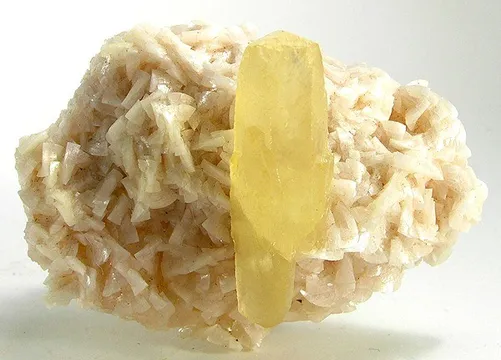
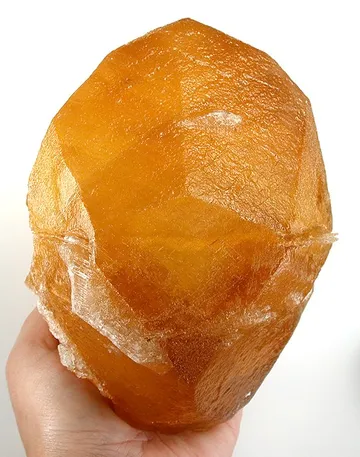
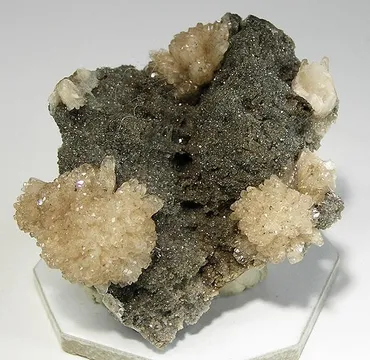
The finest North Vernon calcites have a look that is immediately recognizable: lustrous honey-gold to amber crystals, commonly complex and rounded in outline, combining rhombohedral and prism forms so that individual crystals may suggest a pseudo rhombic-dodecahedral shape. Some are glassy, gemmy, and sharply lustrous; others are darker, included, or etched, with complete rhomb faces and complicated side faces that reward close crystallographic study. Scalenohedral calcites are also known, but the locality’s signature is the golden, blocky, rhombohedral-prismatic habit rather than the long “dogtooth” look seen at many other American limestone quarries.
Regional View
Country View
For the specimen collector, Berry Materials is a locality where quality is measured less by sheer size than by form, luster, freedom from bruising, and that warm Indiana color. The assemblage is small—calcite, sphalerite, pyrite, marcasite, dolomite, baryte, apatite, and glauconite are the key documented names—but it is historically important because the quarry supplied generations of Midwest collectors with a regional classic. In the best pieces, the limestone matrix is only a stage: a single amber calcite, a rosette-like cluster, or a calcite perched on twinned sphalerite is the whole performance.
Search for specimens: View all specimens from Berry Materials Corp. Quarry, USA
Berry Materials Corp. Quarry was a crushed-limestone and agricultural-limestone operation at the northeast edge of North Vernon, in the Butlerville quadrangle of Jennings County. Earlier Indiana Geological Survey directories list the Jennings County operation as the Paul Frank Quarry at North Vernon, with Paul Frank as owner and plant manager, and later directories list it under Berry Materials Corp. as the North Vernon Quarry. By 1977 and 1980 the quarry was formally recorded as Berry Materials Corp., North Vernon Quarry, P.O. Box 450, North Vernon, with Nathaniel Huffman as president and Wallace Gray listed in operating roles. The quarry should not be confused with Berry Materials’ Versailles quarry in Ripley County or its Hayden quarry; older labels using only “Berry Materials” can therefore be ambiguous unless they also say North Vernon, Jennings County, or Paul Frank Quarry.
Geologically, this is a Devonian carbonate quarry rather than an ore mine. Published section descriptions record a cover of New Albany Shale above the Beechwood and North Vernon interval, with Jeffersonville Limestone below and Geneva Dolomite exposed at the quarry floor. One measured section describes roughly 40 feet of New Albany Shale in black, green, and gray-green bands, including pyritic and conglomeratic beds; below it are crinoidal, phosphatic, conglomeratic beds of the Beechwood/North Vernon interval; then dolomitic, cherty, fossiliferous Jeffersonville Limestone with green calcite masses, coarsely banded and mottled dolomite, laminated dolomite, and finally brown, massive Geneva Dolomite with variegated calcite masses. Industrial analyses from the site show the upper North Vernon bed as very high in CaCO3, while much of the Jeffersonville and Geneva section is more dolomitic, with significant MgCO3.
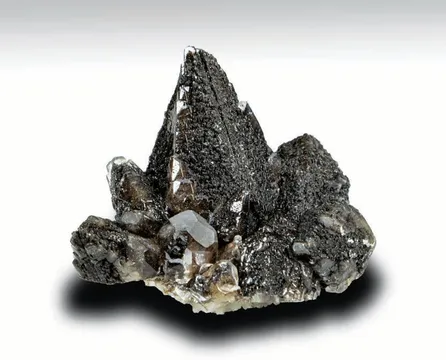
The specimen mineralization was pocket and seam mineralization in the carbonate sequence, not an organized sulfide orebody. Collectible calcite occurred in cavities, along bedding-related openings, and especially in zones near formation contacts. A particularly important specimen note records a 5.3 cm dipyramidal calcite collected in 1967 from the contact of the upper Jeffersonville Limestone with the overlying North Vernon Limestone. Sphalerite is part of the same small, carbonate-hosted sulfide assemblage: it appears as discrete twinned crystals and clusters on limestone matrix, as combinations with calcite, and as inclusions in some darker calcite specimens. Pyrite and marcasite are documented, but some dark inclusions in Berry calcites that might casually be called marcasite have been analytically identified as sphalerite.
Mining history at North Vernon reaches well back into the Paul Frank period. A World War II construction report for Freeman Army Air Field recorded crushed stone furnished from the Paul Frank Quarry at North Vernon and delivered by truck for road base; the same report praised the stone as tough, hard, and possessing good binding qualities. Mid-century Indiana quarry directories describe the Paul Frank Quarry at the northeast edge of North Vernon as producing crushed limestone and agricultural limestone, employing 40 people. Later, under Berry Materials, the quarry remained an important mapped and sampled industrial-stone site and became a reference section in formal stratigraphic work on the Jeffersonville Limestone and Geneva Dolomite Member. The Selmier Member of the New Albany Shale is also tied to the quarry: its type section is given as the south wall of the Berry Materials Co. quarry on the north edge of North Vernon.
Collecting access belongs to an earlier era. Accounts from collectors recall a time when one could check in at the quarry office, sign a waiver, and hunt the benches; by the time of the modern historical study of the locality, the old North Vernon quarry property was described as fenced and overgrown along Fifth Street. Collectors should treat the quarry as closed private/industrial property and should not attempt to enter without explicit permission from the owner or responsible authority. Most available specimens today are old finds from the Paul Frank/Berry collecting period, traded through private collections, show stock, estate material, and occasional dealer offerings.
The best pockets produced lustrous golden calcite crystals from thumbnail to cabinet size, with strong small-cabinet and miniature specimens being the market sweet spot. Individual crystals around 3–5 cm are well represented in the trade; larger groups and exceptional single crystals in the 7 cm range are notable. A sold dealer specimen measured 18.0 x 16.0 x 12.0 cm overall and carried amber, mostly gemmy calcite crystals to 7.0 cm on limestone matrix, explicitly noted as very large for the locality. Another well-documented miniature, 4.5 x 4.0 x 2.5 cm, consisted of a gemmy 1.8 cm calcite crystal set on twinned sphalerite crystals on limestone matrix, a combination described as uncommon for the locality and collected by Dave Rush.
Calcite is the defining mineral at Berry Materials Corp. Quarry, where the classic specimens are honey-gold to amber, lustrous, translucent to gemmy, and crystallographically busy: rhombohedral and prism faces combine into rounded, pseudo rhombic-dodecahedral-looking crystals, with scalenohedral and dipyramidal examples also documented. The most prized pieces show complete, well-balanced crystals on limestone matrix, strong luster, rich warm color, and minimal edge bruising; ordinary examples tend to be duller, more contacted, heavily included, or chipped at the exposed rhomb edges. Size varies from small thumbnails to cabinet groups, but serious locality examples cluster in the miniature to small-cabinet range, with individual crystals of 2–5 cm being respectable and crystals approaching 7 cm exceptional for North Vernon. The upper Jeffersonville–North Vernon contact is a documented source zone for dipyramidal calcite, and darker calcites from the quarry may contain sphalerite inclusions, a detail that is important because such inclusions have sometimes been miscalled marcasite by appearance alone.
Sphalerite from Berry Materials is much scarcer than the calcite and is usually valued as a locality mineral or as an association that elevates a calcite specimen. Documented pieces include clusters of large sphalerite crystals typical of the locality, massive sphalerite with surfaces of well-developed tetrahedral crystals, and twinned semi-lustrous sphalerite crystals carrying a gemmy calcite on limestone matrix. The color is generally dark brown to blackish in hand specimens, though inclusions in calcite can give otherwise golden crystals a smoky, chocolate, or almost black cast. Fine sphalerite-bearing specimens are uncommon because the quarry is remembered primarily for calcite, and combination pieces with an aesthetic calcite crystal perched cleanly on sphalerite are much more desirable than massive or broken sulfide-rich pieces.
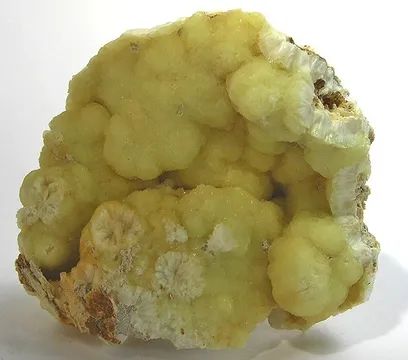
Other documented minerals from Berry Materials Corp. Quarry include baryte, dolomite, pyrite, marcasite, apatite, and glauconite; older and modern locality compilations also note that an apparent malachite report was erroneous and was actually glauconite. The quarry’s “type” importance is stratigraphic rather than mineral-species based: the Selmier Member of the New Albany Shale has its type section in the quarry wall, and the North Vernon quarry is used as a reference section for the Geneva Dolomite Member and Jeffersonville Limestone. For collectors, these ancillary minerals are rarely the reason to buy a North Vernon specimen, but they matter because they explain the matrix environment, the dark sulfide inclusions, and the occasional mislabeled or over-optimistic specimen attribution.
The chief authenticity issue is locality attribution. Berry Materials calcite has a distinctive look—warm honey-gold to amber color, strong luster, complex rhombohedral-prismatic form, and a rounded pseudo rhombic-dodecahedral appearance—but “Indiana calcite” is a broad category, and specimens from other Indiana quarries can be carelessly or wishfully labeled as North Vernon. Collectors should be cautious with pieces showing forms or colors not typical of the quarry, especially pale or differently developed calcites that resemble Logansport or other Indiana quarry material. A good label should ideally include North Vernon, Jennings County, or Paul Frank Quarry rather than merely “Berry Materials,” because Berry operated other Indiana quarries, including Versailles and Hayden.
No consistent modern treatment, dyeing, or manufactured-fake problem is documented for this locality; the real risks are repaired crystals, poor labels, over-cleaning, and confusion of inclusions. Condition is a major value driver. The calcites are often exposed on limestone matrix and have vulnerable rhomb edges, so look for edge bruises, cleaved corners, contacted back sides, and dull areas from abrasion during quarry blasting or extraction. Many otherwise attractive North Vernon calcites have one or two bruises; the premium pieces are those with sharp terminations, minimal contacts, and enough matrix to give context without making the specimen bulky.
Fluorescence is not the locality’s selling point, and specimens are normally collected and valued for daylight aesthetics. As with all calcite, avoid acids and prolonged soaking in aggressive cleaners; even weak acid will attack the crystals, and iron-removal treatments can sometimes dull or undercut surfaces if misused. Sphalerite-bearing pieces should be handled gently because the sulfide crystals can sit proud of the matrix and chip or detach.
Market availability is intermittent rather than rare in an absolute sense. Berry calcites appear regularly enough in old collections, online dealer inventories, and Midwest show material that a representative miniature can be found with patience. Top pieces—gemmy, lustrous, richly colored, complete, well balanced, and well documented—are much scarcer, especially fine calcite-on-sphalerite combinations or large crystals for the locality. Provenance to known collectors such as Terry Huizing, Dave Rush, Stan Woollams, George Feist, or other long-time Midwestern collections adds confidence and interest.
One of the best modern stories about the quarry begins not in a pocket, but on Fifth Street in North Vernon. Terry E. Huizing, already deep into the problem of reconstructing the locality’s history, was standing beside the now-overgrown and fenced quarry property when a helpful stranger, Rae Whitmire, noticed him and asked whether he needed help. Huizing’s answer was direct: “Yes.” He wanted someone who could help with the early history of the stone quarry. Whitmire led him to Vernon and introduced him to Chris Asher of the Jennings County Historical Society. From that roadside moment came a chain of local and professional contacts: Sheila Kell for North Vernon history and Paul Frank data, Mary Kilgore for property-transfer records, Rita Elmore for contact with retired quarry employee Arthur “Buck” Dixon, Lisa Bradley for former Berry employee Tracy Beam, Nelson Shaffer and Todd Thompson for Indiana Geological Survey material, Richard Morin for exploration reports, Stefan Nicolescu at Yale Peabody for an early calcite specimen, and R. Peter Richards for crystallographic drawings of North Vernon calcite forms. The episode is a reminder that for a closed locality, the “field work” may be as much courthouse records, retired employees, and old specimen labels as hammer and chisel.
The older collecting stories have a different texture. In a 2008 Mindat discussion, Stephen Rose recalled a North Vernon calcite collected circa 1966: an extraordinary single crystal, 7.5 x 7 x 6 cm, with minor matrix, complete etched rhomb faces, and complex sides. He had driven down from Bloomington with Mel Dyck; Bill Grove was also in the quarry that day. Their first stop was not the rubble pile but the quarry office, where they secured a waiver—an ordinary enough detail at the time, but one that now sounds like a dispatch from another collecting world. Rose’s aside says much about changing access: quarry operations, he recalled, were “fairly easy to deal with” before liability concerns became the defining barrier. For collectors who know Berry Materials only as a classic label in a dealer flat, that image—Bloomington collectors checking in at the office and walking into a working limestone quarry in the 1960s—explains how so many good old North Vernon calcites entered Midwestern cabinets.
A second small story hides in the labels of specimens themselves. One EarthWonders miniature records a gemmy 1.8 cm calcite perched on twinned sphalerite, all on limestone matrix, collected by Dave Rush and later passing through Weinrich Minerals. The specimen is small—4.5 x 4.0 x 2.5 cm—but locality collectors recognize why it matters. Berry is not short of calcite; it is short of fine, balanced combination pieces where the sphalerite is not merely an inclusion or a dark patch but a real crystallized partner. That kind of specimen compresses the whole North Vernon assemblage into one palm-sized object: Devonian limestone, dark zinc sulfide, and the golden calcite that made the quarry famous.