Saline County, USA — famed for lemon-yellow wavellite from Crystal Baron Mine and distinctive Paron quartz, with bauxite districts prized by collectors.
Key facts
For mineral collectors, Saline County means two rather different Arkansas stories meeting in one county: the world-scale bauxite country around Bauxite and Benton, and the Ouachita quartz–phosphate belt that reaches into the hills around Paron, Bland, Crows, and Lake Winona. The county’s fame in the specimen trade rests especially on uncommon yellow to white wavellite from the Crows area, particularly the Crystal Baron Mine, and on distinctive quartz from the Paron and Stand-on-Your-Head workings. These are not merely “Arkansas” pieces in a broad sense. The best Saline County wavellites have a look all their own: lemon-yellow to creamy white radial balls and sprays, often with sparkling acicular texture, that contrast sharply with the more familiar green wavellites of Garland, Montgomery, and Polk counties. Saline County quartz, meanwhile, ranges from the big historic Willis Mine crystals of the Paron district to faden and tabular quartz carrying pale green, blue-green, or tan cookeite from the Stand-on-Your-Head mines.
Regional View
Country View
Geologically, Saline County sits at a crossroads. The bauxite district belongs to the central Arkansas alkaline province, where Late Cretaceous nepheline syenite of the Granite Mountain pluton weathered deeply under warm, humid Paleogene conditions to form lateritic bauxite. That ore body made Saline County one of the historic centers of American aluminum production. West and northwest of the bauxite town belt, quartz veins cut Paleozoic rocks of the Ouachita Mountains, including Stanley Shale and related fractured sandstone and shale units. In those veins, quartz may be accompanied by chlorite-group minerals, cookeite, rectorite, sulfides, iron oxides, and, locally, aluminum phosphates such as wavellite.

Photo: Wikimedia Commons
The county’s specimen character is therefore broader than one species. Bauxite itself is important historically but rarely aesthetic in the collector sense, though gibbsite-rich bauxite and pisolitic ore are important study pieces. The specimen market, however, follows the rarer and more cabinet-friendly material: yellow wavellite from near Crows, chlorite-included quartz from the Willis-Paron area, faden quartz and cookeite from Stand-on-Your-Head, and occasional micromount species from the Granite Mountain complex on the county’s eastern side.
Search for specimens: View all specimens from Saline County, USA
Saline County is best understood as a county-level collecting locality that includes several unrelated but historically connected mineral districts. The bauxite deposits near the town of Bauxite and the Hurricane Creek–Benton area are lateritic deposits formed by intense in-place weathering of nepheline syenite and related syenitic rocks. They belong to the Arkansas bauxite region of Pulaski and Saline counties, a district of national industrial significance that began commercial production at the end of the nineteenth century and supplied enormous quantities of ore for aluminum, including during both world wars. The ore bodies were largely open-cut operations, with bauxite occurring as in-situ laterite and transported bauxitic material associated with Eocene sedimentary units.
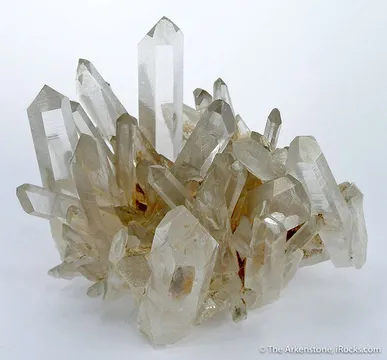
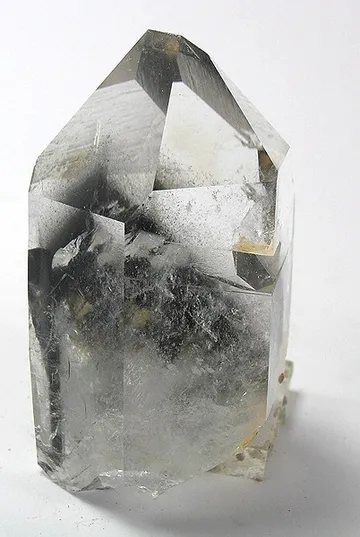
The specimen minerals that interest collectors most are mostly outside that industrial bauxite story. Around Paron, Bland, Lake Winona, and adjacent Ouachita foothill localities, quartz occurs in hydrothermal veins, fissure fillings, and pocketed masses in deformed Paleozoic sedimentary rocks. The Willis Mine, three miles northwest of Paron, was worked intermittently long before and during the Second World War period, and produced quartz crystals from wide lenticular veins in Stanley Shale. Historical descriptions record a hand-opened cut as much as 25 feet deep, a production burst of roughly 200 tons of crystal in about a year and a half in the late 1930s, and exceptionally large pieces, including a single crystal reported at 330 pounds and a cluster reported at 750 pounds. Most Willis Mine material is not the glassy, immaculate Mount Ida style familiar to casual buyers; the better collector pieces are valued for locality, size, chlorite phantoms, iron-oxide coatings, doubly terminated habits, and the documentation tying them to a comparatively obscure Saline County quartz mine.
The Stand-on-Your-Head mines, near Bland, occupy a different niche in Arkansas quartz collecting. Their fame is not mass production but association: tabular, parallel-growth, and faden quartz with cookeite. Cookeite is a lithium-bearing chlorite-group mineral, and at these mines it appears as pale green to blue-green, tan, or brownish spherules, rosettes, platy aggregates, and coatings on quartz. Some specimens show cookeite included within quartz, while others display it as late-stage growth on the outside of already-formed crystals. Stand-on-Your-Head No. 2 is documented with ankerite, cookeite, dickite, goethite, pyrite, and quartz; Stand-on-Your-Head No. 1 is closely associated with the same quartz-cookeite collecting tradition and has produced some of the county’s most memorable small cabinet and thumbnail specimens.
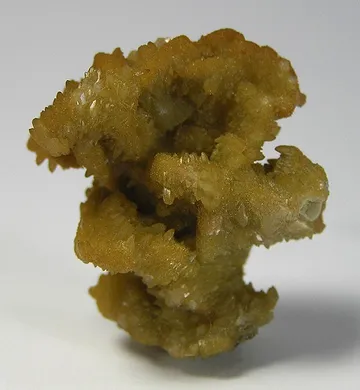
The Crows area, especially the Crystal Baron Mine, is the county’s key wavellite source. Arkansas wavellite is usually thought of as green, but Saline County is prized for a limited production of yellow, white, and yellow-over-white material. Specimens from near Crows may show botryoidal to hemispherical aggregates, acicular radial sprays, and sparkling broken faces where the balls expose fibrous internal structure. Some dealer and collector labels simply say “Saline County,” “Crows,” or “Crystal Baron Mine,” and that difference matters: a true Crows yellow wavellite is not the same thing as a green Mauldin Mountain, Dug Hill, or Big Fork specimen.
Collecting access today should be treated as private, claimed, leased, or otherwise controlled unless a current landowner or operator explicitly says otherwise. Many Saline County localities are old mine cuts, road cuts, reclaimed industrial ground, or named claims. Mindat and state publications repeatedly caution that localities should not be visited without permission from land and mineral-rights holders. The same practical caution applies to bauxite pits, abandoned quartz cuts, and small phosphate prospects: unstable faces, water-filled pits, reclaimed ground, and active private ownership are all real concerns. The safest collecting route is through documented old collections, reputable Arkansas dealers, club sales, and specimens with labels tracing them to known finds.
Saline County wavellite is best known from the Crows area and the Crystal Baron Mine, where it occurs as yellow to white, botryoidal, radial, and acicular aggregates rather than the classic deep green Arkansas material from better-known Garland, Montgomery, and Polk county localities. Good specimens show complete sparkling balls or sprays on matrix, a rich lemon-yellow color, and visible radial-fibrous structure; lesser pieces tend to be thin coatings, bruised botryoids, or unattributed “Arkansas wavellite” with no Crows or Saline County provenance. Documented specimens range from thumbnails and miniatures around 4 cm to small-cabinet pieces exceeding 6 cm across, and some Crows material has been noted with yellow wavellite coating white wavellite, a combination that can show a subtle greenish to yellow-green response under longwave ultraviolet light where iron-poor surface growths are present.
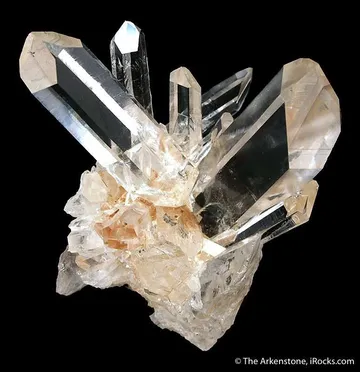
Saline County quartz is most distinctive when the label points to a specific Ouachita locality: Willis Mine near Paron for large historic rock-crystal and chlorite-included pieces, Green’s Crystal Mine for jackstraw quartz with cookeite spheres and cloudy phantoms, and the Stand-on-Your-Head workings for tabular, parallel-growth, and faden quartz with cookeite. At Willis Mine, quartz occurs in wide veins in Stanley Shale and can be milky, clear at the terminations, iron-stained, or internally marked by green chlorite phantoms; historic production included very large crystals, but collector-grade examples are much scarcer than ordinary broken vein quartz. At Stand-on-Your-Head, the premium is on small, sharp, lustrous, colorless to gemmy quartz crystals with a visible faden line, graceful tabular habit, or contrasting green to blue-green cookeite on and between the crystals.
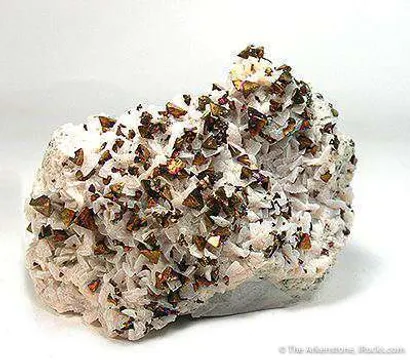
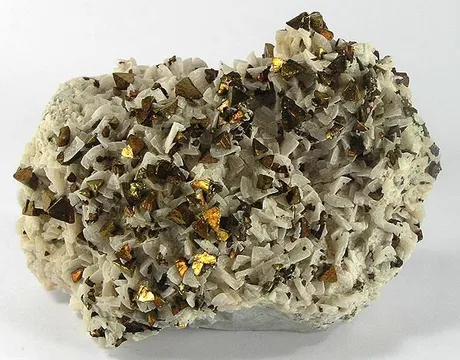
Other documented Saline County minerals broaden the county well beyond wavellite and quartz. The bauxite mines at Bauxite are recorded for gibbsite, siderite, bauxite, iron oxides, and clay-rich lateritic assemblages. The Paron quartz district has produced cookeite, chlorite-group inclusions, goethite, galena, pyrite, siderite, ankerite, dickite, rectorite, and K-feldspar varieties such as adularia. The Stand-on-Your-Head and Green’s Crystal Mine material is especially important for cookeite-on-quartz specimens. Granite Mountain No. 3 Quarry at Sweet Home adds rare alkaline-rock and zeolite interest, with natrolite, aegirine, analcime-like zeolite material, zircon, and related syenite-cavity minerals documented from the broader Granite Mountain complex. One of the county’s strangest records is native ruthenium from an unnamed Saline County locality: a microscopic anhedral grain reported from enigmatic siliceous rocks of the Stanley Shale with barite, acmitic pyroxene, monazite, xenotime, galena, sphalerite, pyrite, rutile, and quartz, described in Arkansas state mineral literature as only the second noted world occurrence of native ruthenium.
The central authenticity issue with Saline County specimens is locality precision. Yellow wavellite from Crows and the Crystal Baron Mine is distinctive and scarcer than most green Arkansas wavellite, so vague labels such as “Arkansas,” “Magnet Cove,” “Garland County,” or “Polk County” should be treated cautiously when the specimen is yellow, white, or yellow-over-white. Conversely, green botryoidal wavellite without a strong Saline County label is more likely to belong to one of the classic Arkansas wavellite districts outside Saline County. For serious cabinets, the best labels name Crows, Crystal Baron Mine, Saline County, or at least “near Crows” and should ideally include an old dealer, collection, or find history.
Condition matters greatly in wavellite. The radial balls are brittle, and broken botryoids expose fibrous interiors that may be attractive but reduce value if the specimen was once a complete mound. Look for undamaged hemispheres, crisp acicular sparkle, good coverage, and a stable matrix. Yellow color should be judged in daylight or neutral lighting; some pieces are cream, buff, or yellow-white rather than vivid lemon. Ultraviolet response is a curiosity rather than a guarantee of locality, and not every Saline County wavellite fluoresces strongly. Handle wavellite gently and keep it out of prolonged damp storage.
Quartz from Saline County has a different set of concerns. Willis Mine and Paron quartz is often iron-stained, rehealed, chlorite-included, or partly milky, and those features are part of the locality style rather than automatic flaws. The best pieces have clear terminations, attractive green chlorite phantoms, doubly terminated form, or strong documentation to an old Willis-area pocket. Stand-on-Your-Head quartz with cookeite should be protected from abrasion: cookeite is soft, platy to micaceous, and easily rubbed or crushed. Cleaning should be conservative. Aggressive acids, ultrasonic cleaning, or vigorous brushing can remove or damage the very cookeite that makes the specimen important.
Market availability is uneven. Ordinary Arkansas quartz is abundant, but well-documented Saline County quartz is not. Willis Mine and Stand-on-Your-Head labels appear periodically in older collections, specialist dealer inventories, and micromount or thumbnail circles, but they are not constant show-table staples. Yellow Crows wavellite is scarcer still; much of the known material seems to have entered the market in limited early-2000s finds and now circulates as old stock or collection pieces. When a Saline County wavellite is clean, richly yellow, well covered, and precisely labeled, it deserves to be treated as a locality specimen first and an Arkansas wavellite second.
The Stand-on-Your-Head name sounds like a joke until the collecting story catches up with it. Jimmy and Hisami McNeil and their partners worked the Saline County claim for years, and one account explains the name with perfect field-collector logic: to reach the pocket, miners had to crawl on hands and knees into a narrow, steeply descending hole and work the specimens loose with a pry bar. From about 1984 to 1994, the McNeils collected there, and around 1988–1989 they broke into the pocket that made the locality memorable: green cookeite with quartz. They did not initially know what the green mineral was. Jimmy McNeil sent a sample to Andy Deetz at the Smithsonian, and Deetz took it to John S. White, who identified it as cookeite. The pocket also produced tabular quartz, parallel-growth quartz, and faden quartz, the exact combination that makes Stand-on-Your-Head specimens so recognizable today.
Another collector’s memory begins not in a mine but in a rock shop. Mike Howard, writing for the Colorado Springs Mineralogical Society geology blog, recalled buying a small Stand-on-Your-Head No. 1 specimen because the quartz was water-clear, gemmy, and nicely terminated. The other side was coated with what he thought was “crud,” perhaps mica or clay. Years later, while thinking through lithium minerals from the Black Hills, he realized that the obscure Arkansas green coating matched cookeite. He pulled the specimen back out, examined the quartz and the coating, and concluded, in collector’s shorthand, “Yep, it was cookeite.” The specimen’s right-hand quartz crystal was only about 1.3 cm long, and the cookeite formed late-stage material over part of a quartz aggregate roughly 6.2 cm across in the field of view, but the little piece connected Saline County to one of the stranger lithium-bearing chlorite occurrences in American quartz collecting.
The Willis Mine story belongs to the older age of Arkansas quartz. Located northwest of Paron, the mine was opened by hand into Stanley Shale, with a single cut reaching as much as 25 feet deep. It was worked intermittently for decades before 1942 by J. T. Willis and contract miners, and the late-1930s production was surprisingly large for such a locality: about 200 tons of crystal over roughly a year and a half. The scale of the crystals was equally surprising. Historical USGS work recorded a single crystal weighing 330 pounds and a cluster weighing 750 pounds. Some clear quartz reportedly went for optical use, but much of the production went to collectors or decorative use. Today, the Willis name on a quartz label has an old-Arkansas gravity very different from the tourist quartz mines around Mount Ida.
The bauxite story is larger and harsher. In 1887, road construction near Little Rock exposed the soft gray ore that would transform Saline County. John C. Branner identified it publicly as bauxite in 1891, and the General Bauxite Company shipped the first ore in 1896. The settlement first known as Perrysmith became Bauxite in 1903 after the first ore-drying plant was established. Alcoa and related companies built not just mines and plants but a company town with churches, a movie theater, stores, a post office, a barber shop, a hospital, a school, and employee camps with names such as Alabama Town, Church Row, Italy, Mexico, and Africa. During the Second World War, the mines ran three shifts a day to meet aluminum demand for aircraft, and the town filled so tightly that spare rooms and garages were rented to miners on different schedules. In some houses, someone was sleeping at nearly every hour because another worker was always coming off shift.
After the war, the economic center of gravity shifted. Foreign bauxite became more profitable, and the company town nearly vanished. A 1967 Alcoa letter informed the twenty-seven remaining families that Bauxite would cease to exist as a company town on July 1, 1969; the town incorporated with West Bauxite on January 16, 1973. The mineral that built the town did not disappear from the ground, but its role changed. By 1982, large-scale bauxite mining for aluminum in the district had ended, and the later uses of Arkansas bauxite turned toward chemicals, abrasives, refractories, and proppants. For collectors, that history makes even an unattractive pisolitic bauxite piece from Saline County more than an ore sample: it is a fragment of the district that once supplied a commanding share of American aluminum ore.