Pendelton Quarry, Indiana — renowned for golden to orange-yellow calcite twins from Devonian Jeffersonville Limestone; gemmy amber crystals prized by collector…
Key facts
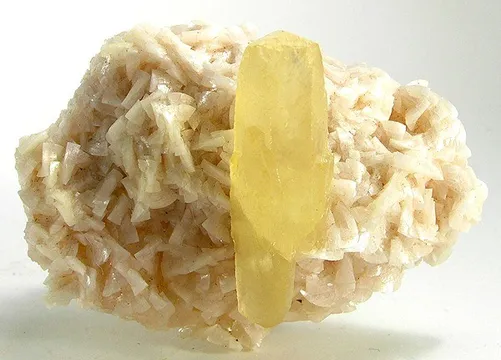
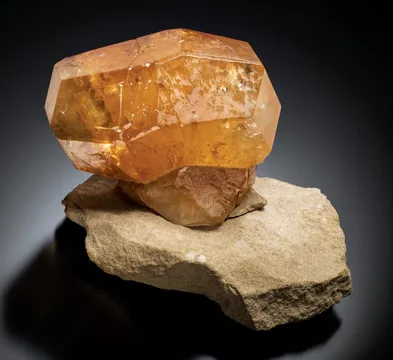
Pendelton Quarry—more commonly printed in mineral literature and operator listings as the Pendleton Quarry or Irving Materials Quarry—is a classic Midwestern calcite locality on the south side of Anderson, Madison County, Indiana. For collectors, its importance rests on a remarkably distinctive suite of vug-grown calcites in Devonian limestone: golden to orange-yellow, translucent to gemmy crystals, many of them contact-twinned into the flattened, heart-like forms long nicknamed “Anderson calcite twins” or “Pendleton twins.” The host is the Jeffersonville Limestone, a coarse-grained, thick-bedded, fossiliferous carbonate unit of Early to Middle Devonian age, quarried here for crushed stone and aggregate rather than for metallic ore.
Regional View
Country View
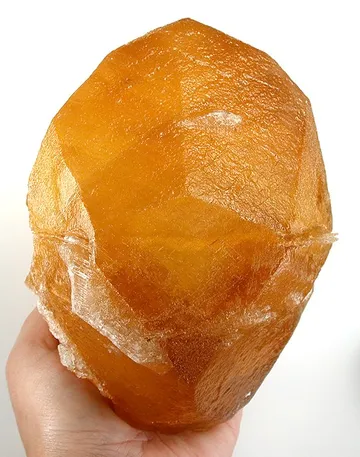
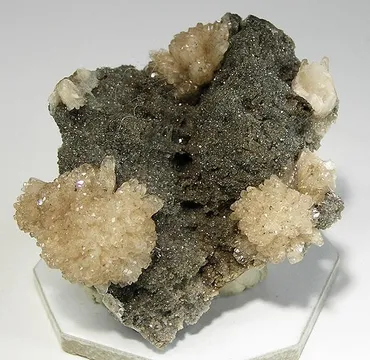
The best specimens are immediately recognizable: compact thumbnails and miniatures with a warm amber body color, glassy luster, and crisp modified scalenohedral to pseudo-rhombic outlines. A fine example is not merely yellow calcite from an Indiana quarry; it has depth, internal glow, a clean twin plane, undamaged edges, and, ideally, a small bit of pale limestone matrix that sets off the crystal without overwhelming it. Cabinet-sized plates and clusters are scarcer, and large undamaged crystals are substantially more desirable than ordinary broken vug linings.

Photo: Wikimedia Commons
Search for specimens: View all specimens from Pendelton Quarry, USA
Pendelton Quarry is an active surface limestone operation in Madison County, Indiana, worked by Irving Materials, Inc. The plant is listed by the operator as imi Aggregates - Pendleton at 5002 S State Road 67, Anderson, Indiana, supplying stone, gravel, and sand to the Anderson area. MSHA-derived mine listings identify it as mine ID 1200354, a surface stone mine producing crushed and broken limestone, with Irving Materials as operator. Its mineral-collecting fame, however, comes not from the commercial aggregate but from small, mineralized cavities exposed during blasting and crushing operations.
Geologically, the quarry cuts the Jeffersonville Limestone, a Devonian carbonate formation widely quarried in Indiana for crushed stone, aglime, base material, asphalt aggregate, riprap, manufactured sand, and other industrial uses. At this locality the specimen-bearing rock is described as coarse-grained, thick-bedded, fossiliferous limestone. Cavities, seams, and vugs in that limestone provided open space for late calcite crystallization, with associated iron and zinc sulfides locally present as marcasite, sphalerite, and, in some specimen records, pyrite. This is not an ore deposit in the normal collector-mining sense; the “ore bodies” are better understood as aggregate stone benches containing scattered crystal pockets.
The quarry began operation in 1961. Specimens were already being collected by the 1970s, and the locality became increasingly celebrated among Midwest collectors after the distinctive twinned orange calcites were recognized from an old section of the workings. By 2019, published locality notes stated that the Jeffersonville Limestone had been mined out to the then-current limits of the quarry, an important clue to why the finest old-style calcite pockets are not simply repeatable on demand. The quarry has nevertheless remained a modern aggregate producer, with recent operator and aglime listings confirming the Pendleton location as a working stone source.
Historically, collecting appears to have depended on permission, organized club trips, and the luck of fresh blasted rock. Friends of Mineralogy - Midwest Chapter recorded a March 24 field trip to the Irving Materials Pendleton Quarry near Anderson in 2001 that drew eight chapter members and ten collectors from a Lansing, Michigan club; the report noted that everyone collected calcite and that a few “quite decent specimens” turned up. A Michigan club notice in 2007 advertised a trip for honey-yellow and iridescent calcite and marcasite, with full safety equipment required. Those notices capture the reality of the place: this is a private, active quarry where access has never been equivalent to casual public collecting.
The pockets themselves were localized and variable. Collectors have described red-brown mud-filled pockets as more promising for intact attached crystals, while gray mud pockets tended to produce looser, more damaged calcites. Notable individual specimens include thumbnail twins around 2 to 4 cm, gemmy floaters, small clusters on limestone, and exceptional larger crystals and clusters. One online specimen record describes a calcite found by Byron Thomas in August 2006 from a basketball-sized pocket: the main scalenohedral crystal was over 4 inches long, with smaller associated crystals, minor marcasite included in the calcite, and pyrite balls beneath.
Calcite is the signature mineral of Pendelton Quarry, and the collector standard here is the golden to orange-yellow twinned crystal: lustrous, translucent to gemmy, commonly thumbnail to small-miniature in size, and shaped by modified scalenohedral faces into a compressed pseudo-rhombic or heart-like form. Documented examples range from roughly 20 mm floaters to 3–4 cm twins, with substantially larger crystals and clusters known but much less common; an exceptional described specimen exceeded 4 inches in length, and a dealer-described cluster carried an 8.5 cm doubly terminated crystal. The finest pieces show a centered twin plane, sharp undamaged edges, glassy luster, strong internal amber glow, and minimal contacting; ordinary examples are more frosted, cleaved, loose from blasted pockets, or dulled by mud and sulfide staining. Associations include Jeffersonville Limestone matrix, marcasite, sphalerite, and occasional pyrite noted in specimen descriptions.
The conservative documented mineral list for the quarry is short: calcite, marcasite, and sphalerite are the principal species recorded from the Jeffersonville Limestone at the locality. Marcasite occurs with calcite in small specimens and is important both as an association and as a condition risk, since iron sulfides from limestone quarries can oxidize if stored damp. Sphalerite is recorded for the locality but is far less visible in the collector market than calcite. No type-locality mineral species are documented from Pendelton Quarry; its “type” importance is cultural rather than nomenclatural, centered on the recognizable Pendleton/Anderson style of twinned calcite.
Pendelton calcites are best bought for form and condition first, color second. The classic look is golden amber and gemmy, but mediocre specimens can share the color while lacking the sharp twinned geometry that makes the locality special. Look for a distinct twin plane, clean termination geometry, natural luster, and complete edges. A small limestone matrix remnant is desirable when it proves origin and provides contrast; a heavy blocky matrix with scattered damaged calcites is less collectible unless the crystals are large or unusually aesthetic.
No published pattern of manufactured fakes or routine treatments is associated with this locality. The more realistic concerns are repair, reattachment to matrix, trimmed matrix, bruised terminations, and confusing locality labels. Labels may read Pendelton, Pendleton, Anderson, Irving Materials Quarry, IMI Quarry, or Irving Materials Quarry/Pendleton; all can refer to the same collecting tradition around the Anderson operation, but vague “Indiana calcite” labels should be treated cautiously because other Indiana quarries—especially Berry Materials, Meshberger, and Anderson-area operations—also produced twinned or yellow calcites.
Condition problems are locality-specific because most specimens came from blasted limestone. Expect contacted sides, tiny edge bruises, cleaved backs, mud-filled crevices, and occasional sulfide oxidation. Pieces associated with marcasite should be kept dry and monitored; active marcasite decay can produce iron staining, acidic alteration products, and specimen damage. Do not clean Pendelton calcites aggressively with acids: calcite itself is CaCO3 and will etch readily, and acid cleaning can also destabilize sulfide-bearing matrix. Gentle mechanical cleaning, distilled-water rinsing when appropriate, and thorough drying are safer for stable examples.
Market availability is steady but selective. Small calcites from Pendelton appear often enough that ordinary loose thumbnails are not great rarities, yet truly fine amber twins with glassy luster, no damage, old labels, or Harris Precht provenance command strong attention. Large undamaged clusters and cabinet specimens are much less common than thumbnails. The most desirable examples sit in the overlap between Indiana classic, calcite systematic, and Midwestern quarry-suite collecting.
The defining discovery story belongs to Harris Peter Precht Jr., a collector whose eye for Midwestern limestone-quarry minerals became part of the locality’s identity. In 1980, Precht was working a long-abandoned section of Irving Materials’ Pendleton quarry in Anderson, a place he had visited before. Most collectors were concentrating on deeper zones for iridescent calcite, but Precht, disappointed by what he was finding, moved instead into the overgrown upper levels. There, only a few feet below the surface, he found mud-filled vugs holding unusual heart-shaped calcite twins. Those crystals became known as the Anderson calcite twins, and the discovery is remembered as the first documented occurrence of that distinctive style.
The scene is instructive for collectors because it reads less like a lucky strike in obvious ore and more like a lesson in quarry instincts. The productive pockets were not in a glamorous vein exposed on a fresh wall; they were shallow, muddy cavities in an overlooked old bench. The later reputation of “Pendleton twins” grew from precisely that kind of observation—recognizing that a strange crystal form in a dirty limestone vug could be more important than a pile of brighter but ordinary calcite from the active deeper workings.
Club reports preserve a more workaday but equally recognizable Pendelton experience. On March 24, 2001, a Friends of Mineralogy - Midwest Chapter field trip led by George Heaton brought eighteen collectors to the Irving Materials Pendleton Quarry: eight chapter members and ten from his Lansing, Michigan club. The weather, feared by some to be wet or cold, turned out sunny, dry, and cool enough for hard work. Everyone collected calcite, and the report notes that a few decent specimens appeared. The most memorable quarry comedy was not a gem crystal but a “yard rock”: George and his brother Roger spent about twenty minutes trying to load a rock that had not looked very large, only to find it too heavy. His verdict was perfect field-trip realism: rocks seemed to be “getting heavier every year.”
Another collector’s field note turns the quarry’s mud into a diagnostic tool. Byron Thomas, writing about pocket indicators at his favorite IMI Anderson/Pendelton quarry, distinguished reddish-brown smelly mud from gray, even smellier mud. In his experience, gray mud pockets tended to be broken up, with loose and more damaged calcite crystals, while red mud pockets more often held attached crystals with less damage. He also emphasized that collecting was in blasted limestone; he had not seen people spall pockets straight from the wall there. That detail matters. Pendelton specimens are products of an active aggregate quarry, and their survival often depended on noticing the pocket after the blast but before the crusher, weather, or careless trimming did the rest.