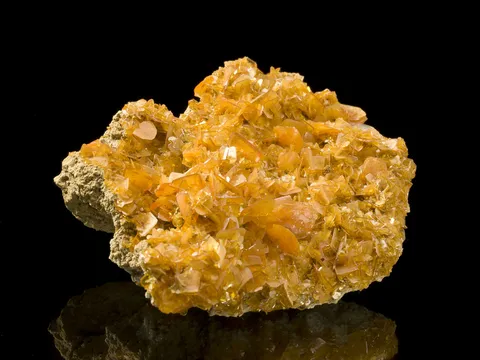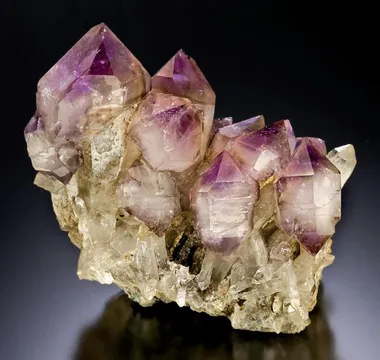
Yavapai County, USA — Arizona’s premier mineral locality for quartz-vein gold, copper sulfides, and Jerome sulfates; prized for diversity and old-Arizona chara…
Key facts
Yavapai County is not a single-species locality so much as an Arizona mineral province: a broad, rugged piece of central Arizona where Precambrian volcanic belts, granitic intrusions, later faulting, supergene alteration, and desert weathering have combined to make one of the state’s great collecting names. For specimen collectors, the county’s identity rests on two overlapping traditions. One is the gold country of the Bradshaw, Weaver, Hassayampa, Lynx Creek, Big Bug, Black Canyon, Crown King, Congress-Octave, and Rich Hill districts, where quartz veins and placers supplied coarse native gold, gold-bearing sulfides, and the occasional memorable gold-on-quartz specimen. The other is the copper-mining and mineralogical laboratory of Jerome, where the United Verde and United Verde Extension mines exposed a major ancient volcanogenic massive sulfide system and, through oxidation and mine-fire chemistry, produced a suite of rare copper, iron, sulfate, nitrate, and selenium minerals of genuine scientific importance.
The geological range is correspondingly wide. The northern part of the county reaches toward the Colorado Plateau, while the southern and central mining belts are dominated by fault-block mountain ranges and valleys. Much of the productive ground is built on Precambrian metamorphic and igneous rocks of the Yavapai terrane, cut by granitic rocks and younger dikes, then locally covered by Tertiary and Quaternary volcanic rocks. In collector language, that translates to quartz-vein gold, lead-zinc-silver sulfide veins, copper oxides, uranium-carbonate efflorescences, pegmatitic phosphate rarities, fluorescent calcite-willemite-fluorite assemblages, and the celebrated Jerome suite of secondary sulfates.
Regional View
Country View
The best Yavapai specimens have an old-Arizona look: mellow yellow gold clinging to milky quartz; amethyst-tipped or smoky quartz crystals from the Crown King country; dark royal-blue azurite from United Verde; wulfenite on purple fluorite, calcite, quartz, or galena at the Purple Passion Mine; and delicate, often highly fragile secondary uranium or sulfate species from Hillside and Jerome. Many historic pieces are labeled only “Yavapai County,” “Bradshaw Mountains,” or “Jerome,” which is part of their charm and part of their problem. For serious collectors, a precise mine or district name adds greatly to both mineralogical interest and market confidence.

Photo:

Photo: Wikimedia Commons
Search for specimens: View all specimens from Yavapai County, USA
Yavapai County’s collecting story begins with geology on a county scale. The old mining literature treats the southern part of the county as a mountain-region mosaic of short north-northwest-trending ranges divided by broad sediment-filled valleys. The productive rocks are chiefly Precambrian metamorphic and igneous units, especially the Yavapai Series or Yavapai Supergroup rocks and associated Bradshaw Granite, with later stocks, plugs, dikes, and volcanic cover. The resulting ore deposits include Precambrian veins and replacement bodies, Mesozoic or early Tertiary veins, volcanogenic massive sulfide bodies, porphyry-related copper mineralization, pegmatitic phosphate occurrences, and extensive placer deposits.
At Jerome, on Cleopatra Hill in the Black Hills, the United Verde system is the county’s most important hard-rock mineral locality. Modern interpretation places the deposit in Early Proterozoic volcanic and volcaniclastic rocks of the Ash Creek Group. The ore formed as a sea-floor volcanogenic massive sulfide deposit above submarine hydrothermal vents in altered Cleopatra Rhyolite, later folded and deformed into a steep, pipe-like ore body. The unoxidized assemblage was dominated by pyrite with chalcopyrite and sphalerite, plus quartz, dolomite, ankerite, and lesser bornite, arsenopyrite, galena, tennantite, and electrum. Weathering, supergene enrichment, and mine-fire alteration added an entirely different collector layer: cuprite, chalcocite, azurite, malachite, native copper, native silver, hydrous copper sulfates, rare ferric sulfates, and other secondary species.
The United Verde Extension, or UVX, was the buried counterpart that made Jerome famous again in the early twentieth century. Unlike the exposed United Verde ore, the UVX ore was concealed beneath Paleozoic and Tertiary cover. When rich chalcocite was finally encountered on the 1,200-foot level in 1914, followed by a larger body in 1916, the mine became one of Arizona’s great bonanza copper stories. It produced high-grade supergene copper ore, with the principal collector interest lying less in showy cabinet specimens than in its importance to Jerome’s geologic history and its oxidized copper assemblage.
The county’s gold fields are more diffuse but equally important historically. Yavapai ranked first among Arizona counties in gold production through 1959, and the Jerome district alone contributed about 1,565,000 ounces of byproduct gold to the lode total by the mid-twentieth century. Rich Hill and the Hassayampa and Lynx Creek placers launched central Arizona’s placer boom in the early 1860s. The Big Bug district, including the Iron King and McCabe-Gladstone mines, produced gold together with copper, silver, lead, and zinc from sulfide veins in Precambrian volcanic rocks. The Hassayampa-Groom Creek district south of Prescott worked placers first, then quartz veins carrying pyrite, arsenopyrite, sphalerite, galena, chalcopyrite, and locally tetrahedrite. The Lynx Creek-Walker district became one of Arizona’s best-known placer areas and also worked sulfide-bearing quartz veins near Walker. The Weaver-Rich Hill district, east of Congress and Yarnell, combined placer gold with the Octave lode system, where coarse white quartz carried pyrite, galena, minor sphalerite and chalcopyrite, and a little native gold.
Bagdad, in the Eureka district of western Yavapai County, adds still another deposit style. The district began with silver, gold, and lead mining, especially at Hillside, but the Bagdad mine later became a major copper producer. The copper ore body lies in and around mineralized quartz monzonite stocks and related intrusive rocks, while the older district geology includes Precambrian metamorphosed volcanic and tuffaceous sedimentary rocks cut by rhyolite, gabbro, quartz diorite, diabase, alaskite, granodiorite, and granite. For collectors, Bagdad and nearby Hillside are not simply copper names; the area is central to uranium-carbonate and sulfate mineralogy, as well as phosphate pegmatite rarities from the 7U7 Ranch.
The Purple Passion Mine in the Big Bug district is the county’s most collector-oriented small mine in the modern literature. Its vein system follows Tertiary faults filled chiefly with ore-bearing quartz or calcite. The old Diamond Joe workings produced lead-silver ore, but collectors know the locality for wulfenite, fluorescent calcite, willemite, fluorite, quartz, galena, smithsonite, anglesite, cerussite, sulfur, and related secondary minerals. The vein has yielded specimens ranging from micromounts to small cabinet size, including wulfenite on clear, smoky, milky, and occasional amethystine quartz, as well as wulfenite on purple fluorite or calcite.
Collecting access today is mixed and must be treated conservatively. Many historic mines are private, patented, reclaimed, collapsed, hazardous, or on active claims; Jerome’s major mine properties are not casual collecting sites. Old shafts, unstable dumps, mine gases, arsenic-bearing materials, and secondary sulfate crusts make abandoned workings especially poor places for improvisation. The most reliable public collecting experience tied to Yavapai gold is recreational panning in the Lynx Creek Mineral Withdrawal area of Prescott National Forest, where hand panning is allowed under Forest Service rules but prospecting, mining, claim-staking, sluicing, and motorized equipment are restricted. For all other localities, current land status, claim status, private ownership, and agency rules must be checked before visiting.
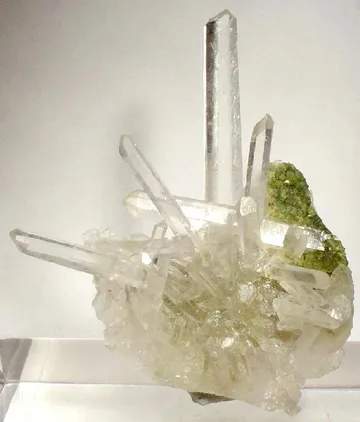
Quartz is the thread running through nearly every collectible Yavapai County story: coarse white vein quartz carrying pyrite, galena, sphalerite, chalcopyrite, and gold in the Octave and Bradshaw districts; glassy quartz in Black Canyon veins with small amounts of sulfides and native gold; drusy sulfide-vein cavities at McCabe-Gladstone; quartz gangue in the United Verde massive sulfide system; and collectible crystals from small mines such as Purple Passion and Fat Jack. The county’s best quartz specimens are not usually giant, pristine alpine-style crystals, but locality-rich pieces with context: smoky or amethyst-zoned crystals from the Crown King–Fat Jack area, amethyst-tipped sceptres with opaque white stems, quartz carrying native gold, or quartz matrix supporting wulfenite, fluorite, galena, and secondary lead minerals at Purple Passion. Ordinary pieces are massive, iron-stained vein quartz; the better ones show sharp terminations, color zoning, gold or sulfide association, or a documented mine name rather than a vague “Arizona” or “Bradshaw Mountains” label.
Gold from Yavapai County spans placer flakes and nuggets, massive and hackly gold on quartz, and less visible gold locked in pyrite, chalcopyrite, galena, tennantite, and other sulfides. Rich Hill and the Weaver district are the classic nugget names, Lynx Creek is the best-known public panning area, and the Bradshaw districts supplied both placer gold and lode gold from quartz veins cutting schist, granite, diorite, granodiorite, and related rocks. The United Verde and United Verde Extension mines produced enormous amounts of gold as a byproduct of copper mining, but display-quality native gold from the county is far scarcer than the production figures suggest. Good collector pieces show natural buttery to rich yellow color, hackly or leafy texture, visible attachment to quartz, and old provenance to a district such as Rich Hill, Bradshaw Mountains, Crown King, or a named claim; many lesser pieces are simply small placer grains, crushed ore gold, or broad “Yavapai County” labels without mine-level documentation.
Beyond quartz and gold, Yavapai County is unusually rich in scientifically important species. United Verde is the type locality for gerhardtite, butlerite, guildite, lausenite, ransomite, and yavapaiite, and is historically associated with the mine-fire sulfate suite that also included jeromite as an unapproved name, plus native selenium and other oxidation products. Hillside Mine is the type locality for andersonite, bayleyite, swartzite, and zinczippeite, all part of the county’s delicate secondary uranium mineral story. The 7U7 Ranch near Bagdad is the type locality for bermanite and paulkerrite in phosphate-bearing pegmatitic material associated with triplite and related phosphates. The Cherry Creek district supplied petersite-(Ce), a modern type-locality mixite-group rarity occurring as tiny yellowish-green acicular sprays in highly weathered granite. Purple Passion is notable for wulfenite, fluorite, willemite, calcite, smithsonite, galena, and fluorescent assemblages, while the broader county list includes azurite, malachite, native copper, native silver, cuprite, chalcocite, sphalerite, galena, pyrite, arsenopyrite, tennantite-group minerals, tetrahedrite-group minerals, scheelite, turquoise, torbernite, metatorbernite, and many more species that reward mine-specific collecting.
The first collector issue with Yavapai County is locality precision. Because the county is large and historically productive, old labels reading only “Yavapai County,” “Bradshaw Mountains,” or “near Prescott” are common. Such labels are not meaningless, but they are less valuable than a mine, claim, district, and provenance trail. A gold-on-quartz specimen labeled “Yavapai County” may be entirely plausible, yet its interpretive value differs greatly from a specimen tied to Rich Hill, Octave, Crown King, Lynx Creek-Walker, or a named Bradshaw claim. The same is true for azurite, wulfenite, and fluorescent material: United Verde, Purple Passion, Hillside, Bagdad, and Cherry Creek are not interchangeable labels.
Gold authenticity deserves the usual caution. Natural Yavapai gold should show coherent attachment, appropriate luster, and textural continuity with quartz or placer wear. Be wary of glued gold on quartz, modern assembled “nugget on matrix” pieces, plated base-metal fakes, and generic Arizona placer gold sold with romantic Rich Hill claims but no provenance. Crystallized or attractive matrix gold from Yavapai is genuinely uncommon on the market, so unusually showy examples deserve close inspection under magnification and, for expensive pieces, a dealer guarantee or analytical confirmation.
Condition varies strongly by species. Gold and quartz are durable, though quartz matrix gold can shed grains from friable iron-stained vugs if handled casually. Azurite from Jerome is more vulnerable: bladed rosettes and thin crusts chip easily, and old copper-oxide specimens may have bruised terminations or rubbed high points. Wulfenite from Purple Passion is brittle, especially acicular or epitaxial “fuzzy” material; fluorite and calcite matrices can cleave or bruise. Hydrous sulfates from United Verde and uranium-carbonate efflorescences from Hillside are far more delicate, often water-soluble or humidity-sensitive, and are best treated as micromount or reference material rather than open-display specimens.
Fluorescence is a real collecting angle at Purple Passion, where calcite, willemite, fluorite, caliche, and some wulfenite-bearing material have been reported to respond under shortwave and longwave ultraviolet light. A good Purple Passion specimen can be appealing both in visible light and under UV, but labels should specify the actual mineral response rather than simply calling the whole piece “fluorescent.” Uranium minerals from Hillside, including andersonite, bayleyite, swartzite, zinczippeite, and associated species, require sensible radioactive-mineral handling: store boxed and labeled, avoid inhaling dust, wash hands after handling, do not abrade or soak them, and keep them away from children, pets, and food preparation areas.
Market availability is uneven. Placer gold from central Arizona is available, but aesthetic, old-time Yavapai matrix gold is much less common than California, Colorado, or Australian material. Quartz from Fat Jack, Purple Passion, and the Bradshaw districts appears sporadically, usually as small cabinet specimens or thumbnails. United Verde azurite, native copper, and rare sulfate specimens are scarcer and often reside in older collections. Type-locality rarities such as yavapaiite, lausenite, guildite, ransomite, bermanite, paulkerrite, petersite-(Ce), and the Hillside uranium minerals are specialist pieces; they are typically micromounts, small reference specimens, or institutional material rather than mainstream display minerals.
Rich Hill is the Yavapai gold story collectors never quite tire of because it reads more like folklore than economic geology. In April 1863, Jack Swilling, Abraham Harlow Peeples, and Paulino Weaver led a prospecting party northeast from Yuma into the central Arizona highlands. The story preserved in Arizona historical sources has the party camped below a rocky hill, with pack animals wandering off and men searching the slope. On the summit they found native gold not merely in pan concentrates or quartz stringers, but loose on the surface. The basin became the “Potato Patch” because chunks of gold were remembered as being as big as potatoes. Within the first month, the mountain was said to have yielded more than $100,000 in gold nuggets. The collector’s lesson is straightforward: Rich Hill’s fame comes from coarse placer gold, not from elegant crystallized gold on matrix, and that is why a properly documented Rich Hill nugget still carries a different aura from anonymous Arizona placer.
Jerome’s great mineralogical accident began in 1894, when fire broke out in the upper levels of the United Verde Mine. The ore body was rich in pyrite and other sulfides, and the fire became a stubborn, long-lived chemical engine rather than a simple timber blaze. Attempts to extinguish it failed, and the burning ground helped force the mine toward open-pit methods. Buildings, shops, and works that stood over the ore had to be moved; the smelter was ultimately shifted down to Clarkdale, and the mining system was reorganized around tunnels and haulage. For collectors, that underground disaster produced an extraordinary afterlife: hot, oxidizing, acidic, sulfate-rich conditions generated fragile minerals that later became type-locality species. Butlerite, guildite, lausenite, ransomite, and related sulfates are not just rare names on labels; they are crystalline records of a burning copper mine.
The Purple Passion Mine offers a much smaller but more intimate collecting tale. Bill Gardner’s account of night collecting there is a classic Arizona field vignette: a vein exposed on a hillside, hammers and crowbars used to open fresh fluorescent material before dark, then ultraviolet lamps revealing calcite in cherry red, bubble-gum pink, and fire orange, willemite in white, yellow, and green, and fluorite in blue to neon violet. Following the vein at night brought hazards as vivid as the minerals. Scorpions about 1 1/2 inches long fluoresced bright yellow-green under the lamps, and thorny desert vegetation turned the route into a maze. In one section of vein about 2,000 feet south of the main collecting area, collectors found patterns described as neon-blue hieroglyphics on a deep red background, plus possible hydrozincite-like sky-blue spots, enough to fill a five-gallon bucket.
The same Purple Passion account preserves the sort of mine detail that matters to locality collectors. The vein had been discovered by A. B. Lovell around 1890 and mined intermittently from 1901 to 1926, with ore reported at about 10 percent lead and 15 ounces of silver per ton. In 1926–27 the Diamond Joe Mining Company developed a more substantial operation: an inclined shaft following the vein, levels at 45, 83, 180, and 225 feet, a vertical haulage shaft intersecting the incline at 83 feet, another shaft across the wash to 500 feet, and roughly 2,250 feet of tunnels, shafts, and stopes. About 135,000 tons of ore were removed before the mine closed in 1928 because of insufficient water for processing. The modern collector knows the aftermath: collapsed shafts, surface exposures, fluorescent vein rock, wulfenite in odd habits, and a locality where a small, well-labeled specimen can tell more history than a larger anonymous cabinet piece.
Anderson, C. A., and Creasey, S. C. (1958), “Geology and ore deposits of the Jerome area, Yavapai County, Arizona,” U.S. Geological Survey Professional Paper 308. The foundational modern geological treatment of the Jerome area, including United Verde, United Verde Extension, Iron King, and associated deposits.
Anderson, C. A., Scholz, E. A., and Strobell, J. D. (1955), “Geology and ore deposits of the Bagdad area, Yavapai County, Arizona,” U.S. Geological Survey Professional Paper 278. Essential for the Bagdad-Eureka district, including the intrusive setting and copper mineralization.
Lindgren, Waldemar (1926), “Ore deposits of the Jerome and Bradshaw Mountains quadrangles, Arizona,” U.S. Geological Survey Bulletin 782. Classic district-by-district source for the Bradshaw, Jerome, and related Yavapai mining belts.
Koschmann, A. H., and Bergendahl, M. H. (1968), “Principal Gold-Producing Districts of the United States,” Yavapai County Arizona Gold Production excerpt. Concise production and district summary for Yavapai County gold through 1959.
Lausen, Carl (1928), “Hydrous sulphates formed under fumerolic conditions at the United Verde mine,” American Mineralogist, 13, 203–229. The key paper behind the United Verde mine-fire sulfate suite, including type-locality minerals from Jerome.
Wells, H. L., and Penfield, S. L. (1885), “Gerhardtite and artificial basic cupric nitrates,” American Journal of Science, 30, 50–57. Original description of gerhardtite from United Verde material.
Hutton, C. Osborne (1959), “Yavapaiite, an anhydrous potassium ferric sulfate from Jerome, Arizona,” American Mineralogist, 44, 1105–1114. Original description of yavapaiite, named for the Yavapai people and based on United Verde material.
Axelrod, J. M., Grimaldi, F. S., Milton, C., and Murata, K. J. (1951), “The uranium minerals from the Hillside Mine, Yavapai County, Arizona,” American Mineralogist, 36, 1–22. Original source for andersonite and associated Hillside uranium minerals.
Hurlbut, Cornelius S. (1936), “A new phosphate, bermanite, occurring with triplite in Arizona,” American Mineralogist, 21, 656–661. Original description of bermanite from the 7U7 Ranch area.
Morrison, Shaunna M., Domanik, Kenneth J., Yang, Hexiong, and Downs, Robert T. (2016), “Petersite-(Ce), Cu2+6Ce(PO4)3(OH)6·3H2O, a new mixite group mineral from Yavapai County, Arizona, USA,” The Canadian Mineralogist, 54, 1505–1511. Modern type-mineral description from the Cherry Creek district.
Grey, I. E., and coauthors (2023), “Crystal chemistry of type paulkerrite and establishment of the paulkerrite group nomenclature,” European Journal of Mineralogy, 35, 909–919. Reexamination of type paulkerrite from the 7U7 Ranch area, including group nomenclature.
Gardner, Bill, and Davis, Ed (2000), “The Purple Passion Mine, Yavapai County, Arizona,” The Mineralogical Record, 31(4), 323–331. Specialist collector reference for the Purple Passion Mine and its wulfenite, fluorite, quartz, fluorescent minerals, and associated species.
Smithsonian Institution, “A Catalog of Type Specimens in the Mineral Collection, National Museum of Natural History,” Smithsonian Contributions to the Earth Sciences, No. 18. Includes type-specimen records for United Verde minerals such as butlerite, guildite, and ransomite.
Panning for Gold at the Lynx Creek Recreation Area, Prescott National Forest, Arizona — Roadside Treasure Hunters. A field video showing recreational gold panning at Lynx Creek using hand tools in the public panning area. URL: https://www.youtube.com/watch?v=-BUgVODRqI4
Gold Panning at Lynx Creek in The Prescott National Forest — YouTube field video. A practical visual introduction to panning conditions at one of Yavapai County’s best-known public placer-gold localities. URL: https://www.youtube.com/watch?v=5fclTgxtRjs
Mindat: Yavapai County, Arizona, USA — Broad mineral list and locality hierarchy for the county, including type-locality counts and sublocalities.
Mindat: United Verde Mine, Jerome, Yavapai County, Arizona — Essential mineral list, references, and type-locality information for the Jerome mine-fire and copper assemblages.
Mindat: Purple Passion Mine, Big Bug Mining District, Yavapai County — Collector-focused locality page for wulfenite, quartz, fluorite, willemite, calcite, and associated species.
Mindat: Hillside Mine, Bagdad, Eureka Mining District — Key source for Hillside uranium-carbonate minerals and type-locality species.
Mindat: Petersite-(Ce) — Mineral data and type-locality information for this Cherry Creek district mixite-group rarity.
U.S. Geological Survey: Geology and ore deposits of the Jerome area, Yavapai County, Arizona — Official USGS entry for Professional Paper 308.
U.S. Geological Survey: Geology and ore deposits of the Bagdad area, Yavapai County, Arizona — Official USGS entry for Professional Paper 278 on the Bagdad district.
Western Mining History: Yavapai County Arizona Gold Production — Readable district-by-district gold production and geology summary drawn from USGS work.
Arizona Geological Society: Jerome, an Early Proterozoic Volcanogenic Massive Sulfide Deposit — Field-trip description with concise modern geological interpretation of United Verde.
U.S. Forest Service: Prospecting within Prescott National Forest — Current-style access and rule guidance for recreational panning and prospecting on Prescott National Forest, including Lynx Creek.
Arizona Memory Project: Rich Hill and Weaver Placer Gold Mines — Historical photograph record and summary of the Rich Hill discovery tradition.
Wikimedia Commons: Minerals of Yavapai County, Arizona — Open image source for documented Yavapai mineral photographs.
Wikimedia Commons: United Verde Mine — Historic and modern images of the United Verde mine and Jerome area.