A collector's guide to Pumpkin Hollow Mine, Yerington, Lyon County, USA: its geology, mining history and notable minerals, illustrated with the 25 specimens documented from this locality on EarthWonders.
Key facts
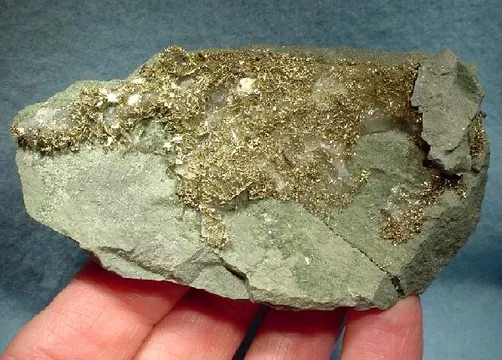
Pumpkin Hollow is one of the great concealed copper-iron skarn systems of the Yerington district: not an old dump locality with weathered scraps on the hillside, but a blind, drill-discovered ore system hidden beneath the eastern flank of Mason Valley. For collectors, its appeal lies in the muscular skarn assemblage—chalcopyrite and magnetite in dense black ore, pyrite and pyrrhotite in retrograde zones, calcite and dolomite as marble and late carbonate, and green to dark calc-silicates such as diopside, actinolite, epidote, tremolite, and andradite. Its best hand specimens have the look of working-mine ore rather than cabinet-fantasy crystallization: brassy chalcopyrite splashed, veined, or brecciated through heavy magnetite; pale carbonate contrasting with sulfides; and dark skarn pieces that tell the story of intrusive heat, replacement, brecciation, and later copper-rich fluids.
The deposit belongs to the broader Jurassic Yerington batholith copper province, where granodioritic to dioritic intrusions met Triassic carbonate and calcareous clastic rocks. Unlike the nearby Yerington-Anaconda porphyry mine, Pumpkin Hollow’s principal identity is skarn and iron-oxide copper-gold style mineralization. The system’s importance is partly geological: it demonstrates how the same magmatic district that produced porphyry copper could also generate large magnetite-rich replacement bodies in limestone and hornfels. It is also historically important because it was found by airborne magnetics in 1960, explored for decades by major companies, and eventually became Nevada’s modern underground copper mine project.
Regional View
Country View
The collector material that reaches the market is necessarily selective. Pumpkin Hollow is an industrial copper property, and specimens are not the product of open public collecting. The pieces that matter most are those that preserve the textural identity of the ore: chalcopyrite replacing or crosscutting magnetite-rich skarn, carbonate-lined cavities or seams carrying sulfides, and dense breccias in which the ore minerals are not merely massive but arranged in readable relationships. A good Pumpkin Hollow label should be treated as part of the specimen’s value, because pieces from the active development era are far scarcer than ordinary Nevada copper minerals from historic surface workings.
Search for specimens: View all specimens from Pumpkin Hollow Mine, Yerington, Lyon County, USA
Pumpkin Hollow lies southeast of Yerington, on the eastern side of the Singatse Range and the gravel-covered margin of Mason Valley. The deposit is best understood as a copper-magnetite skarn with iron-oxide copper-gold affinities, developed where Jurassic Yerington batholith intrusions cut Triassic Mason Valley limestone and the calcareous argillites, shales, siltstones, and limestones of the Gardnerville Formation. The skarn occurs both as exoskarn in carbonate and calcareous sedimentary host rocks and as altered intrusive rock, with calc-silicate hornfels, marble, magnetite replacement, and retrograde amphibole-epidote-carbonate assemblages playing central roles.
The mineralization is distributed among several named ore bodies and zones. The western deposits include the North, South, and Southeast areas, while the deeper eastern side includes the East and E2 deposits; older descriptions and MRDS-derived summaries also refer to Northwest and Southwest skarn zones. The East deposit is a deep, bedding-influenced system of stacked mineralized zones in Mason Valley limestone, while E2 is described as a steeply northwest-dipping high-grade copper-magnetite skarn breccia lens. In the underground targets, chalcopyrite-magnetite mineralization follows the marble front and is especially important near dolomitized limestone, endoskarn contacts, and breccia zones.
The paragenesis is unusually readable in good specimens and drill-core pieces. Early contact metamorphism converted carbonate to calcite ± dolomite ± tremolite marble and produced diopside-garnet calc-silicate hornfels. Later metasomatism introduced diopside-garnet-magnetite ± sulfide replacement, followed by retrograde assemblages containing actinolite, epidote, garnet, magnetite, calcite, dolomite, pyrite, pyrrhotite, and chalcopyrite. Copper commonly increases outward from magnetite-rich proximal skarn, so the collector-grade material often shows an engaging tension between massive black magnetite and later brassy sulfide.
The discovery story is fundamental to the locality. Pumpkin Hollow was not found by following oxidized copper color at the surface. It was detected by airborne magnetic surveying by United States Steel in 1960, a method well suited to a buried magnetite-rich system. Subsequent exploration by U.S. Steel, Anaconda, Cyprus, and later companies outlined a very large copper-magnetite resource through extensive drilling. The property was acquired by Nevada Copper in 2005, and the modern underground operation was built during the following development cycle. Production from the processing plant began in December 2019, but the mine struggled through ramp-up and geotechnical and financial difficulties. Nevada Copper filed for Chapter 11 bankruptcy protection on June 10, 2024, and the Pumpkin Hollow assets were acquired by Southwest Critical Materials LLC, an affiliate of Kinterra Capital, in October 2024.
As of 2026, Pumpkin Hollow is a controlled industrial mine property, not a collecting locality. Southwest Critical Materials has been working toward restarting the underground mine and developing the Southwest Open Pit project as separate but related operations. Public collecting should be regarded as closed: access requires permission from the land and mineral-rights holders, and the underground workings, surface infrastructure, and mine rock areas are not suitable for casual specimen hunting. Most collector specimens are therefore ex-mine, employee-saved, study, or dealer-circulated pieces rather than material that collectors can currently obtain in the field.
The best known specimen-yielding material appears to come from the same geological environments prized by the mine geologists: East and E2 chalcopyrite-magnetite skarn breccias, carbonate-rich retrograde zones, and the North-South open-pit resource areas where magnetite, chalcopyrite, pyrite, calcite, dolomite, and calc-silicates occur together. Collectors should not expect large, isolated, freestanding crystals like those from classic vein localities; Pumpkin Hollow’s strength is matrix texture, ore contrast, and the rarity of attributable specimens from a major modern Nevada skarn.
Chalcopyrite is the signature collector mineral of Pumpkin Hollow because it is also the chief copper ore mineral: it occurs with magnetite as disseminations, veinlets, massive streaks, breccia clasts, and replacement textures in skarn and marble-front ore. The best pieces show fresh brassy metallic chalcopyrite sharply contrasting against black magnetite or dark calc-silicate skarn, commonly with pyrite, pyrrhotite, actinolite, epidote, calcite, or dolomite; ordinary pieces are simply heavy massive ore with little visual separation. Published descriptions place chalcopyrite in retrograde skarn and high-grade chalcopyrite-magnetite breccia, especially in the East and E2 underground deposits and along marble-front mineralization, so collector specimens with clear breccia texture, bright sulfide, and a reliable Pumpkin Hollow provenance are substantially more desirable than unlocalized “Nevada copper ore” fragments.
Tetrahedrite-labeled Pumpkin Hollow specimens occupy a narrower and more cautionary collector niche than chalcopyrite: the broader ore literature records minor tennantite in the skarn sulfide assemblage, and without analytical work many dark-gray copper sulfosalt grains from this system are best treated as tetrahedrite-group material rather than assumed end-member tetrahedrite. On specimens, the material to look for is dark steel-gray to black metallic sulfosalt in association with chalcopyrite, pyrite, magnetite, and carbonate or quartz seams, generally as small masses or granular patches rather than large, isolated tetrahedral crystals. The most convincing pieces are those where the tetrahedrite-group mineral is visibly distinct from magnetite and pyrite, occurs with brassy chalcopyrite in a coherent skarn or carbonate matrix, and carries old or analytical documentation; vague dark metallic patches on Pumpkin Hollow ore should be valued conservatively unless tested.
Calcite at Pumpkin Hollow is not merely a late white gangue mineral; it records both the conversion of Mason Valley limestone to marble and the later retrograde carbonate-rich stages of the skarn. In collector specimens it may appear as white to cream massive carbonate, cleavable seams, pale matrix around sulfides, or small cavity linings associated with chalcopyrite, pyrite, magnetite, actinolite, epidote, talc, or dolomite. The best calcite-bearing pieces use contrast: pale carbonate cutting or cementing dark magnetite-rich skarn, brassy chalcopyrite set off against white calcite, or breccia textures in which calcite helps reveal the sequence of fracturing and replacement; massive limestone-marble fragments without sulfide or skarn context are less compelling as Pumpkin Hollow specimens.
Dolomite from Pumpkin Hollow is important because the deposit literature ties Mg-bearing carbonates and Mg-silicates to the transition between relatively pure marble and magnetite replacement. Earlier work documented dolomite in drill core with calcite-talc assemblages, with massive magnetite, and with chalcopyrite-pyrite-pyrrhotite in talc-dolomite zones, suggesting that dolomite-bearing specimens can be excellent records of the skarn front rather than generic carbonate matrix. Collector pieces are most interesting when dolomite is visibly part of a pale carbonate-talc or carbonate-amphibole association with magnetite and chalcopyrite; small indistinct carbonate patches should be separated from calcite only by testing or analysis, since the two carbonates can be visually similar in Pumpkin Hollow ore.
Quartz is a subordinate but useful mineral at Pumpkin Hollow, occurring in the broader skarn and alteration assemblage rather than as the dominant showy species. It is documented as gangue and as part of magnetite- and calc-silicate-bearing assemblages, especially where brecciation, retrograde alteration, and later veining affected the skarn and hornfels. Collectors should look for quartz where it helps frame the ore minerals—clear to milky vein quartz with chalcopyrite, pyrite, magnetite, calcite, or epidote—rather than expecting large isolated crystals; the best Pumpkin Hollow quartz specimens are those that preserve sulfide-carbonate-quartz relationships in a dense skarn matrix.
Other minerals documented from Pumpkin Hollow include actinolite, ferro-actinolite, tremolite, magnesio-hornblende, andradite and other garnet-group material, diopside, hedenbergite, epidote, titanite, talc, scapolite, scheelite, bornite, pyrite, pyrrhotite, magnetite, and magnetite after bladed hematite known as mushketovite. The locality’s special mineralogical interest is not a famous type-mineral suite but a deep, magnetite-rich skarn assemblage with excellent research value: scheelite and scapolite are notable rarities for collectors, while mushketovite, pyroxene-amphibole replacement, and multiple sulfide generations make the deposit particularly attractive to skarn specialists.
Pumpkin Hollow specimens should be bought with provenance in mind. The most common problem is not outright fakery but vague or overconfident labeling: “Yerington,” “Nevada copper mine,” “Pumpkin Hollow,” and “Nevada Copper” can be used inconsistently in the market. The Yerington district contains several distinct deposits, including the historic Anaconda-Yerington mine, Ann-Mason, Bear, MacArthur, Minnesota, Ludwig, and Pumpkin Hollow; material from one should not be casually transferred to another. Labels that specify Pumpkin Hollow, Nevada Copper, Southwest Critical Materials, East, E2, North, South, or a credible mine-source chain deserve more confidence than loose district labels.
The tetrahedrite issue deserves special care. Technical sources for Pumpkin Hollow commonly mention minor tennantite rather than abundant collector-grade tetrahedrite. If a specimen is sold as tetrahedrite, the buyer should look for analytical support or at least a reputable old label and a visually distinct sulfosalt occurrence. In the absence of analysis, “tetrahedrite group” is the more conservative collector language.
Condition is typical of dense skarn ore. Chalcopyrite can tarnish and may show iridescent films; attractive natural tarnish is acceptable, but harsh cleaning can leave unnatural brightness or etched carbonate. Calcite and dolomite are acid-sensitive and scratch easily, so avoid acid cleaning unless the goal is analytical preparation rather than specimen preservation. Pyrrhotite-bearing pieces should be kept dry and stable, as iron sulfides can oxidize in poor storage. Massive magnetite makes many specimens deceptively heavy, and sharp fractured skarn edges can abrade softer associated carbonates.
Fluorescence is not a major market identity for Pumpkin Hollow calcite, but scheelite is documented from the locality and should be checked under shortwave ultraviolet light on mixed skarn pieces. Any bright response should be interpreted cautiously until the grain is located and identified; pale carbonate fluorescence alone is not enough to infer scheelite.
In availability terms, Pumpkin Hollow is scarce as a collector locality. It is a modern operating and restart-stage copper property, not a classic public collecting site, so specimens appear in small numbers through dealer inventories, employee-saved material, research offcuts, and curated marketplace offerings. Fine examples with bright chalcopyrite on magnetite-rich skarn, credible tetrahedrite-group identification, or attractive carbonate contrast are considerably less common than ordinary massive chalcopyrite-magnetite ore.
The first great Pumpkin Hollow story happened in the air, not underground. In 1960, United States Steel’s geophysical work detected the buried magnetic target that would become Pumpkin Hollow. On the ground, there was no romantic gossan trail leading an old prospector to a discovery shaft. The ore bodies were blind, hidden under cover and barren-looking rock, and the magnetite made the deposit visible to instruments before it was visible to miners. That single fact explains much of Pumpkin Hollow’s collector character: the specimens are not weathered relics from a nineteenth-century dump, but pieces from a concealed system patiently outlined by drilling.
The drilling story became enormous. Before Nevada Copper entered the picture, U.S. Steel, Anaconda, Cyprus, and other major companies had already drilled hundreds of thousands of feet and meters into the system. The numbers are easy to lose in a technical report, but they are worth picturing: long rows of core boxes, sawn cylinders of black magnetite skarn and pale marble, each interval defining an ore body that nobody could simply walk up to and chip from the surface. By the time community accounts in Yerington were describing the project in the 2010s, Pumpkin Hollow was being presented less as a prospect than as a generational attempt to bring copper mining back to Mason Valley.
The human scale appears in the development photographs and local accounts: headframe, hoist house, shop, core sheds, drill rigs on the North Deposit, and the view “looking up through the shaft.” By 2015 the shaft was described at the 1,900-foot level, with underground drill stations planned before sinking to a final shaft bottom near 2,161 feet. For collectors, that depth matters. Every attractive chalcopyrite-magnetite specimen from the underground system is a piece of geology that had to be reached through industrial capital, engineering, ventilation, pumping, hoisting, and years of permitting—not a roadside find.
There is also a modern boom-and-restart chapter. Nevada Copper completed construction of the underground mine in 2019 and announced the start of production at the processing plant in December of that year. The operation then moved through ramp-up difficulties, shutdowns, restarts, and geotechnical challenges. In October 2023 ore processing resumed, and one reported stoping sequence in the Sugarcube area of the East South Zone produced 9,000 tons of ore in July and August before being paste backfilled. Less than a year later, on June 10, 2024, Nevada Copper filed for Chapter 11 bankruptcy protection. By October 2024, the assets had passed to Southwest Critical Materials.
A community tour in August 2025 gave the mine a different kind of public image. Local officials, Boys & Girls Clubs of Mason Valley representatives, and Southwest Critical Materials staff went underground in safety gear for what was framed as a “mine-to-cable” copper journey. The report names the people as precisely as a small-town photograph caption: Ian McMullan, Tracey Thom, Chuck Pollard, Dave Hockaday, Omar Rodriguez Lopez, Shane Martin, Matt Galvin, Jerry Bryant, Andrew Haskin, Brandon Coombs, Nick Beaton, Tommy Crowder, and Taurus Massey. The mine was described as dark, wet, ventilated, cooled, and more than 2,000 feet deep. For a collector holding a heavy Pumpkin Hollow chalcopyrite-magnetite specimen, that scene is the missing context: the piece came from a living industrial landscape, one where geology, community, bankruptcy court, and the energy-transition copper story all converged underground.