Pingwu beryl mine, China - alpine locality yielding scheelite, cassiterite, aquamarine and goshenite with sharp display crystals; famed Xuebaoding assemblages.
Key facts
The Pingwu beryl mine is one of the great modern Chinese specimen localities: a high-altitude W-Sn-Be vein system on Mount Little Xuebaoding where hydrothermal pockets yielded the now unmistakable combination of orange scheelite, jet-black cassiterite, pale blue to colorless tabular beryl, and bladed muscovite. The locality is better known to many collectors simply as “Xuebaoding” or “Pingwu,” but the most precise label places it at Huya township, Mount Little Xuebaoding, Pingwu County, Mianyang, Sichuan. Its importance is not just that these minerals occur together; it is that they occur together as large, open-space, sharply crystallized display specimens in a geologic setting that is not a conventional granitic pegmatite, but a granite-related hydrothermal/greisen vein system cutting Triassic marble and schist near highly evolved leucogranites.
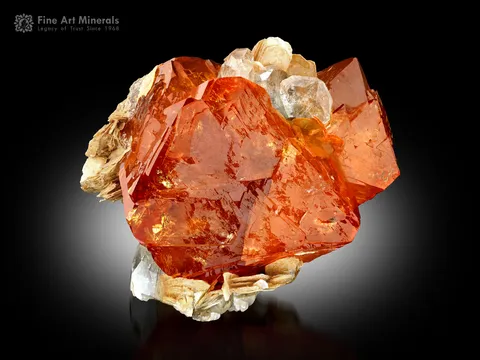
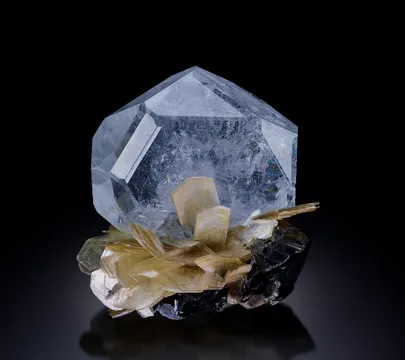
The finest pieces from Pingwu have a distinctive visual language. Scheelite is typically pseudo-octahedral, bright yellow-orange to reddish orange, lustrous, heavy in the hand, and often perched dramatically on silver, gray, or golden muscovite blades. Aquamarine and goshenite occur as flattened hexagonal plates rather than the long prisms familiar from many pegmatites; the best beryls are glassy, gemmy, and lightly blue, with broad basal faces. Cassiterite forms brilliant black cyclic twins and squat complex crystals that give the assemblages their sharp black contrast. Muscovite is not merely matrix here: it is the sparkling stage on which the W-Sn-Be suite performs.
Regional View
Country View
The deposit lies in the rugged eastern Tibetan Plateau margin, in the Songpan-Ganzi orogenic region near the Huya fault system. Mineralized workings are commonly described at roughly 3,800–4,100 m elevation on the southeast side of the Little Xuebaoding massif, with Little Xuebaoding itself rising to more than 5,400 m. This alpine setting matters to collectors because the best specimens are literally products of brittle marble and schist fissures opened near the apical parts of rare-element granites—enough space for crystals to grow cleanly, but enough fluid complexity to bring W, Sn, Be, F, P, B, and alkalis into the same pocket system.

Photo: Wikimedia Commons

Photo: Wikimedia Commons
Search for specimens: View all specimens from Pingwu beryl mine, China
The Pingwu beryl mine is a quartz-vein, granite-related W-Sn-Be deposit whose chief collectible minerals are scheelite, cassiterite, beryl, muscovite, fluorite, apatite, feldspar, and quartz. The broader locality is recorded under several names: Pingwu beryl mine, Huya W-Sn-Be deposit, Xuebaoding W-Sn-Be deposit, and, in specimen trade usage, Mount Xuebaoding or Ping Wu. More than forty mineralized veins are reported on the southeast slope of the Xuebaoding massif near Huya; individual veins are described as several tens of metres long and commonly around 0.5–1.5 m wide.
Geologically, the mine sits where highly fractionated rare-element granites intruded Triassic metasedimentary rocks. Different sources use different stratigraphic terminology for the host sequence, including Zagunao and Zhuwo series rocks, but the collector-relevant point is clear: the mineralization occupies brittle fractures, veins, pods, and geodes in marble, schist, and granite-proximal zones. The best crystals formed in open spaces within quartz-, calcite-, fluorite-, and muscovite-bearing veins rather than as disseminated ore. This is why the deposit produced free-standing scheelite, cassiterite, beryl, and muscovite combinations instead of merely massive tungsten-tin ore.
Modern studies divide the system into wall-rock and assemblage zones. One zone is granite-hosted and dominated by muscovite and beryl; another marks the transition from granite into the Triassic host rocks and carries muscovite with beryl and cassiterite; the principal specimen-producing veins in marble and schist contain beryl, cassiterite, scheelite, fluorite, apatite, feldspars, quartz, and muscovite. In the mineralized veins, coarse crystals commonly grew on muscovite fringes along vein margins, while later quartz could occupy vein centers. Reported crystal-size ranges in the mineralized veins are remarkable: beryl about 0.5–15 cm, cassiterite about 1–30 cm, scheelite about 1–30 cm, K-feldspar and albite about 1–25 cm, muscovite about 1–3 cm, fluorite about 1–10 cm, and apatite about 0.5–3 cm.
The granites most often tied to the Pingwu/Xuebaoding specimen system are the Pankou and Pukouling bodies, with Wuzhutang also discussed in recent studies of the mining area. These are evolved, alkali- and volatile-influenced granitic intrusions rich in components such as Li, Rb, Cs, F, B, W, Sn, and Be. Dating studies place the granite emplacement and mineralization broadly in the Early Jurassic to late Triassic transition, with reported ages around 201–194 Ma for important granites and closely related ages for cassiterite and muscovite associated with the ore.
The mining history has two overlapping chapters. As an economic occurrence, the district was recognized and studied in China from the mid-20th century onward. As a mineral-specimen locality, it became internationally famous in the 1990s and early 2000s, when Xuebaoding specimens reached Western collectors in quantity and immediately stood apart from other Chinese material then entering the market. Berthold Ottens’ 2005 article in The Mineralogical Record helped cement the locality’s reputation, describing the signature assemblage of lustrous deep-orange scheelite, black twinned cassiterite, tabular aquamarine beryl, and muscovite.
Access today should be regarded as highly restricted, not as a recreational collecting opportunity. The mine lies in steep, high-elevation terrain within a region important for giant panda habitat and nature-reserve protection. Collector-market accounts also consistently note that production declined after the 2008 Wenchuan earthquake damaged regional access and after blasting became more restricted because of environmental concerns. Modern specimens still appear, but the classic production—especially undamaged, balanced combinations of scheelite, beryl, cassiterite, and muscovite—is finite and increasingly treated as old-stock material.
Muscovite is the architectural mineral of Pingwu specimens: silvery gray, white, pale straw, or golden bladed mica forms rosettes, compressed stacks, and sparkling plates that line the vein margins and provide the support for beryl, cassiterite, and scheelite. In the mineralized veins, muscovite is reported as a fringe between the host rock and the coarse W-Sn-Be assemblage, with beryl, cassiterite, scheelite, fluorite, apatite, feldspar, and quartz overgrowing it as single crystals or aggregates. The best muscovite specimens from Pingwu are not simply mica plates; they have sculptural, three-dimensional mica matrices that hold a bright orange scheelite or a glassy tabular beryl in an uncluttered position, with clean contrast and minimal bruising along the fragile blade edges.
Pingwu aquamarine is prized for its flattened hexagonal habit, a form so distinctive that many experienced collectors can recognize the locality from silhouette alone. The beryl is commonly colorless to very pale blue, transparent to translucent, and short in the c direction, with broad basal faces rather than elongated prisms; documented examples range from small 0.5–1.5 cm single crystals used in analytical studies to display crystals several centimetres across, and vein-scale beryl is reported up to about 15 cm. The best aquamarines sit sharply on bladed muscovite, sometimes with black cassiterite twins and small orange scheelite crystals nearby; ordinary pieces tend to be opaque, etched, edge-worn, or crowded in mica, while top pieces show glassy luster, undamaged broad faces, pale blue color, and elegant separation from the matrix.
Scheelite is the mineral that gives Pingwu its most dramatic color: rich yellow-orange, tangerine, reddish orange, and occasionally paler honey tones in pseudo-octahedral to biconical crystals, commonly on muscovite and locally with beryl, cassiterite, fluorite, apatite, feldspar, or quartz. Scientific work on Xuebaoding scheelite links its yellow-orange hue to rare-earth elements such as La, Ce, Pr, and Nd substituting into the scheelite structure, while collector descriptions emphasize large grain size, strong luster, and transparency. Good Pingwu scheelite is sharply formed, lustrous, visibly translucent to gemmy at the edges, undamaged on the prominent pyramidal faces, and well placed on muscovite; lesser pieces are dull, repaired-looking, chipped at the points, embedded in massive quartz, or present as isolated crystals without the locality’s full aesthetic context.
Beryl from Pingwu includes aquamarine and goshenite, and the locality has been studied specifically because its crystals are unusually tabular, alkali-rich, and formed in a hydrothermal/greisen W-Sn-Be system rather than a typical pegmatite. Research describes Xuebaoding beryl as mostly colorless and transparent, rarely with a hint of blue, with a simple morphology dominated by the basal pinacoid and prism faces; chemically it trends toward lithium-sodium, alkali-rich beryl, and its flattened habit has been linked to growth conditions and alkali substitution. The strongest collectible beryl specimens show crisp, flattened hexagonal crystals on muscovite, albite, or quartz, ideally with light-blue aquamarine color or water-clear goshenite transparency, while average examples are chalky, overly contacted, or mislabeled in the trade as “white aquamarine” when they are better described as goshenite.
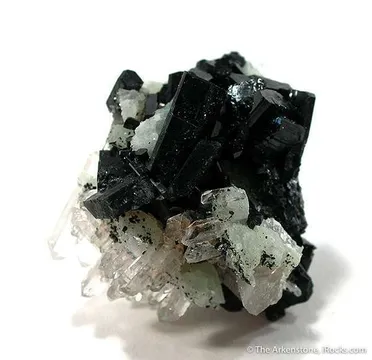
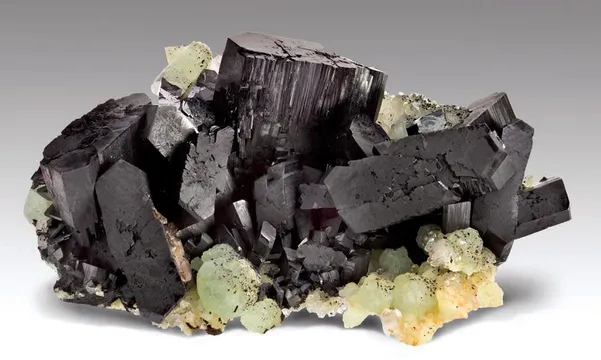
Pingwu cassiterite provides the black, adamantine counterpoint to the locality’s pale beryl and orange scheelite, occurring as sharp complex crystals and cyclic twins on muscovite, commonly with aquamarine, goshenite, scheelite, feldspar, and quartz. The vein system records cassiterite crystals from centimetre size to much larger coarse crystals, and commercial specimens frequently feature lustrous jet-black twins around 1–3 cm with exceptional definition; the best examples have crisp re-entrant angles, mirror-bright faces, strong cyclic-twin geometry, and clean association with tabular beryl or orange scheelite. Good Pingwu cassiterite is also dense and often highly three-dimensional, so edge bruising, pocket-wall contacts, and restoration around attachment points deserve close inspection on larger or high-value pieces.
Other documented minerals from the Pingwu beryl mine include albite and cleavelandite, microcline, fluorite, fluorapatite, quartz including rock crystal and smoky quartz, calcite, dolomite, dravite, schorl, foitite, magnesio-foitite, oxy-dravite, oxy-schorl, rutile, zircon, titanite, pyrite, chalcopyrite, molybdenite, sphalerite, galena, bournonite, boulangerite, geocronite, wulfenite, magnetite, ilmenite, bixbyite-(Fe), vismirnovite, and the tin-bearing rarity mushistonite, which is known here as green coatings associated with kësterite. The rare-mineral side of the locality is especially important for micromounters and systematic collectors, but the public face of Pingwu remains the macro-aesthetic W-Sn-Be suite: orange scheelite, black cassiterite, tabular beryl, and muscovite.
Pingwu specimens are often mislabeled rather than deliberately faked. Old labels may say “Mt. Xuebaoding,” “Xuebaoding,” “Ping Wu,” “Huya,” “Hujia,” “Beryl-Scheelite deposit,” “Huya W-Sn-Be deposit,” or “Shuijingchang.” These names can refer to the same collecting tradition, but a modern label should retain the old wording and add the precise locality: Pingwu beryl mine, Huya township, Mount Little Xuebaoding, Pingwu County, Mianyang, Sichuan, China.
The most common identification issue is beryl variety naming. Pale blue, tabular crystals may properly be called aquamarine; colorless crystals should be called goshenite or simply beryl, not “white aquamarine.” Some Pingwu beryl is only faintly blue, and dealer lighting can exaggerate color, so collectors should judge variety under neutral daylight-equivalent illumination. Likewise, black crystals on Pingwu pieces are often cassiterite, but small black tourmaline, magnetite, and other dark species can occur in the broader assemblage; on expensive pieces, the black mineral should be confirmed by habit, luster, density, and, where necessary, analysis.
Scheelite handling deserves particular care. It is dense, brittle, and commonly forms sharp pyramidal crystals whose points and edges chip easily. The best specimens are frequently on delicate muscovite, so even a secure-looking scheelite-on-mica piece may have fragile attachment points and compressed mica blades that shed if mishandled. Shortwave UV is useful: scheelite typically shows a bright blue-white to bluish fluorescence, and UV examination can help locate small scheelite crystals hidden in quartz or muscovite. UV response is not, by itself, a proof of Pingwu origin, but it is a practical field and collection-room tool.
Condition is central to value. The locality’s display style leaves crystals exposed: aquamarine basal faces can be scratched or edge-nicked, cassiterite twins can have bruised re-entrant angles, scheelite points are prone to small chips, and muscovite matrices may be ragged along pocket-wall breaks. Many otherwise attractive specimens have contacts on the back where they were removed from the pocket wall; that is normal and not fatal if the display face is clean. Repairs and reattachments are plausible on complex, high-value pieces, especially where a heavy scheelite or cassiterite group sits on thin mica. Use magnification and check for glue shine at contact points.
Market availability is steady but uneven. Small muscovite, goshenite, and modest aquamarine pieces remain obtainable, and loose or simple scheelite specimens appear regularly. Fine combination pieces with bright orange scheelite, gemmy tabular aquamarine, sharp black cassiterite, and aesthetic muscovite are much scarcer. The best classic specimens are now treated as older production, and prices rise sharply for undamaged, well-balanced combinations with strong color contrast and credible provenance.
The first story behind Pingwu is a story of names. “Xuebaoding” has the grandeur of a mountain epic—Snow Treasure Crown—and for years collectors used it broadly for the spectacular W-Sn-Be specimens coming out of the high country of northern Sichuan. But the specimen workings most often attached to that name are not simply the summit of Mount Xuebaoding. The best modern locality wording places them around Mount Little Xuebaoding on the Pingwu side, near Huya township. On labels, geography became compressed into shorthand: Pingwu, Ping Wu, Huya, Hujia, Mount Xuebaoding, Little Xuebaoding, Beryl-Scheelite deposit, Huya W-Sn-Be deposit. A serious collection should preserve that history rather than erase it, because those labels track the route by which the locality entered the mineral market.
The second story is the landscape itself. Scientific field figures show Little Xuebaoding rising behind the locality, mineralized zones traced along a nearly horizontal marble band, white mine tailings on steep ground, and a mining camp tucked below. It is difficult country: high, fractured, alpine, and geologically busy. This setting is part of why the specimens look the way they do. In marble, brittle fractures could open cleanly and hold pockets; in schist, mineralization became more stockwork-like. The result was a specimen deposit in which the most valuable objects were not extracted as ore but rescued from cavities: orange scheelite on mica, tabular beryl on mica, black cassiterite twins with beryl, and rare complete combinations of all three.
Then came 2008. The Wenchuan earthquake struck Sichuan on May 12, 2008, devastating communities and infrastructure across the region. Collector-market accounts of Pingwu material repeatedly note that access to the mine area suffered after the earthquake, including disruption to the road leading toward the workings. The same high-relief, landslide-prone mountain country that made the specimens possible also made continued mining difficult. Environmental protection added another pressure: the area lies within important giant panda habitat, and blasting near protected areas became increasingly constrained. In market terms, that changed the meaning of “Pingwu” from a producing locality to a classic one.
There is also a quieter human story in the way specimens were saved. Pingwu is a tungsten-tin-beryllium deposit, and the minerals have industrial identities: scheelite for W, cassiterite for Sn, beryl for Be. Yet the finest pieces survived because miners and dealers recognized that a complete crystal group could be worth far more intact than crushed or processed. Every clean specimen with an orange scheelite poised on muscovite records that change in thinking. It is not merely a mineralogical object; it is evidence of the moment when Chinese specimen mining, local opportunity, scientific attention, and international collector demand all met in the same pocket.