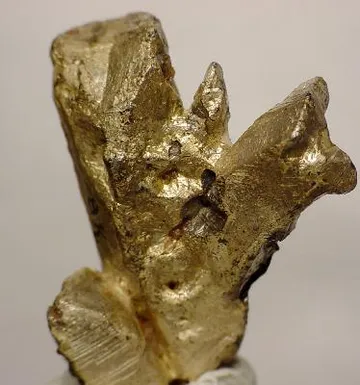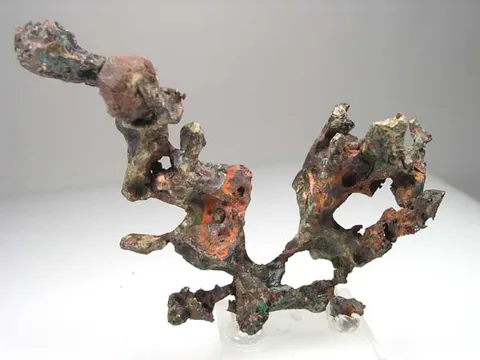
Phoenix Mine, USA — a premier Michigan locality for sharp native copper and analcime, with copper-included calcite and quartz on basalt, collector favorite.
Key facts
Phoenix is one of the great specimen names of Michigan’s native-copper country: not because it was among the district’s biggest producers, but because its fissure veins made mineral specimens with a personality instantly recognizable to collectors. The mine lies at Phoenix, in Houghton Township, Keweenaw County, on the northern Keweenaw Peninsula, close to the junction of US 41 and M-26 and just southwest of Eagle River. Geologically it belongs to the classic Lake Superior native-copper district, where copper-bearing hydrothermal fluids moved through fractures, amygdaloidal basalt flow tops, and associated conglomeratic horizons of the Keweenawan volcanic pile. At Phoenix the controlling landmark is the Greenstone Flow, the immense basaltic escarpment that forms the rugged spine of this part of the peninsula; the mine worked a group of copper-bearing fissures and related lodes at and below that bluff.
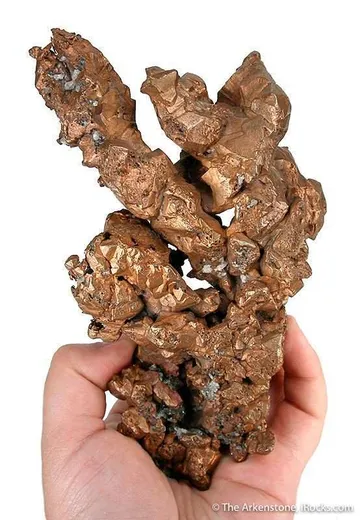
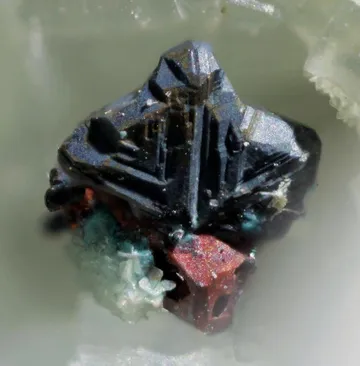
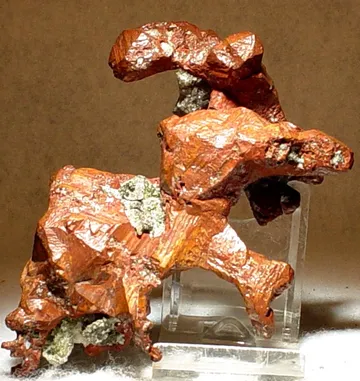
The collector appeal of Phoenix rests on a superb combination: sharp native copper, colorless to pink analcime, copper-included calcite, delicate quartz, prehnite, apophyllite, silver, and uncommon accessory species in the altered basaltic gangue. The best copper specimens are not simply chunks of metal; they are crystallized, arborescent, leafy, mossy, or skeletal groups, often with red cuprite or dark tenorite surfaces and with enough matrix to set off the metallic form. The best analcimes are a different kind of classic: clean trapezohedra, sometimes twinned or overgrown in a distinctive Phoenix style, perched on native copper, calcite, or basaltic matrix. Together they make Phoenix one of the relatively few American localities where a copper specimen can also be a zeolite specimen of high order.
Regional View
Country View
Historically, Phoenix began early. It was opened in 1844 as the Lake Superior mine by the Bay State Mining Company, renamed Phoenix in 1849, and worked with interruptions until June 1905. During that long but uneven life it produced 16,632,536 pounds of copper and about 25,000 ounces of silver. Those numbers are modest beside the giant amygdaloid and conglomerate mines farther south, but Phoenix’s mineralogical reputation is out of proportion to its tonnage. The old workings tied together a set of fissure veins that were treated at various times as separate properties or branches: the Robbins or West vein, the Phoenix vein, the St. Clair vein, the Babbitt vein, the Bay State ground, and associated Ashbed amygdaloid workings. For specimen collectors, those names matter because old labels may say “Phoenix,” “West vein,” “Robbins,” “St. Clair,” “Bay State,” or simply “Phoenix, Keweenaw Co.” and still refer to material from the same tight historic mining neighborhood.
Search for specimens: View all specimens from Phoenix Mine, USA
Phoenix is a Keweenaw native-copper fissure-vein locality, not a porphyry copper deposit, a sulfide vein district, or a modern open pit. Its ore consisted chiefly of native copper and native silver deposited in fractures and adjacent permeable zones within the Keweenawan volcanic sequence. The country rock is part of the Portage Lake volcanic pile, and the most important local topographic and structural feature is the Greenstone Flow, whose bold escarpment rises above the old mine site. Michigan Tech’s Keweenaw geoheritage description emphasizes the Greenstone Flow exposure at Phoenix, including flow layering, columnar jointing, ophitic texture, and a pegmatitic zone visible in the great basaltic outcrop above the mine and dump.
The mine was not a single neat opening but a cluster of related workings. The principal mineralized fissures historically associated with Phoenix include the Phoenix, Robbins or West, St. Clair, and Babbitt veins; the Bay State property was later absorbed into the Phoenix operation, and the mine also explored or worked the Ashbed amygdaloid. USGS descriptions of the district treat these Keweenaw fissures as steep mineralized structures whose productivity depended heavily on where they crossed favorable beds below the Greenstone Flow. At Phoenix, the deepest inclined workings reached about 1,000 feet vertically on the Phoenix fissure, while the Robbins or West vein was opened to about 600 feet. The St. Clair vein lay immediately under the Greenstone Flow, with most stoping between the flow and a branching fault or “slide”; it was rich in places, reportedly carrying 2 to 3 percent copper, but narrow and limited in area.
The earliest phase began as the Lake Superior mine in 1844 under the Bay State Mining Company. The Phoenix Mining Company was organized in 1849 and took over the Lake Superior operation on the Eagle River. In 1863 the company turned renewed attention to rich fissure veins south along the bluffs near the Cliff Mine and sank the Tyler and Crocker shafts on the bluff. In 1869 it reorganized as the Phoenix Copper Company and was working the Phoenix, East Phoenix, Armstrong, Ward, and Robbins veins, as well as the Ashbed amygdaloid. In 1871 it purchased the Bay State property and reorganized again as Phoenix Consolidated Copper Company, controlling a larger group of mines that included Phoenix, St. Clair, Garden City, Meadow, and Atlas. The final reorganization came in 1899 under the same Phoenix Consolidated name. By 1901 most production was coming from the St. Clair fissure, with little from the West vein; a 1905 report described conditions at the St. Clair shafts as unfavorable for deeper work, and the company began selling stock and equipment. Phoenix passed into the Keweenaw Copper Company in 1905, and by 1923 Keweenaw owned all Phoenix properties and the company was dissolved. Calumet & Hecla dewatered and repaired two Phoenix shafts beginning in 1927, but that revival ended by 1929.
The mine’s best production years were episodic. In 1863 it produced more than 244,000 pounds of copper ingots. Between 1866 and 1869 the Phoenix vein yielded about 530 tons of copper ingots. In 1875 the Phoenix and Robbins or West veins produced more than 4,300 ounces of silver, and in 1880–1881 the mine produced 503 tons of copper ingots. USGS summaries judged the early-1870s work on the Phoenix fissure as the only truly profitable period, and placed total assessments of the old Phoenix and Phoenix Consolidated at $2,385,500 against dividends of only $20,000. The mine’s economic story is therefore one of promise, persistence, and repeated reorganization rather than bonanza-scale profit.
For collectors, the old dump was long famous for native copper, native silver, prehnite, analcime, and pumpellyite, but access has changed. The Phoenix piles are private property, and current locality data state that the owners do not grant permission to enter because of caving ground. Older collecting accounts describe permission once being possible through local owners or businesses, but later reports cite safety concerns, including a collapsing shaft, and the broader problem of unauthorized excavation on Keweenaw mine dumps. Phoenix should therefore be treated as a closed historic locality unless a collector has explicit, current permission from the landowner. Specimens on the market are overwhelmingly old collection pieces, older dump finds, or material recovered before closure.
The notable specimen finds are strongly vein-specific in character. Phoenix analcime was described scientifically as early as 1885, when Samuel L. Penfield studied crystals received at New Haven that occurred thickly on calcite and native copper with tabular apophyllite and minute milky quartz. Later specimens include larger analcimes to several centimeters, some showing epitaxial overgrowths considered distinctive enough that experienced collectors can sometimes recognize an otherwise lost Phoenix provenance. A West vein find produced analcime with amber-colored pseudocubic calcite crystals, a combination regarded as unique to that Phoenix occurrence. Copper specimens range from tiny, razor-sharp microcrystals to cabinet-sized branching groups and old-time crystallized masses; one well-known old specimen from the John Sinkankas collection was described as a 40-pound group of copper crystals.
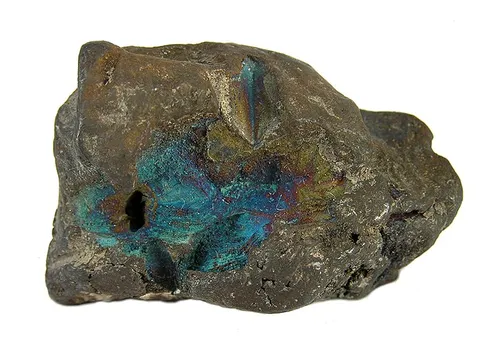
Native copper is the signature mineral of Phoenix, occurring as excellent crystals, leaf copper, moss copper with analcime, arborescent groups, branching cabinet pieces, and smaller skeletal or feathery clusters with red to brown or black oxidation. The most desirable examples are not merely heavy; they show coherent crystallization, balance, and three-dimensional openness, often with basaltic matrix, calcite, analcime, epidote, quartz, prehnite, cuprite, or tenorite providing contrast. Old illustrated Phoenix pieces include sharp copper crystals around 8.8 cm, copper red from cuprite coating, copper with apophyllite, and a 17 cm chisel-chip copper fan made by miners as an artifact rather than a natural specimen. Ordinary Phoenix copper may be massive, flattened, cleaned too aggressively, or lacking matrix; better pieces preserve natural patina, recognizable crystal faces or branching form, and credible old labels distinguishing Phoenix from the neighboring St. Clair, Robbins, Bay State, and other Keweenaw fissure workings.
Phoenix analcime is one of the locality’s defining species and one of the reasons the mine matters beyond native-copper collecting. It occurs as colorless, white, and pinkish trapezohedra, commonly on calcite and native copper and associated with tabular apophyllite and minute milky quartz; Penfield’s 1885 material ranged from minute crystals to about 1 cm, while later locality records and specimen literature document crystals to about 3.5 cm. The finest pieces show sharp isolated or clustered crystals perched on copper or contrasting dark basaltic matrix, sometimes with prehnite, epidote, adularia, or calcite. Especially prized are the complex twinned or overgrown Phoenix analcimes in which a later generation coats an earlier trapezohedral nucleus, producing grooves or reentrant edges; this habit has been regarded as unusually diagnostic for Phoenix within the Lake Superior district. Ordinary examples are small, dull, iron-stained, or crowded; top examples combine size, luster, clean form, matrix contrast, and an undamaged relationship to copper.
Calcite from Phoenix is best known in the Keweenaw style collectors love: transparent to translucent crystals included by bright native copper, giving pinkish, orange, or amber tones, and commonly associated with analcime, prehnite, copper, epidote, and quartz. Habits include scalenohedral crystals, roughly rhombohedral groups, and the distinctive amber-colored pseudocubic calcite recorded from a West vein find with analcime. Market and museum examples include small-cabinet pieces with gemmy scalenohedral crystals around 1 cm, larger copper-included calcite specimens such as a 7 x 8 x 7 cm Wayne State display piece, and miniatures where clear analcime sits among calcite and sponge copper. The best Phoenix calcites retain glassy luster and visible copper inclusions without being acid-burned or mechanically bruised; ordinary examples are cloudy, etched, cleaved, or so heavily cleaned that the calcite has lost its original surface.
Quartz at Phoenix is a supporting but important part of the classic assemblage rather than the main attraction. Penfield noted numerous minute milky quartz crystals scattered over analcime-bearing specimens on calcite and native copper, and modern locality records show quartz associated especially with native copper, tenorite, epidote, calcite, chrysocolla, and pumpellyite. Good Phoenix quartz pieces typically succeed by composition: sparkling white or milky quartz providing a visual ground for copper crystals, or quartz nestled with epidote and calcite in the fissure-vein matrix. The best examples are crisp, balanced miniatures and small-cabinet specimens where quartz enhances the native copper instead of overwhelming it; ordinary examples are simply quartz-bearing basalt or copper pieces with only scattered, abraded druse.
Barite from Phoenix is uncommon and highly locality-specific in appearance. Documented examples show thin white parallel blades, in some cases complex and bladed to about 4 cm, with copper inclusions and native copper reaching the specimen surface; another described Phoenix example consists of wide, flat, mostly white blades around 2.5 x 3 cm, stacked and terminated on both sides, with glossy striated edges, a faint pink hue, reddish matrix, micro milky analcime, and a few larger clear analcimes. Phoenix barite is therefore most collectible when it is more than a label species: sharp bladed crystals, visible association with copper or analcime, and an old or expert-confirmed provenance are crucial. Because bladed white barite can be visually generic, ordinary or doubtful specimens are far less compelling than pieces with matrix, copper inclusions, and a clear Phoenix pedigree.
Other minerals documented from Phoenix include native silver, prehnite, pumpellyite-(Mg) and chlorastrolite, epidote, datolite, fluorapophyllite-(K), natrolite, laumontite, K-feldspar including adularia, microcline, ankerite, dolomite, chrysocolla, cuprite, tenorite, atacamite, hematite, domeykite, babingtonite, and stilbite-subgroup minerals. No valid type-locality species is attached to the Phoenix Mine itself in the standard locality records, but the mine is nevertheless a reference-quality locality for analcime in the Lake Superior native-copper district and an important source of silver- and zeolite-associated native copper. Prehnite deserves special mention: excellent Phoenix prehnite was reported from vein Number 5 as early as the Jackson-era descriptions, with colors ranging from white and yellow through greens and rarely pinkish orange, and with some specimens coated by quartz and calcite or occurring as pseudomorphs after calcite.
Phoenix specimens live or die by provenance. The name “Phoenix” can mean the specific Phoenix Mine, the Phoenix mining camp, or the broader cluster of Phoenix-area workings that includes St. Clair, Robbins or West, Bay State, Lake Superior, and other neighboring fissures. Old labels may be accurate yet imprecise, and modern relabeling can easily blur distinctions. A specimen labeled simply “Phoenix, Keweenaw Co.” is plausible for the historic group, but a high-value piece should be judged by its mineral association, style, label history, and any old collection documentation. Barite is especially vulnerable to mislabeling because white bladed Keweenaw barite can resemble material from other Michigan or Midwest localities; at least one documented Phoenix barite specimen was specifically noted as having been confirmed by George Robinson after an earlier Quincy attribution was rejected.
Outright fabricated Phoenix specimens are not the main published concern; cleaning, etching, and attribution are. Copper specimens from Keweenaw dumps are often acid-cleaned to remove calcite or oxidation, and Phoenix material is no exception. Sensitive pieces with calcite, analcime, barite, prehnite, or apophyllite can be damaged by aggressive acid work. Collectors have reported “burning” native copper and disfiguring calcite by soaking too long, and the warning is particularly relevant to Phoenix pieces in which the entire aesthetic may depend on a copper-calcite-analcime relationship. A copper that is unnaturally bright, stripped, or uniformly polished may have lost much of what makes Phoenix attractive; conversely, a dark tenorite patina or red cuprite surface can be original and desirable when it is stable and not masking repair.
Condition issues are predictable but important. Native copper can be bent, clipped, bruised on high points, or flattened by mine handling. Leaf and moss copper are especially vulnerable to crushing. Analcime crystals can show edge bruises, broken terminations, or dull etched surfaces; large Phoenix analcimes are prized enough that even small damage matters. Calcite is soft and acid-sensitive, so watch for rounded edges, matte surfaces, and hidden cleaves. Barite is heavy, brittle, and perfectly cleavable, so bladed examples should be checked for repaired or missing blade ends. Prehnite and pumpellyite coatings may be attractive but can be difficult to clean without loss.
The current supply is finite. The mine dump was once a known collecting locality, but the Phoenix piles are private property and currently closed to collecting because of safety and caving-ground concerns. Fine copper, analcime, copper-included calcite, and barite specimens therefore tend to appear as old-collection pieces, estate material, dealer recyclings, or carefully documented finds from earlier access periods. Ordinary native copper from the Keweenaw remains broadly available, but genuinely good Phoenix pieces with sharp crystals, analcime association, or old labels are much scarcer and command a premium.
The most elegant Phoenix story begins not in a mine drift but under a microscope in New Haven. In 1885 Samuel L. Penfield examined analcime crystals that had recently reached the Sheffield Scientific School from the Phoenix Mine. They were grouped thickly on calcite and native copper, with tabular apophyllite and tiny milky quartz scattered over the specimens. To the naked eye the larger analcimes looked like highly symmetrical crystals with grooves along their edges. Penfield cut sections through them and found something more subtle: an older analcime crystal at the center, wrapped by a later transparent overgrowth. The sections separated so readily along internal division lines that they could not be mounted on glass without the parts coming apart. That small laboratory observation gave Phoenix analcime a scientific afterlife; collectors today still recognize the locality partly by those complex, overgrown forms.
Another Phoenix object belongs halfway between mineral specimen and mining folklore: a 17 cm copper chisel-chip fan. It was not a natural crystal group at all, but an artifact made by miners, who shaped copper chips into a fan to demonstrate their skill with hammer and chisel and to present such pieces to important mine visitors. The particular fan illustrated in the modern Mineralogical Record treatment of Phoenix spent many years on display in the Calumet & Hecla Company offices. It is a reminder that copper at Phoenix was not just ore and not just crystallography; it was a material the miners knew intimately enough to turn into a calling card.
Phoenix also has a modern field story, and it is a cautionary one. For years collectors remembered the dump as a place where permission could sometimes be obtained locally, and where a patient search might still reveal copper, silver, prehnite, analcime, or pumpellyite. By the 2010s, however, the familiar Keweenaw tension between collecting and landowner liability had tightened. Reports from collectors described unauthorized heavy digging at several old mine piles in the region, dump crushing for aggregate, and closures following unsafe excavation. At Phoenix, the decisive concern was a collapsing shaft. The result is that a locality once treated by many rockhounds as a classic stop became effectively closed. That change has become part of the specimen story: an old Phoenix label now records not merely locality, but access to a collecting era that is largely gone.