






Franklin Mine, USA — top locality for franklinite, willemite, zincite and calcite; iconic UV fluorescence, ancient ore, and rich collecting history.
Key facts
Franklin Mine, in the borough of Franklin in Sussex County, New Jersey, is one of the essential localities in American mineral collecting: a mine whose commercial product was zinc ore, but whose lasting fame rests on a mineralogy so concentrated, odd, and colorful that it has become a collecting world of its own. The Franklin orebody and its sister deposit at Sterling Hill occur in the Mesoproterozoic Franklin Marble of the New Jersey Highlands. Their ore is not the familiar sphalerite-galena-sulfide association of most zinc districts, but a metamorphosed zinc-iron-manganese assemblage dominated by franklinite, willemite, zincite, and calcite, with a halo of rare calcium-, manganese-, zinc-, beryllium-, boron-, arsenate-, and lead-bearing minerals.
For collectors, Franklin is a locality of contrasts. In daylight, the classic ore can look almost architectural: black submetallic franklinite, white to gray cleavable calcite, pale tan to greenish or brownish willemite, and red-brown zincite locked together in massive, heavy rock. Under shortwave ultraviolet light, the same material becomes theatrical: willemite glows a hard apple-green, calcite answers in orange-red to red, and a suite of rarities adds violet-blue, lemon-yellow, cream, blue, cherry-red, and other colors. The best Franklin specimens are not merely fluorescent novelties; they are locality documents—pieces of a peculiar Precambrian ore system, often tied to specific mine areas such as the Parker Shaft, Palmer Shaft, Trotter Dump, Buckwheat Dump, Lang Shaft, or the old open cuts.
Regional View
Country View
Franklin’s historical weight is just as strong as its mineralogical one. The district was worked for generations, ultimately becoming a major operation of the New Jersey Zinc Company. The Franklin Mine alone yielded roughly 22 million tons of ore before depletion ended mining in 1954, and Franklin and Sterling Hill together produced more than 33 million tons of high-grade zinc ore. Scientific work began early: Archibald Bruce described zincite from Franklin in 1810, Pierre Berthier described and named franklinite in 1819, and Franklin’s name has remained attached to an extraordinary number of mineral descriptions, rediscoveries, redefinitions, and collecting debates ever since.

Photo:
The mine is closed, but Franklin remains unusually alive as a collecting locality. The Franklin Mineral Museum preserves the district’s mineral and mining heritage and operates collecting areas, including the famous Buckwheat Dump, where visitors still recover ore fragments, fluorescent specimens, and occasional surprises. For serious collectors, a Franklin label carries more information than a simple town name: mine level, shaft, dump, assemblage, fluorescence, and old collection provenance can matter as much as species name.

Photo: Wikimedia Commons
Search for specimens: View all specimens from Franklin Mine, USA
Franklin Mine is the northern member of the Franklin-Sterling Hill zinc district, in the Highlands of northwestern New Jersey. The ore occurs in Franklin Marble, a metamorphosed carbonate unit of Mesoproterozoic age, and the present mineral assemblage reflects both the unusual chemistry of the original zinc-iron-manganese-rich strata and later high-grade metamorphism and deformation. Modern interpretations commonly treat the ores as originally stratiform, metal-rich sediments or hydrothermally altered carbonate-related material that was later metamorphosed to granulite facies during Grenville-age tectonism. That history explains one of Franklin’s defining features: its main zinc minerals are oxides and silicates—zincite, franklinite, and willemite—rather than sulfides.
The orebody at Franklin was folded and mined as a steeply dipping, U-shaped or synclinal body exposed on Mine Hill and in the old open cuts before deeper underground development. The western limb was the larger and more productive part of the mine, while the eastern limb was also worked after drilling and shaft development. The ore itself was not uniform. Franklinite, willemite, zincite, and calcite vary in proportion through the ore, and local zones and veins introduced or recrystallized exceptional suites: lead silicates, calcium silicates, arsenates, borates, copper-bearing assemblages, axinite-group minerals, rhodonite, barite, datolite, hancockite, hardystonite, esperite, clinohedrite, and many others.
Mining began long before Franklin became a zinc town in the modern industrial sense. Early workers were drawn first to iron and to the striking red and black minerals of Mine Hill and Sterling Hill, without yet understanding the chemistry of the zinc ores. By the nineteenth century, Franklin’s ores had become a focus of both mining and mineralogical research. A series of companies and disputes gave way to consolidation under the New Jersey Zinc Company at the end of the nineteenth century, after which larger-scale underground mining, shaft sinking, milling, and ore concentration transformed Franklin into a company town. The Parker Shaft, begun in 1891 and completed in 1894, reached 975 feet and became a legendary source of rare minerals. It was later superseded by the larger Palmer Shaft operation, which handled the mature mine’s output.
The Franklin Mine closed in 1954 after the ore reserves were exhausted, but its specimen history did not end with commercial mining. The Buckwheat Dump, originally waste rock from mining operations, became one of the most famous public collecting areas in North America. It lies adjacent to the Franklin Mineral Museum and is still worked by visitors under museum rules. The dump is not a polished show locality: collectors sort through heavy, angular rock on steep and uneven ground, and most finds are massive ore or fluorescent fragments rather than display crystals. Yet its endurance is part of Franklin’s appeal. Thousands of tons have been removed over decades, but specimens of calcite, willemite, franklinite, zincite, local marble minerals, fluorescent material, and occasional uncommon species continue to turn up.
The Parker Shaft material occupies a special place in Franklin collecting. The phrase “Parker Shaft mineral” carries real meaning among specialists because that part of the mine produced an exotic suite of rare species, especially lead silicates and associated vein minerals. Roeblingite, nasonite, hancockite, barysilite, ganomalite, esperite-related assemblages, larsenite, axinite, datolite, barite, rhodonite, willemite, copper, and other minerals are all part of the collector vocabulary surrounding that zone. Good labels are critical: “Franklin, N.J.” is useful, but “Parker Shaft,” “Palmer Shaft,” “Trotter Dump,” “Buckwheat Dump,” “Lang Shaft,” or a specific level or pillar can change both the scientific and market value of a piece.
Public collecting today is centered on the Franklin Mineral Museum’s collecting areas, especially the Buckwheat Dump, with access controlled by the museum’s schedule, admission, safety rules, and special events. Outdoor collecting closes before the museum closes, and the museum emphasizes sturdy footwear because the dump is steep and rocky. Night digs and special events are especially attractive to fluorescent-mineral collectors because shortwave ultraviolet lamps reveal responses that are easy to miss in daylight.
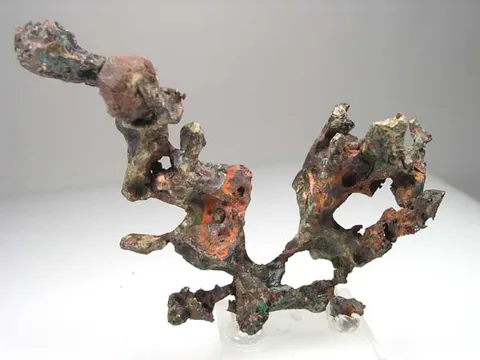
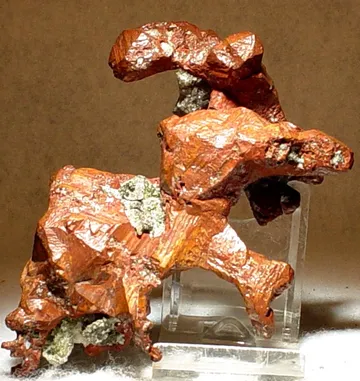
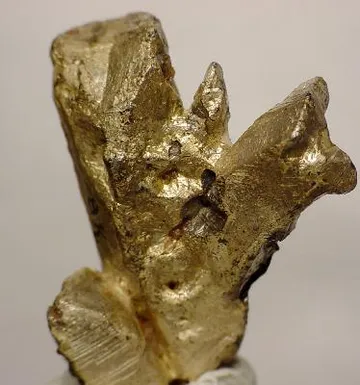
Native copper at Franklin is a classic specialist mineral rather than the headline ore species, and its best pieces are highly prized because they bring the familiar red metallic copper into Franklin’s far stranger zinc-manganese-calcium world. Documented Franklin copper occurs as hackly masses, wires, sheets, films, finely dispersed platelets, crack-fillings, and rare distorted crystals up to about 1 cm; larger hand specimens with megascopic copper can reach impressive size, with masses reported up to about 30 cm and more than half a kilogram. Much of the displayable copper appears to be recrystallized, later than primary ore formation, and many specimens are thought to have come from the northern part of the mine near the Parker and Palmer shafts, with some material noted from the 450 level. Associations are exceptionally varied—willemite, calcite, franklinite, zincite, barite, datolite, hancockite, hodgkinsonite, leucophoenicite, andradite, vesuvianite, bustamite, epidote, and others—and the finest pieces show fresh or attractively patinated native copper in a clearly Franklin matrix, especially copper with willemite and calcite fluorescence, copper-barite-willemite-hodgkinsonite assemblages, or copper in rare Parker Shaft-style associations; ordinary pieces are dull films or brown-black oxidized smears without texture, contrast, or documentation.
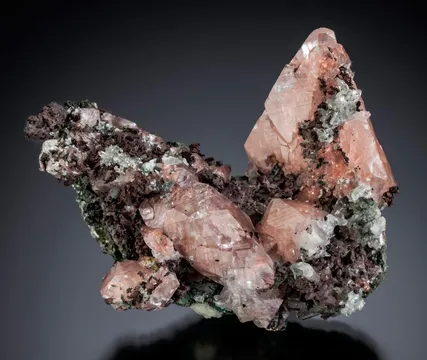
Calcite is the great visual amplifier of Franklin specimens: common, abundant, and often essential to the locality’s best fluorescence. In the ore it forms white, gray, pinkish, salmon, translucent, massive, cleavable, blocky, and drusy material with willemite, franklinite, zincite, and other species; in shortwave ultraviolet light, manganese-activated calcite from Franklin typically fluoresces orange-red to red and may show a brief intense phosphorescence, while some pieces shift hue under midwave or longwave UV. Collectors should distinguish ordinary white calcite matrix from Franklin calcite that carries strong color, crisp association, or locality-specific context: Buckwheat Dump ore with bright red-orange calcite and green willemite, Trotter Dump material with calcite-willemite-franklinite-zincite contrast, Lang Shaft material with calcite in multicomponent veins, and rare assemblages in which calcite accompanies copper, barylite, hedyphane, hardystonite, clinohedrite, or other Franklin specialties. The best calcite pieces are not necessarily isolated calcite crystals; they are balanced Franklin specimens that work in both daylight and ultraviolet light, with clean cleavage faces, strong fluorescence, stable matrix, and an old or specific label.
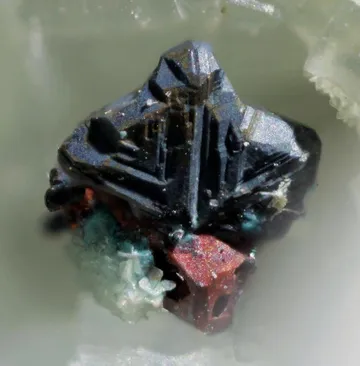
Franklin’s broader mineral list is one of the most celebrated in the world. Franklinite, willemite, zincite, and calcite define the ore, but the locality is also tied to a long roster of type-locality and near-unique minerals, including clinohedrite, esperite, hardystonite, hancockite, hendricksite, hodgkinsonite, holdenite, jarosewichite, jerrygibbsite, johnbaumite, kittatinnyite, larsenite, leucophoenicite, minehillite, nasonite, roeblingite, turneaureite, wawayandaite, yeatmanite, and others depending on how the Franklin Mine, Franklin district, and Sterling Hill associations are parsed. Hardystonite and esperite are especially important to fluorescent collectors: hardystonite is a Franklin classic with violet to violet-blue fluorescence, while esperite gives a bright lemon-yellow response under shortwave ultraviolet. Franklinite itself, black and submetallic to metallic in octahedral crystals or granular ore, is so culturally bound to the locality that New Jersey designated it the official state mineral in 2023.
Franklin specimens reward documentation. The difference between a common fluorescent ore fragment and an important Franklin specimen often lies in its old label, shaft or dump attribution, assemblage, and confirmation history. “Franklin, N.J.” is common on labels, but serious collectors should preserve and evaluate more specific provenances: Franklin Mine, Parker Shaft, Palmer Shaft, Buckwheat Dump, Trotter Dump, Lang Shaft, Franklin Quarry, mill-site material, or “Franklin-Sterling Hill” without further separation. Generic labels can mask real value, but they can also overstate it.
Misidentification is more common than outright fakery. Franklin’s fluorescence is powerful but treacherous: calcite, willemite, hardystonite, clinohedrite, esperite, sphalerite, fluorapatite, hydrozincite, cuspidine, and other species may overlap in color under different lamps, and wavelength matters. A longwave 365 nm lamp is useful, but many classic Franklin responses—especially calcite and willemite in ore—are best judged under shortwave UV. Fluorescence alone should not be used to name rare species; habit, assemblage, hardness, cleavage, specific gravity, reaction to acid where appropriate, and analytical confirmation all matter.
Collectors should be especially skeptical of rare Franklin micromounts and obscure species offered with no analytical history. The district’s own mineral-list committees have long recognized that sight identifications, incomplete data, and financially motivated species claims have caused problems in older and modern collections. For rare species, an old respected collection label helps, but it is not proof. A good Franklin rare-mineral specimen should have a credible chain of custody, an assemblage that makes geological sense, and, for visually indistinguishable species, analytical support.
Native copper from Franklin has its own authenticity wrinkle: some unnatural-looking copper pieces are known to have resulted from copper plates passing through mill crushers. That does not necessarily make the copper non-Franklin, but it does affect specimen interpretation. Collectors should favor copper that is clearly integrated with Franklin matrix and mineral association rather than loose, flattened, oddly shaped pieces with no context.
Condition issues vary by species. Massive ore is tough, but calcite cleaves and bruises easily, willemite crystals and granular masses can chip, and some vein assemblages are fragile. Fluorescent cabinet pieces should be protected from oil, dust, and repeated handling because white calcite and pale willemite surfaces show grime readily under UV. Keep specimens dry, avoid aggressive cleaning, and do not acid-clean mixed Franklin pieces casually: calcite is often an essential visual and fluorescent component, and acid can ruin both the specimen and the assemblage information.
Market availability is broad but stratified. Common Franklin ore with calcite-willemite-franklinite-zincite remains obtainable, especially from museum collecting, old collections, and regional shows. Good fluorescent plates, attractive franklinite crystals, zincite-rich ore, well-labeled Parker Shaft material, copper in strong Franklin matrix, and verified rare species are much scarcer. The strongest pieces combine three things: unmistakable Franklin mineralogy, visual quality under both white light and UV, and a label that places the specimen within the mine’s complex locality map.
The Franklin story begins, fittingly, with a mineralogical mistake. In 1774, red zincite ore from the district was reportedly shipped to England under the impression that it was copper ore. The mistake is understandable in the hand: zincite can be deep red to reddish brown, heavy, and strange-looking, and Franklin’s ore did not behave like ordinary zinc ore. The irony is delicious for collectors. A district that would become famous precisely because its zinc did not occur in the expected sulfide form first entered commerce through confusion with copper.
The Parker Shaft reads like a nineteenth-century engineering episode with a mineral collection hidden inside it. Construction began in 1891 after drilling by Joseph A. Van Mater of the Lehigh Zinc and Iron Company proved the deeper continuation of ore. The three-compartment shaft eventually reached 975 feet, but work was delayed when water rushed in at 560 feet. The shaft had only one landing, at the 950-foot level; miners then drove through a 315-foot crosscut to reach the orebody. Its operating life was short, ending as regular Palmer Shaft operation began in 1910, yet it produced a suite of rare minerals so distinctive that Franklin collectors still use “Parker Shaft minerals” as a term of art. For a label, those two words can still make a specimen sit up in a drawer.
One of Franklin’s memorable chapters is the afterlife of cahnite. Early material appears to have come from the Parker Shaft, but the mineral remained obscure until 1926, when George Stanton of Franklin rediscovered it in the northern part of the mine. The specimens came from pillar 229 north, 36 feet above the 700-foot level, in veins with small open cavities. In that little underground setting, axinite formed the vein material, with rhodonite, barite, hedyphane, and willemite; the cahnite arrived later, and fibrous datolite was later still. Franklin paragenesis is often like that: not a simple list of names, but a sequence of small mineral events preserved in a crack.
The final day of the Franklin Mine belongs to local memory as much as to mining history. On Thursday, September 30, 1954, the New Jersey Zinc Company closed the mine after more than a century of operation. Contemporary recollections place 800 people on the mine payroll; 140 lost their jobs that day, and others followed in the months after. The town around the mine was still a Main Street town of groceries, meat markets, produce stores, lumber, and company houses. One remembered detail cuts through all the statistics: when the whistle blew at the end, Bob Allen of the Franklin Historical Society recalled that “it seemed like an hour.” Everybody knew what it meant.
Franklin’s collecting culture was saved by people who understood that the mine’s value did not end with ore. After closure, miners were still selling specimens from their basements, mineralogical papers kept appearing, and in 1959 collectors formed the Franklin-Ogdensburg Mineralogical Society. The Franklin Kiwanis Club then helped turn local pride into an institution, and the Franklin Mineral Museum opened five years later. That sequence—mine, miners’ basements, collectors’ society, museum, public dump—is why Franklin did not become merely a closed industrial site. It became a locality that still teaches collectors how to look.
Even the dump has had its dramatic modern moments. At the Buckwheat Dump, collectors continue to search through rock that began as waste from the mining operation, and the museum has hosted night digs where ultraviolet lamps turn the ground into a field of red and green sparks. The experience is wonderfully unglamorous: steep grade, rough footing, ordinary-looking rocks, and a great deal of looking. Then a lamp catches a fresh surface, calcite burns orange-red, willemite answers green, and the collector is suddenly holding a small, bright remnant of a world-class orebody.
_1_(32403279061).jpg)
