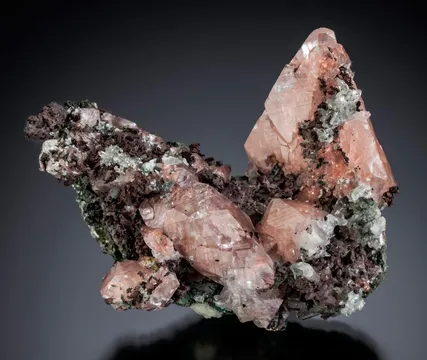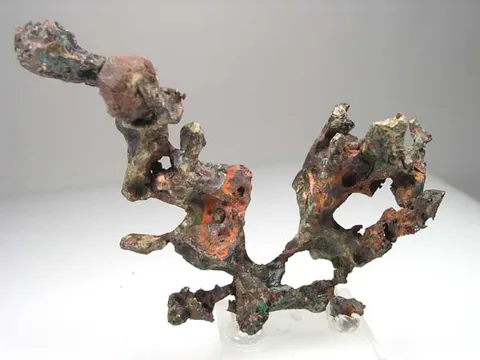
Kearsarge Mine, USA: a Lake Superior copper locality famed for native copper and notable native silver, prehnite-lined vugs, and striking crystalline silver fo…
Key facts
Kearsarge Mine, in the village of Kearsarge north of Calumet on Michigan’s Keweenaw Peninsula, is a classic Lake Superior native-copper locality and one of the important specimen names attached to the Kearsarge copper-bearing amygdaloid lode. The mine worked the copper-mineralized, amygdaloidal top of a basalt flow in the Portage Lake Volcanics, part of the billion-year-old Midcontinent Rift volcanic pile. For collectors, its identity is not simply “Michigan copper”; the Kearsarge name carries a specific look—native copper and native silver hosted in altered basalt, prehnite-lined vugs, calcite, quartz, epidote, datolite, cuprite, and small but highly desirable secondary copper minerals.
The locality matters most for silver. Among Keweenaw mines, the Kearsarge mines are repeatedly singled out as exceptional sources of native silver specimens, particularly crystallized silver and silver-copper combinations rather than mere metallic blebs in trap rock. The best pieces show bright to softly tarnished native silver in flattened, elongated, herringbone, featherlike, dodecahedral, or distorted octahedral forms, sometimes rising from or intergrown with copper. In cabinet pieces, the contrast can be superb: white to steel-gray silver against warm copper, green epidote or prehnite, and the dark reddish-brown amygdaloid basalt.
Regional View
Country View
Historically, the mine began as the Kearsarge Mining Company, organized in the 1880s, and later became divided into North Kearsarge and South Kearsarge under Osceola interests. The old mining literature captures the character of the lode well: it could look promising one week and nearly barren the next, with copper occurring in irregular shoots, patches, and streaks rather than in neat, predictable bands. That geological unevenness is also part of the specimen story. Kearsarge specimens reward sharp locality knowledge: a mediocre lump of “Michigan copper” may be common, but a well-crystallized silver feather from the Kearsarge Amygdaloid, or a balanced copper-silver halfbreed with honest old provenance, belongs in a serious Keweenaw suite.
Search for specimens: View all specimens from Kearsarge Mine, USA
The Kearsarge Mine is in Kearsarge, Calumet Township, Houghton County, Michigan, on the Keweenaw Peninsula’s native-copper belt. The mine system worked the Kearsarge Amygdaloid, the copper-bearing upper, vesicular to brecciated portion of the Kearsarge basalt flow within the Portage Lake Volcanics. In mining terminology this is a lode, but mineralogically it is best understood as a stratiform native-copper amygdaloid: porous lava-top rock served as the channel and trap for mineralizing fluids, while native copper, native silver, calcite, quartz, epidote, prehnite, and related secondary minerals occupied vesicles, fractures, breccia openings, and replacement textures in the basalt.
Classic descriptions of the Kearsarge lode emphasize a brownish amygdaloid full of calcite, quartz, red feldspar, and green epidote amygdules in a softer dense groundmass, with harder greenish zones richer in epidote and quartz. Native copper occurs both in amygdules and as irregular replacement bodies in the rock. The lode was often described as comparatively uniform in mineable width—on the order of 10 to 14 feet in parts of the workings—yet its copper was highly irregular, concentrated in patches, streaks, and shoots separated by lean or barren ground. That irregularity explains why specimen material ranges from massive stamp-rock copper through sharp crystallized pieces to silver-rich vugs and “halfbreed” specimens in which copper and silver occur together as separate native metals.
The broader Kearsarge lava flow is traceable for many miles along strike. Modern summaries of the copper-banded agates of the lode describe a flow roughly 1.1 billion years old, within a Portage Lake Volcanics sequence deposited during Midcontinent Rift volcanism. The commercially mined part was the porous brecciated flow top; beneath it lies a semi-permeable zone that has yielded rare copper-banded agates, in which native copper partly or almost completely replaces earlier chalcedony bands. These agates are especially associated with mine dumps along the Kearsarge lode, with the Wolverine No. 2 and C&H 21 sites noted as productive collecting localities for that material; they are part of the same lode story, though not all such agates should be assigned specifically to the Kearsarge Mine without documentation.
Mining history at Kearsarge is complicated because the name has been used for the original Kearsarge Mining Company property and for later North and South Kearsarge divisions. The Kearsarge Mining Company was organized in 1886 and worked the Kearsarge Lode on ground flanking the Wolverine Mine. Between 1887 and 1897 it produced about 14.5 million pounds of refined copper. In 1897 the property was acquired by the Osceola Consolidated Mining Company and divided into North Kearsarge, with four shafts, and South Kearsarge, with two shafts. South Kearsarge was developed between Centennial and Wolverine; its two shafts were about 1,100 feet apart, and the best ore is recorded from stopes near the Centennial boundary in Shaft No. 2. South Kearsarge closed in 1930 and was not reopened. North Kearsarge closed in 1931, reopened in 1942 for wartime copper production, and finally closed in 1956.
The old shaft and dump localities are not a casual open-pit rock shop. The mine is abandoned, the workings are underground, and access varies by shaft, dump, landowner, and current surface use. Some Kearsarge piles have been removed or reduced for road material; others remain, but collectors should treat every site as permission-only unless they have verified current ownership and access. The No. 4 shaft area at North Kearsarge has been noted as a place where collectors may still search despite removal of the pile, while South Kearsarge material is still described from prehnite vugs containing silver and copper. Serious collecting here is therefore less about stumbling onto untouched ground and more about careful dump work, old labels, estate material, and correctly distinguishing Kearsarge from neighboring Wolverine, Centennial, Allouez, Ahmeek, and Mohawk specimens along the same lode system.
Silver from Kearsarge is the locality’s calling card for collectors: not wire silver in the Kongsberg sense, but distorted, elongated, herringbone, featherlike, spike-form, octahedral, and dodecahedral native silver crystals and aggregates, commonly bright when fresh and mellowing to pale gray or steel-gray with age. Documented Kearsarge pieces include small but superb crystallized feathers in the 3 cm range, a South Kearsarge curved elongated crystal occupying a 3.5 x 5 cm field in the A. E. Seaman Mineral Museum collection, and silver crystals on copper from South Kearsarge in another 3.5 x 5 cm museum specimen. The best Kearsarge silver has form, not just metal content: sharp ribs, sculptural herringbone growth, clean separation from matrix or an attractive copper/prehnite/quartz association, and old mine attribution elevate a piece above ordinary silver-bearing trap rock or sawn halfbreed.
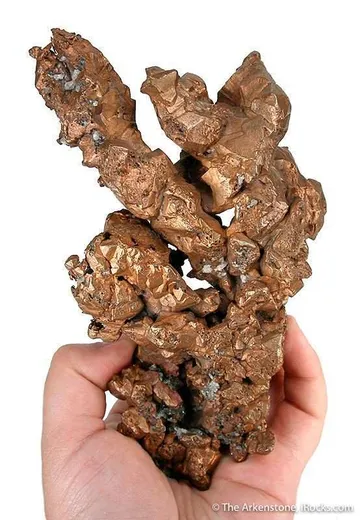
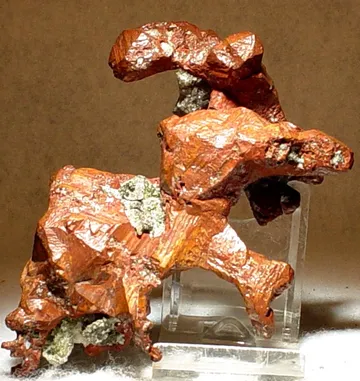
Copper from Kearsarge occurs as native metal in amygdules, fractures, replacement patches, masses, and crystals within the Kearsarge amygdaloid basalt. Much production was stamp rock rather than collector-grade crystallized copper, but good specimens show hackly masses, copper-filled amygdules, copper with prehnite and calcite, and occasional sharp crystals; a documented North Kearsarge No. 3 Shaft specimen, for example, consists of bright dodecahedral copper crystals on a 3.0 x 2.2 x 2.1 cm miniature. Copper-silver “halfbreed” pieces are a major collector category from this mine, but the strongest Kearsarge examples are not simply polished metallic slices: they show natural texture, contrasting native silver and copper, credible old locality data, and preferably a matrix relationship to prehnite, calcite, quartz, epidote, or altered amygdaloid that ties them to the Kearsarge lode rather than to the broader Keweenaw trade.
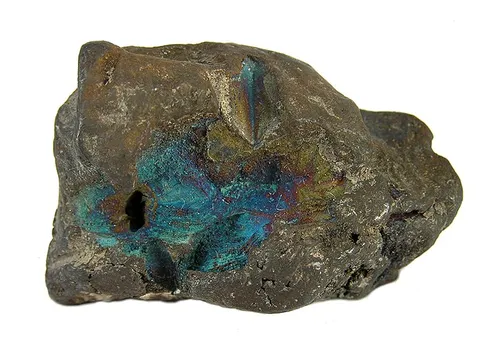
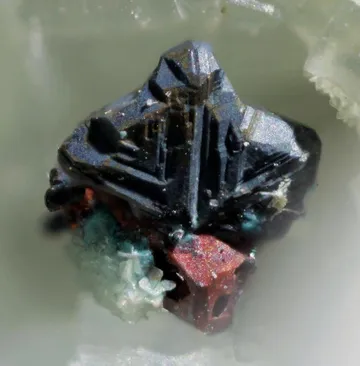
Other documented Kearsarge minerals include calcite, quartz, epidote, datolite, prehnite, cuprite including chalcotrichite from South Kearsarge, saponite, chrysocolla, malachite, azurite, analcime, microcline or K-feldspar, brucite, and kinoite. Kinoite is especially noteworthy because it is a scarce blue calcium-copper silicate recorded from Kearsarge and specifically from the No. 4 shaft area of North Kearsarge. The Kearsarge name also has an intriguing nomenclatural footnote: “kearsargeite” was once proposed for a green pumpellyite-like mineral noticed in Keweenaw copper lodes, but it is not an accepted modern species and is treated as pumpellyite-group material rather than a valid type-locality mineral.
Kearsarge specimens need careful locality discipline. The mine sits in a dense corridor of famous Keweenaw workings—Wolverine between North and South Kearsarge, Centennial nearby, and Allouez, Ahmeek, and Mohawk along the same general lode trend—so old labels reading only “Kearsarge Lode,” “Kearsarge,” or “Calumet” should be interpreted cautiously. “Kearsarge Mine” may mean the original property, North Kearsarge, South Kearsarge, or occasionally a broader lode attribution. For high-value native silver, a label that specifies North Kearsarge, South Kearsarge, shaft number, collection history, or an old dealer/museum provenance is materially more useful than a generic Copper Country label.
The main treatment issue is cleaning. Native copper and silver from the Keweenaw are commonly acid-cleaned, mechanically trimmed, polished, or brightened with commercial copper/silver cleaner. Cleaning is not automatically disqualifying—many historic copper-country specimens were cleaned at some point—but it changes surface character. Look for unnatural uniform brightness, residue in protected cavities, etched prehnite or calcite, and softened crystal edges. Halfbreed material is frequently sawn and polished for lapidary display; such pieces can be attractive, but they occupy a different collecting category from natural crystallized silver on copper or matrix.
Condition issues are typical for native metals but worth checking closely. Copper is malleable and can be bent, bruised, scraped, or artificially shaped; silver feathers and herringbone forms are more delicate than their metallic appearance suggests and may be flattened, repaired, or detached from matrix. Prehnite and calcite vug specimens can be damaged by aggressive acid preparation. Green coatings should not be assumed to be original malachite or chrysocolla without context, and blue-green micro-minerals such as kinoite require magnification and, for serious claims, analytical support.
Market availability is better than for many closed classic silver localities because Kearsarge material has circulated for generations through Copper Country collections, old dealer stock, and mine-dump finds. However, the best pieces are genuinely scarce: crystallized silver with unmistakable form, natural copper association, and reliable Kearsarge provenance is far less common than massive copper, sawn halfbreed, or loosely attributed Keweenaw silver-copper material.
An old mining report gives one of the best metaphors ever attached to the Kearsarge lode. In 1895, after noting that the mine had already produced more than seven million pounds of refined copper by the beginning of that year, the writer admitted how erratic the lode could be: one day it looked fine; within a week the drifts might change to barren ground. Captain Parnal’s description was better than any assay table. The Kearsarge, he said, was “like a rope tied full of knots,” the knots being the copper-bearing portions. For a collector, that sentence explains the locality’s personality: Kearsarge was never a smooth, even sheet of mineral wealth, but a sequence of sudden enrichments, lean stretches, and small geological surprises.
The 1881 account of the area catches Kearsarge just before its real future opened. The company held a 460-acre rectangle of land crossed by prominent lodes and adjoining the newly exciting Wolverine Mine. Wolverine itself had shafts only about 40 feet deep and was already shipping copper to the smelter—enough, the report said, to more than repay the early expenditure for a hoisting engine and compressor. The Kearsarge management watched closely. If Wolverine kept opening favorably, Kearsarge would sink test pits and attack the same Kearsarge amygdaloid. The scene has the feel of a mining district holding its breath: shallow shafts, new houses, a small stream proposed for stamp-mill water, and investors trying to decide whether the copper-rich ground next door would continue under their own land.
The silver story is more colorful and less official. In the Copper Country, silver specimens were the classic high-grade temptation. Mine managers reportedly told new miners to set aside the “white copper,” and the white metal did not always reach the company office. Stories survive of miners paying for drinks with silver specimens and of others melting the silver down for jewelers. One often-repeated remark credited to a Wolverine mine superintendent was that the automobiles in Gay should have belonged to Calumet and Hecla because they had been paid for with high-graded silver. Whether attached to Kearsarge, Wolverine, or the neighboring mines of the same lode, the anecdote reflects the culture around precisely the kind of silver specimens that collectors now prize.