A collector's guide to Peru: its geology, mining history and notable minerals, illustrated with the 183 specimens documented from this locality on EarthWonders.
Key facts
Peru matters to mineral collectors because it is not a single-locality story. It is an Andean mineral province on a country scale, where Cretaceous carbonate sequences, Tertiary volcanic rocks, porphyry intrusions, skarn fronts, epithermal veins, replacement bodies, and arid supergene copper zones have all produced collectible minerals. The best-known specimens are not merely ore fragments; they are fully crystallized show pieces: Huanzala pyrite with mirror-bright cubes and octahedra, pink and green fluorite from the same polymetallic system, quartz with sulfides from Huanzala and Mundo Nuevo, hübnerite with quartz from Pasto Bueno, rhodochrosite and sulfosalt rarities from Uchucchacua, glassy honey to blue barite from Cerro Warihuyn, and copper minerals from Lily, Tentadora, Cunyari, and other Ica-Huancavelica localities.
Peru’s collector identity is inseparable from mining. Many of the specimens now regarded as classics came from active base-metal and precious-metal operations rather than from small hobby diggings. Huanzala, operated in the high Andes by Compañía Minera Santa Luisa, became a specimen powerhouse after modern development in the 1960s; Uchucchacua, a Buenaventura silver-lead-zinc mine in Lima Region, became a mineralogical type-locality district as well as a source of famous pink rhodochrosite. In the drier coastal and western Andean belts, oxidized copper systems produced the brilliant green, blue, and turquoise palette that collectors associate with atacamite, chrysocolla, malachite, and included gypsum.
Regional View
Country View
At its best, Peruvian material has a dramatic contrast that photographs well and displays even better: brass-yellow pyrite against black sphalerite, glassy quartz spikes rising from sulfide-rich matrix, pale calcite or barite cutting across metallic ore, and intensely colored copper minerals sitting on pale drusy quartz. Serious collectors quickly learn to think beyond “Peru” on a label. A useful Peruvian specimen label should resolve, whenever possible, to a mine or prospect, district, province, region, and find period, because the country’s great localities have very different geology, habits, associations, and market histories.

Photo: Ivar Leidus / Wikimedia Commons
Search for specimens: View all specimens from Peru
Peru’s specimen-producing deposits fall into several broad geological families. In the central and northern Andes, polymetallic replacement and skarn systems in carbonate-rich sequences have yielded the classic sulfide-and-gangue assemblages: pyrite, sphalerite, galena, chalcopyrite, quartz, calcite, fluorite, barite, rhodochrosite, and sulfosalts. Huanzala is the collector’s archetype of this style, with ore bodies in limestone and shale affected by quartz-porphyry and related intrusive activity. Uchucchacua represents a complex Ag-Mn-Pb-Zn system with veins, replacement bodies, and skarn-related mineralization in Cretaceous limestone, enriched in manganese minerals and silver-bearing sulfosalts. Pasto Bueno and Mundo Nuevo are famous in the specimen world for tungsten-sulfide-quartz assemblages, especially hübnerite on quartz, with tetrahedrite-group minerals and pyrite in some pieces.
The country’s western and coastal belts add a different collecting personality. At Lily Mine near Pisco, arid supergene copper chemistry produced atacamite, clinoatacamite, paratacamite, malachite, chrysocolla, gypsum, and quartz; the celebrated 1998 find of transparent gypsum with green atacamite inclusions is one of the most distinctive late-20th-century Peruvian specimen events. The Tentadora Mine in the Julcani area produced quartz crystals coated and colored by chrysocolla and malachite, while recent Cunyari material from Huancavelica has brought compact, intensely teal-blue chrysocolla into the market. Cerro Warihuyn in Huánuco is not a major metal mine in the way Huanzala is; for collectors it is a barite locality, discovered for the specimen trade in the mid-2000s and prized for transparent tabular crystals on dolomite-bearing matrix.
Mining history is essential to understanding availability. Huanzala was explored and developed by Mitsui interests in the 1960s and began operations in 1968 under Compañía Minera Santa Luisa; it remains one of the great names in mineral collecting because industrial production repeatedly exposed vugs, replacement zones, and sulfide-rich cavities from which workers and dealers recovered specimens. Uchucchacua, wholly owned by Buenaventura, is a high-Andean underground operation discovered by that company and worked through named mines including Socorro, Carmen, and Huantajalla. Pasto Bueno’s Huayllapon mine is the key collector locality of that tungsten district, while Mundo Nuevo material is commonly encountered in the specimen trade under both Pasto Bueno and Mundo Nuevo labeling conventions.
Collecting access today is generally not recreational. Active Peruvian mines are industrial operations with controlled access, safety rules, property rights, and community agreements. The specimen stream usually reaches collectors through miners, local middlemen, Lima dealers, international show dealers, and estate collections, not through casual field collecting by visiting hobbyists. Old labels are common and often valuable, but they also introduce problems: “Peru” may hide a specific mine, “Pasto Bueno” may actually mean nearby Mundo Nuevo, “Lily” and “Pisco” have been used loosely for several copper and opal localities, and older Huanzala material may be labeled under shifting departmental or provincial names.
Notable pockets and finds define the market. Huanzala’s 1970s and 1980s pyrite production supplied large numbers of bright cubic, octahedral, and modified crystals, often with sphalerite, galena, quartz, calcite, chalcopyrite, fluorite, and barite. Pink octahedral fluorite from Huanzala, especially the early 1980s material with green cores or associated sulfides, is far scarcer than ordinary pyrite and commands a different level of attention. Lily’s 1998 gypsum-atacamite find produced clear crystals with green inclusions and a persistent labeling legacy because early examples were marketed as brochantite-in-gypsum. Cerro Warihuyn’s 2005–2006 barite production introduced transparent tabular crystals, commonly pale, smoky, honey, or blue-toned, to the international market. Tentadora’s 2018-era chrysocolla-on-quartz pieces and Cunyari’s newer teal chrysocolla have continued the Peruvian tradition of vivid copper-mineral specimens suitable for display.
Quartz from Peru is most collectible when it is part of an unmistakable Andean association rather than a simple isolated crystal: at Huanzala it forms clear to milky prismatic crystals and sparkling druses with pyrite, sphalerite, galena, chalcopyrite, fluorite, and calcite; at Mundo Nuevo and Pasto Bueno it accompanies dark red to black hübnerite, tetrahedrite-group minerals, and pyrite; and at Lily and Tentadora it becomes the pale, glittering scaffold for blue chrysocolla, green atacamite, malachite, and gypsum. The best Peruvian quartz specimens have clean terminations, balanced sulfide or copper-mineral contrast, and a locality-specific look—Huanzala’s metallic drama, Mundo Nuevo’s tungsten-suite elegance, or Lily-Tentadora’s turquoise-and-green copper staining—while ordinary pieces are merely drusy quartz with vague “Peru” attribution.
Peruvian atacamite is best known from the Lily Mine in the Humay District near Pisco, where arid copper oxidation produced bright to deep emerald-green crystals, sprays, needles, and inclusions in transparent gypsum, commonly with chrysocolla, malachite, clinoatacamite, paratacamite, quartz, and calcite. Fine Lily pieces range from miniature clusters of sharp green crystals to cabinet plates where clear selenite or gypsum exposes suspended green tufts inside; the most desirable examples combine transparency, visible included crystals, intact gypsum terminations, and a fresh green color, while lesser examples are granular coatings or poorly attributed Pisco-area copper material.
Gypsum from Peru is represented in collections chiefly by the Lily Mine’s late-1990s transparent crystals, many of them selenite-like, on quartz-rich copper-oxide matrix and included or dusted with atacamite, chrysocolla, malachite, and related copper chlorides. The classic 1998 Lily find produced sharp, glassy crystals generally in the miniature to small-cabinet range, with individual crystals commonly a few centimeters long; the finest pieces show water-clear interiors, distinct green inclusions, and minimal bruising on edges, whereas cloudy, scratched, or mislabeled “brochantite-in-gypsum” examples need closer scrutiny.
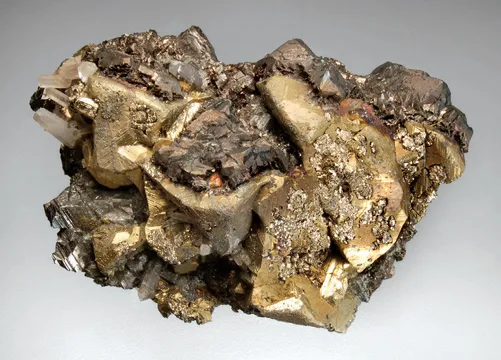
Pyrite is Peru’s most recognizable mineral-specimen export, and Huanzala is the name that serious collectors expect to see on the label: lustrous brass-yellow cubes, modified cubes, octahedra, pyritohedra, and complex intergrowths occur with sphalerite, galena, quartz, calcite, chalcopyrite, fluorite, barite, bournonite, and other sulfides. Classic Huanzala pieces from the 1970s and 1980s can be sculptural cabinet specimens with mirror faces and sharp geometry, while more recent material ranges from attractive miniatures to large decorator-grade masses; premium specimens are judged by luster, undamaged edges, distinctive habit, stable matrix, and lively association rather than size alone.
Peruvian chrysocolla appears in several collector styles: Lily Mine specimens show blue to turquoise chrysocolla with quartz, gypsum, atacamite, clinoatacamite, paratacamite, malachite, and calcite; Tentadora material is famous for quartz crystals coated or veiled in vivid blue-green chrysocolla with malachite; and Cunyari specimens from Huancavelica have entered the market as compact, intensely teal botryoidal or sparkling masses. The best chrysocolla pieces have saturated natural color, strong contrast against quartz or dark matrix, crisp botryoidal or drusy texture, and no oily polish or dye-like pooling, while ordinary material is massive, chalky, or better suited for lapidary use than fine-mineral display.
Chalcopyrite from Peru is most often collected as a bright accessory in polymetallic specimens rather than as the sole featured mineral, especially at Huanzala, where sharp golden crystals and brassy aggregates occur with pyrite, sphalerite, galena, quartz, calcite, fluorite, barite, and dolomite. Older dealer descriptions record Peruvian chalcopyrite as sharp twinned crystals to several centimeters on quartz, dolomite, galena, and pyrite matrices, and good pieces are those where chalcopyrite is distinct, lustrous, and compositionally believable within the sulfide assemblage; weak pieces are easily lost visually beside brighter pyrite or confused with tarnished pyrite when locality and habit are poorly documented.
Peruvian selenite is essentially the collector’s transparent gypsum from Lily Mine, where water-clear blades and tabular crystals carry green atacamite inclusions or sit on quartz and chrysocolla-rich copper-oxide matrix. The finest examples are small but visually memorable: doubly terminated or sharply bladed crystals a few centimeters long, clear enough to show suspended green needles or tufts, with quartz sparkle and blue chrysocolla adding context; lesser examples are edge-bruised, cloudy, or sold under vague “Pisco” labels without the Lily Mine association that gives them their mineralogical significance.
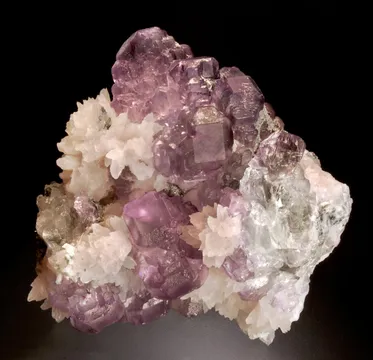
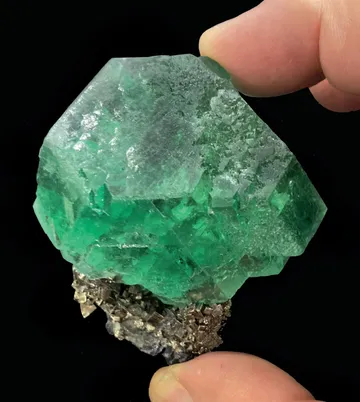
Fluorite from Peru reaches its highest collector status at Huanzala, where octahedrons, dodecahedrons, modified cubes, and complex crystals occur in pink, pale purple, green, colorless, and zoned combinations with pyrite, sphalerite, galena, calcite, quartz, chalcopyrite, dolomite, and barite. The legendary pink octahedral Huanzala fluorites of the early 1980s, especially those with green cores or strong sulfide association, are far rarer than the mine’s pyrite and stand among Peru’s most coveted fluorite specimens; quality is defined by color zoning, transparency, intact corners, and matrix balance, not by a generic “fluorite from Peru” label.
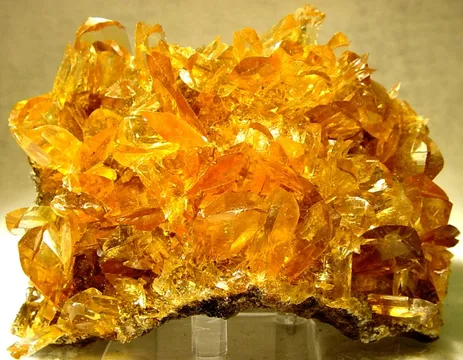
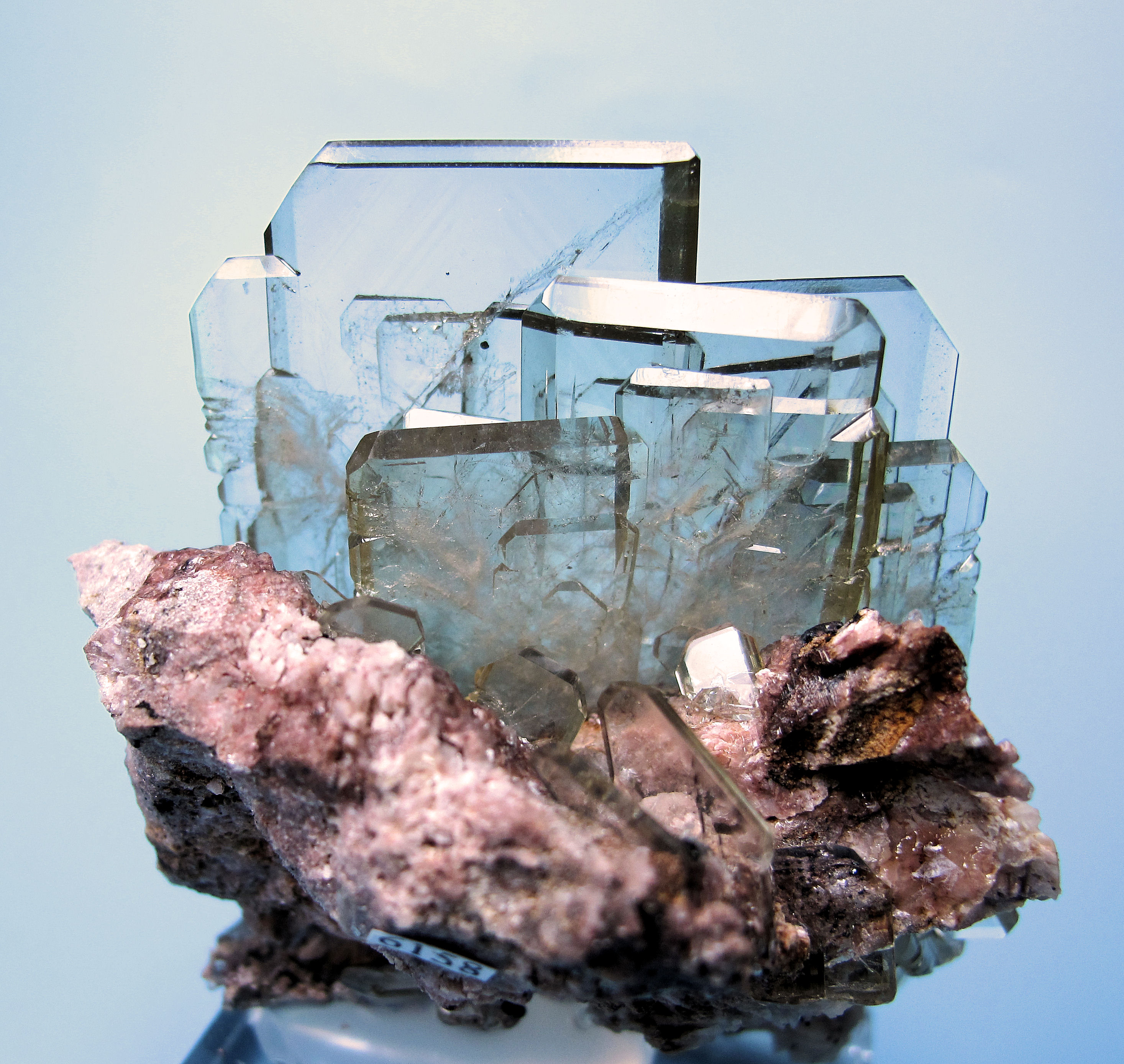
Barite from Peru is led by Cerro Warihuyn in Huánuco, where the specimen locality discovered in the mid-2000s produced transparent to translucent tabular crystals, commonly honey, golden-brown, smoky, blue-gray, or nearly colorless, on dolomite-rich matrix with occasional hematite, marcasite, or pyrite. The most desirable Cerro Warihuyn pieces show crisp glassy blades, visible color zoning, minimal cleavage bruising, and pleasing isolation of crystals; they occupy a different niche from Huanzala barite, which tends toward white spear-shaped tabular clusters associated with sulfides such as pyrite, galena, wurtzite, chalcopyrite, quartz, and fluorite.
Baryte, the mineralogical spelling of barite, is worth separating on Peruvian labels because two collector habits dominate: the glassy tabular Cerro Warihuyn style and the white, spear-shaped Huanzala style grown in a sulfide-rich polymetallic environment. Huanzala baryte is documented as intergrown clusters of tabular white crystals up to about 5 cm with pyrite, galena, wurtzite, chalcopyrite, quartz, fluorite, calcite, tennantite-group minerals, bournonite, and sphalerite, and good examples should show complete blades, clean contrast with metallic sulfides, and stable matrix rather than broken white plates mixed into ore rubble.
Malachite from Peru is strongest as a companion to chrysocolla, quartz, and atacamite-group minerals rather than as the velvet stalactitic material associated with some African localities. Lily Mine pieces may show malachite with quartz, chrysocolla, clinoatacamite, atacamite, paratacamite, gypsum, and calcite, including pseudomorphic relationships after earlier copper minerals, while Tentadora specimens show green malachite coatings or bands with blue chrysocolla over quartz; the best pieces have vivid natural green color, textural separation from chrysocolla, and intact quartz support, while poor examples are massive, polished, dyed-looking, or too vaguely labeled to separate Lily, Tentadora, Cunyari, and broader Huancavelica material.
Peruvian sphalerite is a major collector mineral at Huanzala and Huarón, where dark brown to black, resinous to brilliant crystals occur with pyrite, galena, quartz, calcite, fluorite, chalcopyrite, barite, and other sulfides. Huanzala specimens are prized when the sphalerite provides a dark, lustrous base for bright pyrite cubes or clear quartz points, while Huarón is known for well-formed black crystals, including sizeable spinel-law twins in association with quartz and fluorite; top pieces show sharp form, bright luster, and locality-specific associations, whereas dull massive sphalerite with scattered pyrite is common ore material rather than fine specimen grade.
Calcite from Peru plays an important supporting role in the country’s polymetallic specimens, especially at Huanzala, where white, colorless, tan, and manganese-bearing calcite occurs with pyrite, sphalerite, galena, fluorite, quartz, chalcopyrite, barite, and dolomite. Collectors value calcite here when it gives structure and contrast—scalenohedra, rhombs, or plates perched on pyrite, fluorite, or sphalerite—and some Peruvian calcites, including manganese-bearing material from central districts, show attractive fluorescence; ordinary pieces suffer from bruised cleavage, dull surfaces, or labels that confuse calcite with barite or gypsum in mixed sulfide specimens.
Axinite from Peru is a more recent and scarcer collector category than Huanzala pyrite, with notable material from Lima Region localities such as Sayán and Canta/Cullhuay, where brown to violet-brown axinite-group crystals occur with epidote, quartz, garnet, albite, chlorite, and calc-silicate matrix. Good Peruvian axinite specimens show lustrous wedge-shaped crystals, transparency at the edges, sharp terminations, and attractive contrast with pistachio-green epidote or frosty quartz; lesser pieces are dark, massive, or sold simply as “axinite Peru” without enough locality detail to distinguish Sayán, Canta-area, or other skarn-related occurrences.
Epidote from Peru is tied largely to skarn and calc-silicate assemblages, with collector specimens from Lima, Huancavelica, Ancash, and La Libertad showing pistachio-green to dark green sprays, prismatic crystals, and coatings with quartz, axinite-group minerals, garnet, calcite, and sulfides. The best pieces combine vivid green radial epidote with contrasting brown axinite or white quartz, especially in the Canta/Cullhuay and Sayán-style material, while darker massive epidote from industrial deposits is common but less collectible unless it has distinct crystals, good luster, and a reliable mine or district label.
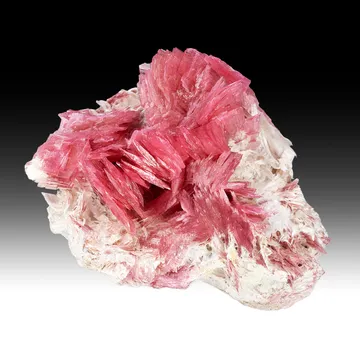
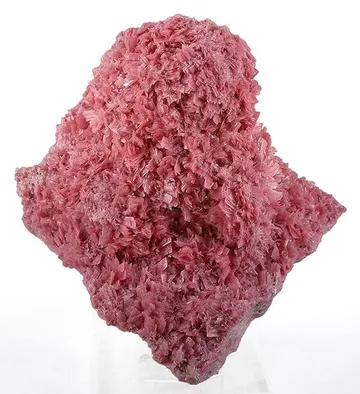
Peru’s broader mineral list is extraordinary. Uchucchacua alone is a type locality for a suite of silver-manganese-lead-antimony-arsenic sulfosalts including uchucchacuaite, benavidesite, manganoquadratite, menchettiite, oyonite, agmantinite, and more recently described species such as keutschite. Huanzala gave its name to huanzalaite, MgWO4, found as inclusions in scheelite in the mine’s skarn-related assemblage. Collectors also prize Peruvian hübnerite from Pasto Bueno and Mundo Nuevo, rhodochrosite from Uchucchacua and other central districts, bournonite from Quiruvilca, tetrahedrite-group minerals from Mundo Nuevo, native silver from Uchucchacua, orpiment and realgar from Quiruvilca, and a steady stream of rarities whose labels often matter more than visual size.
The most common problem with Peruvian specimens is not outright fabrication; it is imprecise or upgraded locality labeling. A loose “Peru” label on pyrite should not automatically be promoted to Huanzala, and a “Pasto Bueno” label on quartz-hübnerite material may require checking against Mundo Nuevo or Huayllapon conventions. Lily Mine material has a documented history of early gypsum-atacamite specimens being sold as brochantite-in-gypsum, so old labels should be preserved but mineral IDs should be corrected when the evidence is clear. Uchucchacua and Raura are geographically close enough that older silver, rhodochrosite, and sulfosalt labels deserve caution.
For copper minerals, treatments and misidentifications are a real concern. Chrysocolla, malachite, and chrysocolla-chalcedony are often sold into both the specimen and lapidary markets, where dyeing, stabilization, polishing, or resin impregnation may occur. Cunyari chrysocolla prompted collector discussion when it first appeared because its saturated teal color and unusual texture looked unfamiliar to some buyers; that does not make all Cunyari material fake, but it does make disclosure, dealer reputation, and close inspection important. Be wary of uniform blue-green color in fractures, glossy plastic-like surfaces, dye transfer, suspiciously light “chrysocolla” beads, and vague “Peruvian turquoise” claims.
Condition issues are species-specific. Huanzala pyrite is hard but edge-bruises readily, and mirror faces reveal tiny contacts; cabinet pyrites should be examined under strong side light. Fluorite from Huanzala has perfect cleavage and corner damage is common, especially on octahedra. Barite and gypsum are much more fragile: Cerro Warihuyn barite blades cleave and nick at the edges, while Lily gypsum/selenite scratches with a fingernail and should be kept dry, dust-free, and away from casual handling. Calcite cleaves easily and may be acid-sensitive; do not clean Peruvian calcite-rich sulfide specimens with acidic solutions. Sulfide-rich pieces containing pyrite, marcasite, arsenopyrite, galena, or enargite should be stored dry and dusted gently, not washed repeatedly.
Fluorescence can add value but should not override daylight quality. Some Huanzala and central Peruvian calcites and sphalerites show attractive response under ultraviolet light, and certain fluorites have notable UV behavior; however, fluorescence claims should be verified with wavelength information when they influence price. Sulfosalt rarities from Uchucchacua and Huanzala require analytical caution: many gray metallic microcrystals cannot be reliably named by eye, and “tetrahedrite,” “tennantite,” “pearceite,” or other group names may need refinement under modern nomenclature.
Market availability is uneven. Huanzala pyrite remains common at shows and online, from inexpensive miniatures to high-end sculptural classics, but truly pristine large crystals and well-balanced pyrite-fluorite-sphalerite-quartz combinations are not common. Lily gypsum with attractive atacamite inclusions is much less available than it once was. Cerro Warihuyn barite appears periodically but fine, transparent, undamaged clusters are selectively held by collectors. Uchucchacua rhodochrosite, silver, and type-locality sulfosalts range from available to extremely rare depending on habit and species. A good Peruvian collection is therefore built selectively: buy the locality and association, not just the species name.
Huanzala’s collecting story begins like an industrial-mining story and turns into a mineral-world legend. The mine was developed by Japanese-backed Compañía Minera Santa Luisa in the 1960s, with exploration, tunnel work, machinery installation, and plant construction preceding formal operation in 1968. What followed was not a boutique specimen venture but a working polymetallic mine that happened to open pockets and ore zones capable of producing startling quantities of display-grade pyrite. By the time Huanzala specimens had moved through Lima dealers and international shows for a generation, Rock Currier’s judgment—that Huanzala probably produced more mineral specimens by total tonnage than any other single mine—had become part of the lore repeated by dealers and collectors.
The visual signature was unmistakable. A Huanzala pyrite cabinet piece could look almost machined: bright brass cubes and modified forms stacked into reflective architecture, with black sphalerite, lead-gray galena, milky calcite, clear quartz, or fluorite making the contrast. One reason the locality became so deeply embedded in collecting culture is that it supplied several market levels at once. Beginners could buy a handsome Peruvian pyrite; advanced collectors could hunt for a particular habit, association, or early-production crystal style; and museums could display large, high-luster pieces that read clearly across a gallery case.
Lily Mine’s story is smaller, stranger, and more delicate. Near Pisco, a locality better known in the gem trade for blue Andean opal also produced a 1998 find of transparent gypsum crystals containing green copper minerals. The early market name was wrong: specimens were sold as brochantite inclusions in gypsum before the material became better understood as atacamite-bearing. That mislabeling is now part of the specimens’ history. Old labels reading “brochantite in gypsum” should not be thrown away; they document the first commercial interpretation of a find that later became a classic Peruvian atacamite-gypsum association.
Cerro Warihuyn arrived in the specimen world almost as a pure collector locality. Discovered for specimens in the spring of 2005 near Miraflores in Huánuco at roughly 2,850 meters elevation, it produced barite crystals that looked unlike Peru’s sulfide-mine staples. Instead of pyrite-and-galena drama, the appeal was glass: thin tabular blades, often transparent, sometimes pale blue, smoky, honey, or nearly colorless, set against dolomite-rich matrix. Good pieces from the 2005–2006 period can show a floating architectural quality, with razor edges and enough clarity to make internal zoning visible.
The modern chrysocolla story has unfolded in several chapters. Lily provided chrysocolla as part of its copper-oxide suite, commonly with quartz, gypsum, and atacamite-group minerals. Tentadora then gave collectors quartz points and smoky quartz forms coated by vivid chrysocolla and malachite, including small finds around 2018 that dealers noted for their bright color and unusual habit. Cunyari brought another surprise: compact, intensely teal chrysocolla that looked so unusual when it appeared in the market that collectors debated its origin and nature. For today’s buyer, that debate is useful; it encourages exactly the habits a serious collector should have—ask for locality history, examine texture and color, and separate a fine natural specimen from treated lapidary material.