Salinas de Otuma, Peru — evaporite locality yielding golden to orange gypsum on halite; renowned for glassy, twinned crystals set in desert-salt matrix.
Key facts
Salinas de Otuma is not a metallic mine trying to be a specimen locality; it is a working coastal salt deposit that happened, for a relatively short and memorable interval, to produce one of Peru’s most recognizable evaporite specimen styles. The classic pieces are golden to orange gypsum, commonly catalogued by collectors as selenite when the crystals are transparent, perched on white, grey, or colorless halite. At their best, the crystals are sharp, glassy, thin, and fishtail- or duckbill-twinned, with amber cores and nearly water-clear edges; the finest matrix examples preserve the fragile halite undergrowth rather than showing only loose gypsum twins.
Geologically the locality belongs to the dry forearc terrain of the Pisco–Paracas coast, where marine Cenozoic sedimentation, arid climate, shallow brines, and coastal depressions have all played roles in concentrating salts. The industrial deposit is the Salinas de Otuma / Las Salinas operation near Otuma village in Paracas District, Pisco Province, Ica. Mineralogically its collector fame rests on a very lean assemblage—halite and gypsum—but that simplicity is exactly the charm: a desert salt environment producing brilliant, gemmy, warm-colored sulfate crystals on soluble chloride matrix.
Regional View
Country View
For collectors, Salinas de Otuma matters because the locality produced an immediately legible combination: golden, lustrous, transparent gypsum twins over granular to cubic halite, often with a sculptural lightness that looks more like a constructed object than a mine product. Good examples are not just “yellow gypsum”; they show the locality’s precise balance of saturated color, transparency, clean twinning, and evaporite context. The halite is not a decorative afterthought—on the best specimens it proves the origin and gives the piece its desert-salt identity.
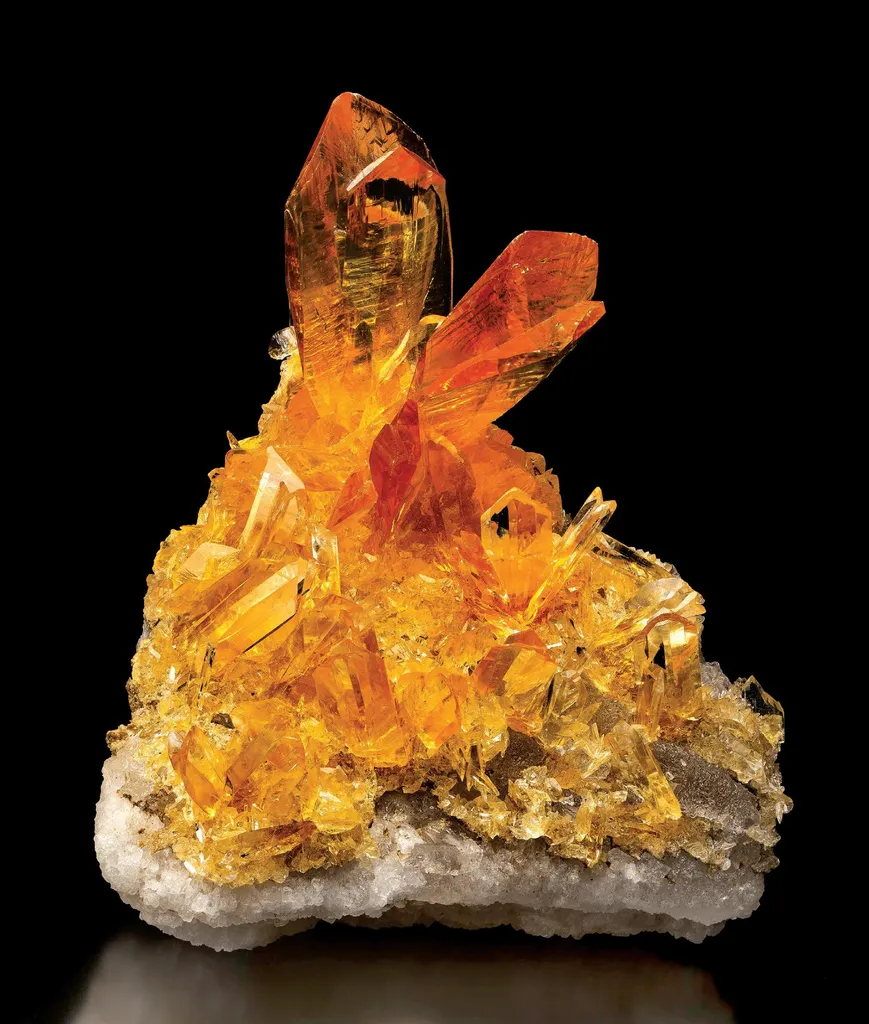
Photo: EarthWonders
Salinas de Otuma, also encountered on specimen labels as Las Salinas, Salinas de Paracas, Otuma, Otume, “Pisco mine,” or “Las Salinas mine near Pisco,” is a nonmetallic salt operation in the Paracas District of Pisco Province, Ica Region. The deposit lies in the arid coastal belt south of Paracas Bay and is reached from Pisco by the coastal road toward the Las Salinas–Otuma area. Modern locality databases place it at Otuma village, while older commercial labels often compress the locality to “Pisco, Ica, Peru,” which is understandable but not sufficiently precise for a serious specimen catalogue.
The deposit is an evaporite salt occurrence. INGEMMET’s resource inventory describes Salinas de Otuma as a salt deposit in the Pampa Las Salinas area, associated with fine-grained sedimentary rocks and extending for roughly 3 linear km. The same official Peruvian resource literature records the site as one of the important salt deposits in its surveyed belt, with the central point given by UTM coordinates in the Punta Grande 29-k quadrangle. In a broader geological sense, the locality sits in the East Pisco Basin, a Cenozoic forearc basin along the south-central Peruvian margin, where marine sandstones, siltstones, diatomaceous units, fossiliferous beds, and evaporitic horizons record repeated changes in shoreline position, restriction, and basin geometry.
The specimen-producing setting is more specific than the industrial saltfield. The yellow gypsum for which collectors know the locality has been reported from a drainage ditch cut into pyritic black shale, an important observation because it helps explain both the restricted nature of the find and the distinctive golden color of many crystals. Iron-bearing inclusions or oxidation products are the likely cause of the amber to orange tones, especially where crystals show golden cores fading to clear margins. Many specimens are composed of gypsum blades and twins set on halite, but loose gypsum twins also circulated, especially where halite matrix had already been lost or dissolved.
Industrial exploitation at Otuma predates the modern specimen trade by generations. A UNIDO report on the Peruvian salt industry described Otuma as a major saltfield in the 1960s, with solar-evaporation ponds harvested at intervals and with Química del Pacífico S.A. operating a concession there. The report noted that the operation’s dry, warm climate supported rapid salt production, but also that windblown sand could contaminate the salt crystals. Later company histories and public filings show the operation passing into the Quimpac system; Quimpac was formed in 1996 from Química del Pacífico S.A. and Servicios Químicos Óptimos S.A., and the company’s current business still lists Salinas de Otuma among its salt operations.
The modern operator is Quimpac S.A., which maintains salt and chemical operations at Oquendo, Huacho, Paramonga, and Otuma. Company and securities-market documents identify Quimpac as holding nonmetallic mining concessions at the Salinas de Huacho and Otuma saltfields, and recent company material lists Salinas de Otuma as part of its industrial-salt infrastructure. The Otuma salt is not a quaint hand-collecting prospect: it is part of an operating industrial supply chain for salt products, including industrial and deicing salt. Collecting access should therefore be regarded as controlled industrial access, not open desert fossicking. Permission from the operator and compliance with protected-area and local regulations are essential.
The celebrated specimen production appears to have entered the international mineral market mainly around the early 2000s. Specimens collected in 2002 are documented in public photo records, and the 2003 Hyršl and Rosales article on golden gypsum from Las Salinas gave the locality its specialist-mineralogical identity. By the 2007 Tucson Show, a small hoard of material was noted in the trade, including gypsum on halite matrix and loose gypsum twins. Since then the locality has become a classic rather than an abundant source: material still appears through old collections, dealer back stock, auctions, and occasional newer listings, but clean matrix pieces with undamaged twins and preserved halite are far less common than they once were.
Gypsum is the defining collector mineral of Salinas de Otuma, occurring as transparent to translucent golden-yellow, amber, orange, and sometimes nearly colorless crystals, most characteristically in sharp, thin blades and fishtail, duckbill, or swallowtail twins on halite or soft evaporitic matrix. Published and market-documented specimens range from small loose twins of a few centimeters to cabinet plates more than 10 cm across; individual crystals commonly run 2–5 cm, with exceptional display specimens showing larger twins or rich crusts of many smaller blades. The best pieces combine high transparency, glassy luster, complete twin form, saturated but natural-looking golden color, and minimal edge bruising, while ordinary pieces tend to be duller, more contacted, loose without context, or damaged along the fragile blade tips.
At Salinas de Otuma, selenite is best understood as the transparent, gemmy expression of gypsum rather than a separate species, and the locality’s finest “selenite” specimens are precisely the water-clear to golden, knife-thin gypsum twins that made Las Salinas famous. Many are richly amber in the center and nearly clear at the margins, giving the crystals a luminous stained-glass effect; others form rosettes or flower-like clusters of flat bladed crystals. Documented examples show bright white to cream fluorescence and phosphorescence under ultraviolet light, including both longwave and shortwave responses in some specimens, which adds a second collecting dimension to already attractive cabinet and miniature pieces. Top-quality Salinas de Otuma selenite is judged on clarity, intact edges, complete twinning, sculptural balance, and whether the specimen retains its original halite or evaporitic base.
Halite from Salinas de Otuma is both the economic mineral of the deposit and the most important association for collector specimens, typically appearing as white, grey, colorless, granular, rough cubic, or gemmy cubic matrix beneath golden gypsum. The halite may be massive, sugary, polycrystalline, or composed of small cubic faces, and on the best specimens it forms a pale, sparkling base that contrasts strongly with the orange gypsum twins above it. Because halite is water-soluble and can be partly removed by natural brines, handling, or cleaning, specimens that preserve attractive, undissolved halite matrix are especially desirable; they show the true evaporite paragenesis of the locality rather than reducing the piece to an isolated gypsum cluster.
The documented mineral list for Salinas de Otuma is unusually short: halite and gypsum, with selenite treated as the transparent variety of gypsum. That scarcity of species is part of the locality’s identity. No IMA-approved type-locality mineral or established suite of rare accessory species is tied to Salinas de Otuma in the standard mineralogical records; collectors should be wary of labels that imply a broader rare-mineral assemblage from this locality without analytical support.
The most common authenticity issue is not fakery but locality precision. Specimens may be labelled “Pisco,” “Otuma mine,” “Otume,” “Las Salinas,” “Salinas de Paracas,” or “Pisco Mine.” These names generally refer to the same Salinas de Otuma / Las Salinas salt locality, but a high-quality catalogue label should resolve them to Salinas de Otuma, Otuma village, Paracas District, Pisco Province, Ica, Peru. Older labels are worth preserving because they can document the specimen’s path through the early-2000s market.
I found no well-documented class of artificial Salinas de Otuma fakes comparable to the famous dyed, assembled, or lab-grown problems known from some other mineral localities. Still, buyers should examine three things carefully. First, make sure the color is internal and natural-looking, not a surface stain concentrated in cracks or along glue lines. Second, check whether gypsum crystals have been reattached to halite or to another gypsum crust; repairs are plausible because the crystals are thin and the matrix can be friable. Third, inspect halite matrix for water damage, sugary collapse, or unnatural coatings that may have been applied to stabilize a weakening base.
Condition is the central quality issue. Gypsum is soft, has perfect cleavage, and the Otuma blades can be extremely thin at the edges. Tiny nicks, cleaved terminations, contacted backs, and broken peripheral blades are common. A specimen can still be excellent with minor peripheral damage if the main twin is complete, bright, and well positioned, but chipped fishtail tips or abraded front edges reduce value quickly. Halite adds another layer of vulnerability: keep it dry, never wash it, and avoid display locations with high humidity, condensation, or salt-air cycling. A sealed acrylic box with desiccant is sensible for finer matrix pieces.
Fluorescence is a real bonus at this locality. Documented Salinas de Otuma selenite can fluoresce white to cream under longwave ultraviolet light and may show afterglow; some specimens also respond under shortwave ultraviolet. Not every piece should be expected to glow equally, so fluorescence should be treated as a specimen-specific attribute rather than a blanket locality guarantee. When present, it is particularly appealing in rosettes and translucent twin clusters where the whole structure lights evenly.
Market availability is sporadic. The early abundance has passed, and many good pieces now trade as older collection material. Small loose twins and modest miniatures still appear at approachable prices, but sharp cabinet plates with golden, transparent twins on preserved halite matrix are much less common. Public auction and dealer records from 2020–2026 show the spread clearly: small to cabinet specimens have sold from low hundreds of dollars, while large, clean, visually dramatic examples with strong size and preservation have reached into the low thousands. The highest collector premium goes to pieces that combine saturated orange color, gem transparency, textbook twinning, a stable halite base, and a provenance traceable to the early Las Salinas finds.
Long before mineral collectors learned to say “golden Otuma selenite,” the Salinas de Otuma salt deposit had already been pulled into a very Peruvian story of desert resources, church obligations, state revenue, and local power. In a 19th-century Ica departmental record, the deposit appears not as a specimen locality but as a contested fiscal asset. The account reaches back to September 5, 1752, when Captain Don Pedro de Vila was said to have discovered a salt mine at Otuma and donated it to the Cofradía del Señor de la Humildad y Paciencia of the parish of San Clemente de Pisco. The salt’s proceeds were intended for masses and the annual procession of the devotional image.
By the late 1800s, that pious origin story had become a legal problem. The Beneficencia of Pisco argued from its role administering cofradía property, but the departmental report rejected the idea that the cofradía had ever existed as a legally organized body capable of owning the saltworks. The report’s logic was blunt: the donation was a religious bequest, not a transfer of ownership, because the salt belonged to the State. The record cites supreme decrees of November 15, 1880 and March 22, 1884 declaring saltworks state property, and later decrees of May 29 and November 8, 1889 placing the Otuma salinas under departmental possession.
The numbers are as telling as the doctrine. A budget law of November 21, 1889 treated the Salinas de Otuma lease as departmental revenue, at one point carrying an expected figure of 19,000 soles. The same discussion later reduced expectations, referring to 6,000 soles as a more prudent effective annual income under a settlement with a former auction-holder, Eduardo Parodi. Even then the religious obligation was not simply erased: the record provided a subsidy connected with the old devotional purpose. It is a striking reminder that Otuma’s salt was valuable long before its gypsum twins entered mineral cabinets; the deposit was a civic income stream, a legal battleground, and a devotional endowment all at once.
The collector story has its own smaller drama. The modern specimen reputation seems to have crystallized around a limited run of material noticed internationally in the early 2000s. Hyršl and Rosales published the golden gypsum from Las Salinas near Pisco in 2003, and by the 2007 Tucson Show dealers were still turning up small pockets of pieces: loose twins, halite-matrix specimens, and brilliant orange transparent crystals. The Mineralogical Record’s 2008 show commentary captured the uncertainty of the trade labels—“Otuma mine, Pisco” versus the more precise Las Salinas halite mine near Otume village—and also the excitement of seeing sharp, lustrous, bright orange gypsum twins to about 4 cm sitting on white halite. That moment is part of why the locality still feels like a find rather than a commodity: the great specimens appeared, were noticed, and then seemed to vanish into collections.