Axinite: wedge-shaped, razor-edged crystals with glassy luster and strong pleochroism; varieties axinite-(Fe/Mn/Mg) and tinzenite from alpine clefts and skarns
Key facts
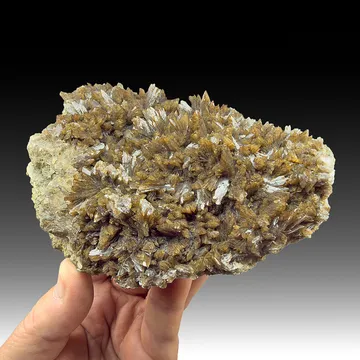
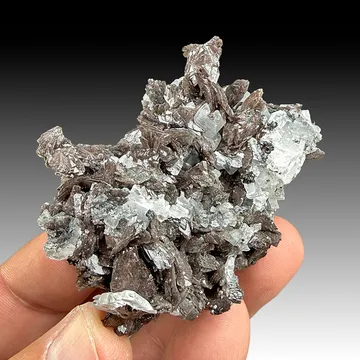
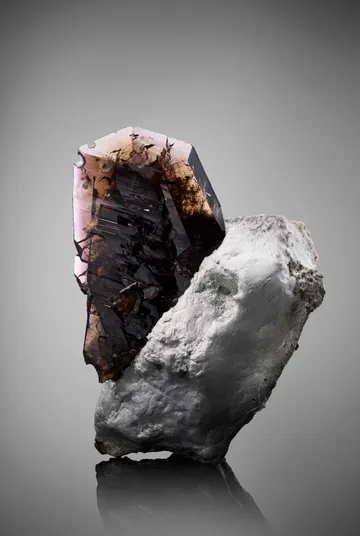
Axinite is a small but beloved group of calcium aluminum borosilicate minerals best known to collectors for thin, wedge-shaped crystals with razor-sharp edges, high glassy luster, and rich pleochroic colors. The group includes axinite-(Fe), axinite-(Mn), and axinite-(Mg), plus the related species tinzenite. Colors range from clove-brown and chocolate to smoky-lilac, violet-brown, and cognac—often shifting in hue with the angle of view. Crystals are typically flattened and blade-like with distinctive acute terminations and striated faces; many form fans or rosettes on contrasting matrix. Aesthetic combinations with smoky quartz, calcite, epidote, and hedenbergite abound at classic localities.
Although not common, axinite has a well-established place in alpine-type cleft mineralogy and skarn assemblages. Fine specimens are elegant, refined, and highly “crystalline” in appearance—thin tablets that sparkle—making them excellent cabinet or thumbnail showpieces. Prices vary widely with sharpness, color, thickness (many are thin), size, matrix quality, and provenance. Exceptional, well-colored, damage-free crystals on attractive matrix from famous localities are competitive with classic alpine minerals in the same size class.
Axinite sits in a sweet spot for collectors who enjoy alpine cleft and skarn aesthetics. Historic European finds in the Mont Blanc and Oisans massifs cemented its classic status, while Japanese and Russian discoveries produced modern, competition-level pieces. Because crystals are usually thin and fragile, undamaged matrix specimens are uncommon and command strong interest. Axinite’s pleochroism and luster are visually striking in a case, and its pairings—on snow-white calcite from Japan, with smoky quartz in the Alps, or with epidote/hedenbergite in Russia—offer superb contrast. Although the species is never “common,” its presence across multiple regions means collectors can build a representative suite spanning colors, habits, and parageneses.
While axinite occurs worldwide, a handful of districts define the species with distinctive styles and world-class examples.
The Obira Mine (Oita Prefecture) is a modern benchmark for axinite-(Fe). Crystals are razor-thin, often perfectly transparent to translucent with a glossy, mirror-like luster and refined wedge terminations. Colors run from smoky-lilac to rich clove-brown, frequently showing strong pleochroism. Many perch on pale calcite or light-colored skarn matrix, amplifying contrast and display appeal. The best pieces offer fine composition: fans or isolated blades on clean matrix, with undamaged edges and crisp, striated faces. Because calcite is common, careful, chemical-free preparation is prized—acid-etched matrices exist but usually reduce overall elegance.
Puiva in the Polar Urals is famous for robust skarn-associated axinite-(Fe). Crystals are usually larger and thicker than many alpine examples, with saturated brown to violet-brown color and high luster. Classic pairings include axinite with epidote, hedenbergite, and smoky quartz, often in dynamic, three-dimensional arrangements. Fans, rosettes, and isolated “spearheads” occur, some exceeding several centimeters. Sharp terminations and rich color are the hallmarks; matrix specimens with well-positioned, intact main crystals are the most coveted.
The Dalnegorsk deposits (Primorsky Krai) have produced superb axinite in varied associations. Expect sharp, lustrous blades in cognac to chestnut hues, sometimes with violet overtones, on skarn matrices featuring quartz, calcite, and hedenbergite. Crystals can be exceptionally clean and reflective, making them “pop” under case lights. Collectors value Dalnegorsk for availability of fine, displayable cabinet pieces—clusters with good separation, minimal damage, and strong composition are standouts.
With thoughtful selection and care, axinite offers a lifetime of collecting enjoyment—elegant crystals, classic localities, and captivating color that rewards close viewing.