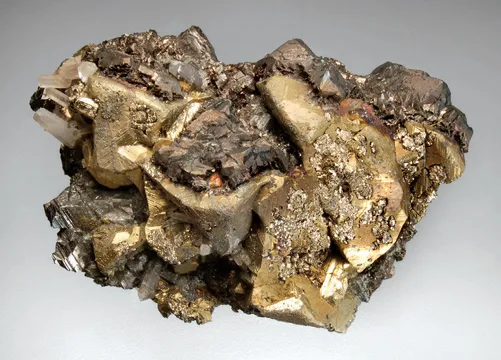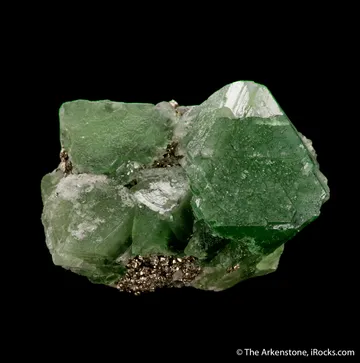
Atacocha Mine, Peru — Andean locality famed for display-quality green fluorite on pyrite, with galena and sphalerite, and Cerro de Pasco sulfide associations.
Key facts
Atacocha is one of the great Central Peruvian polymetallic localities: a high-Andean lead-zinc-silver-gold mine north of Cerro de Pasco, set in a steep belt of folded and faulted carbonate and clastic rocks cut by Tertiary dacitic intrusions. For collectors, its importance comes from the way an ore mine better known to geologists for galena, sphalerite, pyrite, rhodochrosite, realgar, orpiment, and sulfosalts has periodically yielded display-quality specimen pockets—especially modern green fluorite on glittering pyrite, and older sulfide-carbonate associations that belong unmistakably to the Cerro de Pasco tradition.
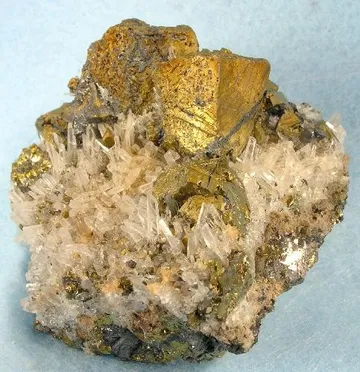
The classic Atacocha look is metallic and vivid: bright brassy pyrite in sharp pyritohedrons or sparkling druses; gemmy to translucent fluorite in saturated green, blue-green, and zoned blue-green crystals; dark sphalerite and galena providing a heavy sulfide base; and, in the broader district, sulfosalt-rich pieces whose labels may require analytical caution. The best pieces are not simply “Peruvian fluorite” in a general sense. They are high-contrast specimens from an active ore environment, with acid-green or emerald fluorite perched on pyrite so bright that the color relationship carries the piece.
Regional View
Country View
Atacocha is also a locality where careful labeling matters. The Atacocha mining district includes both the Atacocha and Milpo mines, and recent green fluorite-sulfide finds have circulated from both names. The collector’s task is to separate “Atacocha Mine” from “Atacocha district,” and to treat unlabeled or broadly labeled Cerro de Pasco material with appropriate skepticism unless the association and provenance are strong.
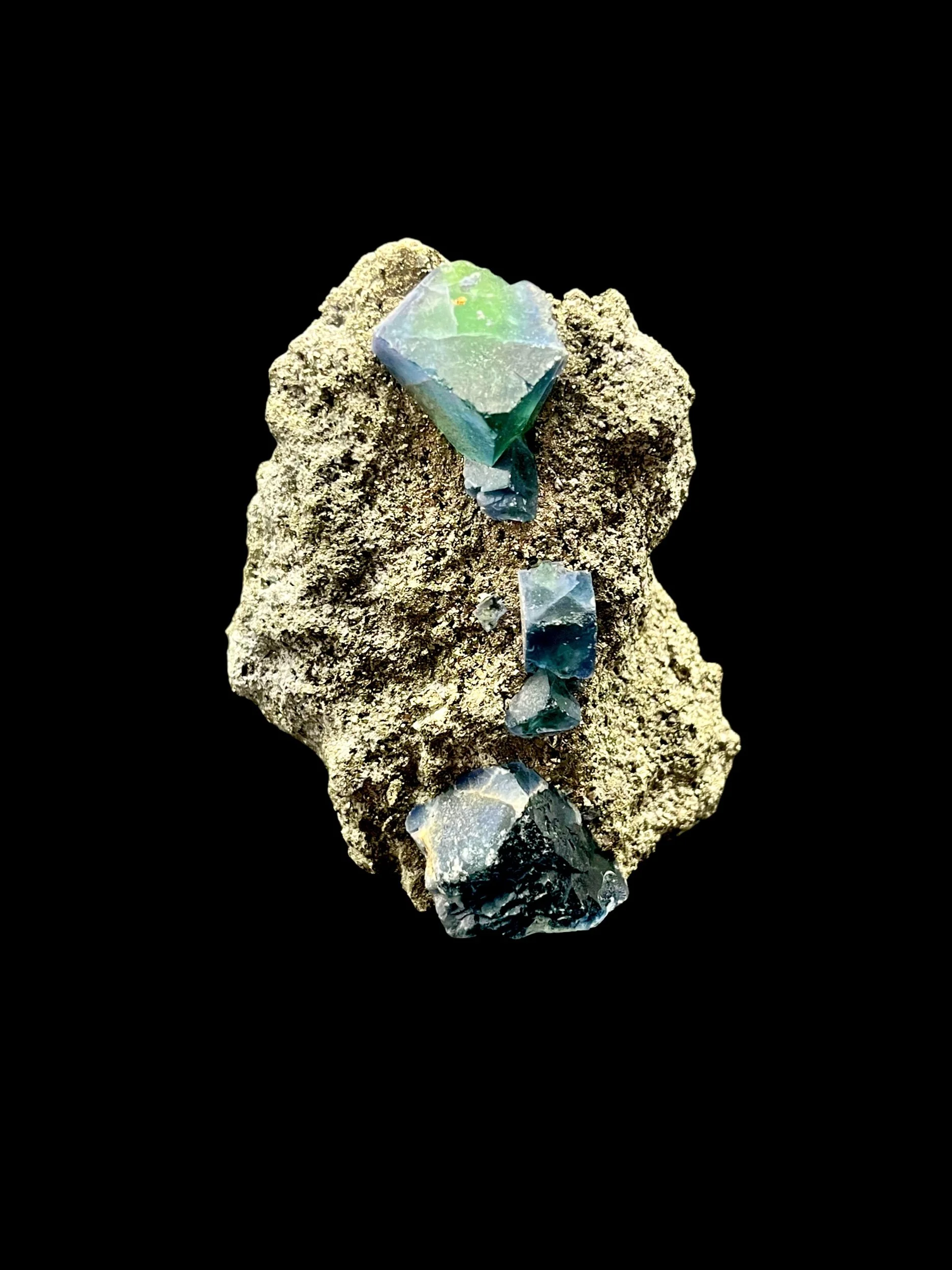
Photo: Earth Signs Fine Minerals
Search for specimens:
The Atacocha Mine lies in Pasco Province, central Peru, northeast of Cerro de Pasco, in the San Francisco de Asís de Yarusyacán district. It is a high-elevation Andean operation, around 4,000–4,050 meters above sea level, in sharply incised terrain between the Río Tingo and Río Huallaga. The mine is part of the larger Cerro Pasco Complex and is operated today under Nexa Resources’ Peruvian polymetallic portfolio.
Geologically, Atacocha is a carbonate-hosted polymetallic system with skarn, replacement, hydrothermal vein, and breccia-style mineralization. The older U.S. Geological Survey work described ore localized in Late Triassic to Early Jurassic Pucará limestone and overlying Cretaceous Goyllarisquisga sandstone, with chert breccia, basalt, and dacitic intrusive rocks also central to the district geology. Later company descriptions refine this into skarn mineralization associated with the Santa Bárbara and San Gerardo stocks, followed by hydrothermal replacement and vein/breccia mineralization carrying Ag-Pb-Zn assemblages between the San Gerardo stock and a major fault structure.
The structural setting is a collector’s clue as much as a mining geologist’s clue. Atacocha mineralization was controlled by folded limestone and sandstone near a cross fold dragged along a major fault zone, with replacement bodies in favorable limestone horizons and veins occupying tension fractures. The 1950s mine was already a substantial underground operation, with roughly 30 kilometers of workings on 16 levels over about 700 meters of vertical range. Those workings followed the principal reverse-fault structure and the mineralized veins and replacement bodies developed around it.
The ore mineral suite is classic Central Peruvian polymetallic: galena and sphalerite as principal ore minerals, pyrite as a major gangue and display mineral, and lesser chalcopyrite, jamesonite, and tetrahedrite-tennantite-series material. Calcite, rhodochrosite, quartz, clay minerals, and fluorite occur as gangue, while realgar and orpiment form late veins that cut earlier ore minerals. Because the district is being actively eroded and has undergone little supergene enrichment relative to many oxidized ore camps, sulfide specimens can retain fresh metallic luster when recovered from protected pockets.
Mining began on an industrial scale in the late 1930s. By late 1953 the operation was producing about 600 tons of ore per day; by the modern period it had become an integrated open-pit and underground polymetallic operation producing zinc, lead, silver, and gold in concentrate. Nexa lists the operation as an open pit and underground mine with a plant capacity of 1.6 million tonnes per year. In recent corporate reporting, the Atacocha underground mine has been suspended since 2020 and kept under care and maintenance, while production has continued primarily from the San Gerardo open pit when access and operating conditions allow. The Cerro Pasco integration plan links Atacocha with the neighboring El Porvenir operation and anticipates changing plant and underground arrangements as the San Gerardo pit is depleted.
For collectors, access should be understood as access to specimens, not access to the mine. Atacocha is an active industrial operation with corporate safety, security, environmental, and community protocols. The important modern specimens have reached the collector market through mine recoveries and dealer channels, not through casual field collecting. Road access to the mine has also been affected at times by community protests and temporary operational suspensions, underscoring that this is a working mine in a living Andean social landscape rather than a recreational collecting site.
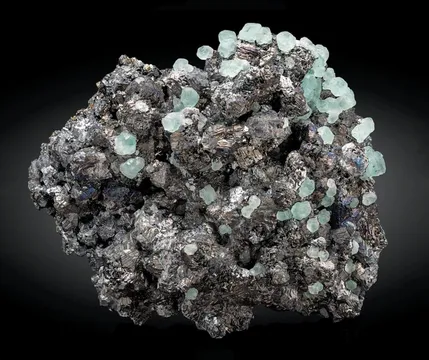
The most important recent collector finds are the green fluorite-pyrite-sphalerite associations that appeared on the market in the early 2020s, including material described as recovered in 2020, 2021–2022, and 2023. The best Atacocha Mine pieces show vivid green cubo-octahedral fluorite or cube-modified octahedrons on brassy pyrite, sometimes with dark brown to reddish-black sphalerite and minor galena. Larger matrix plates are much scarcer than thumbnails and miniatures, and the finest examples combine saturated color, transparency, sharp crystal outlines, intact pyrite, and a display face free of crushing or mining damage.
Atacocha fluorite occupies a special niche among modern Peruvian specimens because the most desirable pieces are not the older minor fluorite of carbonate veinlets, but the recent, intensely colored crystals on sulfide matrix: emerald-green to blue-green, translucent to transparent, commonly cubo-octahedral with dominant octahedral faces and cube modifications, and reported as crystals from small thumbnail size up to about 3–4 cm on better miniatures and plates. The finest Atacocha Mine examples are visually electric against sparkling pyrite, sometimes with dark sphalerite and minor galena; color zoning from ocean-blue to green and strong UV response have also been documented on some pieces. Good specimens separate themselves from ordinary ones by deep even saturation, glassy to resinous luster, crisp edges, undamaged terminations, and a natural balance between the fluorite and the metallic pyrite rather than a loose crystal perched on unattractive ore.
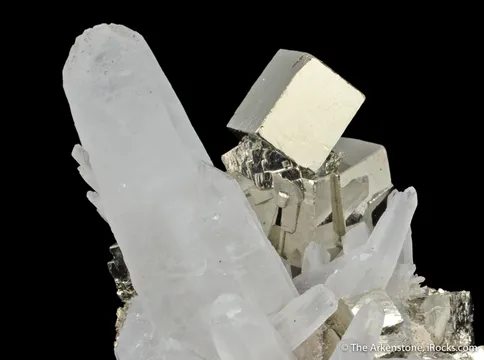
Atacocha pyrite is both an ore-gangue mineral and a major aesthetic player in the mine’s best specimens. In the modern fluorite finds it forms bright brassy-yellow, metallic, striated pyritohedrons or sparkling crystalline carpets beneath green fluorite; in some pieces the pyrite is the dominant display mineral, with fluorite as an accent rather than the reverse. Documented specimens include pyrite-fluorite clusters around 10 cm across with sharp, individual pyritohedrons and only minor peripheral contact, as well as smaller miniatures where 1–5 mm pyrite crystals frame fluorite and sphalerite. The best Atacocha pyrites have sharp geometry, unoxidized luster, clean brassy color, and a disciplined association with fluorite or sphalerite; dull massive pyrite, bruised crystal faces, and crushed sulfide matrix are common downgrades.
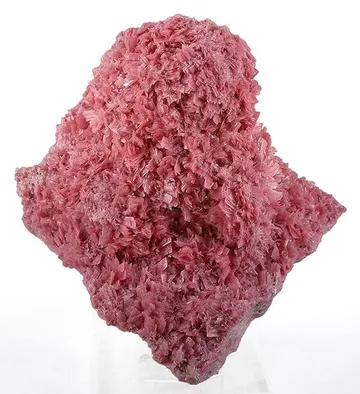
Other documented Atacocha Mine and Atacocha district minerals include galena, sphalerite, chalcopyrite, jamesonite, tetrahedrite-group material, bournonite, geocronite, jordanite, marcasite, arsenopyrite, alabandite, valleriite, realgar, orpiment, calcite, rhodochrosite, siderite, kutnohorite, baryte, quartz including amethyst and chalcedony, and rhodonite. The late arsenic sulfides realgar and orpiment are historically important in the paragenesis because they cut earlier ore, while the sulfosalts and geocronite-jordanite-series material are particularly interesting to systematic collectors. For display collectors, the rarities are less often showy than the fluorite-pyrite pieces, but they add real scientific weight to an Atacocha suite.
The main authenticity and labeling issue is not widespread artificial treatment; it is locality precision. “Atacocha” may mean the Atacocha Mine, the Atacocha mining district, or sometimes a broader Cerro de Pasco trade designation. Because Milpo Mine is also in the Atacocha district and has produced visually similar green fluorite-sulfide specimens, labels should be read carefully. A specimen labeled “Milpo Mine, Atacocha District” should not be relabeled as “Atacocha Mine.” Conversely, some dealer-described Atacocha Mine fluorites are reported to differ from Milpo pieces by resting on bright pyrite rather than darker geocronite-jordanite, bournonite, galena, or mixed sulfosalt-rich matrix—but matrix alone is not proof.
Analytical caution is especially important for dark lead sulfosalts in the district. Galena, geocronite, jordanite, bournonite, and related sulfosalt material can be visually confused, and reputable dealers have specifically noted analysis of galena to distinguish it from geocronite in associated green fluorite finds from the same district. For serious systematic labels, “geocronite-jordanite series” is safer than a confident species call unless XRD, SEM-EDS, or other supporting analysis exists.
Condition is the other major consideration. Atacocha specimens come from a working ore mine, so edge bruising, pocket contact, micro-chipping, and broken sulfide matrix are common. Fluorite edges are particularly unforgiving: the saturated green color can draw the eye, but damaged octahedral tips and cleaved corners lower the specimen’s rank quickly. Pyrite can oxidize or tarnish if stored damp, and arsenic sulfides such as realgar and orpiment should be kept away from prolonged strong light, heat, dust exposure, and unnecessary handling.
Fluorescence has been reported on some Atacocha fluorites, including strong purple under longwave UV and electric blue to green responses in dealer observations. Fluorescence should be treated as a bonus, not as a locality test, because response varies by specimen and lighting. The best buying strategy is still mineralogical: saturated color, crystal form, transparency, matrix contrast, condition, and trustworthy provenance.
On the market, Atacocha Mine fluorite with pyrite is available but not abundant in truly fine quality. Small commercial examples and miniatures appear periodically, while large pristine plates with sharp, saturated fluorites on bright pyrite are much scarcer and priced accordingly. Pyrite-dominant specimens with minor fluorite are less common than massive ore pieces but can be superb if the pyritohedrons are sharp and bright. Older sulfide-carbonate or arsenic-sulfide specimens are more specialized and may be less frequently encountered than the modern green fluorite material.
The most instructive modern Atacocha story is a labeling story, and it is exactly the sort of thing that separates casual mineral buying from serious collecting. In the early 2020s, green Peruvian fluorites began circulating from the Cerro de Pasco region, many attributed to Milpo Mine in the Atacocha district. They were exciting immediately: lime to apple-green fluorite on dark sulfosalt-rich matrix, sometimes with geocronite-jordanite-series material, bournonite, galena, and pyrite mixed into the story. Then, by the 2024 Tucson Show, another thread emerged. Paul Lohr of Out of This World Minerals stated that his green fluorites were from the Atacocha Mine itself, “not to be confused with the Milpo mine, in the same district.” The distinction mattered because the specimens looked deceptively similar at first glance, yet the Atacocha Mine pieces were described as green fluorite resting on bright golden pyrite with minor galena, rather than the darker sulfosalt-rich Milpo associations. For collectors, that is not just a trade anecdote; it is a warning printed in mineral form.
A single pyrite-fluorite specimen posted to Mindat captures the excitement and disappointment of the 2020 find. The specimen measured 10.1 x 8.2 x 4.5 cm and was dominated by sharp, bright brassy pyritohedrons with two light-green fluorite crystals in association. Robert Lavinsky described it as a piece from new finds in 2020 at the working ore mine and added the kind of line collectors remember: “We have held these back, awaiting more.” A few later pockets were found, but according to the same note they did not carry pyrite crystals of comparable quality. That is how many modern mine finds become classics: not through a single giant pocket that floods the market, but through a brief run of pieces good enough to make everyone wait for the next pocket—and then the next pocket fails to match it.
Another specimen shows why the fluorite itself became the headline. A 13.0 x 7.7 x 3.9 cm plate from modern production was described with deep green crystals to 3.4 cm covering pyrite. The color was compared to “Jolly Rancher green candies,” a deliberately unscientific but wonderfully accurate collector shorthand for that saturated candy-green look. The same description noted a strong longwave UV response. When a Peruvian fluorite has that degree of color, sits on bright pyrite, and survives mining as a large plate, it moves from “new find” to “reference specimen” territory very quickly.