






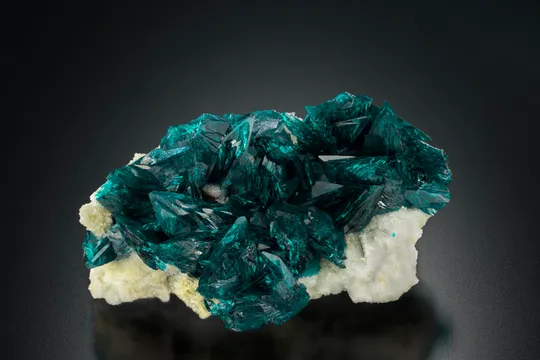
Veszelyite - vivid blue copper-zinc phosphate with sharp prisms in radiating sprays; rare and highly prized by collectors, with Tsumeb pieces and newer finds.
Key facts
Veszelyite is a rare secondary copper–zinc phosphate best known for its vivid cyan to deep azure-blue color and striking crystal habits. Most specimens occur as sharp, lustrous prisms or bladed crystals forming radiating sprays and rosettes on contrasting matrix—most commonly white to gray drusy quartz, dolomite, or limonitic gossan. Individual crystals are usually small (a few millimeters), while exceptional finds have produced crystals approaching 1–2 cm. The combination of saturated blue color, high luster, and elegant, delicate crystal groupings gives fine Veszelyite a visual punch that belies its size, making thumbnails and small miniatures some of the most captivating “blue” specimens available to collectors.
Paragenetically, Veszelyite forms in the oxidized zones of copper–zinc deposits where phosphate-bearing fluids circulate. It is uncommon anywhere, and truly fine crystals are rare. Associations can include smithsonite, hemimorphite, sphalerite, chalcopyrite relics, quartz, dolomite, and iron oxides. Because production has come in short-lived bursts from only a handful of localities, demand has consistently outpaced supply—especially for well-composed, undamaged matrix pieces.
Among connoisseurs of colorful rare species, Veszelyite ranks high. Its intense blue rivals azurite while offering a different aesthetic: airy sprays and delicate crystal bouquets rather than hefty blocky crystals. Historic classics from Tsumeb set an early standard, but modern benchmark pieces came from Montana’s Black Pine Mine, and more recently from several Chinese finds that briefly brought superb, lustrous crystals to market. Because top crystals are small and fragile, pristine pieces with great color and contrast are coveted and command strong prices. This is a species where “best-of-size” thumbnails and choice miniatures can be genuinely world-class, and a single perfect spray on bright quartz can become a cabinet centerpiece despite modest dimensions.
While Veszelyite is recorded from various copper–zinc deposits worldwide, only a few localities have produced truly collectible crystals with strong color and luster. Below are four of the most important sources recognized by collectors.
The Black Pine Mine is widely regarded as the premier modern source of Veszelyite. Pockets discovered in the 1990s–2000s produced crisp, lustrous cyan-to-royal-blue crystals—often as radiating sprays or freestanding prisms—on sparkling white quartz and drusy dolomite. Aesthetic contrast and superb luster are hallmarks, and some crystals reach close to a centimeter, which is large for the species. Many pieces show elegant, three-dimensional groupings with multiple sprays rising from a single quartz pedestal, making them fabulous display specimens. The best are competition-level thumbnails and miniatures; cabinet pieces exist but are far rarer and typically feature multiple smaller sprays on wider matrix.
Color and saturation:
Luster and translucency:
Crystal size and form:
Matrix and contrast:
Condition:
Provenance and rarity:
Repairs:
Treatments:
Veszelyite is a fragile display species and benefits from gentle handling and conservative cleaning.
Physical properties and handling:
Light and temperature:
Cleaning:
Storage and display:
By focusing on saturated color, high luster, sharp undamaged terminations, and clean contrasty matrix, collectors can build a first-rate suite of this charismatic, uncommon phosphate. Even within the small sizes typical of the species, Veszelyite offers tremendous visual drama—proof that great mineral aesthetics aren’t measured in centimeters.