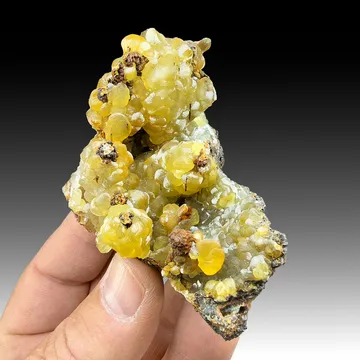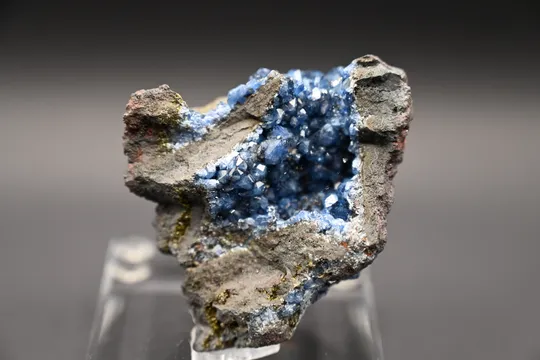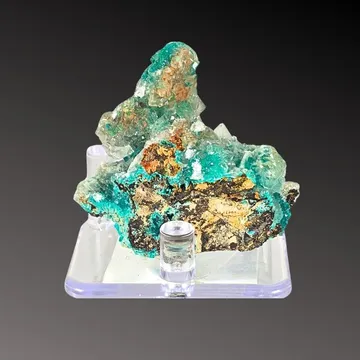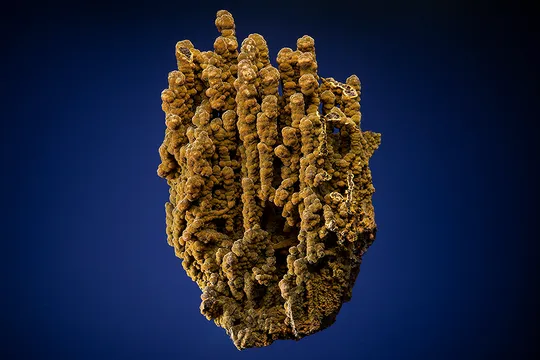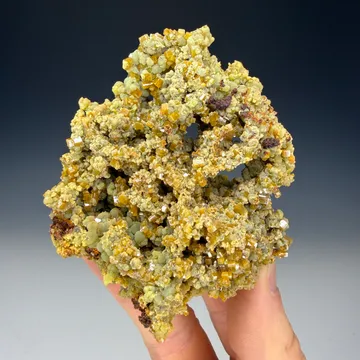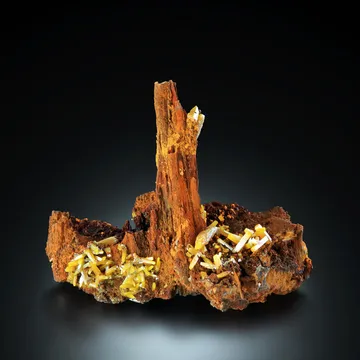
Ojuela Mine, Mexico — renowned locality for vivid adamite, legrandite, mimetite, and wulfenite; prized for color, crystal habit, and mining heritage.
Key facts
The Ojuela Mine at Mapimí, Durango, is one of the great mineral-specimen localities of the world: an old Mexican silver-lead-zinc mine whose oxidized carbonate-replacement ore bodies became a laboratory for arsenates, vanadates, molybdates, carbonates, and iron-manganese oxides. Its collector identity is unmistakable—sharp yellow-green adamite, electric lemon legrandite, olive mimetite, butterscotch wulfenite, pale calcite, blue-green rosasite and aurichalcite, glassy hemimorphite, and a long tail of rare zinc, iron, copper, lead, and manganese species set into dark, cavernous gossan.
Geologically, Ojuela is a classic northern Mexican carbonate-replacement system developed in folded and faulted limestone of the Aurora Formation. Ore was localized in mantos and steep chimneys, with sulfide mineralization dominated by argentiferous galena, sphalerite, pyrite, arsenopyrite, chalcopyrite, bornite, and tetrahedrite. The collecting magic lies in the depth and vigor of oxidation: descending fluids attacked the sulfides and opened vugs, seams, clay-lined cavities, and limonitic pockets where zinc, lead, copper, arsenic, vanadium, molybdenum, carbonate, and silica recombined as showy secondary minerals.
Regional View
Country View
Historically, Ojuela belongs to the first wave of Spanish-era mining in northern Mexico. The mine was discovered in 1598, prospered through colonial and later industrial periods, was modernized under Peñoles in the late nineteenth century, and eventually shifted from major ore production to specimen recovery, local small-scale work, and heritage tourism. The suspension bridge across the canyon, the ruins of the settlement, and the extensive underground workings give the locality a physical grandeur that matches its mineralogical reputation.
The best specimens have a strong “Ojuela look”: color sitting on iron. The most desirable adamites and legrandites are not merely colorful; they are spatially articulate—sparkling wedges, fans, sprays, or rosettes on brown to black limonite/goethite, often with enough open space to show individual terminations. Wulfenite and mimetite combinations are prized when the geometry is clean: amber to butterscotch wulfenite crystals riding over velvety olive mimetite or white calcite, with the rusty matrix providing contrast rather than visual clutter.

Photo: Wikimedia Commons

Photo: Wikimedia Commons

Photo: Wikimedia Commons
Search for specimens: View all specimens from Ojuela Mine, Mexico
Ojuela lies in the Mapimí mining district in northern Durango, in the Sierra de Mapimí near the town of Mapimí. The mine is developed in carbonate rocks, especially limestone of the Aurora Formation, where structural preparation—folding, thrusting, normal faulting, fissuring, and favorable carbonate horizons—localized replacement ore. In mine terms, the important bodies were mantos and chimneys rather than simple open fissure veins. Published district descriptions record the Ojuela chimney as extending to great depth, with the oxidized zone reaching several hundred meters below surface, an unusually favorable condition for the growth of secondary minerals in collectible cavities.
The primary ore assemblage was a polymetallic suite: argentiferous galena for lead and silver, sphalerite for zinc, with pyrite, arsenopyrite, chalcopyrite, bornite, tetrahedrite, and locally native silver and gold. Gangue included calcite, quartz, fluorite, barite, and iron oxides. The secondary suite grew where those sulfides and gangue minerals broke down in the presence of oxygenated waters. Zinc and arsenic produced adamite, legrandite, paradamite, köttigite/metaköttigite-related minerals, mapimite, ojuelaite, lotharmeyerite-group phases, austinite, and hemimorphite. Lead contributed wulfenite, mimetite, cerussite, anglesite, plattnerite, minium, and related species. Copper introduced malachite, rosasite, aurichalcite, conichalcite, mottramite, cuprite, native copper, and rare copper halides. Manganese and iron oxides—cryptomelane, goethite, limonite mixtures, pyrolusite, ramsdellite, romanèchite, and manganite—formed much of the dark matrix that makes Ojuela colors stand out so well.
The mine’s history begins in 1598, when Spanish explorers and prospectors recognized iron-stained mineralized outcrops in the canyon walls. By the eighteenth century Ojuela had become one of the district’s most prosperous mines, though difficult access remained a defining problem: old accounts describe numerous shafts and complicated approaches. Peñoles acquired Ojuela in 1891 and modernized it with electric power, heavy drilling equipment, a rack railway, a beneficiation plant, and the suspension bridge that still frames the site visually. The bridge, built in 1892 by the German engineer Santiago Minguín, spans roughly 336 meters and has become almost as iconic as the minerals themselves.
Large-scale ore mining had largely declined by the mid-twentieth century, but specimen collecting gave Ojuela a second life. Miners, local cooperatives, and later specimen dealers recovered material from old workings, dumps, pockets, and newly opened places within the mine. This is not a simple roadside collecting locality: Ojuela is a large, old, unstable mine complex with controlled tourist access to selected areas and separately controlled specimen recovery. Serious collectors should assume that legal specimen production depends on authorized local access, mine safety, and the cooperation of people working in or managing the mine—not on casual personal collecting.
Several named parts of the mine recur in specimen history. The Las Palomas ore body, just above the 11th level, produced the celebrated 1946 adamite pocket discovered by Mary E. Mrose, Dan E. Mayers, and Francis A. Wise. San Judas Chimney is tied to Mike New’s famous 1981 purple adamite discovery and, later, to the type specimen of mikenewite. San Juan Poniente is well known on the collector market for wulfenite-mimetite combinations, especially material with butterscotch to amber wulfenite on olive-green mimetite and gossan. America Dos, America Poniente, Palomas Oriente, La Esperanza, Cumbres, and other sublocalities appear in mineralogical records for specific species and associations.
Specimen availability has been episodic. The mine is old enough that many pieces on the market have passed through several collections, but it has also produced fresh waves of material in modern times: wulfenite-mimetite combinations, calcite, aurichalcite, rosasite, malachite, austinite, fluorite, and distinctive adamite varieties have all appeared from renewed activity and selective specimen recovery. This long, uneven supply explains why Ojuela is simultaneously common in the marketplace and capable of producing great rarities.
Adamite is Ojuela’s signature species and occurs there in a range wide enough to make the mine a reference point for the mineral: pale yellow to vivid yellow-green crystals, apple-green cuprian material, rare pink to violet manganese-bearing adamite, sparkling crusts, wedge-shaped crystals, rosettes, pinwheels, and drusy carpets on limonite, goethite, and limestone. The classic 1946 Las Palomas pocket just above the 11th level produced yellow-green crystals up to about 5/16 inch long and large plates on brown limonite, while the 1981 San Judas Chimney find made purple adamite one of the modern icons of the locality. Good Ojuela adamite is judged by sharpness, luster, color saturation, freedom from iron staining on crystal faces, an open arrangement of rosettes or individual wedges, and enough contrast with the gossan matrix to make the crystals read as specimens rather than mineralized crusts.
Ojuela wulfenite is most familiar as yellow, orange-yellow, caramel, amber, or butterscotch crystals on limonite-rich matrix, commonly with green mimetite and white to colorless calcite; San Juan Poniente material, including Level 6 examples, is especially well known for this palette. Crystals range from tiny glittering tabs to lustrous, translucent individuals around the centimeter scale, with habits including blocky pseudocubic forms, elongated prismatic crystals, doubly terminated crystals, and locally tapered or bipyramidal-looking forms. Ordinary pieces are attractive but crowded; the better ones show isolated, undamaged wulfenite crystals with bright faces, good transparency, strong placement on contrasting mimetite or calcite, and a matrix sturdy enough that the specimen can be handled and displayed without constant fear of crumbling.
Mimetite from Ojuela is an essential part of the mine’s lead-arsenate identity, most often appearing as olive-green, apple-green, yellow-green, yellow, or brownish botryoidal to globular coatings and crusts on iron-rich gossan, commonly accented by wulfenite and calcite. The best-known collector style is the wulfenite-on-mimetite combination: velvety green balls or cushions of mimetite with lustrous amber wulfenite crystals perched across the surface, sometimes with white calcite rhombs or flakes for contrast. Strong Ojuela mimetite specimens are judged less by individual crystal size than by richness of color, continuity of coverage, absence of dull iron smearing, attractive relief across a vuggy matrix, and the quality of associated wulfenite when present.
Legrandite is one of Ojuela’s true trophy minerals, occurring as bright yellow to lemon-yellow, transparent to translucent prismatic crystals, sprays, sheaves, and radiating clusters on dark gossan, often with adamite, paradamite, smithsonite, goethite, and other zinc arsenates. Although the species was first described from Nuevo León, Ojuela is the locality collectors think of when they picture great legrandite; important pieces are known from Level 5 material, and fine examples can reach several centimeters across as specimens even when individual crystals are much smaller. The best pieces have saturated yellow color, glassy luster, separated crystals with complete terminations, lively spray geometry, and strong contrast; ordinary pieces are dull, crowded, stained, or reduced to scattered microcrystals on brown matrix.
Calcite at Ojuela is both a gangue mineral and a crucial display mineral, appearing as white, colorless, cream, or lightly tinted rhombs, scalenohedra, platy crystals, flakelike crystals, crusts, and later cavity linings on gossan and oxidized ore. It commonly accompanies wulfenite, mimetite, hemimorphite, rosasite, malachite, cerussite, and fluorite, and on the best wulfenite specimens it works visually like snow on rust—brightening the matrix and setting off yellow to orange crystals. Fine Ojuela calcites are sought when the calcite is not simply background but contributes sharp rhombs, lustrous pearly surfaces, stalactitic or drusy texture, fluorescence in some pieces, and undamaged crystal edges in combination with more colorful species.
Aurichalcite from Ojuela forms soft-looking blue-green to pale turquoise acicular sprays, silky tufts, crusts, and fibrous mats in oxidized zinc-copper cavities, typically on brown limonitic gossan and commonly near calcite, rosasite, hemimorphite, smithsonite, malachite, and other carbonate-zone minerals. Its appeal is textural rather than architectural: the best examples have fresh, bright color and a velvety or feathery surface that has not been flattened by handling or coated by dust. Because aurichalcite is delicate, superior Ojuela pieces preserve undisturbed sprays in protected vugs or on stable matrix; ordinary examples are pale, rubbed, powdery, or visually lost among stronger green copper minerals.
Rosasite gives Ojuela some of its most saturated blue-green color, occurring as botryoidal crusts, reniform linings, and fine acicular aggregates in cavities of the oxidized zinc-copper ore, commonly on limonite with calcite, aurichalcite, hemimorphite, smithsonite, malachite, and occasionally wulfenite-related assemblages. Good pieces show dense turquoise to teal botryoids with a silky sparkle and clean contrast against rusty matrix; some market specimens show small cabinet-scale cavities lined with color rather than isolated crystal groups. The distinction between better and ordinary examples is freshness: vivid color, undamaged rounded surfaces, and a clear identity separate good rosasite from dull mixed blue-green coatings that may grade visually into aurichalcite, malachite, conichalcite, or mixed copper-zinc secondary material.
Hemimorphite at Ojuela reflects the zinc-rich oxidation of sphalerite-bearing replacement ore and is documented as colorless, white, pale blue-white, or glassy transparent to translucent crystals, sprays, crusts, and aggregates on gossan, commonly associated with calcite, rosasite, aurichalcite, adamite, smithsonite, and iron oxides. The Palomas ore body between the 11th and 12th levels was noted historically for large hemimorphite crystals reminiscent of Santa Eulalia material, giving context to the zinc-rich fluids that also produced adamite nearby. Fine Ojuela hemimorphite shows sharp glassy terminations, clean separation from the matrix, and attractive association with blue-green copper-zinc minerals; ordinary pieces are white crusts or bruised aggregates whose identity is less visually distinct.
Austinite is one of Ojuela’s specialist arsenates, occurring in the oxidized zinc-arsenic environment as white, pale yellow, yellow-green, green, or locally copper-influenced crystals, often bladed, acicular, radiating, or crusty on limonite with adamite, conichalcite, duftite, mimetite, calcite, and other secondary arsenates. It can be deceptively similar in color to adamite or conichalcite, so habit and association matter: Ojuela austinite tends to reward close viewing, especially when crisp orthorhombic crystals or sprays are visible rather than a featureless green coating. Better examples have identifiable individual crystals, clean color, and a known old label or reliable sublocality history; lesser pieces are mixed green arsenate crusts that require analytical caution.
Fluorite at Ojuela occurs both as primary gangue and as collectible secondary-stage crystals, most memorably in transparent to translucent purple, lavender, and violet cubes or cube modifications on oxidized matrix, sometimes with adamite, austinite-like green arsenates, calcite, and gossan. Modern reports and fluorescent-mineral documentation note purple fluorite from Ojuela with a bright red longwave UV response, a feature tied to naturally irradiated fluorite and trace activators rather than residual radioactivity in the specimen. The best fluorites are gemmy, saturated, sharply cubic, and lightly etched or modified without being corroded beyond form; average pieces may be attractive color spots but lack the sharpness and transparency expected of a serious Ojuela fluorite.
Scorodite from Ojuela belongs to the arsenopyrite-derived side of the oxidation suite and is documented with iron oxides and other arsenates, often as greenish, bluish-green, brownish, or earthy to crystalline material in gossan rather than as the large glassy crystals seen at a few other world localities. Historically, rarer arsenates including scorodite were noted from dump and oxidized material, and good specimens tend to be modest but mineralogically important. Collectors should prize sharp, lustrous, identifiable crystals or rich crystalline crusts with reliable provenance; ordinary material can be drab and easily confused with other green to brown arsenates or iron-rich alteration products without analysis.
Paradamite is one of Ojuela’s great type-locality minerals and a structural companion to adamite, first described from this mine and still strongly associated with its oxidized zinc-arsenate pockets. It occurs as pale yellow, yellow, greenish-yellow, honey, or colorless to translucent crystals and aggregates on limonite and goethite-rich matrix, commonly with adamite, legrandite, smithsonite, austinite, hydrozincite, ojuelaite, and other arsenates. Fine Ojuela paradamite is valued when it is visibly paradamite rather than “yellow zinc arsenate”: sharp crystals, good luster, recognizable habit, and association with classic Ojuela matrix lift a specimen; poorly crystallized crusts and mixed yellow adamite-paradamite material require careful labeling.
Mottramite at Ojuela is part of the vanadate-arsenate fringe of the oxidized lead-copper system, generally appearing as dark olive-green, tobacco-green, brown-green, or nearly black crusts, botryoids, and microcrystalline coatings on gossan, often near wulfenite, mimetite, duftite, conichalcite, calcite, and other secondary lead-copper minerals. It is rarely the most flamboyant Ojuela species, but it gives depth and contrast to wulfenite combinations and is important to collectors who appreciate the mine’s chemical complexity. Better pieces show discrete, lustrous botryoidal or crystalline mottramite with attractive associated wulfenite or mimetite; ordinary material is a dark coating that may need analysis to separate confidently from duftite, descloizite, conichalcite, or mixed alteration films.
Smithsonite is a quieter but important Ojuela zinc mineral, forming white, pale gray, yellowish, greenish, bluish, or brownish botryoidal crusts, rhombohedral to drusy coatings, and compact masses in the oxidized sphalerite environment, associated with adamite, legrandite, hemimorphite, rosasite, aurichalcite, calcite, goethite, and galena. It is documented sparingly in some of the historically important adamite context, including traces near Las Palomas-style zinc-rich oxidation. Good Ojuela smithsonite is not judged against the big colorful smithsonites of Santa Eulalia; it is valued when it is sharp, clean, well-associated with Ojuela arsenates or gossan, and securely labeled, while anonymous Mexican smithsonite labeled “Ojuela” deserves special scrutiny.
Conichalcite from Ojuela is a copper-calcium arsenate of the oxidized zone and typically appears as bright to dark green crusts, botryoidal aggregates, sparkling microcrystalline coatings, or small spheroidal aggregates on limonitic matrix, often with calcite, adamite, austinite, duftite, mottramite, malachite, mimetite, and goethite. It is a classic “green Ojuela” mineral but also one of the species most likely to be visually confused with austinite, duftite, mottramite, or malachite when crystals are tiny. The best examples have vivid color, visible crystal sparkle or well-formed rounded aggregates, and clean separation from other green coatings; ordinary specimens may be attractive but mineralogically ambiguous without testing.
Malachite at Ojuela records the copper-bearing parts of the oxidized polymetallic system and is found as green coatings, botryoidal crusts, silky acicular sprays, small balls, and replacement textures on gossan, often with calcite, cerussite, rosasite, aurichalcite, conichalcite, cuprite, native copper, and wulfenite-related assemblages. It is not the mine’s headline species, but its presence can make mixed copper-lead-zinc specimens unusually colorful and chemically interesting. Strong Ojuela malachites have saturated color, well-preserved fibrous or botryoidal texture, and association with classic Ojuela species; lesser pieces are common green smears on iron-stained rock and may be confused with other green copper minerals.
Goethite is the backbone of many Ojuela specimens, forming brown, black, rusty, stalactitic, botryoidal, earthy, and lustrous iron-oxide matrices that carry adamite, legrandite, mimetite, wulfenite, rosasite, aurichalcite, cerussite, and a host of rarities. It is easy to overlook because it often serves as matrix, but good goethite from Ojuela can be sculptural in its own right: ridged gossan, cavernous boxwork, stalactitic limonite-goethite forms, and glossy black-brown surfaces are part of the locality’s visual language. The better examples are stable, three-dimensional, and texturally interesting, while poor matrix crumbles, sheds dust, or overwhelms delicate secondary crystals with iron staining.
Galena was a principal ore mineral at Ojuela, especially as argentiferous galena in the lead-silver replacement bodies, and it survives in specimens as massive gray ore, cleavable metallic patches, and occasional cubic or modified crystal remnants associated with sphalerite, pyrite, arsenopyrite, calcite, quartz, fluorite, cerussite, anglesite, mimetite, and wulfenite. For collectors, galena is usually more important as the source mineral behind Ojuela’s lead-rich secondary suite than as a display species on its own. A good Ojuela galena specimen has clear metallic galena in meaningful association with secondary lead minerals—especially mimetite, wulfenite, or cerussite—whereas plain massive ore is historically interesting but not usually a cabinet highlight.
Collectors encountering “manganese” from Ojuela should treat the term as a locality-style shorthand unless the label is analytically specific, because Ojuela’s manganese expression is most often black to dark brown manganese oxides and manganese-bearing secondary minerals rather than showy native manganese metal. The mine is documented for manganese oxides such as cryptomelane, pyrolusite, ramsdellite, romanèchite, and manganite, as well as manganese-bearing adamite and rarities such as miguelromeroite and mikenewite from the San Judas Chimney assemblage. The better “manganese” specimens from Ojuela are those with a clear species identification, association with adamite or lotharmeyerite-group minerals, or a role as lustrous black matrix; vague black oxide lumps are common and should not be over-described.
Native copper is documented from Ojuela’s oxidized copper-bearing zones, where it belongs with cuprite, malachite, rosasite, aurichalcite, conichalcite, paramelaconite, claringbullite, and other copper minerals in the complex supergene environment. Specimens are typically small and uncommon compared with the mine’s zinc arsenates and lead minerals, and copper may appear as metallic blebs, small wires, grains, or coppery patches in iron-rich or cuprite-bearing matrix rather than as large sculptural native-copper forms. Good examples are valued for provenance and association—especially with cuprite or unusual copper secondary minerals—while ordinary pieces need careful confirmation because small copper-colored areas can be misread in mixed oxidized ore.
Cerussite from Ojuela is a relatively scarce lead-carbonate species compared with wulfenite and mimetite, occurring as colorless, white, grayish, transparent to translucent crystals, twins, flattened forms, and crusts on limonite or oxidized galena-bearing matrix, sometimes with malachite, pyrite, calcite, goethite, and other lead-copper secondary minerals. Documented fine examples show lustrous twinned crystals on stalactitic limonite and flattened, hexagonal-looking twinned groups under a centimeter to around centimeter scale. Better Ojuela cerussites have clean twinning, transparency, sharp form, and a reliable old label; ordinary pieces are easily lost among pale calcite or other white secondary minerals and should be checked carefully.
Arsendescloizite is one of the rarer members of Ojuela’s lead-zinc-copper arsenate-vanadate chemistry, occurring in the same oxidized environment that produced mottramite, duftite, conichalcite, mimetite, wulfenite, and a long suite of related microcrystalline species. At the specimen scale it is not a flamboyant Ojuela mineral; collectors should expect dark green, brownish, olive, or resinous microcrystalline coatings, crusts, or tiny crystals on gossan, and reliable identification depends heavily on analytical work or strong provenance from a specialist source. Fine examples are important because they are rare and chemically specific, not because they dominate visually; ordinary pieces may be indistinguishable from other dark vanadate or arsenate coatings without testing.
Creedite is an uncommon accessory at Ojuela, tied to fluorine- and sulfate-bearing late-stage conditions in a mine already rich in fluorite, barite, calcite, gypsum, and oxidized base-metal minerals. Unlike the well-known purple creedites from other Mexican localities, Ojuela creedite is not a standard show mineral here; specimens are likely to be small, pale, drusy to acicular, or association pieces in vugs rather than large sculptural sprays. The best Ojuela examples are those with clearly identifiable crystals, documented locality history, and association with the mine’s fluorite-calcite-barite-gossan assemblage; poorly labeled Mexican creedite should not be assumed to be Ojuela.
Quartz is a documented gangue and cavity mineral at Ojuela, occurring with calcite, fluorite, barite, sulfides, and oxidized mineral suites as clear to white crystals, druses, crusts, and silica-rich linings in replacement cavities. It usually plays a supporting role rather than competing with the mine’s famous arsenates, but quartz can provide sparkle and structure to gossan specimens, especially when associated with hemimorphite, calcite, or secondary lead-zinc minerals. Good Ojuela quartz is clean, sharp, and well-associated; ordinary quartz from the mine is common gangue and needs a stronger mineralogical association or old provenance to interest locality collectors.
Barite is a recognized gangue mineral in the Ojuela system and appears in oxidized and replacement assemblages with fluorite, calcite, quartz, sulfides, and iron oxides, generally as white, cream, honey, tan, or colorless tabular crystals, blades, crusts, or massive gangue. It matters geologically because it marks sulfate-rich hydrothermal conditions, and it matters aesthetically when its tabular crystals provide pale contrast beneath darker gossan or colorful secondary minerals. The better Ojuela barites are sharp, lustrous, and visibly crystallized with classic Ojuela associates; plain massive barite is more geological context than specimen centerpiece.
Pyrite was one of the major primary sulfides at Ojuela and is also present as gangue and relict sulfide in oxidized ore, associated with arsenopyrite, sphalerite, galena, chalcopyrite, calcite, quartz, fluorite, barite, goethite, and secondary arsenates and carbonates. Collectors may encounter small brassy crystals, cubes, pyritohedra, granular masses, or oxidized pyrite casts in gossan rather than large showy pyrite specimens. Fine Ojuela pyrite is most desirable when it documents the transition from sulfide ore to secondary mineralization—fresh brassy crystals beside adamite, legrandite, cerussite, or calcite—while heavily altered massive pyrite is prone to deterioration and has limited display appeal.
Gypsum at Ojuela is a late secondary sulfate, appearing as colorless to white blades, needles, crusts, fibrous aggregates, or delicate crystalline growths in oxidized cavities and on mine surfaces where sulfate-bearing waters reacted with calcium-rich carbonate host rocks. It can occur with limonite, iron sulfates, köttigite-group minerals, calcite, and other late-stage oxidation products, and it is especially relevant in micro-assemblages where delicate evaporative or supergene minerals line protected vugs. Good Ojuela gypsum is transparent, undamaged, and clearly associated with the mine’s secondary suite; ordinary pieces are fragile white crusts and should be kept dry and handled minimally.
Beyond these collector staples, Ojuela is important for its type-locality and rare-mineral record. The mine is the type locality for paradamite, mapimite, ojuelaite, metaköttigite, lotharmeyerite, miguelromeroite, mikenewite, and scrutinyite, and it has produced a deep bench of rarities and micro-minerals including arseniosiderite, beudantite, carminite, chalcophanite, claringbullite, cryptomelane, duftite, hedyphane, hydrozincite, köttigite, leiteite, murdochite, nantokite, ogdensburgite, olivenite, paramelaconite, parasymplesite, pharmacosiderite, plattnerite, plumbojarosite, segnitite, and many others. This is why Ojuela rewards both kinds of collector: the cabinet specialist who wants a single world-class adamite, and the systematic mineralogist who can spend years untangling tiny species on one piece of gossan.
Ojuela specimens are abundant enough that almost every serious mineral dealer has handled them, yet the locality is also vulnerable to mislabeling because the name adds value. Many Mexican mimetites, smithsonites, pyromorphites, and “endlichite” or vanadinite-style materials have historically circulated under overly broad or incorrect Ojuela labels. Be especially cautious with specimens labeled only “Mapimí,” “Durango,” or “Mexico” when the species could plausibly come from Santa Eulalia, Velardeña, Zimapán, Sierra de Los Lamentos, or another Mexican district. Strong provenance—old labels, sublocality names such as San Juan Poniente, San Judas Chimney, Las Palomas, America Dos, or Palomas Oriente, and a dealer or collection history—matters.
The most common identification problems are among visually similar green, yellow, and blue-green secondary minerals. Adamite, austinite, conichalcite, duftite, mottramite, mimetite, and rosasite can overlap in color when crystals are tiny or crusty. “Green balls on gossan” may be mimetite, adamite, conichalcite, rosasite, or a mixture; “yellow sprays” may be legrandite, adamite, or another arsenate depending on habit and chemistry. For valuable or rare-species claims—arsendescloizite, lotharmeyerite-group minerals, metaköttigite, ojuelaite, mapimite, mikenewite, claringbullite, or manganese-rich phases—analytical confirmation is far more meaningful than visual resemblance.
Condition is a major value driver. Ojuela matrix can be porous, crumbly, dusty, and iron-stained, and many wulfenite or legrandite specimens sit on fragile gossan ribs. Wulfenite edges chip easily; legrandite sprays break at the bases; aurichalcite and rosasite can be bruised or flattened by careless wrapping; hemimorphite and calcite can chip along exposed terminations; and gypsum-bearing micro-assemblages should be kept dry. On older pieces, look for repaired matrix, glued crystals, stabilized gossan, or trimmed bases. Stabilization is not automatically a defect if disclosed, but hidden repairs matter greatly on high-end adamite, legrandite, and wulfenite.
Fluorescence adds interest but should not be treated as a substitute for identification. Ojuela adamite commonly fluoresces green under shortwave UV, with the response often attributed to trace uranium-related activation in the adamite structure. Some purple fluorite from Ojuela shows bright red longwave fluorescence tied to natural irradiation defects and activators; fluorescence may bleach under prolonged longwave exposure and can be restored only to a limited degree by shortwave exposure in documented red-fluorescent fluorites. Use UV as a display and diagnostic aid, but avoid prolonged exposure of sensitive specimens and never infer radioactivity from fluorescence alone.
Market availability varies strongly by species. Green adamite, wulfenite-mimetite combinations, calcite, rosasite, aurichalcite, and hemimorphite remain obtainable from thumbnails through cabinet pieces. Fine legrandite, purple manganese-bearing adamite, sharp paradamite, high-quality cerussite, and well-documented rare species are far scarcer and command specialist attention. The best Ojuela specimens combine locality aesthetics with mineralogical credibility: sharp crystals, vivid color, undamaged surfaces, classic gossan contrast, and a label history that can survive scrutiny.
In June 1946, Mary E. Mrose, Dan E. Mayers, and Francis A. Wise were underground in the Las Palomas ore body, just above the 11th level, moving toward a stope already known for wulfenite and green mimetite. Their lamps caught a small opening in the limestone—a pocket in a manway rather than a grand chamber. Inside was a cavity about four feet across and four feet deep, its interior carved into irregular shapes and covered with undulating waves of sparkling yellow-green adamite. The published account called it “a glorious sight,” and the phrase is justified: miners were put to work at once, and one of the largest pieces weighed about 75 pounds underground and measured almost three feet square before trimming. That specimen, with a continuous crust of green crystals on brown limonite, entered the U.S. National Museum; two other notable pieces went to Harvard.
The chemistry of that 1946 pocket tells a subtler story. It sat in an elbow of the Las Palomas ore chimney, a place where descending zinc-rich solutions could slow down, stagnate, and alter the wall rock without being flushed too quickly away. Nearby, between the 11th and 12th levels, hemimorphite occurred in large crystals, showing how zinc-rich the local oxidation environment had become. The adamite pocket itself was not simply “a lucky hole”; it was a small hydrologic trap in a vast mine, where structure, chemistry, and time lined up for crystal growth.
Ojuela’s modern collecting history has its own central character: Michael Edwin New, the Tucson dealer and specimen miner behind Top Gem Minerals. New had permission to mine and export Ojuela material, and for decades his work helped feed the international market with specimens from a locality many collectors thought of as historical. His most famous Ojuela moment came in 1981 in the San Judas Chimney, where miners encountered purple adamite—manganese-bearing material that became one of the great color variants of the species. Decades later, a specimen from that same San Judas Chimney environment produced mikenewite, a new manganese sulfite mineral named in New’s honor.
The bridge is the other unforgettable Ojuela object. Peñoles acquired the mine in 1891 and modernized it at industrial scale: electric power, large drills, a rack railway, a beneficiation hacienda, and a suspension bridge built in 1892 across the canyon. That bridge, roughly 336 meters long, connected the mine world physically and psychologically. Today the ruins, the bridge, and the tourist-accessible workings give visitors a rare sensation for a mineral locality: you are not just looking at where specimens came from, but at the infrastructure that made a remote mountain ore body into a town, an industry, and eventually a collecting legend.
Mary E. Mrose, Dan E. Mayers, and Francis A. Wise, “Adamite from the Ojuela Mine, Mapimi, Mexico,” American Mineralogist, 33, 1948, pp. 449–457. Classic paper describing Ojuela adamite chemistry and the 1946 Las Palomas pocket. https://msaweb.org/AmMin/AM33/AM33_449.pdf
Victor Joseph Hoffmann, The Mineralogy of the Mapimí Mining District, Durango, Mexico, Ph.D. dissertation, University of Arizona, 1968. Foundational district mineralogy reference for Ojuela and neighboring Mapimí deposits. https://repository.arizona.edu/handle/10150/565169
Thomas P. Moore and Peter K. M. Megaw, “Famous Mineral Localities: The Ojuela Mine, Mapimí, Durango, Mexico,” The Mineralogical Record, 34(5), 2003, pp. 5–91. The standard modern collector monograph on the mine’s history, geology, specimen production, and mineral species. https://www.researchgate.net/publication/289067355_The_Ojuela_mine_Mapimi_Durango_Mexico
Servicio Geológico Mexicano, Carta Geológica-Minera Mapimí G13-D14, Durango, 1:50,000. Regional geological and mining summary documenting Ojuela as skarn and carbonate-replacement mineralization in Aurora Formation limestone, with chimneys, mantos, oxidation depth, ore grades, and Peñoles production figures. https://mapserver.sgm.gob.mx/Cartas_Online/metadatos_geol/1018_Mapimi%20G13-D14_Geol.html
John Wilfred Patterson, “Composite plan of the ore bodies of the Ojuela Mine,” supplement to The Manto Type Limestone Replacement Deposits of Northern Mexico, Caltech thesis data, 1932. Historical ore-body map and manto-replacement context for Mapimí and other northern Mexican districts. https://data.caltech.edu/records/femw9-5mz75
George Switzer, “Paradamite, a New Zinc Arsenate from Mexico,” American Mineralogist, 41, 1956, pp. 905–906. Original description of paradamite from Ojuela, one of the mine’s key type-locality minerals. https://rruff.info/doclib/am/vol41/AM41_905.pdf
Fabien Cesbron, Miguel Romero S., and Sydney A. Williams, “La mapimite et l’ojuélaïte, deux nouveaux arséniates hydratés de zinc et de fer de la mine Ojuela, Mapimi, Mexique,” Bulletin de Minéralogie, 104(4), 1981, pp. 582–586. Original description of mapimite and ojuelaite. https://www.persee.fr/doc/bulmi_0180-9210_1981_num_104_4_7510
Pete J. Dunn, “Lotharmeyerite, a New Mineral from Mapimi, Durango, Mexico,” The Mineralogical Record, 14(1), 1983, pp. 35–36. Type description of lotharmeyerite from Ojuela. https://rruff.info/uploads/Lotharmeyerite.pdf
K. Schmetzer, G. Amthauer, V. Stähle, and O. Medenbach, “Metaköttigit, (Zn,Fe3+)(Zn,Fe3+,Fe2+)2(AsO4)2·8(H2O,OH), ein neues Mineral aus Mapimi, Mexiko,” Neues Jahrbuch für Mineralogie, Monatshefte, 1982, pp. 506–518. Original work on metaköttigite from Ojuela. https://www.mindat.org/reference.php?id=402930
Anthony R. Kampf, Joseph Marty, George R. Rossman, and Robert M. Housley, “Miguelromeroite, the Mn analogue of sainfeldite, and redefinition of villyaellenite as an ordered intermediate in the sainfeldite-miguelromeroite series,” American Mineralogist, 94, 2009, pp. 1535–1543. New-species work including Ojuela type material and honoring Mexican mineralogist Miguel Romero Sánchez. https://pubs.geoscienceworld.org/msa/ammin/article-abstract/94/11-12/1535/44706/Miguelromeroite-the-Mn-analogue-of-sainfeldite
Guowu Li, Hexiong Yang, Robert T. Downs, Xiangping Gu, and Guang Fan, “Mikenewite, the natural analogue of synthetic α-Mn2+(S4+O3)·3H2O, a new sulfite mineral from the Ojuela mine, Mapimí, Mexico,” Mineralogical Magazine, 87(4), 2023, pp. 534–541. Type description of mikenewite from the San Judas Chimney, named for Michael Edwin New. https://www.cambridge.org/core/journals/mineralogical-magazine/article/mikenewite-the-natural-analogue-of-synthetic-mn2s4o33h2o-a-new-sulfite-mineral-from-the-ojuela-mine-mapimi-mexico/450CA3146919226D7BF44FDD8C7B2853
Mindat, “Type Locality Report for Ojuela Mine, Mapimí, Mapimí Municipality, Durango, Mexico.” Useful consolidated list of Ojuela type-locality minerals and type references. https://www.mindat.org/typelocs-2318.html