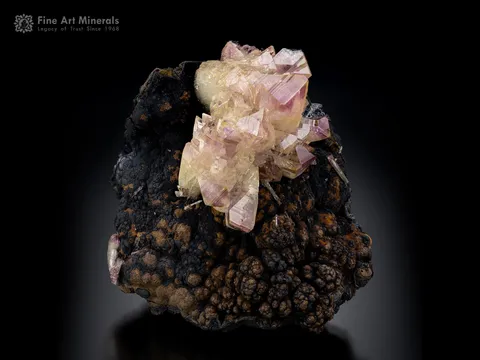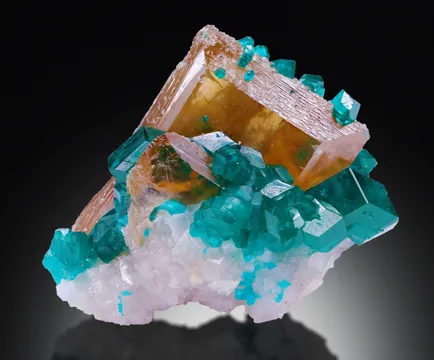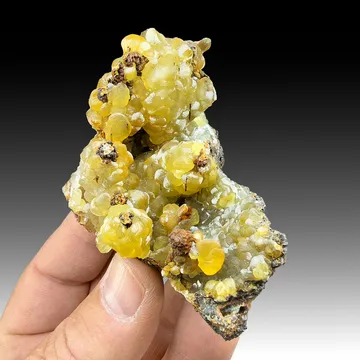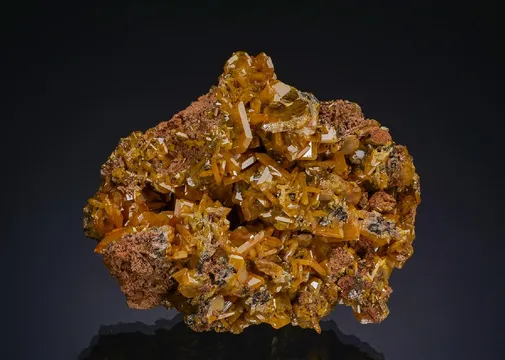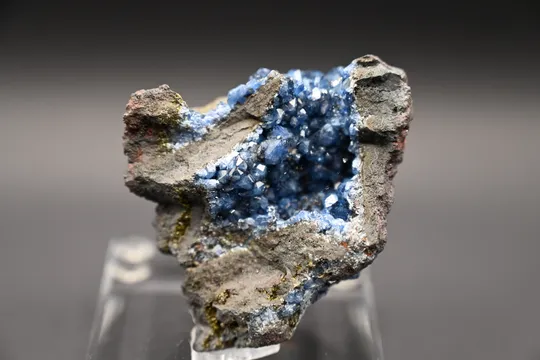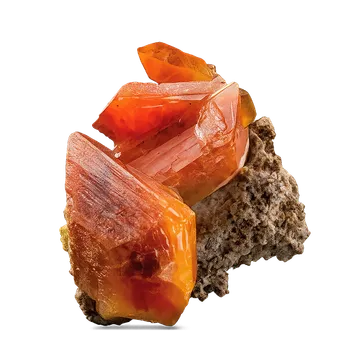
Ojuela Mine, Mapimí, Durango, Mexico - Wulfenite known for orange-yellow prisms, often with mimetite and calcite; a premier, collector-favored locality.
Key facts
Ojuela wulfenite belongs to that small group of mineral specimens whose locality identity is visible at a glance. Instead of the broad, glassy, orange “windowpanes” of many southwestern U.S. classics, the Mapimí material often has a more sculptural, bristling character: tapered yellow to orange-brown crystals, spear-like prisms, thick tablets, and eccentric “sandwich” crystals in which a brown middle zone is framed by yellow outer growth. On the best pieces, the wulfenite is set against the colors that made Ojuela famous—green mimetite, white calcite, brown limonite and goethite, tobacco-green mottramite, and the rusty gossan of a deeply oxidized lead-silver-zinc deposit.

Photo: Wikimedia Commons
Mineralogically, Ojuela is a vast oxidized carbonate-replacement system rather than a single simple vein. The primary ores included argentiferous galena, sphalerite, pyrite, and arsenopyrite; oxidation then rebuilt that metal-rich system into one of the world’s great secondary-mineral assemblages. Wulfenite, Pb(MoO4), formed where lead from galena met molybdenum-bearing oxidizing solutions, while the same environment produced the arsenates and vanadates that collectors associate with the mine: mimetite, adamite, legrandite, austinite, paradamite, duftite, mottramite, and many rarer species.
Ojuela’s fame does not rest on wulfenite alone. The mine is one of Mexico’s great mineral localities—arguably the country’s most beloved among specimen collectors—and its wulfenite is part of a much larger mineralogical theater. That broader context is exactly why the wulfenite is so desirable: a fine Ojuela piece is not merely “a wulfenite,” but a small cross-section of the mine’s oxidized chemistry. A specimen with orange wulfenite rising from green botryoidal mimetite or resting among white calcite on limonitic matrix carries the unmistakable Mapimí signature.

Photo: Wikimedia Commons
Collectors look first for color, form, and association. The classic appeal is warm yellow to orange wulfenite in sharp, lustrous crystals, ideally perched rather than buried, with enough contrast from matrix or associated minerals to make the crystals read at arm’s length. “Sandwich” wulfenite has become a distinct sub-style: thick tabular to prismatic crystals with darker brown centers and lighter yellow outer zones, especially attractive when the zoning is visible on broken or edge-on crystal faces. The finest combination pieces balance several Ojuela hallmarks at once—wulfenite for color and geometry, mimetite for texture, calcite for contrast, and gossan for the old oxidized-mine atmosphere.
Search for specimens: View all wulfenite specimens from Ojuela Mine, Mapimí, Durango, Mexico
The Ojuela Mine lies at the northeast escarpment of the Sierra de Mapimí, near the town of Mapimí in Durango. The locality is often spoken of as “the Ojuela Mine,” but collectors should think of it as a large mine complex, with multiple shafts, stopes, levels, and named collecting areas. Mindat records workings including Cumbres, Esperanza, Ojuela, San Diego, San Judas, San Pointe, Santo Domingo, and the Socavón shaft, with entrances such as Americana, Americados, Norte, and Ojuela.
The deposit is a northern Mexico-style limestone replacement deposit. Mineralization followed fractures and favored dolomitic horizons, forming caves, pipes, chimneys, and mantos separated by barren carbonate rock. Older descriptions emphasize the enormous underground scale: one could travel for weeks underground without returning to the same place. The principal ore bodies were hosted in limestone and dolomite, and the oxidized zones are where collectors’ minerals were made.
Primary mineralization emplaced sulfide ore bodies rich in arsenopyrite, pyrite, sphalerite, and argentiferous galena, with calcite, quartz, fluorite, and iron oxides as important gangue. In the oxidized zone, those sulfides were broken down and reassembled into Ojuela’s famous secondary suite. The mine is especially celebrated for arsenates and related species, but wulfenite is one of the locality’s key lead minerals and appears repeatedly in the oxidized assemblage with mimetite, calcite, mottramite, hemimorphite, limonite/goethite, fluorite, duftite, plattnerite, descloizite, and other species.
Mining history at Ojuela is long and layered. The district’s colonial mining began in the early Spanish period, with some accounts tracing discovery to 1598 and older geological notes describing work for rich secondary silver ores since about 1600. In the late nineteenth century the property became a major lead-silver producer under large-scale corporate mining. Historical accounts record millions of tons of ore extracted and cite high lead and silver grades for the early modern operation. Large-scale mining declined because of drainage problems and depleted reserves, but the mine survived in a different form: as a specimen-producing locality, a cooperative and small-scale mining area, and eventually a tourist landmark tied to the famous Ojuela suspension bridge.
Formal ore production and specimen collecting were never the same thing. The miners pursued silver, lead, and related metals; collectors came later for the oxidized cavities that commercial miners often had little reason to value. The great specimen era accelerated after mineralogists and dealers began recognizing the importance of the mine’s secondary suite. W.F. Foshag’s 1927 visit brought Ojuela into mineralogical view, and Dan Mayers and Francis Wise’s 1946 discoveries helped launch its specimen reputation in earnest. Since then, finds have been sporadic rather than continuous, but Ojuela has repeatedly delivered new pockets of collector minerals, including wulfenite.
Collecting access is not casual collecting in the public-land sense. Ojuela is an active and historically dangerous mine complex with controlled workings, local guides, mining cooperative activity, and tourist access to selected upper areas. Specimen recovery has historically depended on miners, authorized collectors, local dealers, and occasional pockets opened during small-scale work. Serious collectors should buy through reputable specimen channels rather than assume that field collecting is available.
For wulfenite, notable production includes older orange-yellow and mimetite-associated pieces, classic “sandwich” material attributed by market and literature references to finds around 1980 and 1993, and a more recent wave of banded “sandwich” wulfenite beginning in 2017. The 2017 material was important enough to receive analytical study: the brown banding was shown to be surface-related secondary growth rather than a simple internal color layer, with later fluid chemistry differing from that of the original wulfenite crystal.
Ojuela wulfenite is unusually diverse for a single locality. The most recognizable habits are tapered prismatic crystals, spear-like to wedge-shaped crystals, thick tablets, blocky tabular forms, and jumbled aggregates. Some crystals are doubly terminated; others sit as sharp, projecting blades from gossan. The “jackstraw” look—interlaced orange-brown prisms jutting in many directions—is one of the locality’s most charismatic styles.
The color range is warm and earthy rather than neon: yellow, honey-yellow, butterscotch, caramel, amber-orange, orange-brown, and chocolate-brown zoning. Some crystals are translucent to gemmy; others have frosted or matte faces with glassier interiors. Ojuela pieces are rarely valued for perfect transparency alone. Their appeal is usually the combination of luster, sculptural crystal form, strong color contrast, and association.
“Sandwich” wulfenite deserves separate attention. In this style, tabular to thick-tabular crystals show darker brown zones along their centers and yellow to cream-yellow outer growth. Dealers and collectors have used the term for decades, and the style has appeared intermittently from Ojuela. Analytical work on banded material found since 2017 showed that at least some of the darker banding is not an internal layer running through the entire crystal. Instead, it is secondary wulfenite growth limited to selected surfaces, with differences in trace-element substitution between the main crystal and the later band. That finding matters to collectors because it confirms the “sandwich” look as a natural growth phenomenon tied to changing solution chemistry, not a superficial stain or modern treatment.
Typical crystal sizes vary by style. Many matrix specimens show crystals from a few millimeters to about 1 cm. Better miniatures and small cabinets may carry individual crystals around 1–2 cm, with published and cataloged examples noting wulfenite to about 1.6–1.8 cm on small-cabinet pieces. Larger overall specimens exist, but big pieces are usually valued for composition and abundance rather than for single very large wulfenite crystals.
The classic associated mineral is mimetite. Ojuela’s green to yellow-green botryoidal mimetite gives wulfenite a superb contrasting base, and the combination is one of the most locality-specific looks in Mexican mineral collecting. Calcite is also important, especially white to pale calcite that brightens the composition and makes yellow-orange wulfenite stand out. Other common or documented associates include mottramite, hemimorphite, limonite/goethite, quartz, plattnerite, duftite, fluorite, descloizite, galena, smithsonite, baryte, rosasite, conichalcite, and malachite.
Quality is judged differently depending on style. For prismatic or spear-like wulfenite, look for sharp terminations, minimal edge wear, good luster, and open placement on matrix. For tabular or “sandwich” material, the best pieces show visible zoning, intact edges, and an arrangement that lets the crystals be viewed edge-on as well as face-on. For wulfenite with mimetite, the green associated mineral should be fresh, not muddy or scraped, and the wulfenite should sit prominently rather than disappear into the botryoidal surface. For all Ojuela wulfenite, a natural-looking gossan matrix is a plus when it adds contrast and context.
Ojuela is a famous name, and famous names attract both honest overuse and outright confusion. Mindat specifically warns that many specimens sold as Ojuela actually come from other Mexican localities, including mimetite from Velardeña or Santa Eulalia, smithsonite from Santa Eulalia, pyromorphite from San José near Guazapares or Zimapán, and “endlichite” from Sierra de Los Lamentos. That warning is not aimed only at wulfenite, but it matters for wulfenite collectors because Mexican wulfenite and mimetite combinations can be relabeled easily when locality data are weak.
For Ojuela wulfenite, the biggest authenticity issue is locality precision rather than species identity. Wulfenite itself is visually distinctive and common enough that faking the species is less of a concern than attaching the Ojuela name to material from another Mexican lead deposit. A convincing Ojuela specimen should fit the mine’s known styles: yellow to orange or brownish wulfenite with limonite/goethite, green to yellow mimetite, white calcite, mottramite, or other Ojuela-compatible associates. Very broad, flat, bright-orange “windowpane” crystals on unfamiliar matrix should be evaluated carefully; they may be excellent Mexican wulfenite, but not necessarily from Ojuela.
There are documented artificial or deceptive specimens associated with the Ojuela name, though not specifically mainstream wulfenite treatments. Mindat notes likely man-made kobyashevite specimens attributed to the mine, artificial kobyashevite and gypsum replacing calcite, and artificially colored electric-blue hemimorphite that appeared on the market in 2020. These examples show why Ojuela labels deserve scrutiny. They also reinforce a practical rule: unusual colors, improbable associations, and too-good-to-be-true surface coatings should be checked against reliable references or analytical documentation.
Condition is the everyday challenge. Wulfenite has perfect cleavage and a Mohs hardness around 3, so crystals chip easily. Ojuela’s projecting prismatic and tabular crystals are especially vulnerable at terminations and edges. Slight peripheral wear is common on older pieces and may be acceptable if the specimen is rich and visually strong, but broken front-and-center terminations reduce value sharply. On mimetite-associated pieces, inspect the junctions: wulfenite crystals can be partially detached or repaired where they rise from botryoidal mimetite or fragile gossan.
Rarity depends on style. Modest Ojuela wulfenite is available in thumbnails, miniatures, and small cabinets, especially as “sandwich” lots or wulfenite-mimetite combinations. Good display pieces remain obtainable, but fine old-time specimens with sharp, prominent crystals, attractive green mimetite, and balanced matrix are much less common. The most desirable examples are those that look unmistakably Ojuela without needing a label: orange to yellow wulfenite, green mimetite or contrasting calcite, and the oxidized brown matrix of Mapimí.
Market availability is steady but uneven. Small wulfenite-mimetite pieces can still appear at accessible prices, while cleaner, larger, more sculptural, or strongly zoned “sandwich” specimens move quickly. Pieces with old provenance—especially pre-1960s labels, named collections, or documented find periods—deserve a premium when condition is good. For serious collecting, provenance is not just historical ornament; it is protection against the locality-confusion problem that follows the Ojuela name.
The most vivid early specimen story from Ojuela was not, strictly speaking, a wulfenite discovery—but wulfenite was the lure that put the collectors in the right place. In June 1946, Dan E. Mayers and Francis A. Wise were underground in the Las Palomas ore body, just above the 11th level. They were on their way to a stope known for fine wulfenite and green mimetite when their lamps caught a pocket in the limestone.
What they saw stopped them. The opening was a miniature grotto, about four feet across and four feet deep. Its interior was “carved into fantastic shapes,” and every surface was covered with undulating waves of sparkling yellow adamite crystals. Mayers and Wise later wrote that it looked like a mineral specimen “of unimaginable splendor.” They immediately put miners to work.
The largest specimen from that pocket reportedly weighed 75 pounds underground and was almost three feet square. It carried a continuous crust of green crystals on brown limonite. After trimming, that great plate went to the U.S. National Museum; two other notable specimens went to Harvard. The moment matters for wulfenite collectors because it captures Ojuela’s specimen world exactly as it existed underground: ladders, levels, ore bodies, oxidized pockets, and a planned trip toward wulfenite and green mimetite that instead opened one of the classic adamite finds in mineral history.
Ojuela’s other great story is above ground: the mine’s bridge. The suspension bridge over the canyon became the district’s visual emblem, as recognizable to travelers as mimetite and adamite are to collectors. Accounts of the old mining camp describe the remains of the church, miners’ houses, warehouses, and mine facilities, with the bridge surviving as the dramatic way into the old workings. The bridge and the ghost-town setting are not decorative background; they are part of the same system that produced the specimens. Ore had to move, miners had to cross, and the district’s engineering grew to match the scale of the underground workings.
Modern Ojuela collecting has a different rhythm. Instead of a single continuous production stream, the mine releases pockets irregularly. A dealer or collector may see a sudden group of “sandwich” wulfenites, then little for years; a few fine scorodites, paradamites, or wulfenite combinations appear, and then the market goes quiet again. This stop-and-start availability is one reason Ojuela remains exciting. It is an old locality that still behaves like a living one: a historic mine capable of surprising the market with a style collectors thought they already understood.