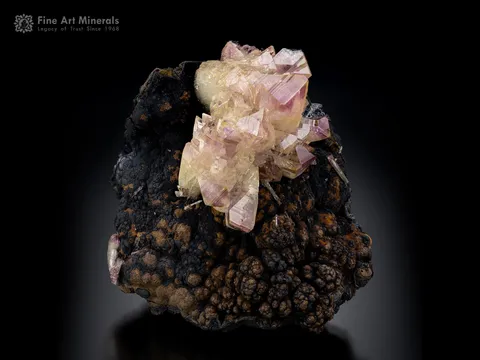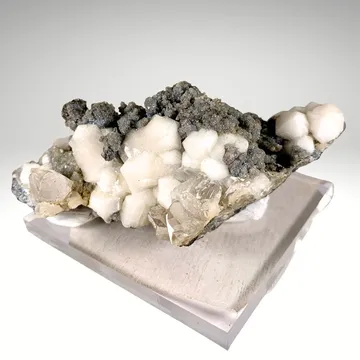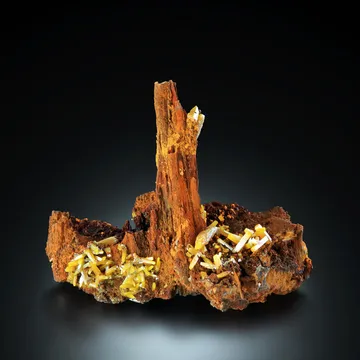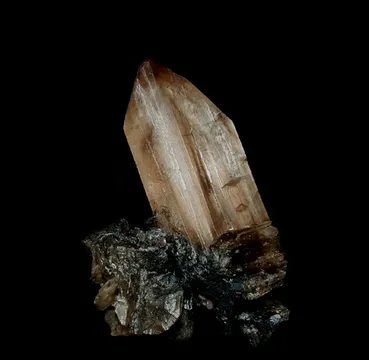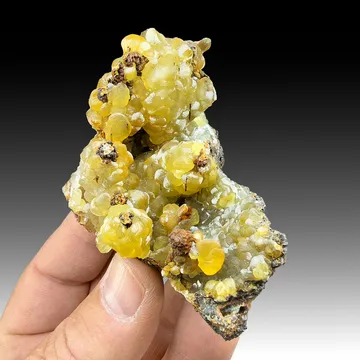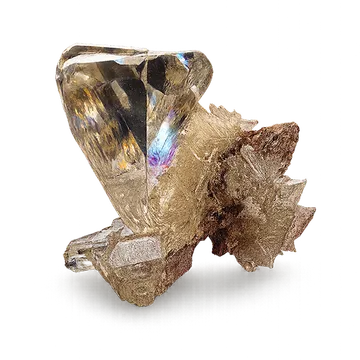
Cerussite from Ojuela Mine, Mexico - sharp, lustrous translucent to white crystals; prized for reticulated and snowflake twins on contrasting oxidized matrix.
Key facts
Cerussite from the Ojuela Mine occupies an unusual niche in the Mapimí pantheon. Ojuela is celebrated first for adamite, legrandite, paradamite, mimetite, wulfenite, aurichalcite, rosasite, hemimorphite, and a bewildering suite of rare arsenates; cerussite, though once one of the major ore minerals of the district, is much less often encountered as fine display material. That contrast is exactly what gives good Ojuela cerussite its collector appeal: the species belongs to the very core of the ore system, but the attractive crystals are select, fragile, and far less abundant on the specimen market than the locality’s famous zinc arsenates.
The best Ojuela cerussites are not the massive, dull, ore-grade carbonate that miners knew so well, but sharp, lustrous, translucent to white or smoky twins on oxidized matrix. Collectors prize the reticulated and “snowflake” twinned groups, V-twins, isolated twins, and small but crisp crystal sprays perched on the mine’s iron-rich gossan. The most characterful specimens combine white or colorless cerussite with deep brown goethite-limonite matrix, golden pyrite, velvety malachite, or classic Ojuela lead-zone companions such as mimetite and wulfenite.

Photo: MineralAuctions.com
Geologically, Ojuela is a huge oxidized Ag-Pb-Zn-Cu-Au carbonate-replacement system developed in the carbonate rocks of the Sierra de Mapimí. The ore bodies rose through the limestones and dolostones as chimneys and mantos, and the oxidation of arsenopyrite-, galena-, sphalerite-, and pyrite-bearing sulfide ore produced a deep and chemically complex supergene environment. In that oxidized column, lead remained relatively immobile compared with zinc and became concentrated as argentiferous cerussite, while zinc was leached outward and reprecipitated in the surrounding secondary zinc mineral shells that would later yield Ojuela’s great adamite, legrandite, hemimorphite, and related species.
The finest cerussites therefore tell two stories at once. They are attractive miniature-scale lead carbonate crystals in their own right, but they are also windows into the same oxidation engine that made Ojuela one of the great mineral localities of the Western Hemisphere. A collector building a serious Mapimí suite should not treat cerussite as an afterthought; it is one of the species that connects the spectacular specimen mineralogy to the mine’s original economic heart.

Photo: Marin Mineral Company
Search for specimens: View all cerussite specimens from Ojuela Mine, Mexico
The Ojuela Mine is near Mapimí, in northern Durango, Mexico, at the northeastern escarpment of the Sierra de Mapimí. It is not a single simple vein but a large mine complex with many named shafts, stopes, chimneys, mantos, and levels. Historic accounts describe a vast network of workings, with ore bodies such as Ojuela or Paloma, San Judas, San Antonio or Cumbres, San Ignacio or Monterrey, San Vicente, San Nicolás, San Jorge-San Juan, Santa Rita, San Carlos, Socavón, and America Dos appearing in the mine’s long technical and collecting history.
The deposit is a Mexican-style carbonate replacement deposit, formed where mineralizing fluids replaced favorable beds and structures in Cretaceous carbonate rocks. The important host rocks include limestones, dolomitic limestones, and dolostones, especially in the Paila and Cuesta del Cura formations. Ore was localized by folding, thrusting, fractures, faults, and chemically and physically receptive carbonate beds. Ojuela’s great chimneys and mantos are classic examples of how replacement mineralization can blossom laterally through favorable beds while also rising vertically along structural conduits.
Primary mineralization was dominated by sulfides such as argentiferous galena, sphalerite, pyrite, arsenopyrite, and locally chalcopyrite, with gangue including calcite, quartz, fluorite, and iron oxides. The unusually arsenic-rich character of the sulfides explains much of Ojuela’s secondary mineral fame. Oxidation extends to extraordinary depth, and acidic, metal-bearing waters moving through the ore and carbonate walls created cavities, dissolved and reprecipitated material, and generated the supergene mineral assemblages for which the mine is famous.
Cerussite formed as an alteration product of galena and anglesite in these oxidized lead-rich zones. Much of the cerussite in the mine was not specimen-grade crystal material, but banded alteration rims on anglesite resting on massive galena. Economically, argentiferous cerussite was a major ore target. Mineralogically, the more collectible material occurred where twinned cerussite crystals grew free enough to show form, often in goethitic cavities or in association with other lead-zone minerals.
Ojuela was discovered by Spanish prospectors in 1598 and was worked for silver through the colonial period. During the nineteenth century and especially under the Compañía Minera de Peñoles, the mine was transformed into a major industrial operation. Peñoles acquired the Ojuela property in 1891 and modernized the district with rail links, electric power, deep shafts, pumps, compressed-air drilling, smelting facilities, and the famous suspension bridge across the canyon to the mine workings. Around the turn of the twentieth century, the operation supported a large miners’ settlement at Ojuela and produced substantial lead-silver ore.
Industrial production declined in the twentieth century. Flooding in the lower workings became a major problem in the early 1930s, and large-scale ore mining was effectively finished by the mid-1940s. After that, local cooperative miners continued small-scale work, and the mine increasingly became a specimen locality. The great post-ore-mining era of Ojuela collecting began with major finds in the 1940s and continued through later pocket discoveries of adamite, legrandite, wulfenite with mimetite, hemimorphite, aurichalcite, calcite, rosasite, and many rarer species.
Modern access is not casual collecting. Ojuela is a historic mine and tourist destination, with guided visits in portions of the old workings and the restored suspension bridge forming part of the site’s public identity. Serious specimen production has historically depended on permission, contracts, local miners, and export arrangements rather than open rockhounding. Collectors should assume that underground collecting is controlled, dangerous, and not available without proper authorization.
Ojuela cerussite is PbCO3 and typically appears in the visual language of oxidized lead deposits: colorless, white, grayish, faintly smoky, or included crystals on dark, iron-rich matrix. The most desirable pieces show high luster, translucency, sharp terminations, and a balanced contrast between bright cerussite and the red-brown to black gossanous host.
Crystal habit is the key to the locality’s appeal. Reticulated clusters of twinned cerussite, cyclically twinned crystals, V-twins, and isolated twins are all documented from Ojuela. Published descriptions record twinning on 110 and 130, with the best isolated twins twinned on 130. Reticulated “jackstraw” or “snowflake” groups are especially attractive when they sit cleanly on matrix rather than disappearing into massive ore.
Crystal size is generally modest. Fine Ojuela cerussite is normally a miniature- to small-cabinet-scale pleasure rather than a giant-crystal locality. Classic literature notes good crystals to about 2 cm, while market examples commonly emphasize individual blades or twinned groups in the millimeter to low-centimeter range. A 1.5 to 2 cm sharp, lustrous, undamaged Ojuela twin can be much more important than its size suggests because fine cerussite is not common from this mine.
The principal matrix is oxidized lead ore: goethite, limonite, altered galena, anglesite, and porous gossan. Associated minerals documented with Ojuela cerussite include pyrite, malachite, goethite, fluorite, quartz, beudantite, ojuelaite, azurite, mimetite, wulfenite, and limonite. Published accounts also note cerussite with massicot, rosasite, plattnerite, nantokite, aurichalcite, and pseudomorphic material after anglesite and possibly hemimorphite.
The finest examples show three qualities at once: recognizable Ojuela matrix, undamaged twinning, and attractive association. Cerussite with malachite is especially showy because the white to colorless lead carbonate stands against velvety green copper carbonate. Cerussite with pyrite has a different appeal: bright lead carbonate lattices and golden metallic cubes on oxidized matrix. Cerussite with mimetite or wulfenite links the species directly to the classic Mapimí lead-zone palette.
Collectors should distinguish between ore significance and specimen significance. Cerussite was abundant enough as ore to matter economically, but attractive crystallized specimens are not abundant relative to Ojuela’s better-known species. Massive, dull, banded, or earthy cerussite-bearing ore is mineralogically authentic but not comparable to sharp twinned specimens. For advanced collectors, labels noting specific Ojuela sublocalities such as San Juan Poniente or Level Four add interest when credible, because cerussite is documented from those parts of the mine.
Condition is the central issue with Ojuela cerussite. Cerussite has good density, bright luster, and strong visual presence, but the twinned lattices and reticulated groups are mechanically vulnerable. Damage commonly appears as missing blade tips, bruised twin junctions, broken reticulated arms, or small detached crystals. The matrix can also be friable, especially where the specimen is built on decomposed galena, goethite, or porous gossan.
Restoration is possible and should be expected as a question on important pieces. A reattached crystal is not automatically disqualifying if it is disclosed, stable, and priced accordingly, but undisclosed repairs are a real concern because white or colorless cerussite can hide glue lines along natural contacts and twin seams. Examine suspect pieces with magnification and oblique light. Pay close attention to junctions where a V-twin meets a main crystal, and to places where a reticulated group contacts a soft matrix.
Authentic locality attribution matters. Ojuela is such a famous name that many Mexican minerals have historically been assigned to it too casually. Published warnings note that specimens from other Mexican localities have been sold as Ojuela, including mimetite, smithsonite, pyromorphite, and other secondary minerals. This problem is not limited to cerussite, but it affects any species whose appearance overlaps with other oxidized lead-zinc districts. A high-quality Ojuela cerussite should ideally come with an old label, a reputable dealer history, a known collection pedigree, or a documented modern source.
There are also documented Ojuela-related deceptions in the broader specimen trade. Reports include fabricated specimens from shops in the Bermejillo-Mapimí area, artificially colored blue hemimorphite marketed as Ojuela material, and likely man-made kobyashevite offered from the mine. These are not cerussite-specific treatments, but they reinforce the collector’s rule for the locality: buy the specimen and the provenance, not just the famous name on the label.
Rarity is relative. Cerussite as a mineral is common worldwide, and Ojuela as a mine produced lead carbonate abundantly as ore. Fine crystallized Ojuela cerussite, however, is not common in the way Ojuela adamite or mimetite is common. Market examples appear sporadically rather than continuously, and many are small. Good matrix specimens with clean twinning, strong luster, and little damage deserve attention, especially when paired with malachite, pyrite, mimetite, or wulfenite.
On the current collector market, expect Ojuela cerussite to appear mostly as miniatures and small-cabinet specimens from established dealers, auction archives, and older collections. Prices respond strongly to completeness and aesthetics. A visually coherent reticulated twin on contrasting matrix will outperform a larger but damaged or massive example. For a serious Ojuela suite, one well-chosen cerussite can add depth: it represents the lead-carbonate ore core of the deposit, not merely another accessory species.
The Ojuela story begins with a name that still feels half mineralogical and half folkloric. One explanation traces “Ojuela” to Don Pedro de Ojuela, said to have been an early missionary. Another points to a hole like the eye of a needle high on the mountain, an “ojito” in stone. The explanation favored by miners is more fitting for a lead-silver deposit: hojuela, an old Spanish mining term for leafy argentiferous galena. It is easy to picture the first Spanish prospectors in 1598 finding lead-gray, leaf-textured ore in the canyon and naming the place for the metal itself.
By the Peñoles boom years, Ojuela had become an industrial mountain town. The company built housing for miners and families, supplied water from Mapimí, provided public baths with hot and cold water, maintained a school with two teachers, stores, a theater, a doctor, and a hospital in town. Around 1905, roughly 5,000 people lived at the mine settlement. The miners crossed the canyon on a narrow suspension bridge and worked a labyrinth of shafts, stopes, mantos, and chimneys below the Sierra de Mapimí.
That bridge became the great emblem of the mine. It was built to connect the Ojuela settlement to the No. 4 shaft complex and measured more than 325 meters long and less than two meters wide, hanging high over the arroyo on steel cables. From the midpoint, one could look down toward the black opening of the old boca mina, the Discovery hole below the village bluff. At the far end were the mine entrance and old openings, one of them later sealed with a steel grating. A grim local story from the 1970s tells of a woman who fell at an open shaft collar and, as she toppled, managed to throw her infant child to her husband.
The working life underground could be punishingly archaic even when the surface plant looked modern. Before rail and hoist systems took over the bulk of the work, miners carried ore in leather or ixtle-fiber sacks suspended from forehead straps, with loads reported up to 200 pounds. Old steps cut into the limestone of the Bufa de Mapimí still recalled those ascents from the canyon. Later accounts still mention “chicken ladders,” notched logs used in primitive winzes and awkward underground passages. The phrase sounds almost comic until one imagines descending hundreds of meters through old workings by lamp, timber, sweat, and nerve.
For collectors, the mine changed character after ore mining declined. Crystals that once would have been crushed as ore became riscos, “treasure.” The 1946 adamite grotto discovered by Dan Mayers and Francis Wise was the moment that truly announced Ojuela to specimen collectors. Manuel López later remembered working the great pocket with George Griffith’s team, loading tons of specimens into sacks as earlier miners had loaded tons of ore. Burros carried the sacks down to the valley. Griffith’s Casa de Las Rocas in Gómez Palacio became a mineralogical waystation, part shop and part informal school where local miners learned how to recognize and handle delicate specimens rather than destroy them.
The underground world retained a strange economy of its own. Cooperative miners, buscones, and later risceros competed for ore and specimens in the old workings. Around 1960, some 50 unauthorized treasure-seekers were reportedly active, and confrontations underground were not unusual. In later years, specimen mining became more formalized through contracts, most notably under Mike New and Top Gem Minerals, who worked with local miners and marketed Ojuela specimens internationally.
Even the animals became part of Ojuela lore. Ore-carrying mules were sometimes brought into the mine and left underground for the rest of their lives, where overwork and darkness could leave them wasting away or blind. Thousands of large rats lived in the mine as well, disposing of mule manure in an unintended but practical symbiosis with miners and animals. Such details belong to the same mine that produced elegant crystals of adamite, legrandite, and cerussite: beauty above the table, hardship behind the pocket.
The trade around Mapimí had its own bright and shadowed chapters. Mid-century visitors could find real Ojuela treasures in Bermejillo and Mapimí shops, but the fame of the locality also encouraged mislabeling and outright fabrication. One reported Bermejillo shop owner made fakes such as legrandite crystals inserted into nearly closed adamite pockets and celestine crystals glued to whatever matrix was available. That history is one reason old Ojuela labels can be wonderful but not infallible, and why experienced collectors study both the mineral and the story attached to it.