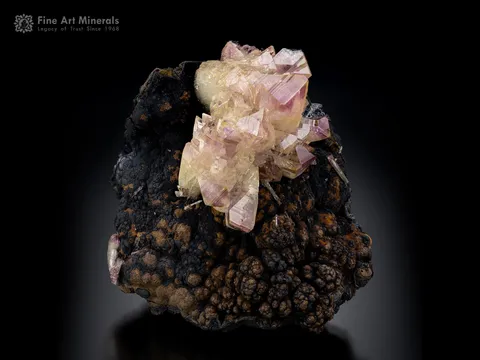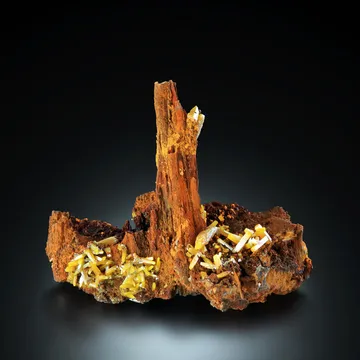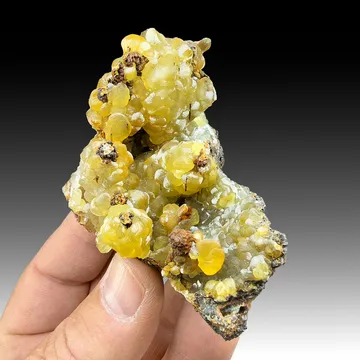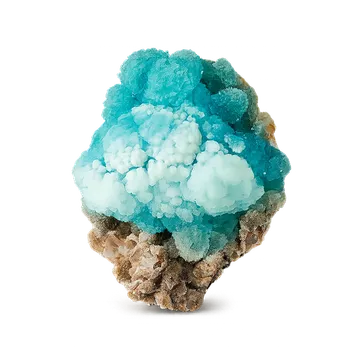
Hemimorphite from the Ojuela Mine, Mexico — classic oxidized-zone crystals, glassy colorless to milky blades, and collector-focused quality factors.
Key facts
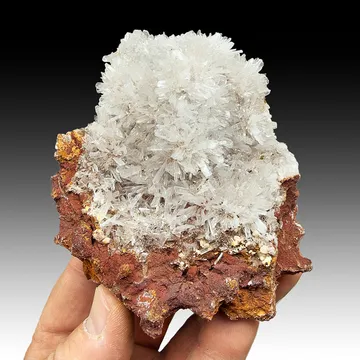
Hemimorphite from the Ojuela Mine is one of the quiet classics of Mapimí: not as fluorescently famous as Ojuela adamite, not as golden and theatrical as legrandite, but instantly recognizable to collectors who love the mine’s oxidized-zone aesthetics. The best pieces are glassy, colorless to milky white prismatic blades and sheaves rising from rusty brown limonite gossan, commonly with calcite, mimetite, rosasite, aurichalcite, plattnerite, or adamite close by in the same mineralized cavities. On fine examples the contrast is almost architectural: water-clear zinc silicate crystals standing upright from crumbly iron oxide, like ice growing out of desert soil.

Photo: Wikimedia Commons
The Ojuela Mine lies in the Mapimí district of Durango, at the northeastern escarpment of the Sierra de Mapimí. The deposit is a northern Mexican limestone-replacement system: primary sulfides including sphalerite, argentiferous galena, pyrite, and arsenopyrite were later deeply oxidized, giving rise to the exceptional secondary mineral suite for which Ojuela is renowned. Hemimorphite, Zn4Si2O7(OH)2·H2O, belongs to that oxidized zinc environment, typically forming where zinc-bearing sulfides have been altered in open, limonitic cavities.

Photo: Wikimedia Commons
The locality’s historical weight adds greatly to the appeal. Ojuela was founded in the Spanish colonial period, modernized under Peñoles in the late nineteenth century, and later became one of Mexico’s most studied and beloved mineral localities. It is a place where specimen mining and mining history overlap: a world-class oxidized orebody, a ghost town, a dramatic suspension bridge, and a steady trickle of fine mineral specimens entering collections long after large-scale ore extraction ended.
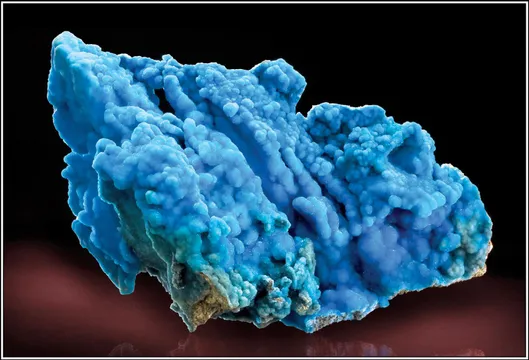
For hemimorphite specifically, collectors look for undamaged, upright crystals with bright vitreous luster, strong transparency or translucency, and an aesthetic balance between isolated blades and fanlike aggregates. The most desirable Ojuela pieces are not merely coatings; they show well-terminated prismatic crystals, often several centimeters long, perched on contrasting iron-rich matrix. Pale blue examples exist and can be attractive, but they require special caution because a widely discussed group of vivid blue Ojuela hemimorphites was analytically shown to be artificially colored.
Search for specimens: View all hemimorphite specimens from Ojuela Mine, Mexico
The Ojuela Mine is in Mapimí, Mapimí Municipality, Durango, Mexico, in the arid Bolsón de Mapimí region. Mineralogically it is best understood as a large limestone-replacement deposit with strong structural control: fractures and favorable dolomitic horizons localized the ore, while large caves, pipes, and oxidized cavities provided space for later secondary mineral growth. The original ore system was rich in lead, silver, zinc, arsenic, and iron; the later oxidized environment transformed that chemistry into the complex arsenate, silicate, carbonate, sulfate, oxide, and hydroxide assemblages for which Ojuela is famous.
Large-scale mining history at Ojuela is long and layered. The mine is recorded as founded in 1598, and rich secondary silver ores were worked at shallow depth from the early colonial period. By the late nineteenth century, Peñoles-era modernization transformed the district. Electric power, large drills, a rack railway, improved ore transport, and the famous suspension bridge were introduced to connect workings and move ore efficiently across the canyon. The mining town grew with the operation, then declined as ore reserves and drainage economics became unfavorable. Major industrial mining ended in the early twentieth century, but smaller-scale work, specimen recovery, tourism, and local collecting activity continued in different forms.
The deposit’s fame among mineral collectors came later than its mining fame. W. F. Foshag’s 1927 visit helped bring Ojuela to the attention of mineralogists, and the spectacular 1946 adamite pocket found by Dan Mayers and Francis Wise established the mine’s specimen reputation on a world stage. Since then, Ojuela has become a standard reference locality for adamite, legrandite, paradamite, köttigite-parasymplesite, aurichalcite, rosasite, plattnerite, mimetite, wulfenite, fluorite, calcite, and hemimorphite. It is also the type locality for several rare species, including paradamite, lotharmeyerite, metaköttigite, mapimite, and ojuelaite, and it remains one of the most species-rich Mexican localities in collector literature.
For collecting access, Ojuela should not be treated as an open recreational collecting site. The mine and bridge are a heritage and tourism destination, with guided access to historic workings and the bridge area, while specimen recovery is tied to local miners, concession arrangements, and small-scale work. Collectors should acquire pieces through reputable dealers or documented older collections rather than assuming that casual collecting is permitted. Good Ojuela specimens still appear on the market, but fine hemimorphite is sporadic rather than abundant, especially in larger, damage-free cabinet pieces.
Notable hemimorphite finds include older colorless-to-white crystal groups from the late twentieth century and small groups of later material. Many commercial examples are thumbnails to small cabinets, but Ojuela has produced large individual crystals and handsome cabinet plates. Pieces with sharp, glassy blades on clean limonite matrix are the benchmark; hemimorphite intergrown with calcite, mimetite, aurichalcite, or rosasite can be especially attractive when the associated minerals create contrast without obscuring the hemimorphite.
Ojuela hemimorphite is most admired in sharp prismatic and bladed crystals rather than massive botryoidal crusts. Classic specimens show colorless, white, translucent, or water-clear crystals in sprays, sheaves, subparallel fans, and upright individual blades. The crystal faces can be brightly lustrous, sometimes mirrorlike, with fine vertical striations and gemmy terminations. Good examples have a lively sparkle that distinguishes them from duller white zinc minerals on the same brown gossan matrix.
Color is usually the first diagnostic cue for experienced collectors. The typical Ojuela look is colorless to white, sometimes with pale cream or faint bluish tones. Light blue to greenish-blue material has been reported and sold, but the strongest, saturated electric-blue pieces are not representative of classic Ojuela hemimorphite and must be treated with caution. In normal Ojuela material, the visual drama comes less from color than from transparency, luster, crystal size, and contrast against red-brown limonite.
Typical specimen sizes range from thumbnails and miniatures to small cabinets. Many market pieces measure roughly 3–7 cm across, with individual crystals from a few millimeters to around 2–3 cm. Better cabinet specimens may carry crystal fans around 4 cm, and exceptional examples can show individual crystals exceeding 5 cm. Large plates with many complete, upright crystals are much scarcer than small drusy or clustered pieces.
The most common matrix is limonitic gossan: rusty, earthy, iron-rich material derived from the oxidation of sulfides. This matrix is visually perfect for hemimorphite but physically troublesome, because it can be soft and friable. Calcite is a frequent companion, occurring as colorless to pale rhombs, compressed rhombs, or disk-like forms. Other documented associates include rosasite, mimetite, aurichalcite, plattnerite, adamite, hydrozincite, wulfenite, dolomite, conichalcite, goethite, smithsonite, chalcophanite, hematite, fluorite, malachite, bayldonite, murdochite, arsendescloizite, quartz, baryte, arseniosiderite, and rarer species in the broader oxidized assemblage.
Quality is judged by a combination of crystal definition, luster, openness, and matrix contrast. The best Ojuela hemimorphites have complete terminations, free-standing crystals, minimal bruising, and enough negative space for the crystals to read individually. A specimen with a few tall, transparent blades can be more desirable than a busy plate of broken or crowded crystals. Collectors also prize pieces where hemimorphite is clearly the star, rather than a white background mineral partly hidden under calcite or later coatings.
Condition is particularly important. Hemimorphite crystals have a brittle, glassy look and can chip at exposed tips. The limonite matrix can shed grains or crumble along trimmed edges. On older pieces, look carefully for glued repairs, matrix stabilization, broken crystal tips, and old dust caught between blades. None of these issues automatically disqualify a specimen, but they should be reflected in price and disclosure.
Some Ojuela hemimorphite fluoresces green under ultraviolet light, with reports of response under multiple UV wavelengths and strongest response in midwave on at least one documented specimen. That response is not universal enough to be used as an identity test, but it can add interest for collectors of fluorescent minerals when present.
The main authenticity issue for Ojuela hemimorphite is blue color. In 2020, striking electric-blue hemimorphite specimens attributed to Ojuela entered discussion in the mineral community. Laboratory work by Dr. John Rakovan and his Miami University research group examined representative crystals using powder X-ray diffraction, Raman spectroscopy, scanning electron microscopy, energy-dispersive X-ray spectroscopy, and optical microscopy. The hemimorphite itself was real, but the blue color was identified as a surface film matching Phthalocyanine Blue BN, a synthetic copper-bearing pigment widely used in paints and dyes. The coating was uneven and concentrated in surface depressions such as striation troughs and intergrown crystal edges.
This matters because the fakes were more sophisticated than simple dye jobs. Powder X-ray diffraction could show only hemimorphite, and EDS could detect copper in the blue film, potentially misleading a collector into thinking the color was caused by copper in the mineral. The blue pigment is also resistant to many common solvents, making ordinary “wipe tests” unreliable. The lesson is straightforward: vivid blue Ojuela hemimorphite should not be bought on appearance alone. A trustworthy old label, credible provenance, restrained natural color, and dealer disclosure are essential; for high-value pieces, analytical confirmation is the safest route.
Natural, pale blue Ojuela hemimorphite has been reported, and some pieces with light blue or greenish-blue crystals may be legitimate. These are best approached case by case. Look for color that is subtle, internally consistent, and not merely pooled in surface grooves. Be wary of intense, uniform, neon, or “Windex” blue color, especially if the matrix and associated calcite look oddly clean compared with the hemimorphite.
For ordinary colorless to white specimens, the authenticity concerns are much lower, but condition concerns remain. Ojuela limonite matrix is often soft and can be crumbly. Trimmed matrix edges may shed powder, and older specimens may have been hardened or stabilized. Carefully inspect tall freestanding crystals for repaired tips, impact marks, and missing terminations. Because hemimorphite blades can be transparent, small chips may disappear under casual lighting and become obvious only under a loupe or raking light.
Availability is moderate but uneven. Small Ojuela hemimorphites appear regularly from dealer inventories, older collections, and online auctions. Fine cabinet specimens with large, glassy, complete crystals are far less common and command a premium. Recent market examples show the spread clearly: modest thumbnails and miniatures can be accessible, while aesthetic small cabinets and large cabinets with undamaged crystal groups can climb into the mid hundreds or higher, especially when crystals are tall, glassy, and well isolated on limonite.
Provenance adds value. Older Ojuela material from late twentieth-century finds, pieces from major dealers, and specimens carrying old collection labels are more desirable than anonymous recent stock. Labels that specify a sublocality or stope, such as San Judas, Santo Domingo, Cumbres, Palomas Oriente, La Esperanza, or San Juan Poniente, are especially worth preserving, though hemimorphite labels are often less specific than labels for rarer Ojuela arsenates.
The most famous specimen story from Ojuela is not a hemimorphite story, but it explains why collectors still speak of the mine with a kind of reverence. In June 1946, Dan Mayers and Francis Wise were moving through the Las Palomas ore body, just above the 11th level, on their way to a stope known for wulfenite and green mimetite. Their lamps caught a pocket in the limestone. It was roughly four feet across and four feet deep, a small chamber lined with yellow-green adamite crystals in undulating waves. Mrose later called it a “glorious sight,” and the phrase feels restrained for what followed. Miners were put to work immediately. One specimen weighed 75 pounds underground and was nearly three feet square before trimming; it later entered the U.S. National Museum. Two other important pieces went to Harvard. That 1946 pocket made clear that Ojuela was not only an old ore producer but a specimen mine of international importance.
The bridge story is just as vivid, but in iron, timber, and cable instead of crystals. By the 1890s, Peñoles needed to move ore more efficiently across the canyon between the workings and the processing route. The modernization program brought electric power, drilling equipment, a rack railway, and a suspension bridge whose cables and connections were supplied by John A. Roebling’s Sons Company. Engineering accounts name Wilhelm Hildenbrand in design and supervision, Henry G. Tyrrell as assistant engineer, and Santiago Menghini as construction engineer. The bridge replaced the slow work of pack animals and long detours around the hill with ore cars pushed across a central rail. In the same period the community around Ojuela swelled into a real mining town: by 1900, one engineering-history account gives 3,590 inhabitants, with schools, commerce, a cinema, a hotel, Mexican and foreign casinos, a chapel, a pharmacy, and nursing facilities. Today the mining town is a ghost town, but the bridge remains the visual emblem of the district.
The blue hemimorphite episode belongs to the modern era of collecting, where a specimen can become famous worldwide before anyone has held it under a microscope. In 2020, vivid blue crystals attributed to Ojuela appeared in photos and videos. The color was so startling that collectors split almost immediately between excitement and suspicion. The story had all the ingredients of a modern mineral drama: claims of a newly exposed flooded zone, clean specimens supposedly filmed underground, associated calcite that did not look stained, and a color strong enough to make experienced collectors uneasy. When samples were analyzed, the result was more interesting than a simple “dyed” verdict. The crystals were hemimorphite, but Raman spectroscopy revealed the blue film as Phthalocyanine Blue BN. The pigment was thin enough that ordinary bulk methods could miss it, and copper in the pigment could misdirect simple elemental analysis. The episode has become a cautionary tale for Ojuela buyers: the most spectacular color is not always the most collectible color.