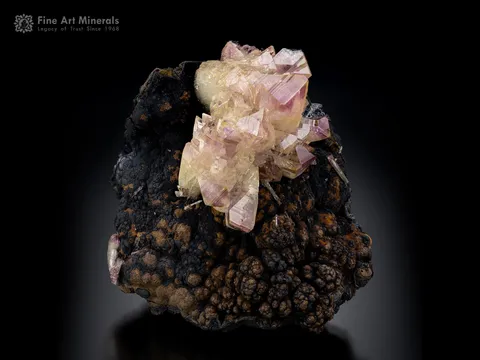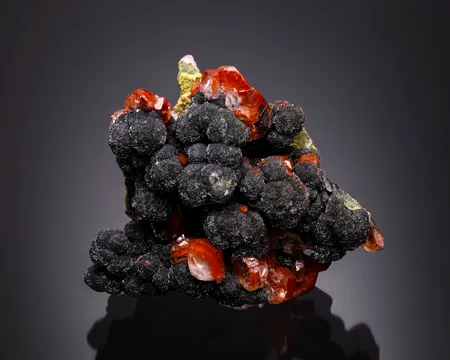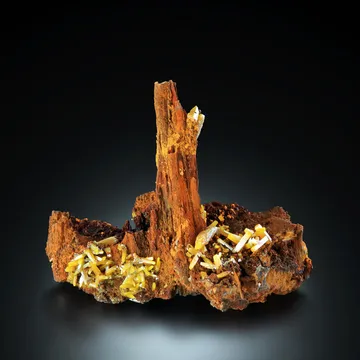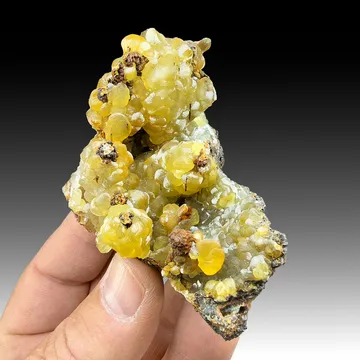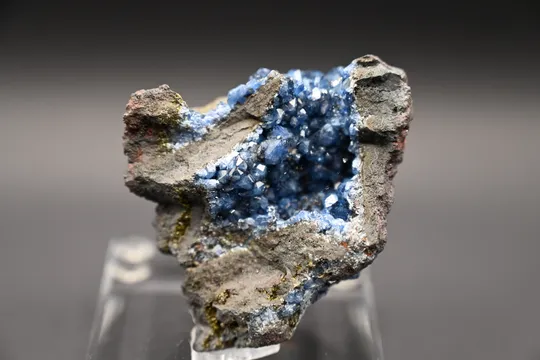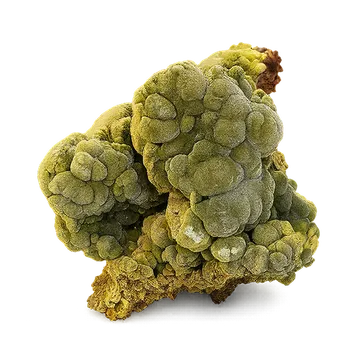
Ojuela Mine Mottramite from Mexico - velvety olive-green botryoidal crusts on iron-oxide matrix, a famous locality prized by collectors for color and contrast.
Key facts
Mottramite from the Ojuela Mine is one of the more recent surprises from a locality that collectors thought they knew almost exhaustively. Ojuela had already secured its place among the great Mexican specimen mines through adamite, legrandite, paradamite, wulfenite, rosasite, aurichalcite, hemimorphite, and a formidable suite of oxidized arsenates and phosphates. Then, in late 2011, level 35 produced rich, visually distinctive mottramite: velvety to silky botryoidal crusts and spheroidal aggregates in deep olive green, greenish brown, and nearly black-green tones, commonly on the iron-oxide-rich limonitic matrix so characteristic of the mine.

Photo: Daderot, Wikimedia Commons
The appeal is not simply that mottramite is “another species” from Ojuela. The best examples from the 2011 material are handsome, sculptural specimens in their own right: rounded, grape-like surfaces with a soft sheen, often forming complete carpets over thin gossan plates or knobs. On better combination pieces, yellow to orange wulfenite crystals rise from the darker mottramite base, giving a classic Ojuela color contrast: warm molybdate tablets and prisms against mossy vanadate botryoids.
Geologically, the setting is exactly the kind of oxidized polymetallic system in which mottramite can thrive. Ojuela is a carbonate-replacement Ag-Pb-Zn deposit in folded limestone and dolomite of northern Mexico, with ore bodies developed as chimneys, pipes, mantos, and replacement zones along fractures and favorable dolomitic horizons. Long exposure to oxygenated groundwater produced one of the world’s great deep oxidation environments, converting primary sulfides into a spectacular secondary suite. Mottramite, PbCu(VO4)(OH), belongs to that late oxidized story: lead, copper, and vanadium were mobilized and recombined in small cavities, coatings, and crusts on iron-rich matrix.
For collectors, the best Ojuela mottramite offers several things at once: a famous locality, a discrete modern find, a recognizable habit, and a mineralogical link to the mine’s wulfenite-bearing oxidized assemblages. Choice pieces are judged by the richness and continuity of the botryoidal coverage, the depth and evenness of the olive-green to brown-green color, the silky surface texture, lack of bruising on the rounded forms, and—when present—the placement and condition of associated wulfenite.
Search for specimens: View all mottramite specimens from Ojuela Mine, Mexico
The Ojuela Mine lies near Mapimí in northern Durango, Mexico, at the base of the Sierra de Mapimí in the Chihuahuan Desert region. The locality is a group of mine workings rather than a single tidy shaft, and its reputation rests on both its scale and its oxidized mineralogy. Historic descriptions emphasize the labyrinthine character of the workings: large chambers, pipes, caves, and replacement bodies separated by barren limestone, with mineralization controlled by fractures and by receptive dolomitic horizons.
The deposit is classically described as a carbonate-replacement Ag-Pb-Zn system. In such deposits, metal-bearing hydrothermal fluids move through fractured carbonate rocks and replace limestone or dolomite with sulfides and skarn-related assemblages. At Ojuela, later oxidation transformed the upper and accessible portions of the ore system into a remarkably diverse suite of secondary species. The primary economic metals were silver, lead, zinc, with gold and copper in lesser but significant amounts; the secondary specimen suite reflects the same chemistry enriched by arsenic, vanadium, molybdenum, and other elements.
Mining at Mapimí began in the Spanish colonial period, with early work focused on rich oxidized silver and lead ores near the surface. By the late nineteenth century, Ojuela had become a major lead-silver operation under modernized management, with large-scale underground development, transport infrastructure, and smelting support. In the twentieth century, production declined as rich ore was depleted and water problems became more serious. The postwar era brought a different kind of productivity: independent miners and cooperatives leased portions of the workings, and the mine became a steady source of mineral specimens for the international market.
Ojuela’s specimen history is inseparable from its deep oxidation. Adamite pockets publicized after the 1940s drew collectors and dealers to the mine; later decades produced superb legrandite, paradamite, köttigite-parasymplesite, rosasite, aurichalcite, hemimorphite, calcite, fluorite, wulfenite, mimetite, plattnerite, and many rarer species. Mottramite joined that roster as a significant collector mineral only much later, with the late-2011 level 35 material that reached the market around the 2012 Tucson show.
Modern collecting access should not be romanticized. Ojuela is an active or intermittently active mining locality with private, cooperative, and tourist-related controls, and the extensive underground workings include old, unstable, and flooded areas. Collectors generally acquire Ojuela mottramite through dealers, miners, and collections rather than by casual field collecting. Labels that specify level 35 and a November 2011 date are especially desirable for the classic mottramite find.
The standard Ojuela mottramite habit is botryoidal to mammillary rather than sharply crystallized. The best surfaces are made of closely packed, rounded spheroids—sometimes described by dealers and collectors as bubbly, cauliflower-like, or grape-like—with a velvety, silky, or softly lustrous appearance. Individual crystals are typically microscopic or hidden within radiating aggregates, so the collector reads the specimen through texture, color, and overall architecture rather than through crystal faces.
Color is central. Ojuela material ranges from dark olive green through tobacco green and greenish brown to nearly black-green. Fresh, high-quality examples show a deep, even olive tone; lesser pieces can look dull brown, sooty, or patchy. Because mottramite lies in solid solution toward descloizite and can show chemical overlap or visual confusion with other green secondary copper-lead minerals, a fine label or analytical provenance adds real value.
Typical sizes range from thumbnails and miniatures to small-cabinet and cabinet plates. Dealer-documented specimens from the 2011 level 35 find include miniatures around 5 cm across, small-cabinet pieces around 7–9 cm, and larger cabinet specimens exceeding 11–13 cm. The most attractive pieces are not necessarily the largest; a compact miniature with complete, undamaged botryoidal coverage and one or two well-placed wulfenites may be more desirable than a broad but bruised crust.
The most important association is wulfenite. Ojuela wulfenite on mottramite occurs as yellow, orange-yellow, or deeper orange crystals, commonly tabular to short prismatic, perched on the mottramite surface or rising from the same limonitic matrix. These combinations are prized because the two species tell a coherent oxidized lead-system story: vanadate mottramite and molybdate wulfenite crystallizing in the same late-stage environment. Other documented associates for Ojuela mottramite include calcite, limonite, baryte, plattnerite, rosasite, chalcophanite, legrandite, scrutinyite, adamite, goethite, and quartz.
Collectors should distinguish three broad modes of appearance. First are pure mottramite plates: carpets of rounded, dark olive-green botryoids on thin gossan or limonite. Second are wulfenite-on-mottramite combinations, often the most displayable and commercially popular form. Third are mixed oxidized assemblages in which mottramite is present as a coating or secondary accent with calcite, conichalcite, malachite, rosasite, or other green minerals. The first two are the classic Ojuela mottramite types; the third can be attractive, but identification is more dependent on careful labeling or analysis.
Quality is controlled by coverage, contrast, surface freshness, and condition. Strong specimens show continuous botryoidal growth rather than scattered stains, a deep olive to brown-green color that is recognizably mottramite, and rounded forms with minimal rubbing. Wulfenite combinations improve greatly when the crystals are sharp, lustrous, undamaged, and aesthetically spaced. Matrix also matters: the orange-brown to dark-brown limonitic Ojuela gossan provides a natural frame, but friable, powdery, or overly massive matrix can make a piece less refined.
The main authenticity issue with Ojuela mottramite is not a well-documented treatment of mottramite itself, but the broader Ojuela problem: the mine’s fame makes its name marketable, and unrelated Mexican material has sometimes been sold as Ojuela. Mindat’s locality page specifically warns that various minerals attributed to Ojuela have in fact come from other Mexican localities, and it also records artificial or suspect material for some other Ojuela-attributed species. For mottramite, the prudent approach is to prefer specimens with precise provenance, especially labels referencing the level 35, November 2011 find, or dealers who supplied analytical confirmation.
Identification can be tricky. Dark green botryoidal coatings from Ojuela may be visually confused with duftite, descloizite, conichalcite, malachite, rosasite, or mixed copper arsenate/vanadate coatings. Mottramite and descloizite form a solid-solution series, and mottramite also has chemical kinship with duftite through arsenate-vanadate substitution. A label saying “mottramite” is best when supported by a reputable source or analysis; for high-value examples, SEM-EDS, XRD, or a known analytical chain is worth seeking.
Condition issues are typical of soft secondary vanadates on gossan. Mottramite has low hardness, and Ojuela botryoids can show rubbed high points, flattened bubbles, edge chipping, dusty surfaces, or bruised areas where the velvety sheen has been lost. Iron-oxide matrix may be crumbly. Wulfenite associations add another vulnerability: the wulfenite crystals can be chipped, contacted, or reattached, and even small edge damage is noticeable against the dark mottramite base.
Rarity is nuanced. Ojuela itself is prolific, and mottramite from the 2011 find is obtainable compared with many true Ojuela rarities. But excellent examples—rich, fresh, undamaged, well-colored, and ideally with fine wulfenite—are far less common than ordinary dark crusts. The find appears to have been a discrete event rather than continuous production, so better pieces now mostly circulate through dealer inventories, auctions, and older collections.
Market availability remains active but uneven. Small to mid-sized pure mottramite pieces and wulfenite-on-mottramite combinations appear periodically from specialist dealers, auction archives, online marketplaces, and recycled collections. Lower-priced examples tend to be small, dark, or simple crusts; premium examples have sculptural botryoidal form, fine contrast, good wulfenite placement, or cabinet size with full coverage. As with most Ojuela material, a strong old label or a named dealer provenance can add confidence and value.
The best mottramite story at Ojuela is a late addition to a very old mine. For centuries, the mine had been known for silver, lead, zinc, and eventually for a roll call of collector minerals so long that new finds could seem incremental. Then, in November 2011, material from level 35 changed the species’ standing at Mapimí. Dealer descriptions from the first wave treated the find as genuinely new for collectors: not just a chemical footnote, but rich, displayable mottramite in spheroidal, silky, deep olive-green growths on limonite.
The timing mattered. Pieces from the find reached the collecting world around the 2012 Tucson show, where new Ojuela material still commands attention from serious Mexican specialists. One contemporary forum report described “a huge pocket” containing about 150 specimens, many of them large, with botryoidal mottramite “like cauliflower.” That image fits the material perfectly: rounded, clustered, organic-looking surfaces, as if the vanadate had grown in soft dark-green lobes rather than in the sharp geometries collectors expect from many lead minerals.
A second chapter followed with wulfenite-on-mottramite combinations seen around the 2013 Tucson season. These specimens gave the find its most recognizable display style: dark olive botryoidal mottramite as the ground, bright yellow to orange wulfenite crystals as the accent. Some dealer records note analyzed mottramite and list Ojuela Mine, level 35, with October 2012 or November 2011 dates. For a collector, those labels capture the excitement of a modern pocket from a classic mine: a precise level, a narrow time window, and a species suddenly elevated from obscure occurrence to cabinet-worthy Ojuela classic.
The larger Ojuela story remains visible before a collector ever sees the mineral. The old mine is approached through the desert country around Mapimí, where the famous suspension bridge crosses the ravine between the old settlement and the mine area. That bridge has become the public symbol of Ojuela: a long, airy crossing into a mining landscape that once produced ore and now produces memory, tourism, and mineral specimens. The mottramite did not make the mine famous, but it benefits from everything the mine already was—a historic Mexican giant whose oxidized pockets continue to surprise collectors more than four centuries after mining began.