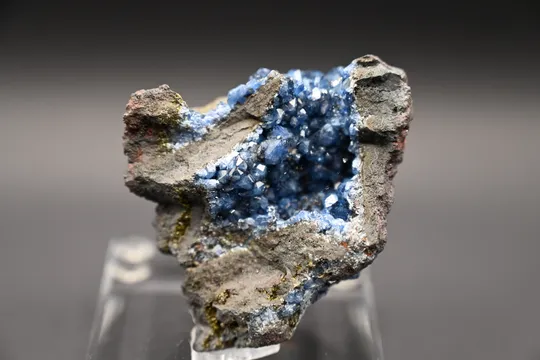
Smithsonite from Ojuela Mine, Mexico: silvery botryoidal forms on limonite, olive-green crusts, rare blue botryoids; prized, scarce specimen from locality.
Key facts
Smithsonite from the Ojuela Mine is not the obvious headline act of Mapimí—adamite, legrandite, köttigite, paradamite, and the rare zinc arsenates usually take that role—but it is one of the locality’s most rewarding “insider” species. Good Ojuela smithsonite has the compact, sparkling charm collectors expect from a zinc-carbonate oxidation zone, but it carries the unmistakable personality of the mine: limonitic matrix, association with zinc arsenates, occasional hemimorphite, and a tendency toward small, textural specimens rather than the large, pastel showpieces associated with Santa Eulalia, Choix, or Kelly.

Photo: Géry Parent / Wikimedia Commons
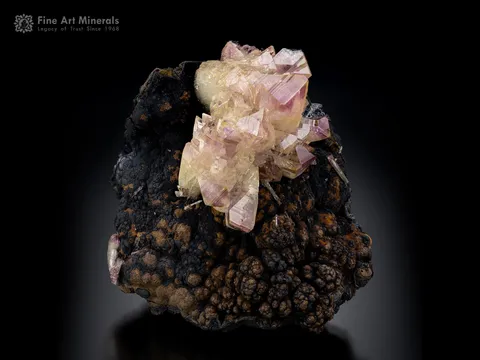
The best Ojuela smithsonites are valued for surface and context: silvery-white botryoidal aggregates on rusty gossan, olive-green crusts that flash with microcrystalline sparkle, rare blue botryoids on limonite, and brown smithsonite replacing earlier calcite forms. They are not generally abundant on the market, and truly fine examples are usually older collection pieces, small-cabinet plates, or association specimens in which smithsonite shares the stage with legrandite, adamite, hemimorphite, aurichalcite, calcite, goethite, or limonite.
Ojuela’s mineralogical setting explains why smithsonite appears here in such varied guises. The mine is a northern Mexican limestone-replacement lead-silver-zinc deposit. Primary sulfides included sphalerite, galena, pyrite, and arsenopyrite; later oxidation converted that sulfide mass into one of the world’s great secondary-mineral laboratories. Smithsonite formed in this oxidized zinc environment along with hemimorphite, hydrozincite, aurichalcite, and a remarkable suite of zinc arsenates. At Ojuela, smithsonite is often less a solitary species than a carbonate witness to the same zinc-rich fluids that produced the mine’s better-known adamite, legrandite, paradamite, mapimite, and ojuelaite.
For collectors, the appeal is partly comparative. A cabinet of Mexican smithsonite can easily be dominated by the large botryoidal forms of Santa Eulalia or the colored smithsonites of other districts, but Ojuela adds a different note: small, dense, mineralogically sophisticated specimens from one of Mexico’s most studied classic localities. A modest Ojuela smithsonite with good provenance may be more interesting than a larger but anonymous zinc carbonate, especially when it shows the mine’s classic limonite matrix and a verified association with Ojuela species.
Search for specimens: View all smithsonite specimens from Ojuela Mine, Mexico
The Ojuela Mine lies near Mapimí, Durango, on the northeast side of the Sierra de Mapimí. In collector usage, “Ojuela Mine” usually refers not to a single simple opening but to a large, complex system of workings, stopes, shafts, chimneys, and named collecting areas. Smithsonite has been recorded from the general Ojuela Mine and from several internal or associated areas, including La Cigueña vein, La Esperanza, Palomas Oriente, San Diego, and the San Judas Chimney.
Geologically, Ojuela is a limestone-replacement deposit of the northern Mexico type. Mineralization was guided by fractures and favorable dolomitic horizons, with major ore bodies occurring in large caves and pipe-like zones separated by barren limestone. The primary assemblage was dominated by arsenopyrite, pyrite, sphalerite, and argentiferous galena, with calcite, quartz, fluorite, and limonite among the important gangue and alteration minerals. That original sulfide system was later overprinted by intense oxidation, producing the mine’s celebrated secondary minerals: zinc arsenates, lead arsenates, carbonates, silicates, sulfates, oxides, and iron-rich gossan minerals.
Smithsonite, ZnCO3, belongs to this oxidized zinc story. Its presence reflects the alteration of sphalerite-bearing ore in carbonate host rocks, where zinc-bearing solutions could react with carbonate-rich wall rock and mine waters. At Ojuela, smithsonite is commonly encountered in the same broad secondary environment as hemimorphite, aurichalcite, hydrozincite, adamite, legrandite, and paradamite. It is particularly important as part of the mine’s zinc-rich paragenesis rather than as the locality’s most abundant or most celebrated species.
The mining history is long and complicated. Mexican heritage sources place Ojuela’s founding in 1598, and mineralogical sources describe the mine as having been worked for rich secondary silver ores since about 1600. By the late nineteenth century the district had entered a modern industrial phase. Peñoles acquired the Ojuela property in 1891, and the mine was modernized with electrical power, heavy drilling equipment, a rack railway, beneficiation facilities, and the famous suspension bridge that still defines the landscape for visitors. By the 1890s Ojuela had become a major lead-silver operation; historical mineralogical accounts record nearly four million tons of ore mined after its conversion into a large lead-silver property, with average grades reported as 3.7 grams gold per ton, 462 grams silver per ton, and 14.9 percent lead.
Large-scale production declined in the early twentieth century as reserves were depleted and drainage problems mounted. By the late 1930s, the great industrial period had effectively ended, though cooperative and small-scale work continued. For the mineral collector, the crucial transition came not from ore production alone but from specimen discovery. Ojuela was known to mineralogists in the first half of the twentieth century, but the mine’s modern collecting fame accelerated after remarkable secondary-mineral pockets began to be documented, especially the 1946 adamite find in the Las Palomas ore body and later postwar specimen mining by Mexican miners, dealers, and collectors.
Collecting access should be treated with care. Ojuela is a historic mining site and tourist destination, but a tourist visit is not permission to collect. The workings are extensive, old, and hazardous, and the mine remains a locality where access depends on land, mineral, and safety permissions. Specimens reaching the market today generally come through old collections, historic dealer stock, occasional small-scale production, or modern material handled by people with appropriate local access. Serious collectors should value precise labels that name Ojuela accurately and, when possible, identify the internal mine area or collecting level.
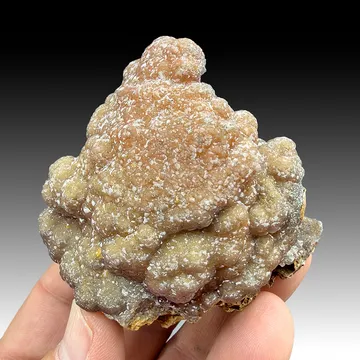
Ojuela smithsonite is usually seen as botryoidal to mammillary crusts, rounded aggregates, microcrystalline druses, and replacement forms rather than as large, isolated crystals. The most familiar pieces show small, lustrous hemispheres or “balls” scattered across oxidized matrix. Individual botryoids may be only a few millimeters across, but when they are bright, clean, and well spaced on limonite, the visual effect is far richer than the size suggests.
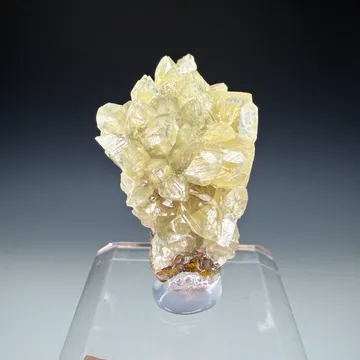
Color is one of the most useful collecting clues, but also one of the traps. Ojuela smithsonite can be white, silvery white, gray-white, brown, olive green, yellowish, orange-yellow, and rarely blue. Silvery-white botryoidal aggregates on iron oxide are among the more typical display pieces. Olive-green material has appeared in the market as sparkling botryoidal crusts, sometimes with a heavy, wet-looking sheen from countless microcrystals. Blue Ojuela smithsonite is genuinely uncommon and should be considered a premium color when the provenance is sound. Orange to yellow-orange material is often marketed as cadmian or cadmium-bearing smithsonite, though the collector should not assume trace-element chemistry from color alone without analysis or a reputable chain of identification.
The brown replacement specimens are especially interesting. Ojuela has produced smithsonite pseudomorphs or replacements after sharp calcite forms, including dogtooth-style calcite habits. These pieces can look subdued at first glance—brown smithsonite on brown matrix—but the best examples preserve the earlier calcite geometry and may be sprinkled with bright white hemimorphite, creating a strong contrast of form, luster, and texture.
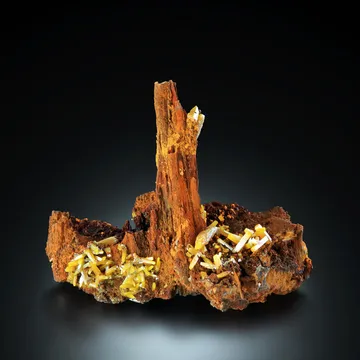
Associations are central to evaluating Ojuela smithsonite. The most commonly documented companions include legrandite, adamite, calcite, goethite, hemimorphite, limonite, paradamite, rosasite, galena, wulfenite, quartz, hedyphane, malachite, köttigite, hydrozincite, and aurichalcite. A smithsonite specimen with legrandite or adamite has immediate locality appeal, but the association must be real and not simply an attractive assemblage from a different Mexican mine. At Ojuela, the matrix is often a rusty, porous, iron-rich gossan, and the best association pieces look geologically coherent: zinc carbonate, zinc silicate, zinc arsenate, and iron oxides developed together in the oxidation zone.
Typical specimens range from thumbnail to small cabinet. Verified Ojuela smithsonites have appeared as tiny blue thumbnails under 3 cm, small cabinet plates around 7 cm with millimeter-scale botryoids, and larger cabinet replacements after calcite around 11 cm across. The species is not collected from Ojuela for huge size; it is collected for provenance, association, color rarity, sparkle, and the way it fits into one of the world’s classic secondary-mineral systems.
Quality factors are specific. For botryoidal material, look for intact rounded surfaces, strong luster, even coverage, attractive spacing, and good contrast against limonite or gossan. For blue or olive-green examples, color saturation and verified Ojuela provenance matter more than size. For pseudomorphs, the sharpness of the inherited calcite form is critical. For association specimens, balance is everything: smithsonite should be visually identifiable and not merely a minor gray crust hidden beneath the more valuable species.
The most important authenticity concern is locality confusion. Ojuela is such a famous name that specimens from other Mexican localities have sometimes been sold under the Ojuela label. This problem is specifically documented for smithsonite: material from Santa Eulalia has been reported as being offered as Ojuela. That matters because Santa Eulalia is itself a major smithsonite source, and its specimens may be larger, more colorful, or more typical of what the general market expects from Mexican smithsonite. A collector buying Ojuela should ask whether the label is old, whether it names a sublocality, and whether the specimen’s matrix and associations fit Mapimí rather than another Mexican zinc-lead deposit.
Do not rely on color alone. Blue, green, yellow, and orange smithsonite all occur in trade, and “cadmium smithsonite” is a common commercial description for yellow to orange material, but color is not a laboratory report. Unless a specimen has analytical support, treat such labels as descriptive or historical rather than definitive. The same caution applies to “cuprian” labels on green smithsonite.
Condition issues are usually subtle but important. Botryoidal smithsonite abrades on high points, producing dull patches on otherwise lustrous surfaces. White and gray crusts may carry chalky or powdery areas that are natural but less desirable if they interrupt the luster. Limonitic Ojuela matrix can be friable, and association pieces with hemimorphite or delicate arsenates may shed small crystals if handled carelessly. Replacement specimens after calcite should be checked for bruised points, repaired breaks, or matrix cracks.
Ojuela smithsonite is not impossible to buy, but fine examples are not common. Modest olive-green or white botryoidal pieces appear periodically from recent or mixed lots, often at accessible prices. Older blue thumbnails, well-labeled association specimens, and sharp smithsonite-after-calcite replacements are much scarcer. Auction records show that collectors are willing to pay a premium for confirmed Ojuela provenance, unusual color, old collection history, or a strong association with classic Ojuela minerals.
The story that changed Ojuela’s reputation among collectors begins underground in June 1946. Dan Mayers and Francis Wise were moving through the Las Palomas ore body, just above the 11th level, on their way to a stope known for wulfenite and green mimetite. Their lamps caught a pocket in the limestone. It was not a small vug with a few loose crystals, but a chamber roughly four feet across and four feet deep, its interior carved into shapes and coated with waves of sparkling yellow-green adamite. The discoverers described it as a “miniature grotto,” a phrase that has followed Ojuela ever since.
Miners were put to work immediately. The largest specimen weighed 75 pounds underground and measured almost three feet square before trimming. It carried a continuous crust of green crystals on brown limonite and ultimately went to the U.S. National Museum. Two other important specimens went into the Harvard collection. Smithsonite did not dominate that pocket, but it mattered scientifically: the same account noted that hemimorphite was abundant nearby between the 11th and 12th levels, and that smithsonite was sparingly present. In other words, the legendary adamite grotto grew within a zinc-rich oxidized environment—the same chemical world that produced Ojuela’s smithsonite.
Another Ojuela story belongs to Mike New, the Tucson mineral dealer and specimen miner whose work helped feed the modern collector market with Ojuela material. A 2023 description of the new mineral mikenewite records that New had permission to mine and export specimens from Ojuela and that his most spectacular find came in 1981 in the San Judas Chimney, where superb purple adamites were found. Those specimens spread into museums and private collections worldwide. The type material for mikenewite came from a specimen mined by New and his crew, and the mineral was named in his honor after his death in 2022.
Ojuela’s surface landscape has its own drama. The mine sits in desert country near Mapimí, and the suspension bridge is part of the collector’s mental image of the locality almost as much as the limonite matrix and yellow adamite crystals. Late-nineteenth-century modernization brought electricity, heavy drilling, a rack railway, and a bridge across the canyon to solve the mine’s access problem. Whether one approaches Ojuela as a historian, a specimen collector, or a field mineralogist, that bridge is the threshold: beyond it are the old workings, the ghost-town ruins, and the oxidized chambers that turned an ore mine into a mineral locality of world rank.