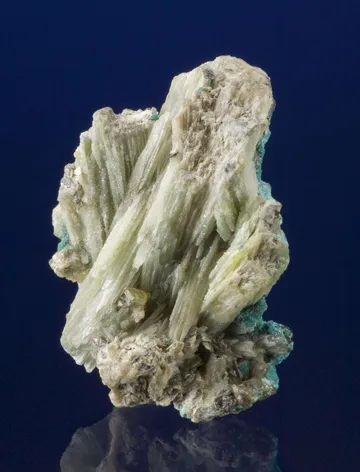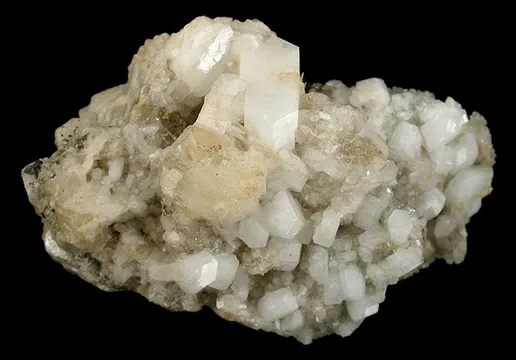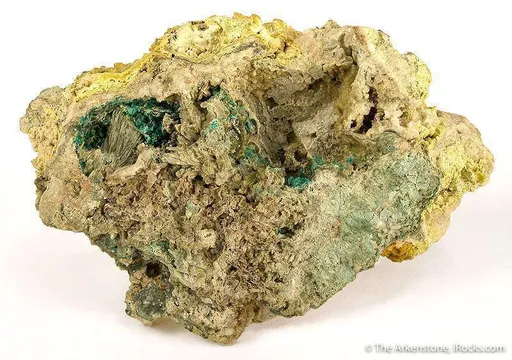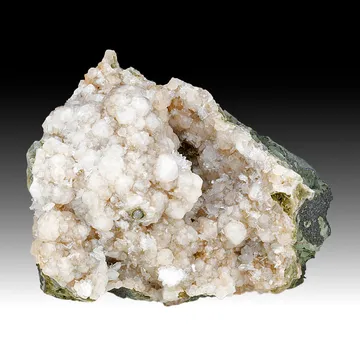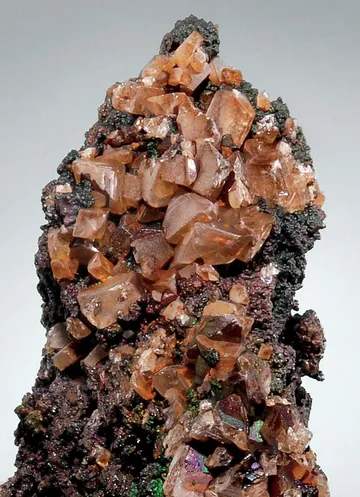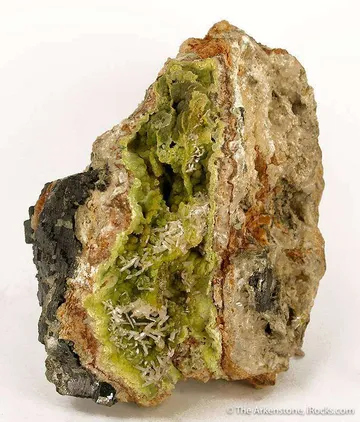
A collector's guide to New Glencrieff Mine, UK: its geology, mining history and notable minerals, illustrated with the 33 specimens documented from this locality on EarthWonders.
Key facts
New Glencrieff is the collector’s name for the great Wanlockhead lead-zinc mine on the New Glencrieff Vein and its west branch, the West Grove or West Glencrieff Vein, in the Lowther Hills of southern Scotland. It belongs to the Leadhills–Wanlockhead orefield, the classic Scottish suite of fissure veins cutting intensely deformed Ordovician greywacke, chert and shale. To the mining historian it was one of Britain’s important lead producers; to the mineral collector it is the Wanlockhead locality where robust primary ore specimens—galena, black sphalerite, calcite, quartz, dolomite, baryte and pyrite—meet a rich suite of oxidation-zone species.
The best New Glencrieff specimens have a distinctly old British character: black, sharply modified sphalerite crystals partly dusted or draped with white quartz; grey-metallic galena cubes and cube-octahedra set in calcite; transparent to pale grey calcite scalenohedra, sometimes with marcasite or pyrite inclusions; and small but mineralogically fascinating secondary assemblages of pyromorphite, hemimorphite, cerussite, linarite, caledonite, leadhillite, lanarkite, vanadinite, descloizite, phosphohedyphane, erythrite and related species. New Glencrieff pieces are seldom flamboyant in the manner of modern mine productions; their attraction is locality, age, association and the density of information locked into relatively modest hand specimens.
Regional View
Country View
Geologically, the mine is a textbook example of a greywacke-hosted Pb-Zn vein system, with ore shoots developed along mineralised fractures and fault zones. The old Geological Survey memoir describes the district’s veins as well-walled fissures, in places only strings but elsewhere several metres wide, commonly filled with brecciated greywacke cemented by calcite or dolomite and cut by strings of galena and sphalerite. In the New Glencrieff system the ore body was exceptional: the main shoot at the south end of the vein extended from near surface down to the 200-fathom level, making it one of the great lead ore shoots of Scotland.

Photo: Wikimedia Commons

Photo: Wikimedia Commons

Photo: Wikimedia Commons
Search for specimens: View all specimens from New Glencrieff Mine, UK
New Glencrieff lies at Wanlockhead, Dumfries and Galloway, close to the county boundary with the Leadhills side of the orefield. The mine worked the New Glencrieff Vein and its west branch, with the principal shaft sunk on the West Grove branch and connected to the main vein by levels and crosscuts. The mine site is around NS 865 133, just below the village, at roughly 360 metres elevation, within a landscape of spoil heaps, capped shafts, ruined buildings, adits and preserved mining features.
The deposit is a hydrothermal lead-zinc vein system hosted by Lower Palaeozoic Southern Uplands sedimentary rocks, chiefly greywacke with associated chert and shale. The main veins in the Wanlockhead district trend roughly north-north-west to south-south-east and dip steeply, with mineralisation localised by repeated fracturing, clay gouge and brecciation. Gangue is dominated by calcite, dolomite, quartz and baryte, with ankerite, siderite and witherite locally important. The principal sulphides are galena and sphalerite, accompanied by pyrite and chalcopyrite, and by rarer nickel-arsenic minerals such as nickeline and rammelsbergite.
The ore bodies were not uniform sheets but shoots and pockets along the vein. The famous main shoot at the south end of the New Glencrieff Vein was mined from near the surface to the 200-fathom level; older Geological Survey descriptions give a pitch length of about 1600 feet and a breadth of about 1200 feet. Later summaries translate the largest New Glencrieff ore body as about 360 metres along strike and 400 metres down dip. In places the lodes showed typical banding, but much of the vein filling consisted of broken greywacke fragments cemented by carbonate and quartz, then cut by narrower strings and masses of sulphide ore. Exceptional solid galena masses were encountered in the district, but the collector specimens generally came from cavities and oxidised pockets rather than from compact shipping ore.
New Glencrieff’s mineralogy is divided neatly between primary cavity specimens and oxidation-zone specimens. The former include calcite, quartz, dolomite, baryte, galena and black sphalerite. The latter are much more varied and include cerussite, pyromorphite, hemimorphite, anglesite, linarite, caledonite, leadhillite, lanarkite, malachite, chrysocolla, descloizite, mottramite, vanadinite, phosphohedyphane, erythrite and several uncommon sulphates, carbonates, vanadates and arsenates. The south end of the New Glencrieff Vein was especially notable because oxidation extended unusually deep—reported in the old memoir to about 200 fathoms from surface, or around 120 fathoms below adit level.
Mining on the New Glencrieff Vein began in the early eighteenth century, with discovery generally placed between 1710 and 1721 and first recorded working in 1718. Early operations raised ore but struggled to pay until the Glenglass adit was driven around 1740 and cut the west branch, which proved much richer. A new company headed by Ronald Crawford took control in 1755; the mine was extensively worked until about 1770, then lay essentially abandoned for more than seventy years. It was reopened between 1842 and 1850 under J. Stewart, during the period when the Duke of Buccleuch retained the mines under his management, and the great south-end shoot became one of Scotland’s richest lead producers.
Nineteenth-century improvements transformed the operation. Hydraulic engines and steam engines were installed for pumping and hauling, and ore was treated and smelted at Meadowfoot, about a kilometre to the north-west. Mid-nineteenth-century figures record an average annual output of about 1000 tons of lead and 5750 ounces of silver. The mine later passed through the Wanlockhead Lead Mining Company period and into twentieth-century decline. It closed in 1931, was reopened in the 1950s by Lowland Lead Mines interests associated with Siamese Tin Syndicate, Bangrin Tin and Rio Tinto, and finally failed again when costs and low lead prices made the venture uneconomic. Sources differ slightly on the exact final closure year, giving 1956, 1958 or 1959 depending on whether the mine, production or the company’s remaining work is meant, but all agree that New Glencrieff was the last Wanlockhead mine to be revived and the last substantial mine of the village.
Access today should be approached conservatively. The mine is on private land, the remains are industrial archaeological features, and the wider Wanlockhead–Leadhills area includes protected ground, including SSSI and Scheduled Ancient Monument designations. Underground access is not a collecting option for ordinary visitors; modern access projects have been formal, safety-managed heritage work carried out with landowner permission and consultation with the relevant bodies. Surface spoil has historically yielded collector material—especially sphalerite, galena, dolomite, quartz, calcite and small secondary minerals—but responsible collectors should seek permission, avoid digging into protected or unstable structures, and treat the site primarily as a preserved mining landscape. The Museum of Lead Mining at Wanlockhead is the natural first stop for understanding the district before trying to interpret loose dump material.
The most important specimen finds came from open cavities in the lodes and from the oxidised portions of the vein system. Old accounts record large cavities lined by calcite scalenohedra and nail-head calcite, beautiful galena cube-octahedra, and black sphalerite crystals in cavities. A witherite cavity opened early in 1918 on the west branch of the New Glencrieff Vein at the 200-fathom level produced the first reliable Scottish witherite specimens: radiating botryoidal or semiglobular masses, intimately associated with baryte and interpreted as secondary after it. The hemimorphite-rich zone at the south end of the 100-fathom level was another notable occurrence, with fine cavity-lining crystals and locally very thick material between the 80- and 120-fathom levels, associated with cerussite, pyromorphite, sphalerite and galena.
Calcite from New Glencrieff is one of the locality’s most collectible gangue minerals, ranging from massive carbonate vein fill to lustrous individual crystals from open cavities in the New Glencrieff and West Glencrieff workings. The classic habits are pale grey to colourless scalenohedra—the old miners’ “dog-tooth spar”—and flatter “nail-head spar,” with old Geological Survey accounts noting that nail-head growths may overgrow earlier scalenohedra so that the older crystal appears as a ghost inside the later one. Documented specimens include transparent to translucent clusters around 7 cm across, single showy scalenohedral floaters included with pyrite microcrystals, and creamy calcite groups perched on black sphalerite, dolomite or quartz. The best pieces are sharp, lustrous, undamaged, and compositionally tied to the ore assemblage: calcite with black sphalerite, galena, pyrite or marcasite has a much stronger New Glencrieff “signature” than loose, weathered carbonate from the dumps.
Sphalerite is the emblematic New Glencrieff collector mineral: dark brown to coal-black “black jack,” commonly massive in the ore but locally developed as lustrous modified crystals lining cavities. Old descriptions record sphalerite as an important and abundant constituent of some district veins, commonly mixed with galena and chalcopyrite, while collector specimens from New Glencrieff are prized when the crystals are sharp, bright black, and partly coated with sparkling drusy quartz or accented by creamy calcite and dolomite. Historic dealer and museum descriptions document sphalerite plates of cabinet size, individual crystals over an inch across, and at least one outstanding specimen with a 3.6 cm sphalerite crystal on a 7.2 cm quartz-dusted plate. Good pieces show undamaged crystal faces and strong contrast between black sphalerite and white quartz or calcite; ordinary examples are dull massive blende, cleaved fragments, or dump material weathered by zinc sulphide alteration.
Galena was the economic heart of New Glencrieff and remains one of its most important specimen species. In the mine it occurred chiefly as massive and coarse crystalline lead ore, with fine-grained “steel ore” reported occasionally, but the collector pieces come from cavities where cubes and cube-octahedral combinations formed to appreciable size. Early Geological Survey descriptions note individual galena crystals in New Glencrieff cavities up to about 2 inches across, sometimes compact on the exterior but spongy within and in some cases enclosing chalcopyrite cores. Museum specimens include groups of grey metallic galena cubes with calcite, and the best collector examples are sharp, bright, heavy pieces with intact cubic or octahedral faces and a clear association with calcite, quartz, sphalerite or secondary lead minerals. Dull massive ore, cleavage fragments and weathered pieces are commoner than attractive crystallised specimens, and old labels materially increase confidence and desirability.
Other documented New Glencrieff minerals make the locality far more than a galena-sphalerite-calcite mine. Mindat’s modern locality list includes 33 valid minerals, among them anglesite, ankerite, aurichalcite, baryte, brochantite, caledonite, cerussite, chrysocolla, creaseyite, descloizite, dolomite, erythrite, hemimorphite, lanarkite, langite, leadhillite, linarite, malachite, mottramite, native sulphur, nickeline, phosphohedyphane, pyrite, pyromorphite, calcium-bearing pyromorphite, quartz, rammelsbergite, susannite, vanadinite, witherite and wulfenite. The Leadhills–Wanlockhead district as a whole is famous for type-locality species such as leadhillite, lanarkite, caledonite and susannite from nearby district veins rather than specifically from New Glencrieff, so old labels should not be silently upgraded to New Glencrieff without evidence. Within New Glencrieff itself, the rarities most worth watching for are witherite from the 1918 deep-level cavity, nickel-arsenide material including nickeline and rammelsbergite from the west branch, erythrite reported from historical collection material, small vanadinite and descloizite-group microminerals, and deep oxidation-zone hemimorphite with pyromorphite and cerussite.
New Glencrieff specimens are locality-driven classics, and labels matter. Because the Leadhills–Wanlockhead orefield contains many closely spaced veins with overlapping mineralogy—Old Glencrieff, New Glencrieff, West Glencrieff, Straitstep, Bay, Belton Grain, Whytes Cleuch and others—mislocalisation is the chief authenticity problem. A specimen labelled simply “Wanlockhead,” “Glencrieff,” “West Branch,” “East Branch,” “80 level,” “120 level,” “160 level,” “200 level,” or “Glencrieff Mine” may well relate to the New Glencrieff complex, but it deserves careful interpretation rather than automatic precision. Conversely, rare district species from classic type localities should not be moved onto a New Glencrieff label unless the old label, analytical record or collection history specifically supports it.
No widespread commercial fakery is documented for New Glencrieff in the way it is for some modern high-volume localities. The practical problems are subtler: old labels may have been abbreviated; old dealer catalogues sometimes used older county names such as Dumfriesshire; and “Leadhills” is occasionally used loosely by non-specialists for the broader district even when Wanlockhead is meant. The most persuasive specimens are those with old British collection provenance, museum or dealer labels, or a mineral association that fits New Glencrieff: black sphalerite with drusy quartz and calcite, galena-calcite cavity material, calcite scalenohedra with pyrite or marcasite inclusions, and small oxidation assemblages consistent with the recorded vein suite.
Condition is a major discriminator. Calcite crystals often show bruised tips, etched surfaces, cleaves or iron staining, and old-time calcites should be examined under side light for repaired scalenohedra or polished-down terminations. Sphalerite is brittle and cleaves readily, so bright crystal faces with unchipped edges are worth a premium. Galena oxidises and tarnishes; attractive old pieces retain metallic lustre in protected faces, while dump-collected material may be dull, rounded or frost-weathered. Secondary minerals are usually small and fragile: hemimorphite, cerussite, anglesite, linarite, leadhillite and caledonite coatings can be damaged by aggressive cleaning, acids or abrasion.
Handling should be conservative. Galena, anglesite, cerussite, leadhillite, lanarkite, caledonite, pyromorphite and related species are lead minerals; vanadinite and descloizite add vanadium; erythrite and nickel arsenides add arsenic or nickel concerns. These are stable display specimens when left intact, but dust generation, sawing, trimming and ultrasonic cleaning are poor practice. Wash hands after handling and keep powdery or friable specimens boxed. Some calcite may fluoresce, but New Glencrieff is not primarily collected as a fluorescent locality; fluorescence should be treated as a bonus rather than a diagnostic feature.
Market availability is limited. New Glencrieff is a finite, historically mined locality with no modern specimen production, and good crystallised material appears mainly through old British collections, museum deaccessions, estate lots or specialist dealers. Modest sphalerite, galena, calcite, quartz and dolomite pieces still surface, but fine black sphalerite plates with quartz, undamaged calcite clusters, well-crystallised galena-calcite groups, and analytically supported rarities are genuinely scarce. For serious collectors, a small, well-provenanced New Glencrieff specimen is often preferable to a larger but vague “Wanlockhead” piece.
The New Glencrieff story has the peculiar rhythm of a mine that became rich only after it had already disappointed its first backers. The vein was found in the early eighteenth century, and by 1718 men were working it in the hills above Wanlock Water. Early ore was real but not profitable enough. The Friendly Mining Society drove trials northward from the lowest level, southward from the Dean-of-Guild’s drift, and by other workings cut up the vein for hundreds of fathoms. They raised more ore than the earlier smelting company, but still not enough to cover the cost, and in 1734 the society dissolved.
The breakthrough came around 1740, when the Glenglass adit level met the west branch of the New Glencrieff Vein. The west branch was the one miners wanted: rich enough to pull the mine into a different class. By 1755 a new company led by Ronald Crawford had taken control. Its first lease ran only nineteen years, but the company later secured a lease to 1842. It drove, pumped and explored aggressively, installing steam engines both on surface and underground when workable ore ran below natural drainage. Over fifty years, the operation raised 47,420 tons of lead—a figure that still gives weight to the ruined buildings and grassed-over spoil.
The nineteenth-century reopening reads like the second act of a mine that refused to die. After more than seventy years of abandonment, J. Stewart reopened New Glencrieff between 1842 and 1850. The south end of the vein then revealed the great ore shoot that older writers called one of the richest in Scotland. By the Geological Survey’s 1921 account, the main shoot ran practically from surface to the 200-fathom level, with a pitch length of about 1600 feet and breadth of about 1200 feet. The same account notes the consequence of success: so much ore had been removed that the walls of the vein were creeping together.
One of New Glencrieff’s most memorable specimen episodes occurred early in 1918, deep in the west branch at the 200-fathom level. A cavity was opened that yielded the first reliable Scottish witherite specimens. The mineral was not just a curiosity on a label; it appeared as radiating, semiglobular masses up to 8 inches across, intimately associated with corroded baryte and interpreted as secondary after baryte. For a Scottish mineral collection, that was a landmark pocket.
A century later, another kind of collection story emerged from the British Geological Survey’s Wilson Collection, a group of Wanlockhead and Leadhills mineral and ore samples preserved in a wonderfully improvised way. Much of the Wanlockhead material could be associated with Glencrieff. The specimens were not grand cabinet display pieces but grains, granules and ore fragments packed in confectioners’ tubes, recycled bottles, corked lengths of laboratory glass tubing, test tubes and small uniform jars. Some tubes carried Rowntrees or Needlers branding; labels showed different hands and dates, suggesting a practical mine collection saved and expanded by the Wilson family as mining declined. For a locality like New Glencrieff, such humble containers can be as historically eloquent as a showy calcite.
The final reopening after the Second World War has the air of a last industrial wager. In 1950 Rio Tinto Zinc appointed J. R. Foster-Smith to manage the effort to reopen New Glencrieff after more than twenty years out of work. His first impression, according to a later account, was of a semi-derelict village ringed by waste dumps and ruined engine houses. Engineers, geologists and surveyors spent two years preparing the shaft and adit and draining water from the old workings. A mill was installed and lead concentrate production began, but the revival came too late. Falling lead prices and high operating costs closed the mine again in the late 1950s.
Even the surface remains had a hard afterlife. During the Second World War, the Ministry of Defence used mine buildings at Wanlockhead for demolition practice, and structures that had survived mining were gradually destroyed by training. Later heritage reports recognised the scale of what was being lost. By the late twentieth century, concern was not only archaeological but environmental: waste tips and lagoon areas were landscaped to reduce wind-blown lead-bearing dust affecting the village. That is part of the reason collectors today should read the landscape with care. New Glencrieff is not merely a dump locality; it is an industrial, environmental and mineralogical record.
G. V. Wilson and J. S. Flett, The Lead, Zinc, Copper and Nickel Ores of Scotland, Memoirs of the Geological Survey, Special Reports on the Mineral Resources of Great Britain, Vol. XVII, 1921 — The essential early Geological Survey account for New Glencrieff’s workings, ore shoots, mineralogy, depth, production methods and specimen-forming cavities.
A. K. Temple, “Rammelsbergite from the Southern Uplands of Scotland,” Mineralogical Magazine and Journal of the Mineralogical Society, 30, no. 227, 541–543, 1954 — Documents rammelsbergite associated with nickeline from material attributed to the west branch of the New Glencrieff Vein and dumps at Glencrieff.
David Currie and co-authors, “Trace and minor element concentrations in sulfide ore material from the Leadhills and Wanlockhead Orefield, SW Scotland,” Scottish Journal of Geology, 2026 — Modern geochemical study of galena, sphalerite, chalcopyrite and pyrite from the orefield, with New Glencrieff included among the sampled sites and with updated ore-genesis discussion.
David Currie, Constraining ore genesis and palaeoclimate change using (U-Th)/He/Ne dating and stable isotope geochemistry, PhD thesis, University of Glasgow, 2024 — Provides recent geochronological and isotopic interpretation relevant to the timing and fluid history of the Leadhills–Wanlockhead vein system.
Phil Stone, “Archives in lockdown: The curious case of the BGS ‘Wilson Collection’,” 2021 — Discusses the Wilson Collection of Wanlockhead and Leadhills ore and mineral samples, including material confidently associated with Glencrieff levels and branches.
R. Brown, “More about the mines and minerals of Wanlockhead and Leadhills,” Transactions of the Dumfriesshire and Galloway Natural History and Antiquarian Society, vol. 13, 58–79, 1927 — An important cited historical source for the district’s mines and minerals, referenced in later mineralogical work on New Glencrieff-related rammelsbergite.
E. A. Pickett and J. D. Floyd, Geology of the Leadhills District, British Geological Survey Sheet Explanation 15E, 2003 — Concise BGS geological framework for the district, including the structural and stratigraphic setting of the mineralised veins.
Mindat photo record for a Natural History Museum London galena-calcite specimen, Sir Arthur Russell Collection, New Glencrieff Mine — Documents a 20 cm field-of-view galena and calcite specimen in the Natural History Museum’s Earth’s Treasury display, from the Sir Arthur Russell Collection.
Mindat locality page: New Glencrieff Mine — The most useful live mineral list, gallery gateway and reference index for the locality.
Mindat photo gallery: New Glencrieff Mine — Specimen and locality photographs, including modern micromineral images and museum material.
Scottish Geology Trust Geosite: Leadhills–Wanlockhead — Accessible overview of why the broader mining district is nationally important geologically and mineralogically.
Earthwise GeoGuide: Leadhills and Wanlockhead excursion — Field-guide style geological and historical context for the Wanlockhead and Leadhills localities.
BGS Earthwise: Metalliferous and associated minerals resources, Southern Uplands — Regional summary of Southern Uplands mineral resources and the scale of the New Glencrieff ore body.
Scottish Cave and Mine Database: New Glencrieff Mine, West Glencrieff Pit — Detailed modern site record with coordinates, access status, historical notes and links to mine plans.
Scottish Cave and Mine Database: New Glencrieff Mine, Adit Level — Useful description of the east-branch/adit-level part of the complex and the Glenglass access history.
Buddlepit Mine Database: New Glencrieff Mine — Mine database entry summarising location, land status, publication links and BGS mine-plan references.
Wanlock Visions: Heritage Sites, Wanlockhead — Local heritage summary for New Glencrieff, Meadowfoot and related Wanlockhead mining structures.
Wikimedia Commons category: New Glencrieff Mine — Freely licensed specimen and locality images, including calcite and sphalerite examples.
Geograph: New Glencrieff Mine, Wanlockhead — Modern site photograph with notes drawn from the nearby information board.
Cambridge Core: A. K. Temple, “Rammelsbergite from the Southern Uplands of Scotland” — Primary mineralogical paper for rammelsbergite and nickeline associated with the west branch of New Glencrieff.