A collector's guide to Nashik District, India: its geology, mining history and notable minerals, illustrated with the 129 specimens documented from this locality on EarthWonders.
Key facts
Nashik District is one of the great Deccan Trap names in mineral collecting: not a single mine, but a district-scale basalt-quarry province in northern Maharashtra where hard black lava flows open into cavities lined with zeolites, apophyllite, silica, calcite, and rarer late hydrothermal minerals. The specimens that made the district famous are classic Indian cavity pieces—peach to salmon stilbite sheaves, colorless to pale green fluorapophyllite-(K), lustrous heulandite, quartz and chalcedony crusts, and, from a much smaller number of pockets, brilliant golden powellite and strange botryoidal fluorite. Their geological setting is part of the western Deccan Volcanic Province: stacked tholeiitic basalt flows whose vesicles, amygdales, breccia cavities, and larger open vugs were mineralized by circulating post-eruptive fluids.
Regional View
Country View
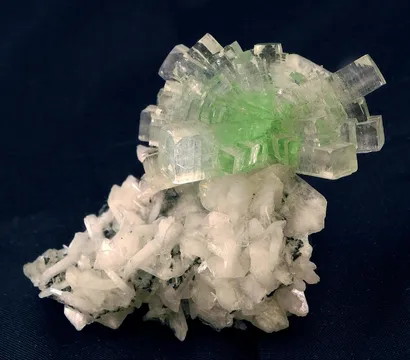
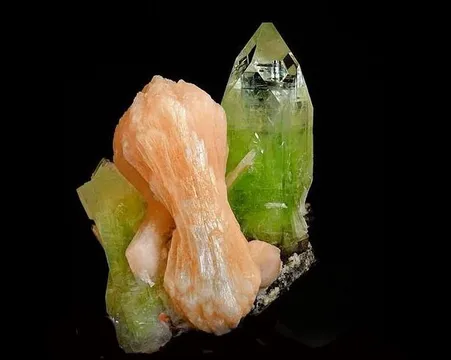
For collectors, “Nashik” means visual architecture. Fine pieces are rarely just single crystals; they are pocket fragments where the growth sequence produced contrast: glassy square apophyllite on matte basalt, apricot stilbite blades crossing pale green apophyllite, snow-white scolecite with a honey powellite crystal perched like a crown, or a translucent yellow fluorite sphere glowing against quartz. The best Nashik specimens have crisp terminations, undamaged exposed faces, and enough natural matrix to explain the pocket without drowning the crystals.
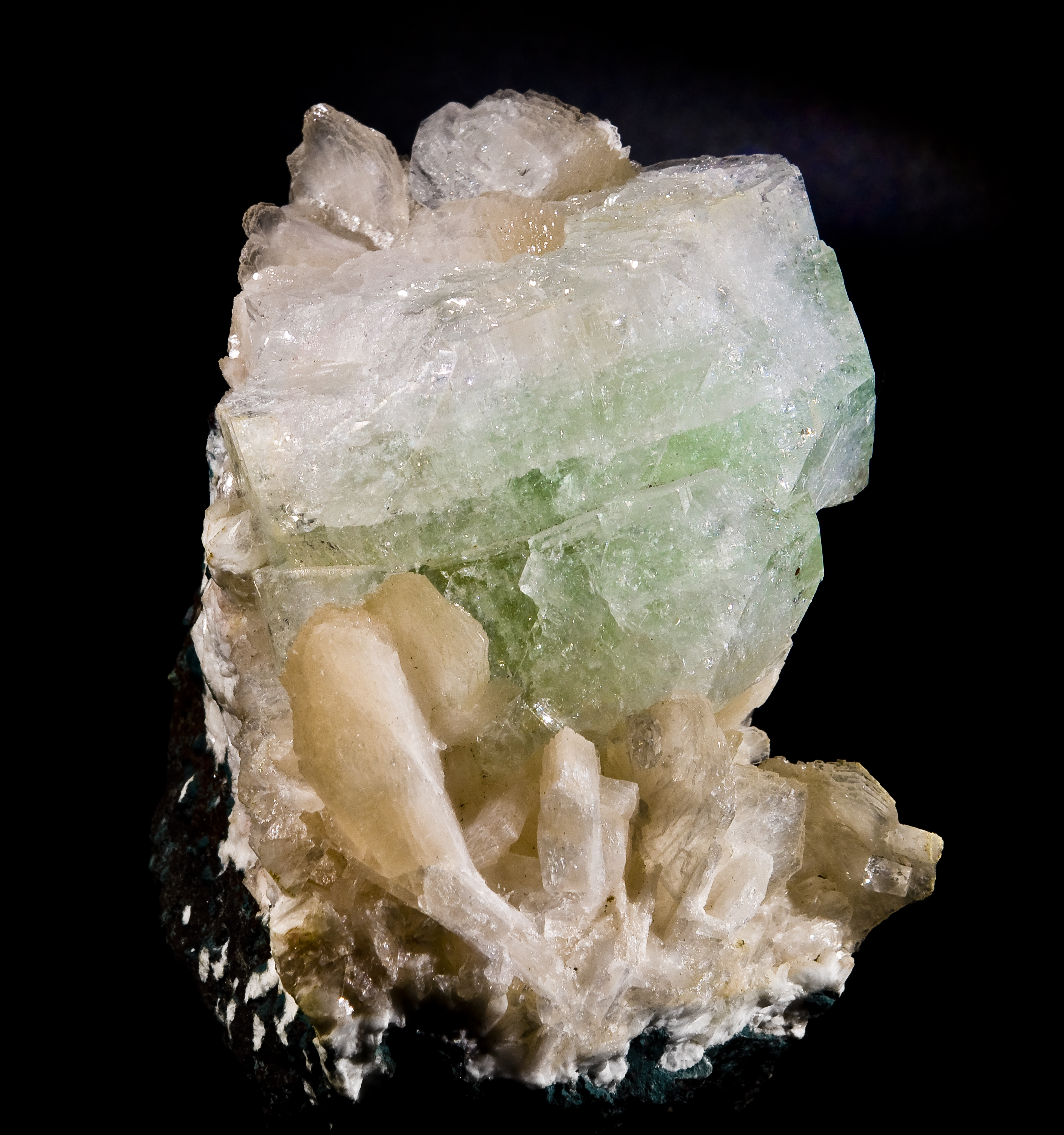
Photo: Wikimedia Commons
The district is also historically important because it helped define the modern market for Indian zeolites and associated minerals. By the early 1980s, Pandulena Hill powellite had become significant enough to receive a cluster of articles in The Mineralogical Record, including Rustam Z. Kothavala’s account of the Nasik discovery and follow-up notes on the species and crystal morphology. Later, the 2003 Indian zeolite issue of The Mineralogical Record placed Nashik among the central localities of the Deccan Trap specimen trade. Scientific work has since shown that Deccan cavity minerals did not all form in one brief pulse: Nashik-area apophyllite and stilbite samples record multiple mineralizing episodes, including much later hydrothermal activity long after the basalt erupted.
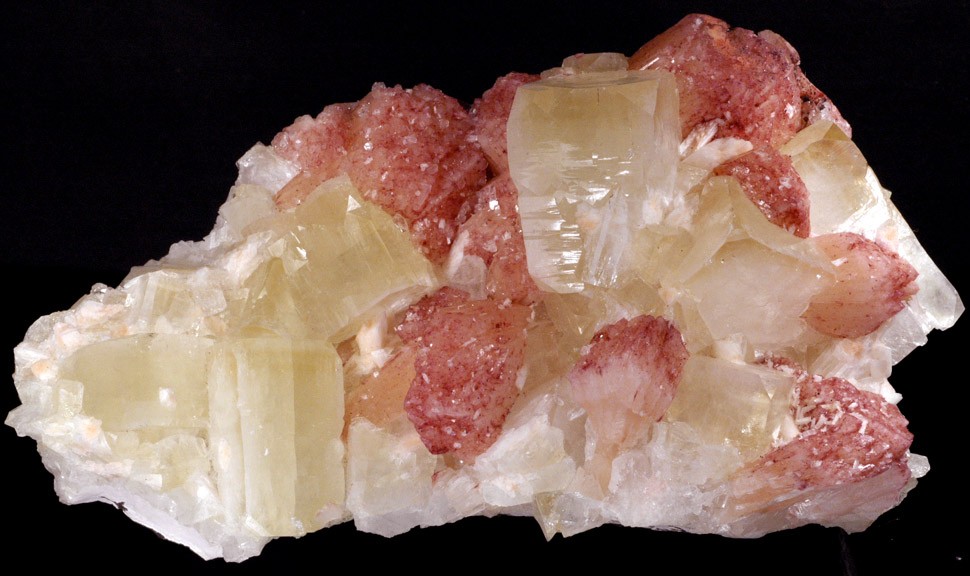
Photo: Wikimedia Commons
Among the named collecting labels, Pandulena Hills and Mahodari quarry stand out. Pandulena is the famous powellite district label, with Aurora Quarry and Jagoda quarry tied to the early discoveries. Mahodari, near Sinnar, is prized for colorless tabular apophyllite, pink-orange stilbite, amethystine quartz, and the district’s unmistakable spheroidal fluorite. Older labels may read “Nasik quarry,” “Nasik quarries,” “Nashik quarries,” or simply “Nasik, India,” and those labels often reflect dealer usage rather than a precisely documented quarry face.

Photo: Wikimedia Commons
Search for specimens: View all specimens from Nashik District, India
Nashik District lies in the northern part of Maharashtra and belongs geologically to the western Deccan Traps, a vast flood-basalt province built of stacked lava flows. The collectible mineralization is a basalt-cavity assemblage rather than an ore body in the conventional mining sense. Vesicles, amygdales, fractures, and brecciated zones in the lava acted as open spaces for late fluids. Those fluids deposited clay minerals, green celadonitic coatings, chalcedony and quartz, calcite, zeolites such as stilbite, heulandite, scolecite, laumontite, epistilbite, goosecreekite, and related species, and non-zeolite associates such as fluorapophyllite-(K), powellite, and fluorite.
The old Bombay Presidency gazetteer described Nasik as entirely volcanic in formation, made of compact stratified basalts and earthy trap. It noted amygdaloidal horizons containing quartz, crystals, and zeolitic minerals, especially apophyllite—an observation that still reads like a field description of the district’s specimen source. Modern work refines that picture: Deccan cavity mineralization is multistage, with early silica and clay-related fillings, later zeolite and calcite episodes, and late hydrothermal crystallization that can include apophyllite and powellite. Four Nashik-area hand specimens studied for Rb-Sr dating came from Panduleni, Dindori, Mohu, and Mahodari, showing the same collector’s associations—stilbite, apophyllite, heulandite, quartz—used by dealers and museums.
The locality is best thought of as a quarry belt rather than a mine. Mindat lists “Nashik quarries” as hard-rock aggregate quarries and warns that many specimens attributed to “Nasik quarry” were probably labelled broadly as Nasik District rather than tied to a single quarry. That matters. Serious collectors should treat exact quarry attributions cautiously unless a label, field note, or older collection history supports them. “Nashik District” is often the honest locality; “Mahodari,” “Pandulena Hills,” “Vilholi,” “Odha,” “Eklara,” “Pathardi,” “Dindori,” “Mohu,” “Yeola,” or “Sinnar” is more specific and more valuable only when credible.
Pandulena Hills, southwest of Nashik, is the historic powellite locality. The 1982 Mineralogical Record articles document powellite from Nasik, with Pandulena Hills, Aurora Quarry, and Jagoda quarry appearing in occurrence records tied to Kothavala’s account. The best powellite specimens are gemmy yellow to amber tetragonal dipyramids, commonly on stilbite, apophyllite, scolecite, or laumontite. Their rarity is real: compared with the constant stream of ordinary Deccan zeolites, quality Nashik powellite has always been a small-pocket mineral, and older examples with 1970s or early 1980s provenance are especially desirable.
Mahodari quarry, near Sinnar and roughly 27 km from Nashik, is a different kind of classic. It is recorded under several spellings—Mahodari, Mahadari, Mohadari—and belongs to the system of quarries around Nashik town. The locality is noted for cavities rich in colorless, commonly tabular apophyllite and pink to orange stilbite, but it is most visually distinctive for spheroidal fluorite on quartz and calcite. Mahodari fluorites may be lemon-yellow, honey, cream, red-brown, or hematite-tinted, often as botryoidal balls or “egg-yolk” forms sitting in quartz-lined vugs. Good fluorite spheres from Mahodari are unlike the standard Indian zeolite look and occupy a separate niche in advanced collections.
Mining has been driven by aggregate, road metal, and construction stone rather than specimen extraction. Pocket collecting followed quarrying. When quarry faces intersected mineralized cavities, pieces were removed, trimmed, cleaned, and passed into the Indian and international specimen trade. This explains both the abundance of broad labels and the irregularity of supply: a quarry may produce ordinary apophyllite-stilbite material for years, then briefly expose a pocket of superb color, powellite, fluorite, or green included heulandite, and then nothing comparable.
Access today should be regarded as industrial and permission-based. These are working or former quarries, not public collecting parks. Quarry walls, blasting areas, unstable basalt, and private operators make casual collecting inappropriate without local permission and guidance. Most collectors will encounter Nashik material through dealers, recycled collections, auction records, and museum holdings rather than by field collecting. When buying, provenance quality matters: old Indian dealer labels, collection cards from known collectors, and precise sublocality notes can add as much interest as an incremental improvement in crystal size.
Nashik stilbite is the visual framework of many district specimens: peach, salmon, pink-orange, cream, tan, and occasionally vivid reddish bladed crystals forming sheaves, bow-ties, fans, and crossing sprays in basalt cavities. At Mahodari, pink to orange stilbite is specifically associated with colorless tabular apophyllite; at Pandulena Hill and Aurora Quarry, Kothavala recorded pink stilbite sheaves and bow-ties with laumontite, clear apophyllite, heulandite, amethyst quartz, and exceptional golden powellite in basalt breccia. Documented cabinet specimens show stilbite blades around 3 cm with yellowish-green apophyllite, individual Mahodari blades to several centimeters, and unusually broad fans that carry the composition. The best Nashik stilbites are not merely “matrix”: they have pearly luster, clean terminations, strong salmon or peach color, and enough separation from apophyllite or quartz to read as deliberate sculpture rather than a crowded zeolite crust.
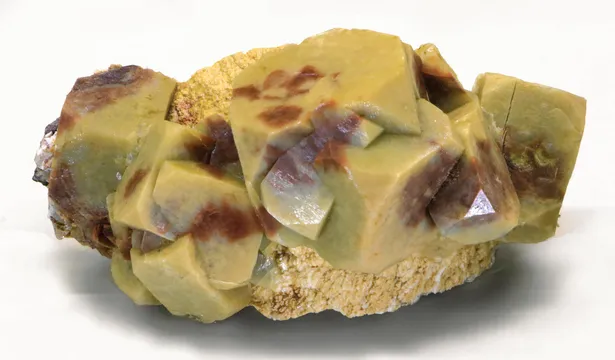
The apophyllite of Nashik District is most commonly labelled simply “apophyllite,” but collector-grade specimens are generally fluorapophyllite-(K), KCa4(Si8O20)(F,OH) · 8H2O. It occurs as colorless, water-clear, pale green, yellowish-green, and occasionally blue-green square to blocky tetragonal crystals, commonly with pyramidal terminations and mirror-bright faces. Mahodari is known for colorless tabular habits, while broad Nashik quarry labels include blocky and pseudo-cubic crystals with peach stilbite, quartz, heulandite, scolecite, and calcite. Good crystals run from small sparkling druses to several centimeters; documented photographed examples include crystals over 4 cm and exceptional blocky crystals much larger. The finest Nashik apophyllites combine undamaged terminations, sharp edges, transparency, balanced color, and contrast with stilbite or dark basalt; a pale but glassy, perfectly composed plate can be more desirable than a greener, bruised cluster.
Quartz at Nashik is the quiet stage on which many of the district’s showier minerals perform. It occurs as chalcedony linings, drusy crystal carpets, stalactitic or botryoidal growths, rock crystal, smoky quartz, and amethystine druses, especially in the Mahodari and Pandulena records. At Mahodari, quartz is the classic matrix for spheroidal fluorite and amethyst is repeatedly documented with fluorite and calcite; at Pandulena, amethystine quartz appears in the powellite-era assemblage and as a support for epistilbite. Good Nashik quartz specimens are judged less by quartz crystal size than by surface quality and association: sparkling, clean druse in a natural curved vug; pale amethyst that sets off white zeolites; or crisp quartz points carrying a single fluorite ball, apophyllite crystal, or powellite without distracting bruising or over-trimming.
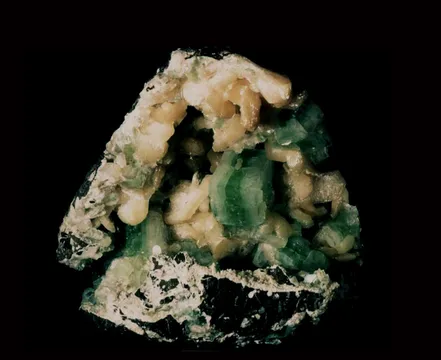
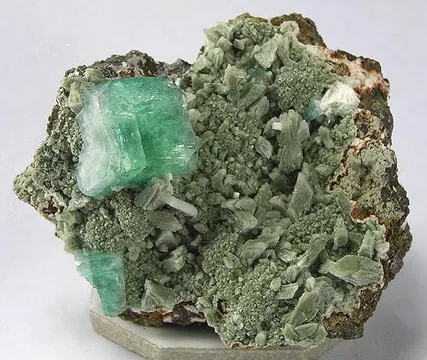
Nashik heulandite ranges from pale cream and peach to salmon, pink, and green-included crystals, occurring as tabular to bladed aggregates, curved sheaves, and lustrous pocket linings with stilbite, apophyllite, calcite, quartz, and scolecite. Scientific samples from Mohu specifically include heulandite with stilbite and apophyllite, while district records include heulandite-Ca and the heulandite subgroup from Nashik quarries and Mahodari. The most attractive pieces have pearly luster, curved or doubly terminated blades, and either strong peach-salmon color or distinctive green internal color from celadonitic inclusions. Heulandite is easy to undervalue in mixed Nashik pieces, but on the best specimens it provides the broad, satiny crystal form that softens the sharper geometry of apophyllite and quartz.
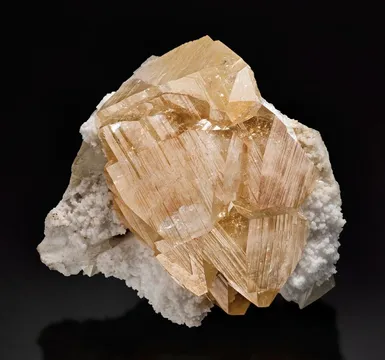
Powellite is the prestige rarity of Nashik District, especially from Pandulena Hills, Aurora Quarry, Jagoda quarry, and related Pandulena labels. The best crystals are transparent to translucent straw-yellow, honey, sherry, golden, or amber tetragonal dipyramids, commonly described as pseudo-octahedral, with glassy to subadamantine luster and fine face striations. Classic associations include peach stilbite, white scolecite, colorless to pale green fluorapophyllite-(K), quartz, and laumontite; documented specimens show powellite crystals around 1.5 to 3 cm, with an exceptional museum-quality example described as a 5.8 cm pale yellow doubly terminated crystal on scolecite. A top Nashik powellite needs more than species rarity: the crystal should be sharp, bright, naturally positioned, fluorescent, and minimally contacted, because many otherwise important pieces show bruising, tip contacts, or partial embedding from the cramped basalt cavities that made them.
Mahodari fluorite is one of Nashik District’s most distinctive signatures: not the usual cubic fluorite cabinet specimen, but smooth spheroidal, hemispherical, botryoidal, and “egg-yolk” aggregates on quartz, chalcedony, calcite, and locally opal. Colors include pale lemon, honey-yellow, cream, buff, red-brown, and hematite-tinted red; fine examples can be translucent and may glow dramatically when backlit. Documented pieces include 3 cm and larger fluorite spheres on quartz-lined vugs, and a major 18.7 cm Bruce Carter specimen with hematite-tinted botryoids to 3.5 cm on calcite that sold at auction in 2026. The best Mahodari fluorites retain a natural vug context, clean quartz contrast, even color, translucency, and unscarred rounded surfaces; over-worked “eggs,” obvious saw cuts, or heavily acid-sculpted edges should be evaluated with care.
Scolecite from Nashik is usually a delicate supporting species rather than the dominant Indian acicular showpiece associated with some other Maharashtra districts, but good examples do occur as white to colorless prismatic crystals, sprays, blades, and needle clusters with apophyllite, calcite, stilbite, and powellite. Mindat photo records document Nashik quarry scolecite crystals to several centimeters, including upright sprays with small calcite crystals on their terminations and larger transparent prismatic crystals described as 80–90 mm long. In the Pandulena powellite assemblage, scolecite can be crucial: a white needle “tiara” or bush gives a golden powellite crystal contrast and height. Quality depends on intact tips, clean white color, open spray geometry, and freedom from the crushing and bruising that slender scolecite suffers during quarry extraction and trimming.
Calcite is widespread in Nashik cavities and appears in multiple habits: clear to pale yellow scalenohedra, sharp transparent crystals, cubes with phantoms from Mahodari, lenticular forms with apophyllite, and larger crystals set in concave beds of stilbite and apophyllite. A notable photographed Nasik District specimen shows a razor-sharp transparent calcite crystal 9 cm long nestled among stilbites and apophyllites; Mahodari records also describe calcite with heulandite and calcite as a substrate or partner for spheroidal fluorite. The best Nashik calcites are chosen for clarity, sharpness, and placement—one dominant, undamaged crystal rising from a zeolite-lined pocket can be far more desirable than a busy plate of average calcite. Because calcite is softer and acid-sensitive, collectors should examine both the crystal faces and the surrounding matrix for cleaning damage.
Nashik amethyst is a quartz variety tied to the same basalt-cavity environment, especially Mahodari, Pandulena Hills, and the Vani-Dindori area. It is typically found as pale to moderate purple druse or amethystine quartz lining geodes and vugs, rather than as large isolated crystals. Its collector value here lies in association: Mahodari amethyst accompanies fluorite, chalcedony, quartz, and calcite, while Pandulena records include amethyst with the powellite-apophyllite-stilbite assemblage and epistilbite on amethyst-lined pockets. Good Nashik amethyst pieces have even sparkle, undamaged drusy surfaces, attractive purple color, and a natural pocket form; a modest amethyst lining with fluorite, epistilbite, or stilbite can be much more locality-significant than a larger but anonymous purple quartz plate.
Other documented Nashik minerals include epistilbite, goosecreekite, gyrolite, laumontite, mordenite, natrolite, mesolite, okenite, opal, prehnite, aragonite, babingtonite, celadonite, aluminoceladonite, goethite, hematite, gypsum/selenite, yugawaralite, and basalt-forming or accessory minerals such as augite, ilmenite, magnetite, plagioclase, orthoclase, nepheline, sodalite, titanite, and zircon. Nashik District is not primarily celebrated as a type-locality district; its strength is locality excellence—common species in unusually aesthetic Deccan Trap habits, plus rare zeolites and late minerals that appear only sparingly in specimen-quality pockets. Goosecreekite, epistilbite, yugawaralite, powellite, and spheroidal fluorite are the rarities to watch for on serious Nashik labels.
The chief authenticity problem for Nashik is not laboratory synthesis but locality precision. Old labels reading “Nasik quarry,” “Nasik quarries,” “Nashik,” or “Nasik, India” may represent any of several aggregate quarries in the district. A specific label such as Mahodari, Pandulena Hills, Aurora Quarry, Jagoda quarry, Vilholi, Dindori, or Odha is valuable only if it is plausible and supported by an older tag, dealer record, collection note, or distinctive association.
Species names also need attention. “Apophyllite” on an older Nashik label usually means fluorapophyllite-(K), but historic labels may use apophyllite-(KF), apophyllite-KF, natroapophyllite, or simply apophyllite. “Stilbite” may be stilbite-Ca or may be used more loosely for the stilbite subgroup. “Heulandite” may be heulandite-Ca or a subgroup label. For high-value specimens, especially powellite, unusual green included heulandite, and rare zeolites such as goosecreekite or yugawaralite, analytical confirmation or a trusted provenance is preferable.
Condition is a serious issue. Nashik specimens come from basalt cavities broken open by quarrying, so edge contacts, bruised apophyllite tips, snapped stilbite blades, crushed scolecite sprays, and trimmed backs are common. Apophyllite cleaves and chips along exposed edges; stilbite can bruise to dull white on blade tips; scolecite breaks easily; calcite can be etched or dulled by cleaning; and powellite often shows contact marks at the tips or on the back where it grew against a cavity wall. A visible contact is not automatically fatal, but undisclosed repairs, glued crystals, or polished-looking chips should reduce confidence and price.
Mahodari fluorite deserves separate scrutiny. These rounded fluorite-on-quartz specimens are natural combinations, but market examples may be trimmed, sawn, acid-cleaned, or carefully sculpted around imperfect edges to improve the “egg” form. Some high-end specimens have naturally flat backs or sawn display edges; others have been cleaned to remove calcite or clay. The issue is disclosure. A well-prepared Mahodari fluorite can still be highly collectible, but buyers should distinguish natural vug contours from modern shaping and should inspect for acid-dulled calcite, altered surfaces, and awkward cuts.
Fluorescence is a useful collecting tool. Nashik powellite is prized for bright yellow to yellow-white fluorescence, especially under shortwave UV, and some specimens respond under both shortwave and longwave. Calcite and opal coatings on Mahodari fluorite pieces may also fluoresce. Fluorescence can support identification, but it is not a substitute for morphology, provenance, or analysis, because scheelite-powellite solid solution and associated fluorescent minerals can complicate casual UV identification.
Market availability is uneven. Ordinary Nashik apophyllite-stilbite and mixed zeolite plates remain obtainable, but top historical pieces, sharp powellite, fine green-included heulandite, large clean apophyllite, and the best Mahodari fluorite are much scarcer. Recent auction records show strong demand for exceptional Mahodari fluorite, while powellite specimens continue to be recycled from older collections. For serious collectors, the best purchases are not the largest pieces but those with a coherent cavity story: correct label, natural matrix, undamaged focal crystals, and associations that make sense for the sublocality.
One of the liveliest Nashik stories is preserved not in a field diary but in the old market life of a single stilbite-apophyllite specimen. The piece measured 18.5 × 10.3 × 7.5 cm, with red-pink stilbite blades to 3.0 cm intergrown with glassy yellowish-green apophyllite crystals to 4.2 cm. Its caption noted that the pocket had been found about three years before the 2010 photo record, and that when the pieces reached Tucson, collectors and dealers “grabbed them as fast as possible.” That little phrase explains a great deal about Indian zeolite collecting: the finest pockets did not remain abundant simply because the Deccan Traps were vast. They flashed into the market, were recognized instantly by experienced eyes, and disappeared into cabinets.
Another telling episode comes from the Richard Gunter catalogue. Gunter’s specimen had an original card from the 1981 Austin Gem and Mineral Show calling it “Apophyllite (blue) and Stilbite, Nasik, India.” The later catalogue note is wonderfully human: the writer had not seen blue apophyllite in the literature, and the crystals were instead water-clear and perfectly gemmy. That is Nashik labelling in miniature—an early North American market moment, a beautiful Indian zeolite entering circulation just as the trade was becoming established, and a color word on a handwritten card that may have recorded lighting, memory, or enthusiasm more than mineralogical precision.
The powellite story is older and more consequential. In 1982, The Mineralogical Record devoted three consecutive items to Nasik powellite: Rustam Z. Kothavala’s “The Discovery of Powellite at Nasik, India,” Cornelius S. Hurlbut Jr.’s note “Powellite from Nasik, India,” and Peter G. Embrey and A. G. Couper’s “The Morphology of a Large Powellite Crystal from Nasik, India.” That sequence says how surprising the material was. Powellite had been known as a species long before, but Nasik suddenly supplied crystals worthy of connoisseur attention: sharp, gemmy, fluorescent, and large enough that their morphology deserved separate discussion.
Mahodari has its own modern collecting drama. On May 16, 2026, a Bruce Carter fluorite with hematite on calcite from Mahodari quarry sold for $87,500. The specimen measured 18.7 × 12.2 × 6.0 cm and carried red hematite-tinted fluorite botryoids to 3.5 cm in a quartz-lined vug, set on calcite. Carter’s note was memorable because it described the moment of revelation: the piece had been in a basalt vug with a window on the left side, and cutting it open caused the basalt matrix to spall off. His reaction to the finished specimen was almost disbelief—had he found it already exposed, he said, he would not have thought it genuine. For a locality often represented by small zeolite plates, that sale showed how powerful a single perfectly presented Mahodari vug can be.
There is also a quieter story in the laboratory record. The 2019 study of Deccan cavity minerals treated Nashik specimens not as pretty plates but as evidence: NAS-6 from Panduleni with stilbite and apophyllite, NAS-9 from Dindori with stilbite and apophyllite, NAS-10 from Mohu with heulandite, stilbite, and apophyllite, and NAS-11 from Mahodari with quartz, stilbite, and apophyllite. These are ordinary collector associations, but in the lab they became clocks. The Nashik apophyllites yielded age clusters around 55–58 Ma and 21–23 Ma, turning cabinet specimens into records of fluids moving through basalt across immense stretches of time.